
Les robots compagnons dotés d'intelligence artificielle occupent une place de plus en plus importante dans les maisons connectées, l'éducation, la santé et le secteur des services. Contrairement aux appareils électroniques traditionnels, les robots dotés d'intelligence artificielle doivent prendre en charge interaction continue, informatique intelligente, mouvement, capteurs, caméras et communication sans fil, ce qui impose des exigences plus élevées à leurs réseaux électriques.
Le choix d'une batterie adaptée ne se résume pas à sa capacité. Une batterie adaptée à un robot doté d'IA doit offrir un bon équilibre entre autonomie, sécurité, poids, vitesse de recharge, durée de vie et gestion intelligente de la batterie.
Alors, comment choisir le la batterie adaptée à un robot compagnon doté d'une intelligence artificielle?
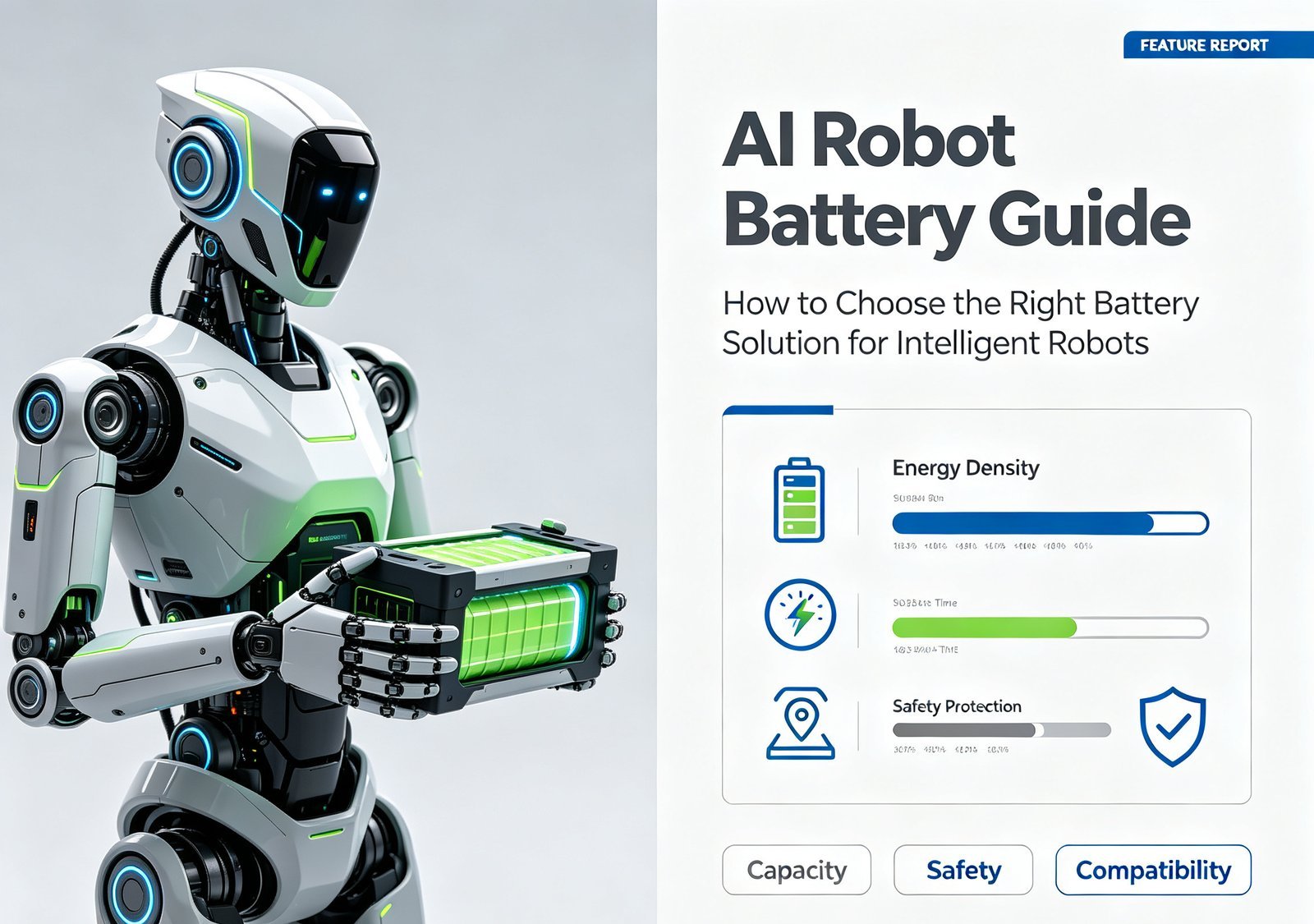
1re partie : Comprendre les besoins en alimentation électrique des robots d'assistance dotés d'IA
Avant de choisir une batterie, les fabricants doivent évaluer la consommation électrique réelle du robot.
Un robot compagnon doté d'une intelligence artificielle comprend généralement :
- Modules de traitement par IA
- Caméras et capteurs
- Moteurs et actionneurs
- Écrans tactiles ou affichages
- Haut-parleurs et microphones
- Modules de communication Wi-Fi / Bluetooth / 4G
Selon les fonctions, les besoins énergétiques varient.
Par exemple :
| Application | Exigences relatives à la batterie |
|---|---|
| Robot d'assistance à domicile | Léger, grande autonomie, fonctionnement silencieux |
| Robot pédagogique | Cycles de recharge fréquents et sans risque |
| Robot médical | Haute fiabilité, sortie stable |
| Robot de service | Haute capacité, fonctionnement en continu |
Une solution de batterie doit être conçue en fonction de l'environnement de travail du robot, plutôt que de se contenter de choisir la plus grande capacité.
2e partie. Choix de la composition chimique des batteries au lithium
Dans le domaine des robots compagnons dotés d'intelligence artificielle, les batteries au lithium sont largement utilisées en raison de leur densité énergétique et de leur conception modulable.
Batterie au lithium-ion (Li-ion)
Convient pour :
- Robots grand public compacts
- Appareils portables dotés d'intelligence artificielle
- Robots domestiques
Avantages :
- Densité énergétique élevée
- Conception légère
- Personnalisation flexible de la forme
- Bonnes performances en termes de puissance
Batterie LiFePO4
Convient pour :
- Robots de service
- Robots destinés au secteur de la santé
- Robots commerciaux dotés d'intelligence artificielle nécessitant une longue durée de vie
Avantages :
- Excellente stabilité thermique
- Durée de vie plus longue
- Meilleures performances en matière de sécurité
- Caractéristiques de décharge stables
Pour les robots fonctionnant plusieurs heures par jour, les batteries LiFePO4 constituent une source d'alimentation fiable.
3e partie. Capacité de la batterie : de quelle quantité d'énergie votre robot a-t-il besoin ?
La capacité de la batterie détermine la durée pendant laquelle un robot doté d'une intelligence artificielle peut fonctionner.
Le calcul de base :
Énergie de la batterie (Wh) = Tension (V) × Capacité (Ah)
Exemple :
Une batterie de 24 V et 10 Ah :
24 V × 10 Ah = 240 Wh
Si le robot consomme 40 W :
240 Wh ÷ 40 W ≈ 6 heures d'autonomie
Toutefois, dans le cadre d'applications concrètes, il convient de tenir compte des éléments suivants :
- Courant de démarrage du moteur
- Charge de calcul liée à l'IA
- Fonctionnement du capteur
- Modules de communication
- Vieillissement de la batterie
La conception professionnelle des batteries prévoit généralement une marge de sécurité afin d'éviter tout arrêt imprévu.
4e partie. Poids et taille : chaque gramme compte
Les robots d'assistance dotés d'IA nécessitent souvent :
- Interaction humaine
- Mouvement mobile
- Structure compacte
- Fonctionnement fluide
Une batterie surdimensionnée peut augmenter :
- Poids du robot
- Charge de travail du moteur
- Consommation d'énergie
- Coût de fabrication
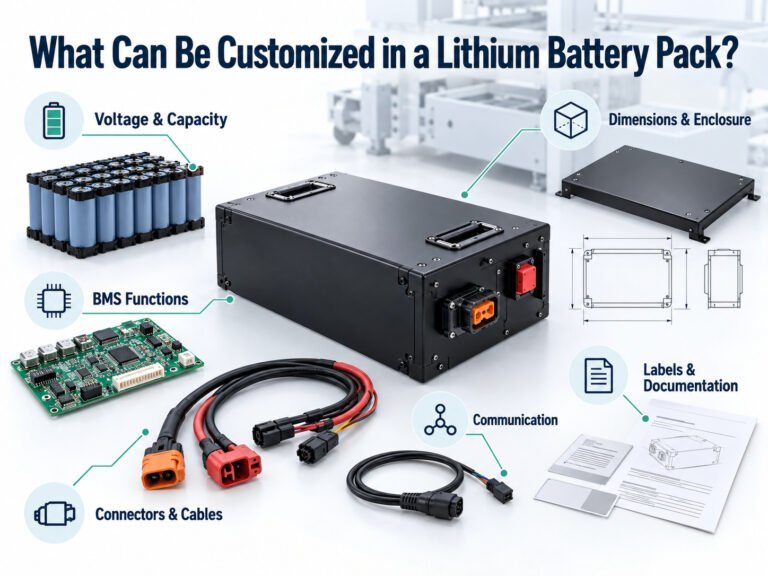
Les batteries sur mesure permettent aux fabricants d'optimiser :
- Forme de la batterie
- Disposition des cellules
- Tension
- Capacité
- Position de montage
Par exemple :
- Cellules cylindriques pour des configurations flexibles
- Cellules de type « pouch » pour les conceptions ultra-minces
- Boîtiers de batterie sur mesure pour structures robotiques
Partie 5. Un système de gestion de batterie (BMS) intelligent est indispensable pour les robots dotés d'IA
Le système de gestion de batterie (BMS) est le “ cerveau ” du bloc-batterie.
Un système de gestion de batterie (BMS) intelligent peut offrir :
✅ Protection contre les surcharges
✅ Protection contre la décharge excessive
✅ Protection contre les surintensités
✅ Surveillance de la température
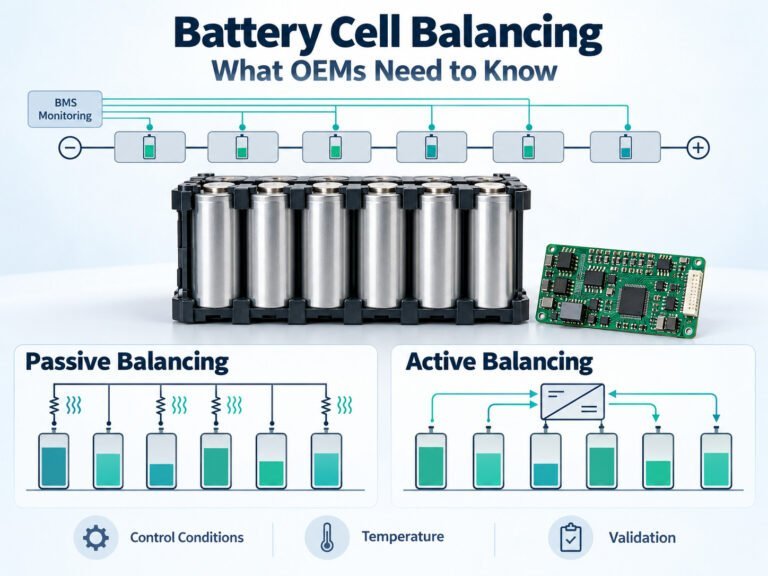
✅ Équilibrage cellulaire
✅ Surveillance de l'état de la batterie
Pour les robots intelligents, les solutions BMS avancées peuvent également prendre en charge :
- Communication CAN
- Communication RS485
- Communication UART
- Diagnostic à distance de la batterie
Cela permet au système de commande du robot de surveiller l'état de la batterie en temps réel.
Partie 6. Exigences de sécurité relatives aux batteries des robots dotés d'intelligence artificielle
Les robots dotés d'intelligence artificielle fonctionnant souvent à proximité de personnes, la sécurité des batteries revêt une importance cruciale.
Une batterie fiable pour robot doit présenter les caractéristiques suivantes :
- Piles au lithium de haute qualité
- Structure de batterie stable
- Mécanismes de protection multiples
- Conception de la gestion thermique
- Tests de sécurité rigoureux
Parmi les certifications recommandées, on peut citer :
- UN38.3
- IEC 62133
- CE
- Normes UL
- RoHS
Pour les marchés mondiaux, le respect des réglementations régionales en matière de batteries revêt également une grande importance.
Partie 7. Vitesse de recharge et autonomie de la batterie
Les robots dotés d'intelligence artificielle utilisés dans des environnements commerciaux ont besoin d'un système de recharge efficace.
Parmi les facteurs importants, on peut citer :
Fonctionnalité de recharge rapide
Réduit les temps d'arrêt et améliore la productivité.
Cycle de vie
Une batterie offrant une durée de vie plus longue signifie :
- Moins de remplacements
- Réduction des coûts de maintenance
- Une meilleure fiabilité à long terme
Pour les robots utilisés fréquemment, le choix d'une batterie conçue pour supporter des milliers de cycles de charge peut améliorer considérablement l'efficacité opérationnelle.
Partie 8. Solutions de batteries sur mesure pour les robots compagnons dotés d'IA
Chaque robot doté d'une intelligence artificielle a des besoins différents.
Un fabricant professionnel de batteries au lithium peut proposer :
- Conception de la structure de la batterie
- Sélection des cellules
- Développement du BMS
- Fabrication de prototypes
- Tests de sécurité
- Prise en charge de la production en série
Paramètres personnalisés courants :
- Tension : 12 V / 24 V / 36 V / 48 V
- Capacité : adaptée en fonction des besoins en termes d'autonomie
- Communication : CAN / RS485 / UART
- Niveau de protection : modèles conformes à la norme IP disponibles
Pourquoi choisir Yizhan Electronics pour vos solutions de batteries destinées aux robots dotés d'IA ?
Dongguan Yizhan Electronics Technology Co. Ltd. est spécialisée dans les solutions sur mesure de batteries au lithium destinées à la robotique, aux équipements industriels et aux appareils connectés.
Fort de son expérience dans le développement de batteries en tant qu'OEM/ODM, Yizhan propose :
- Conception sur mesure de batteries au lithium
- Solutions BMS intelligentes
- Batteries Li-ion et LiFePO4
- Développement de prototypes
- Accompagnement en matière de certification de sécurité
- Capacité de production en série
De la conception initiale des batteries à la production finale, Yizhan aide les fabricants de robots à mettre au point des solutions d'alimentation fiables et intelligentes.
FAQ
Quel type de batterie convient le mieux aux robots compagnons dotés d'IA ?
Les batteries lithium-ion sont couramment utilisées pour les robots IA compacts, tandis que les batteries LiFePO4 conviennent aux robots nécessitant une durée de vie plus longue et un niveau de sécurité plus élevé.
Quelle est la durée de vie de la batterie d'un robot doté d'une intelligence artificielle ?
L'autonomie dépend de la capacité de la batterie et de la consommation électrique du robot. Il est possible de concevoir des batteries sur mesure en fonction des heures de fonctionnement requises.
Les batteries des robots dotés d'IA permettent-elles la communication avec le système robotique ?
Oui. Les solutions BMS intelligentes prennent en charge les protocoles de communication CAN, RS485 et UART pour la surveillance en temps réel.
Les batteries peuvent-elles être adaptées à différents modèles de robots ?
Oui. Les fabricants de batteries peuvent personnaliser la tension, la capacité, les dimensions, les connecteurs et les fonctions de communication.
 English
  Chinese
  Japanese
  German
  French
  Korean
