
AI companion robots are becoming an important part of smart homes, education, healthcare, and service industries. Unlike traditional electronic devices, AI robots need to support continuous interaction, intelligent computing, movement, sensors, cameras, and wireless communication, which places higher requirements on their power systems.
Choosing the right battery is not only about capacity. A suitable AI robot battery must balance runtime, safety, weight, charging speed, cycle life, and intelligent battery management.
So, how do you choose the right battery for an AI companion robot?

Part 1. Understand the Power Requirements of AI Companion Robots
Before selecting a battery, manufacturers need to evaluate the robot’s actual power consumption.
An AI companion robot usually includes:
- AI processing modules
- Cameras and sensors
- Motors and actuators
- Touch screens or displays
- Speakers and microphones
- Wi-Fi / Bluetooth / 4G communication modules
Different functions create different energy demands.
For example:
| Application | Battery Requirement |
|---|---|
| Home companion robot | Lightweight, long runtime, quiet operation |
| Educational robot | Safe, frequent charging cycles |
| Healthcare robot | High reliability, stable output |
| Service robot | High capacity, continuous operation |
A battery solution should be designed according to the robot’s working environment rather than simply choosing the largest capacity.
Part 2. Lithium Battery Chemistry Selection
For AI companion robots, lithium batteries are widely used because of their energy density and flexible design.
Lithium-ion Battery (Li-ion)
Suitable for:
- Compact consumer robots
- Portable AI devices
- Home robots
Advantages:
- High energy density
- Lightweight design
- Flexible shape customization
- Good power performance
LiFePO4 Battery
Suitable for:
- Service robots
- Healthcare robots
- Commercial AI robots requiring long lifespan
Advantages:
- Excellent thermal stability
- Longer cycle life
- Higher safety performance
- Stable discharge characteristics
For robots operating for many hours every day, LiFePO4 batteries can provide a reliable power foundation.
Part 3. Battery Capacity: How Much Energy Does Your Robot Need?
Battery capacity determines how long an AI robot can operate.
The basic calculation:
Battery Energy (Wh) = Voltage (V) × Capacity (Ah)
Example:
A 24V 10Ah battery:
24V × 10Ah = 240Wh
If the robot consumes 40W:
240Wh ÷ 40W ≈ 6 hours runtime
However, real applications should consider:
- Motor startup current
- AI computing load
- Sensor operation
- Communication modules
- Battery aging
Professional battery design usually includes a safety margin to avoid unexpected shutdowns.
Part 4. Weight and Size: Every Gram Matters
AI companion robots often require:
- Human interaction
- Mobile movement
- Compact structure
- Smooth operation
An oversized battery can increase:
- Robot weight
- Motor workload
- Energy consumption
- Manufacturing cost
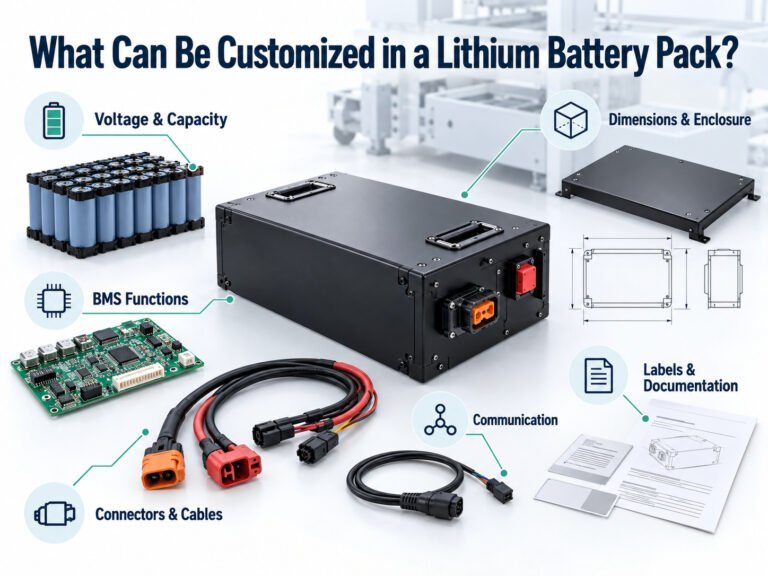
Custom battery packs allow manufacturers to optimize:
- Battery shape
- Cell arrangement
- Voltage
- Capacity
- Installation position
For example:
- Cylindrical cells for flexible layouts
- Pouch cells for ultra-thin designs
- Customized battery housings for robot structures
Part 5. Smart BMS Is Essential for AI Robots
The Battery Management System (BMS) is the “brain” of the battery pack.
A smart BMS can provide:
✅ Overcharge protection
✅ Over-discharge protection
✅ Over-current protection
✅ Temperature monitoring
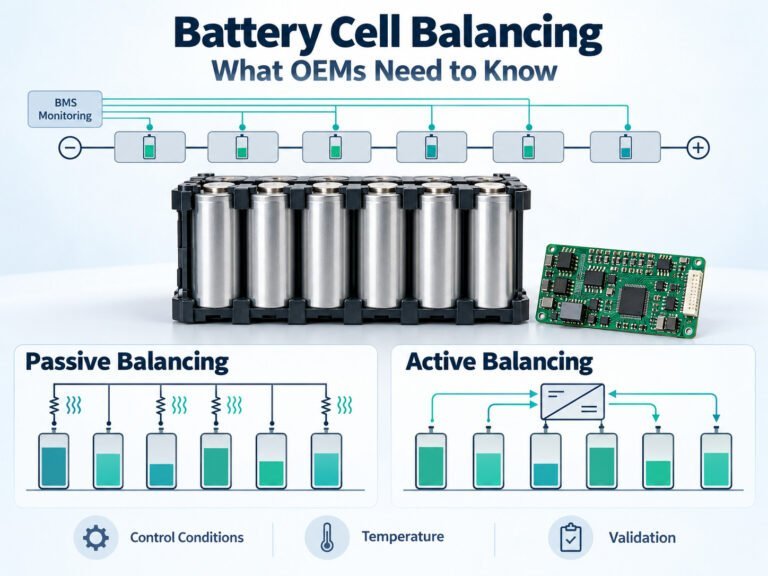
✅ Cell balancing
✅ Battery health monitoring
For intelligent robots, advanced BMS solutions can also support:
- CAN communication
- RS485 communication
- UART communication
- Remote battery diagnostics
This allows the robot control system to monitor battery status in real time.
Part 6. Safety Requirements for AI Robot Batteries
Because AI robots often operate near people, battery safety is critical.
A reliable robot battery should include:
- High-quality lithium cells
- Stable battery structure
- Multiple protection mechanisms
- Thermal management design
- Strict safety testing
Recommended certifications include:
- UN38.3
- IEC 62133
- CE
- UL standards
- RoHS
For global markets, compliance with regional battery regulations is also important.
Part 7. Charging Speed and Battery Life
AI robots used in commercial environments need efficient charging.
Important factors include:
Fast Charging Capability
Reduces downtime and improves productivity.
Cycle Life
A battery with longer cycle life means:
- Fewer replacements
- Lower maintenance costs
- Better long-term reliability
For frequently used robots, selecting a battery designed for thousands of charging cycles can significantly improve operational efficiency.
Part 8. Custom Battery Solutions for AI Companion Robots
Every AI robot has different requirements.
A professional lithium battery manufacturer can provide:
- Battery structure design
- Cell selection
- BMS development
- Prototype production
- Safety testing
- Mass production support
Typical customized parameters:
- Voltage: 12V / 24V / 36V / 48V
- Capacity: customized according to runtime requirements
- Communication: CAN / RS485 / UART
- Protection level: IP-rated designs available
Why Choose Yizhan Electronics for AI Robot Battery Solutions?
Dongguan Yizhan Electronics Technology Co., Ltd. specializes in customized lithium battery pack solutions for robotics, industrial equipment, and smart devices.
With OEM/ODM battery development experience, Yizhan provides:
- Customized lithium battery design
- Smart BMS solutions
- Li-ion and LiFePO4 battery packs
- Prototype development
- Safety certification support
- Mass production capability
From battery concept design to final production, Yizhan helps robot manufacturers build reliable and intelligent power solutions.
FAQ
What type of battery is best for AI companion robots?
Lithium-ion batteries are commonly used for compact AI robots, while LiFePO4 batteries are suitable for robots requiring longer lifespan and higher safety.
How long can an AI robot battery last?
Runtime depends on battery capacity and robot power consumption. Customized battery packs can be designed according to specific operating hours.
Can AI robot batteries support communication with the robot system?
Yes. Smart BMS solutions can support CAN, RS485, and UART communication for real-time monitoring.
Can battery packs be customized for different robot designs?
Yes. Battery manufacturers can customize voltage, capacity, dimensions, connectors, and communication functions.
 English
  Chinese
  Japanese
  German
  French
  Korean
