
With the rapid growth of electrification in industries such as electric vehicles, AGV/AMR robots, energy storage systems, power tools, medical devices, and smart equipment, more companies are looking for custom OEM battery pack manufacturers instead of purchasing standard batteries.
A reliable OEM battery supplier should provide more than battery cells. They should have the capabilities of battery solution design, BMS development, structural design, certification testing, mass production, and after-sales support.
For global buyers, choosing the wrong battery supplier may lead to delayed projects, failed certifications, quality issues, and supply chain risks.
This guide explains:
- What OEM battery pack manufacturing means
- How to select the right battery supplier
- Custom battery development process
- Key technical specifications to evaluate
- Battery cell, BMS, and structural design requirements
- International certification requirements
- How to evaluate an OEM battery factory
1. What Is an OEM Battery Pack Manufacturer?
An OEM (Original Equipment Manufacturer) battery pack manufacturer designs and produces customized battery solutions according to customer requirements.
Unlike standard battery suppliers, OEM battery manufacturing includes:
✅ Battery cell selection
✅ Battery pack design
✅ Battery Management System (BMS) development
✅ Protection circuit design
✅ Housing and mechanical design
✅ Connector customization
✅ Communication protocol development
✅ Safety testing
✅ Mass production
Examples:
- AGV robots require 24V/48V/72V high-cycle battery systems
- E-bikes require UL2271 certified lithium batteries
- Energy storage systems require 51.2V LiFePO4 battery packs
- Medical devices require reliable and compact battery solutions
These applications usually require customized battery packs instead of off-the-shelf products.
2. Why Choose OEM Battery Pack Manufacturing?
2.1 Customized Design for Limited Space
Different devices have different internal structures.
OEM battery manufacturers can design battery packs according to:
- Length
- Width
- Height
- Installation method
- Connector position
For example, robot batteries may require:
- Slim design
- Quick replacement structure
- Shock resistance
- IP65/IP67 waterproof protection
2.2 Matching Specific Performance Requirements
Standard batteries may not meet the requirements of professional equipment.
OEM solutions can customize:
Voltage Options
Common configurations:
- 12V
- 24V
- 36V
- 48V
- 51.2V
- 72V
Capacity Options
Examples:
- 10Ah
- 20Ah
- 50Ah
- 100Ah+
Discharge Performance
Designed according to application requirements:
- Standard discharge
- High-rate discharge
- High peak current output
2.3 Improving Product Competitiveness
For equipment manufacturers, customized battery solutions provide:
- Product differentiation
- More stable supply chain
- Better user experience
- Higher product value
3. Information Required Before Purchasing OEM Battery Packs
Before contacting an OEM battery supplier, prepare a detailed RFQ (Request for Quotation).
Basic Battery Specifications
| Item | Example |
|---|---|
| Battery Type | Li-ion / LiFePO4 / NMC |
| Nominal Voltage | 48V |
| Capacity | 20Ah |
| Energy | 960Wh |
| Operating Temperature | -20℃ to 60℃ |
| Charging Method | CC/CV |
| Cycle Life | 2000+ cycles |
Application Information
The supplier needs to understand:
Application Scenario
Examples:
- AGV robots
- AMR robots
- E-bikes
- Forklifts
- Golf carts
- Energy storage systems
Working Environment
Consider:
- Indoor or outdoor operation
- High temperature conditions
- Low temperature conditions
- Humidity
- Vibration environment
Electrical Requirements
Important parameters include:
- Maximum continuous current
- Peak discharge current
- Charging current
- Discharge rate
- Communication protocol
Advanced BMS systems may support:
- CAN
- RS485
- UART
- Modbus
4. How to Select the Right OEM Battery Supplier?
Price should not be the only factor when selecting a battery manufacturer. A comprehensive evaluation is required.
4.1 Evaluate Factory Manufacturing Capability
A professional OEM battery factory should have:
Battery Cell Testing Capability
Including:
- Voltage testing
- Internal resistance testing
- Capacity testing
- Cell matching and sorting
High-quality battery packs require:
- Consistent voltage
- Consistent internal resistance
- Balanced capacity
Battery Pack Production Capability
Check whether the factory has:
- Automated assembly lines
- Laser welding equipment
- Spot welding equipment
- Aging test rooms
- High and low-temperature testing equipment
- Waterproof testing equipment
Quality Management System
Recommended certifications:
- ISO9001
- ISO14001
- IATF16949 (automotive applications)
- Complete quality inspection procedures
4.2 Check R&D Capability
A true OEM battery manufacturer should have professional engineering teams.
Electrical Engineering Team
Responsible for:
- Circuit design
- BMS development
- Parameter adjustment
Mechanical Engineering Team
Responsible for:
- CAD design
- Battery housing design
- Waterproof structure design
Testing Team
Responsible for:
- Performance verification
- Safety testing
- Reliability testing
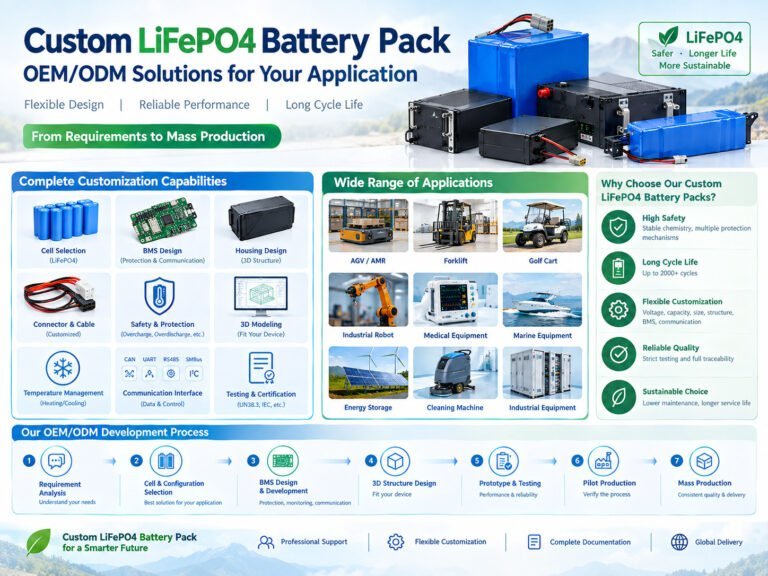
5. OEM Battery Development Process
A complete development process usually includes:
Step 1: Requirement Confirmation
Customer provides:
- Application details
- Battery specifications
- Size limitations
- Certification requirements
Step 2: Battery Solution Design
Engineers determine:
- Battery cell model
- Series and parallel configuration
- BMS solution
- Housing structure
Example:
48V 20Ah battery pack:
13-series lithium cells:
13S × 3.7V ≈ 48V
Step 3: Prototype Production
Prototype samples are created for:
- Engineering verification
- Functional testing
Testing includes:
- Voltage
- Capacity
- Discharge performance
- Communication functions
Step 4: Reliability Testing
Electrical Performance Testing
Including:
- Charge/discharge testing
- Cycle life testing
- Capacity testing
Safety Testing
Including:
- Overcharge protection
- Over-discharge protection
- Short circuit protection
- Temperature rise testing
Step 5: Mass Production
Manufacturing process:
Cell sorting
↓
Cell assembly
↓
Welding
↓
BMS installation
↓
Battery pack assembly
↓
Aging test
↓
Final inspection
↓
Shipment
6. Three Core Components of OEM Battery Packs
6.1 Battery Cell Selection
Common battery chemistries:
LiFePO4 Battery Cells
Advantages:
- High safety
- Long cycle life
- Excellent thermal stability
Suitable for:
- AGV
- Energy storage
- Forklifts
- Industrial robots
NMC Lithium Battery Cells
Advantages:
- Higher energy density
- Compact size
- Lightweight design
Suitable for:
- Electric vehicles
- Power tools
- Portable equipment
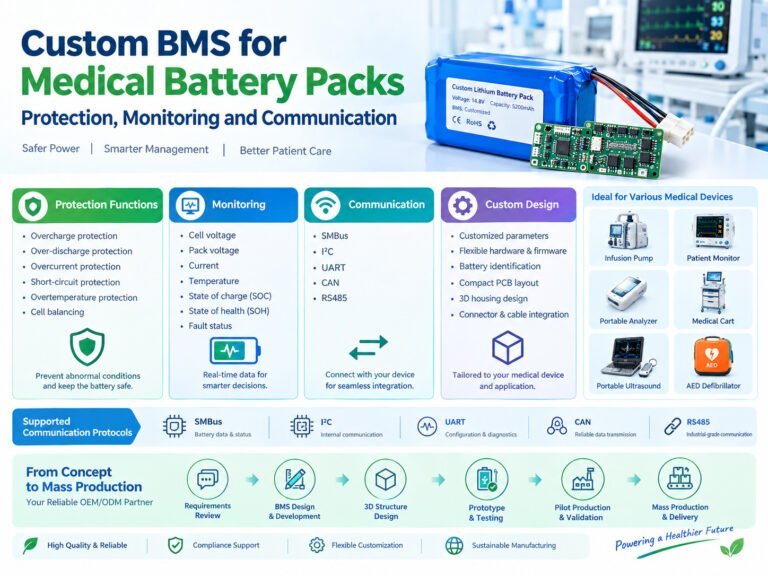
6.2 Battery Management System (BMS)
BMS is the intelligent control system of a battery pack.
Main functions:
Protection Functions
Including:
- Overcharge protection
- Over-discharge protection
- Over-current protection
- Short-circuit protection
- Temperature protection
Smart Communication
Advanced BMS supports:
- CAN communication
- RS485
- Bluetooth APP
Used in:
- AGV
- AMR
- Industrial equipment
6.3 Battery Structure Design
Professional battery design should consider:
- Heat dissipation
- Waterproof performance
- Shock resistance
- Maintenance convenience
Common protection ratings:
- IP65
- IP67
- IP68
7. OEM Battery Certification Requirements
Different markets require different certifications.
Common certifications include:
| Certification | Purpose |
|---|---|
| UN38.3 | Lithium battery transportation safety |
| IEC62133 | Battery safety standard |
| CE | European market compliance |
| UL2054 | North American battery safety |
| UL2271 | Light electric vehicle battery |
| RoHS | Environmental compliance |
| MSDS | Material safety document |
UN38.3 focuses on transportation safety testing, while IEC 62133 focuses on battery safety performance. OEM buyers should confirm certification requirements based on their target market.
8. How to Choose OEM Batteries for Different Applications?
AGV / AMR Robot Batteries
Recommended:
LiFePO4 battery technology
Key requirements:
- Long cycle life
- Fast charging capability
- High safety
- CAN communication
Typical voltages:
24V / 48V / 72V
Electric Bike Batteries
Important factors:
- Lightweight design
- Waterproof protection
- Long range
- UL certification
Common systems:
36V
48V
52V
Energy Storage Batteries
Recommended:
LiFePO4
Important factors:
- Long lifespan
- High safety
- Large capacity
Example:
51.2V 100Ah
Industrial Equipment Batteries
Requirements:
- High reliability
- Wide temperature operation
- Shock resistance
Applications:
- Forklifts
- Cleaning machines
- Industrial robots
9. Common Mistakes When Purchasing OEM Battery Packs
Mistake 1: Only Comparing Prices
Low-cost batteries may involve:
- Lower-grade cells
- Simplified BMS
- Reduced testing procedures
Mistake 2: Only Focusing on Battery Cell Brands
A famous battery cell brand does not automatically guarantee a high-quality battery pack.
PACK quality also depends on:
- Engineering design
- Welding technology
- BMS matching
- Quality control process
Mistake 3: Ignoring Certifications
Without proper certifications, products may face:
- Customs clearance problems
- Market restrictions
- Customer complaints
10. OEM Battery Supplier Evaluation Checklist
Before choosing a supplier, confirm:
✅ Does the company have an independent battery R&D team?
✅ Can they provide prototype samples?
✅ Do they provide complete test reports?
✅ Can they support international certifications?
✅ Do they have export experience?
✅ Can they provide long-term supply?
✅ Do they offer technical support after delivery?
FAQ
Q1: How long does OEM battery development take?
Typical timeline:
- Solution design: 3-7 days
- Prototype development: 2-6 weeks
- Mass production: Depends on order quantity
Q2: What is the MOQ for customized battery packs?
MOQ depends on:
- Battery model
- Structural complexity
- Cell supply availability
Some manufacturers support small-batch prototype testing before mass production.
Q3: Can customers specify battery cell brands?
Yes.
Common options include:
- EVE
- Samsung SDI
- LG Energy Solution
- Panasonic
- FEB
Q4: Can OEM battery packs be exported globally?
Yes, but buyers should confirm:
- UN38.3
- MSDS
- Shipping documents
- Target market certifications
Conclusion
Choosing the right OEM battery pack manufacturer means selecting a long-term technology partner.
A professional OEM supplier provides more than batteries. They provide:
⚡ Battery solution design
⚡ Product safety assurance
⚡ Stable mass production capability
⚡ Global certification support
For companies developing AGV robots, electric vehicles, energy storage systems, and industrial equipment, a reliable OEM battery solution can reduce development risks and accelerate product commercialization.
Dongguan Yizhan Electronics Technology Co., Ltd. specializes in lithium battery PACK OEM/ODM solutions, providing customized 18650, 21700, LiFePO4, and NMC battery solutions for AGV, AMR robots, electric vehicles, energy storage systems, and industrial equipment. We support 24V-72V customized battery development, smart BMS communication, waterproof designs, and global certification services.
 English
  Chinese
  Japanese
  German
  French
  Korean
