
Mobile industrial automation equipment is used in manufacturing facilities, warehouses, production workshops, inspection operations, and maintenance applications.
These systems combine electrical power, motion control, industrial sensors, communication equipment, and automation functions to perform tasks across different working locations.
Unlike stationary machines connected to a fixed electrical supply, battery-powered mobile equipment requires an onboard energy source that supports movement and equipment operation.
For equipment manufacturers, custom battery packs for mobile industrial automation equipment must be designed according to the electrical load, operating duration, current demand, charging method, environmental conditions, and mechanical installation requirements.
This article explains the design considerations for industrial mobile equipment batteries, including cell chemistry, voltage, capacity, Battery Management System (BMS), communication interfaces, mechanical construction, and system integration.

1. Battery Applications in Mobile Industrial Automation Equipment
Mobile industrial automation equipment includes different machine configurations with specific electrical requirements.
Mobile Industrial Inspection Equipment
Mobile inspection equipment may be used for equipment monitoring, industrial facility inspections, and automated measurement activities.
Depending on the system, a battery pack may power:
- Electric drive systems
- Inspection cameras
- Industrial sensors
- Onboard computers
- Wireless communication modules
- Measurement instruments
Battery selection depends on the inspection cycle, electrical load, and equipment installation dimensions.
Mobile Industrial Testing Equipment
Mobile testing systems transport electrical or mechanical testing equipment between working locations.
Applications may include mobile diagnostic stations, electrical measurement equipment, and automated testing platforms.
The battery system may supply power to control electronics, measurement modules, displays, and auxiliary equipment.
Mobile Maintenance Equipment
Battery-powered maintenance equipment may incorporate pumps, actuators, motors, controllers, and monitoring systems.
The battery must support the operating current required by these components under specified working conditions.
Mobile Material Handling Equipment
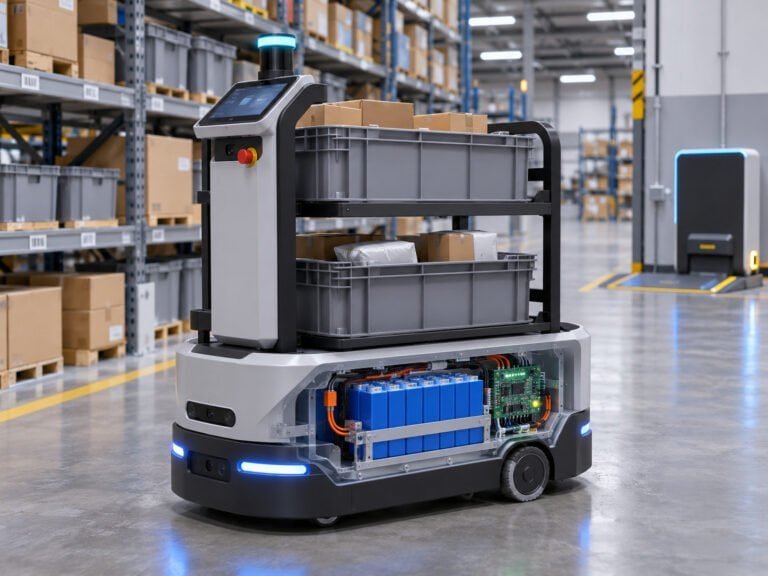
Industrial mobile platforms may include powered carts, lifting equipment, conveyor modules, and electrically driven material transport systems.
Battery requirements depend on the equipment load, drive motor specifications, movement profile, and operating schedule.
Mobile Industrial Automation Platforms
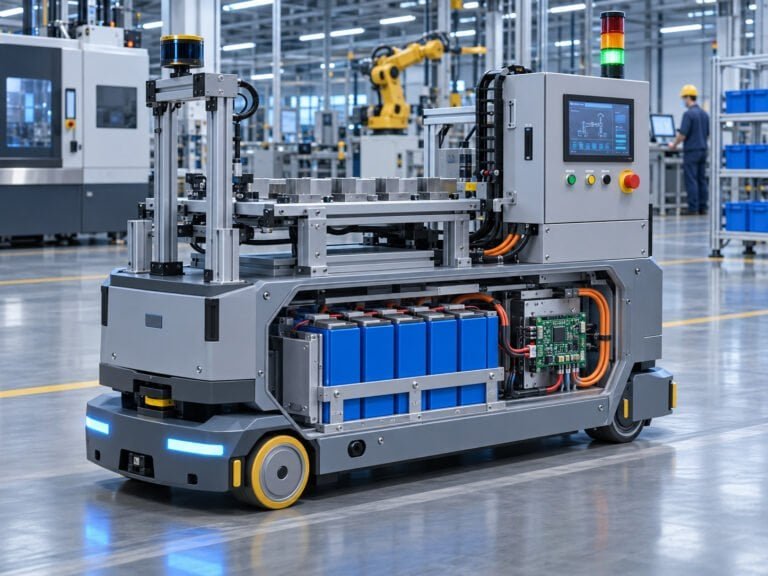
Some automation systems use a mobile platform to carry robotic mechanisms, control cabinets, sensors, or industrial tools.
These applications may require power for both platform movement and the installed automation equipment.
Each application requires evaluation of its electrical architecture and operating cycle.
2. Selecting Battery Voltage for Industrial Mobile Equipment
Battery voltage is determined by the electrical requirements of the equipment.
Industrial mobile systems may use 12V, 24V, 36V, 48V, or application-specific voltage configurations.
The selected voltage must be compatible with the motor controllers, DC-DC converters, industrial control electronics, and charging system.
Lithium Battery Voltage Configurations
Lithium battery packs use cells connected in series to achieve the required nominal voltage.
Examples include:
| Battery Configuration | Cell Chemistry | Nominal Voltage |
|---|---|---|
| 4S | LiFePO4 | 12.8V |
| 8S | LiFePO4 | 25.6V |
| 12S | LiFePO4 | 38.4V |
| 15S | LiFePO4 | 48.0V |
| 16S | LiFePO4 | 51.2V |
| 7S | Ternary Lithium-Ion | 25.2V |
| 10S | Ternary Lithium-Ion | 36.0V |
| 13S | Ternary Lithium-Ion | 46.8V |
The values assume nominal cell voltages of 3.2V for LiFePO4 and 3.6V for ternary lithium-ion.
These are illustrative calculations rather than existing product specifications.
Electrical Compatibility Requirements
Before selecting a battery configuration, equipment manufacturers should confirm:
- Nominal battery voltage
- Minimum operating voltage
- Maximum operating voltage
- Motor controller voltage range
- DC-DC converter input requirements
- Charger voltage
- Equipment startup requirements
- Electrical protection limits
Battery voltage compatibility should be evaluated using the complete battery operating range rather than nominal voltage alone.
3. Calculating Battery Capacity and Operating Runtime
Battery capacity should be calculated according to the energy consumed during the equipment’s intended operating cycle.
Mobile industrial automation equipment may contain several electrical loads operating simultaneously or at different intervals.
Main Electrical Loads
The battery may supply power to:
- Traction motors
- Linear actuators
- Hydraulic pumps
- Control computers
- Programmable Logic Controllers (PLCs)
- Sensors
- Communication systems
- Industrial displays
- Lighting
- Auxiliary equipment
The electrical power required by each component should be included in the calculation.
Battery Energy Calculation
Nominal battery energy is calculated using:
Battery Energy (Wh) = Nominal Voltage (V) × Capacity (Ah)
For example, a theoretical 25.6V 50Ah LiFePO4 battery has:
25.6V × 50Ah = 1,280Wh
This value represents nominal battery energy.
Actual usable energy depends on battery operating limits, discharge conditions, temperature, and battery condition.
Runtime Calculation
An initial theoretical runtime estimate can be calculated using:
Runtime (hours) = Nominal Battery Energy (Wh) ÷ Average Power (W)
For engineering design, usable battery energy should be considered.
Estimated Runtime (hours) = Usable Battery Energy (Wh) ÷ Average Power (W)
Example: Mobile Industrial Inspection Platform
Assume a mobile industrial inspection platform has the following average electrical loads:
| Component | Average Power |
|---|---|
| Drive Motors | 150W |
| Inspection Equipment | 80W |
| Industrial Controller | 30W |
| Sensors and Communication | 20W |
| Auxiliary Equipment | 20W |
| Total | 300W |
For a required operating time of four hours:
Required Usable Energy = 300W × 4h = 1,200Wh
If the equipment uses a nominal 25.6V battery:
Theoretical Capacity = 1,200Wh ÷ 25.6V = 46.9Ah
Assuming an illustrative usable energy fraction of 90%:
Required Nominal Capacity = 1,200Wh ÷ (25.6V × 0.90)
Required Nominal Capacity ≈ 52.1Ah
The 90% value is a calculation assumption, not a universal battery performance specification.
The final battery capacity should account for actual energy consumption, battery aging requirements, electrical losses, temperature, and the defined operating reserve.
4. Evaluating Equipment Duty Cycles
Industrial automation equipment may operate under different power conditions throughout a working cycle.
Battery sizing should reflect these operating modes.
Typical Operating Conditions
A mobile industrial automation system may include:
- Equipment startup
- Traveling between locations
- Automated task execution
- Motor or actuator operation
- Measurement and data collection
- Standby
- Return to charging
- Battery charging
Duty Cycle Calculation
The total battery energy requirement can be estimated by calculating the energy consumed in each operating mode.
Total Energy (Wh) = Σ [Power Consumption (W) × Operating Time (h)]
For example:
| Operating Mode | Average Power | Duration | Energy |
|---|---|---|---|
| Equipment Movement | 400W | 1 hour | 400Wh |
| Automated Operation | 250W | 2 hours | 500Wh |
| Standby | 50W | 1 hour | 50Wh |
| Total | — | 4 hours | 950Wh |
The average power consumption is:
950Wh ÷ 4h = 237.5W
These figures are illustrative.
The equipment manufacturer’s measured power profile should be used for actual battery selection.
Energy Reserve
Some equipment requires an energy reserve to complete a task or reach a charging location.
The reserve should be determined according to the equipment’s operating conditions and control strategy.
5. Continuous and Peak Discharge Current Requirements
Battery energy capacity and discharge current capability are separate design parameters.
Industrial mobile equipment may require current pulses during motor startup, acceleration, lifting, or actuator operation.
Continuous Discharge Current
Continuous current refers to the electrical current required during sustained operation.
It influences:
- Battery cell selection
- Cell configuration
- BMS current rating
- Cable specifications
- Connector selection
- Busbar design
- Thermal management
Peak Discharge Current
Peak current may occur during:
- Motor startup
- Equipment acceleration
- Hydraulic pump activation
- Linear actuator operation
- Material lifting
- Temporary load changes
Peak current should be specified with its duration and repetition frequency.
Example Current Requirements
| Parameter | Illustrative Value |
|---|---|
| Nominal Battery Voltage | 25.6V |
| Battery Capacity | 60Ah |
| Continuous Discharge Current | 40A |
| Peak Discharge Current | 100A |
| Peak Duration | 3 seconds |
These values are illustrative engineering requirements rather than specifications for existing products.
The battery cells, BMS, connectors, and current-carrying components must be evaluated against the actual equipment load.
6. LiFePO4 and Ternary Lithium-Ion Cell Selection
Industrial battery packs may use LiFePO4 or ternary lithium-ion cells according to the equipment’s electrical and mechanical requirements.
Cell selection should be based on the manufacturer’s technical documentation and the intended operating conditions.
LiFePO4 Battery Cells
LiFePO4 cells are used in industrial equipment, robotics, and energy storage applications.
Relevant selection parameters include:
- Nominal voltage
- Rated capacity
- Continuous discharge current
- Pulse discharge capability
- Charging current
- Operating temperature
- Cell dimensions
- Terminal configuration
- Cycle life specifications
Prismatic and cylindrical LiFePO4 cells can be evaluated according to the application requirements.
Ternary Lithium-Ion Battery Cells
Ternary lithium-ion cells, including NMC chemistry, are used in mobile equipment and industrial applications.
The selection process should evaluate voltage range, electrical current, cell dimensions, thermal conditions, and charging requirements.
Cylindrical cells may be considered for equipment requiring specified battery shapes and cell arrangements.
Series and Parallel Configuration
Series connections determine battery voltage.
Parallel connections determine combined nominal capacity and contribute to current capability.
The final arrangement should account for cell matching, electrical insulation, mechanical retention, and current distribution.
7. BMS Requirements for Mobile Industrial Equipment
The Battery Management System monitors battery conditions and provides protection functions according to its hardware and firmware configuration.
A custom industrial battery pack may require:
- Cell voltage monitoring
- Overcharge protection
- Over-discharge protection
- Overcurrent protection
- Short-circuit protection
- Charging temperature protection
- Discharging temperature protection
- Cell balancing
- Battery fault reporting
Current Protection
The BMS current rating should be evaluated according to the continuous current and specified peak current requirements.
Protection behavior must also be considered during equipment startup and temporary current pulses.
Temperature Monitoring
Temperature sensors may monitor selected battery locations.
Protection thresholds should be defined according to the cell manufacturer’s specifications and approved battery design.
State of Charge Monitoring
Some industrial automation systems require State of Charge (SOC) reporting.
SOC information may be displayed on the equipment or transmitted to the main controller.
The estimation method and required accuracy should be confirmed during development.
Battery Fault Reporting
Battery fault status may be transmitted to the equipment controller through a communication interface.
The required fault information and system response should be defined in the technical specification.
8. CAN, UART, and RS485 Communication
Mobile industrial automation equipment may require battery data for monitoring, diagnostics, and maintenance planning.
Depending on the project, the battery pack may support CAN, UART, or RS485 communication.
Battery Information
A compatible BMS may transmit:
- Total battery voltage
- Charge and discharge current
- State of Charge
- Battery temperature
- Protection status
- Fault information
The available information depends on the BMS configuration.
CAN Communication Requirements
For CAN communication projects, equipment manufacturers should provide:
- CAN bit rate
- Message identifiers
- Data frame definitions
- Required battery parameters
- Transmission intervals
- Connector pin assignments
Communication compatibility requires agreement on the hardware interface and protocol.
Monitoring and Control
In a monitoring-only BMS configuration, CAN communication transmits battery operating information.
Charging and discharging are not automatically controlled through CAN communication.
Any communication-based control functions must be defined as separate design requirements and supported by compatible hardware and firmware.
9. Charging System Integration
Mobile industrial equipment may use external chargers, onboard charging systems, automatic charging stations, or removable battery arrangements.
The charging system must be compatible with the selected battery chemistry and configuration.
Charging Voltage and Current
The charger must provide an appropriate charging profile.
The design should confirm:
- Maximum charging voltage
- Charging current
- Charging termination conditions
- Charging temperature range
- Protection behavior
- Charger communication requirements, where applicable
External Charging
Some equipment uses a dedicated external charger connected through a specified charging interface.
Connector selection must account for charging current, voltage, polarity, and mechanical requirements.
Onboard Charging
Mobile equipment may incorporate an onboard charging module.
Battery and charger compatibility should be verified during system development.
Automatic Charging
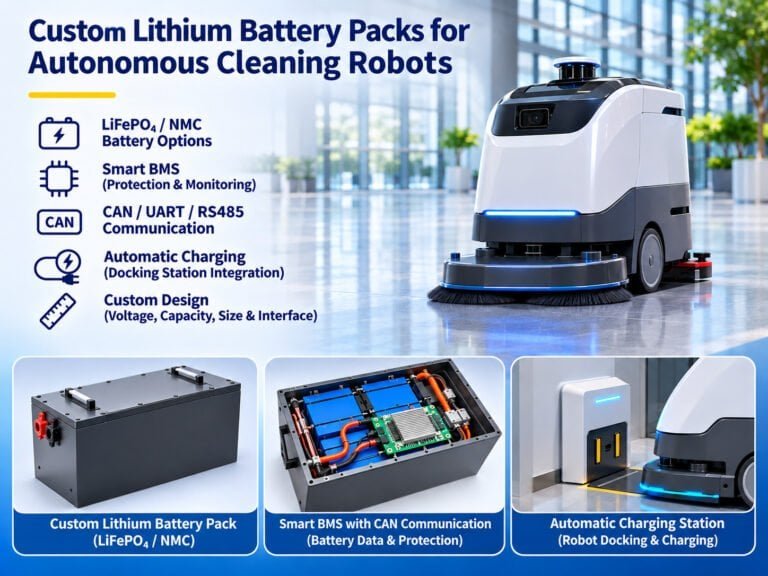
Some mobile automation platforms use automatic charging stations.
The charging interface may involve specified contacts or mating connectors.
The design should account for contact alignment, connection resistance, charging safety, and fault conditions.
The charging station and battery pack must be evaluated as part of the equipment’s electrical system.
10. Removable and Swappable Battery Pack Design
Some mobile equipment requires removable battery packs for maintenance or operational scheduling.
A removable battery configuration involves mechanical and electrical interface requirements.
Mechanical Considerations
The battery design should address:
- Installation dimensions
- Mounting orientation
- Retention and locking mechanisms
- Handles
- Battery mass
- Removal clearance
- Connector mating arrangement
Electrical Considerations
Removable battery systems may require:
- Suitable connector current ratings
- Defined connector polarity
- Power isolation provisions
- Pre-charge arrangements, where specified
- Protection against unintended disconnection
A removable battery pack is not automatically suitable for replacement while the equipment remains powered.
Hot-swapping requires an appropriate electrical architecture and system-level verification.
11. Mechanical Battery Pack Design
Industrial mobile equipment may contain motors, control electronics, actuators, and mechanical assemblies within a defined enclosure.
Battery dimensions and mounting requirements should be confirmed during equipment development.
Available Installation Space
The equipment manufacturer should provide the maximum allowable:
Length × Width × Height
The dimensions should include space for cables, connectors, mounting structures, and service access.
Battery Enclosure
Plastic and metal battery enclosures may be considered according to the project requirements.
The enclosure should provide mechanical support, electrical insulation, and protection against the specified operating environment.
Mounting and Vibration
Mobile industrial equipment may experience vibration during movement or operation.
The battery mounting structure and internal component retention should be evaluated according to specified mechanical loads.
Battery Mass and Equipment Stability
Battery mass and installation position may influence equipment stability, movement, and load distribution.
These factors should be reviewed with the equipment manufacturer.
12. Environmental Protection and Thermal Management
Mobile industrial equipment may operate in factories, warehouses, workshops, and other industrial environments.
The battery pack may encounter dust, humidity, vibration, and temperature changes.
Enclosure Protection
The required Ingress Protection (IP) rating depends on the equipment installation and environmental exposure.
Enclosure sealing should account for housing joints, connectors, cable exits, and other relevant components.
Operating Temperature
Charging and discharging temperature limits should follow the selected cell manufacturer’s specifications.
The BMS should provide the temperature protection functions defined in the battery design.
Thermal Management
Battery cells and electrical connections generate heat during operation.
Thermal design should consider:
- Continuous discharge current
- Peak current duration
- Charging current
- Cell arrangement
- Enclosure construction
- Ambient temperature
- Heat transfer paths
Industrial Environmental Exposure
Where equipment may encounter liquids, industrial chemicals, or cleaning agents, enclosure materials and connector compatibility should be evaluated.
Environmental protection requirements should be verified according to the applicable project specifications.
13. Battery Testing and Applicable Standards
Battery pack development may involve electrical, thermal, mechanical, environmental, and communication testing.
Applicable standards depend on the equipment application, battery configuration, target market, and regulatory requirements.
Electrical Validation
Testing may include:
- Voltage verification
- Capacity testing
- Energy measurement
- Continuous discharge testing
- Peak current testing
- Charging verification
- BMS protection testing
Mechanical and Environmental Validation
Testing may include:
- Enclosure inspection
- Mounting verification
- Vibration testing
- Connector assessment
- Temperature testing
- Ingress protection testing, where applicable
Communication and System Integration
Verification may include:
- CAN communication
- SOC reporting
- Fault status transmission
- Charging interface compatibility
- Equipment operating runtime
- Protection response
Applicable Standards
| Standard / Requirement | General Scope |
|---|---|
| IEC 62619 | Safety requirements for industrial secondary lithium cells and batteries |
| UN38.3 | Lithium battery transportation testing |
| IEC 60529 | Enclosure ingress protection classification |
| ISO 3691-4 | Driverless industrial trucks and their systems, where applicable |
| Applicable Market Requirements | Requirements determined by the equipment classification and destination market |
These standards have different purposes and do not establish interchangeable certifications.
The applicable editions and test requirements should be confirmed according to the individual project.
Battery-level testing does not automatically establish compliance for the complete mobile automation equipment.
14. Information Required for a Custom Industrial Mobile Equipment Battery Quotation
Equipment manufacturers requesting a custom lithium battery pack should provide the following technical information.
| Item | Required Information |
|---|---|
| Equipment Application | Mobile inspection, industrial testing, maintenance, material handling, or automation equipment |
| Nominal Voltage | V |
| Operating Voltage Range | Minimum and maximum voltage |
| Battery Capacity | Ah or Wh |
| Required Runtime | Hours |
| Average Power Consumption | W |
| Continuous Discharge Current | A |
| Peak Discharge Current | A and duration |
| Battery Chemistry | LiFePO4 or ternary lithium-ion |
| Battery Dimensions | Maximum length × width × height |
| Battery Mass | Required mass limit or range |
| BMS Requirements | Protection, monitoring, and balancing |
| Communication | CAN, UART, RS485, or specified interface |
| Charging Method | External, onboard, automatic, or removable battery |
| Charging Voltage and Current | V and A |
| Connector Requirements | Charging, discharging, and signal connections |
| Mechanical Requirements | Mounting, orientation, vibration, and retention |
| Environmental Requirements | Temperature, dust, humidity, and IP protection |
| Applicable Standards | Target market and certification requirements |
| Prototype Quantity | Sample requirements |
| Production Forecast | Estimated annual demand |
| Delivery Destination | Country and address |
Equipment electrical schematics, mechanical drawings, and operating load profiles can support battery design evaluation.
15. Custom Industrial Lithium Battery Pack Development at Dongguan Yizhan Electronics Technology Co., Ltd.
Dongguan Yizhan Electronics Technology Co., Ltd. provides OEM and ODM lithium battery pack development and manufacturing services for industrial equipment, robotics, electric mobility, and energy storage applications.
For mobile industrial automation equipment projects, battery specifications can be evaluated according to electrical demand, operating duration, current requirements, mechanical dimensions, and charging interfaces.
Our customization scope includes:
- LiFePO4 and ternary lithium-ion battery configurations
- Customized voltage and capacity
- Battery cell selection
- BMS configuration according to project requirements
- CAN, UART, and RS485 communication options
- NTC temperature monitoring
- Customized charging and discharging connectors
- Plastic and metal battery enclosures
- Battery pack assembly
- Technical documentation and testing coordination
Communication functions, electrical protection, enclosure requirements, and battery integration arrangements are evaluated according to each project specification.
Customers can provide equipment drawings, electrical requirements, application details, and estimated production quantities for technical discussion.
Conclusion
Custom battery packs for mobile industrial automation equipment require electrical, mechanical, thermal, and system integration planning.
Battery voltage, energy capacity, continuous current, peak current, and operating duty cycle determine the initial electrical requirements.
BMS protection, communication interfaces, charging compatibility, and installation conditions influence battery pack development.
For industrial equipment manufacturers, battery specifications should be confirmed according to the equipment’s operating profile and technical requirements.
Looking for a custom lithium battery pack for mobile industrial automation equipment?
Contact Dongguan Yizhan Electronics Technology Co., Ltd. with your equipment application, nominal voltage, required runtime, continuous and peak discharge current, battery dimensions, charging requirements, and estimated production quantity.
 English
 Chinese
 Japanese
 German
 French
 Korean

