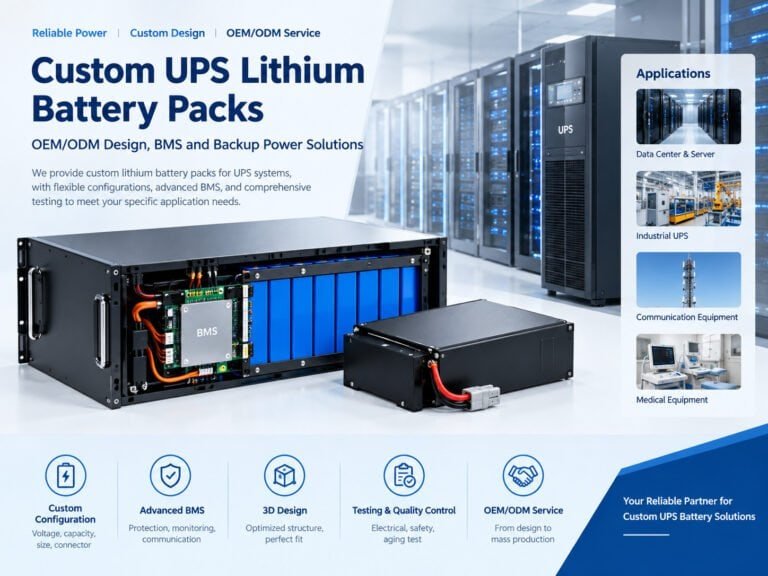
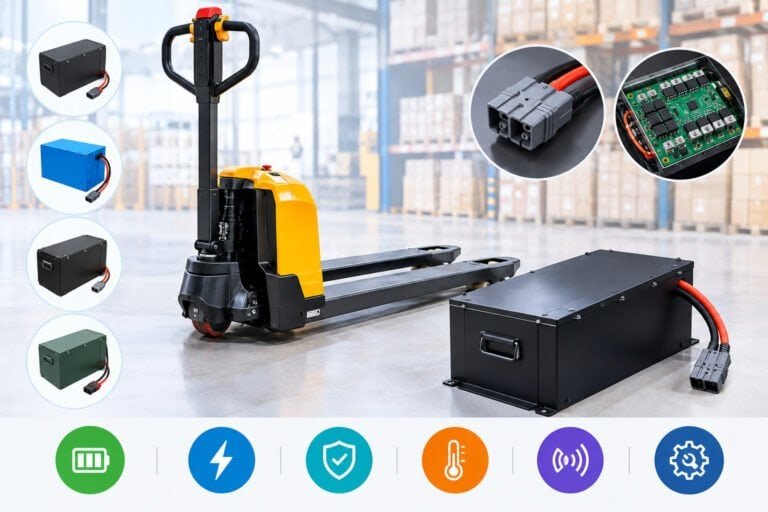
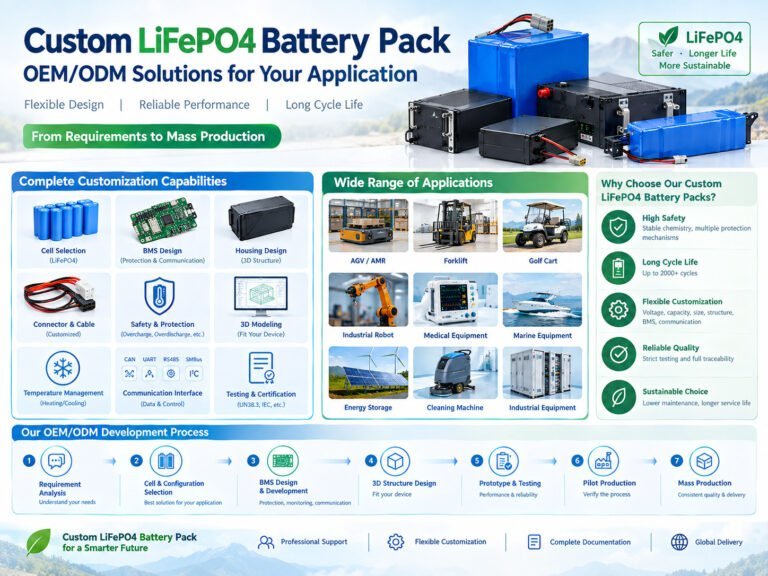
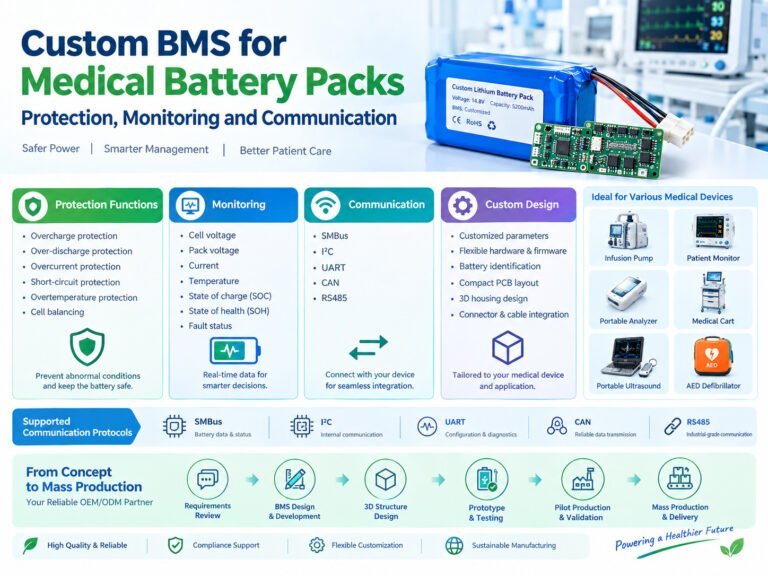
With the rapid growth of electrification in industries such as electric vehicles, AGV/AMR robots, energy storage systems, power tools, medical devices, and smart equipment, more companies are looking for custom OEM battery pack manufacturers instead of purchasing standard batteries.
A reliable OEM battery supplier should provide more than battery cells. They should have the capabilities of battery solution design, BMS development, structural design, certification testing, mass production, and after-sales support.
For global buyers, choosing the wrong battery supplier may lead to delayed projects, failed certifications, quality issues, and supply chain risks.
This guide explains:
- What OEM battery pack manufacturing means
- How to select the right battery supplier
- Custom battery development process
- Key technical specifications to evaluate
- Battery cell, BMS, and structural design requirements
- International certification requirements
- How to evaluate an OEM battery factory
1. What Is an OEM Battery Pack Manufacturer?
An OEM (Original Equipment Manufacturer) battery pack manufacturer designs and produces customized battery solutions according to customer requirements.
Unlike standard battery suppliers, OEM battery manufacturing includes:
✅ Battery cell selection
✅ Battery pack design
✅ Battery Management System (BMS) development
✅ Protection circuit design
✅ Housing and mechanical design
✅ Connector customization
✅ Communication protocol development
✅ Safety testing
✅ Mass production
例如
- AGV robots require 24V/48V/72V high-cycle battery systems
- E-bikes require UL2271 certified lithium batteries
- Energy storage systems require 51.2V LiFePO4 battery packs
- Medical devices require reliable and compact battery solutions
These applications usually require customized battery packs instead of off-the-shelf products.
2. Why Choose OEM Battery Pack Manufacturing?
2.1 Customized Design for Limited Space
Different devices have different internal structures.
OEM battery manufacturers can design battery packs according to:
- Length
- Width
- Height
- Installation method
- Connector position
For example, robot batteries may require:
- Slim design
- Quick replacement structure
- 抗冲击性
- IP65/IP67 waterproof protection
2.2 Matching Specific Performance Requirements
Standard batteries may not meet the requirements of professional equipment.
OEM solutions can customize:
电压选项
常见配置:
- 12V
- 24V
- 36V
- 48V
- 51.2V
- 72V
Capacity Options
例如
- 10 安培
- 20 安培
- 50Ah
- 100Ah+
Discharge Performance
Designed according to application requirements:
- Standard discharge
- High-rate discharge
- High peak current output
2.3 Improving Product Competitiveness
For equipment manufacturers, customized battery solutions provide:
- Product differentiation
- More stable supply chain
- Better user experience
- Higher product value
3. Information Required Before Purchasing OEM Battery Packs
Before contacting an OEM battery supplier, prepare a detailed RFQ (Request for Quotation).
Basic Battery Specifications
| 项目 | Example |
|---|---|
| 电池类型 | Li-ion / LiFePO4 / NMC |
| 额定电压 | 48V |
| 容量 | 20 安培 |
| 能源 | 960 瓦时 |
| 工作温度 | -20℃ to 60℃ |
| 充电方法 | CC/CV |
| 周期寿命 | 2000+ cycles |
Application Information
The supplier needs to understand:
Application Scenario
例如
- AGV 机器人
- AMR robots
- 电动自行车
- 叉车
- 高尔夫球车
- 储能系统
Working Environment
Consider:
- Indoor or outdoor operation
- High temperature conditions
- Low temperature conditions
- Humidity
- Vibration environment
Electrical Requirements
Important parameters include:
- Maximum continuous current
- Peak discharge current
- 充电电流
- Discharge rate
- 通信协议
Advanced BMS systems may support:
- CAN
- RS485
- UART
- Modbus
4. How to Select the Right OEM Battery Supplier?
Price should not be the only factor when selecting a battery manufacturer. A comprehensive evaluation is required.
4.1 Evaluate Factory Manufacturing Capability
A professional OEM battery factory should have:
Battery Cell Testing Capability
包括
- 电压测试
- 内部电阻测试
- 能力测试
- Cell matching and sorting
High-quality battery packs require:
- Consistent voltage
- Consistent internal resistance
- Balanced capacity
Battery Pack Production Capability
Check whether the factory has:
- 自动化装配线
- Laser welding equipment
- Spot welding equipment
- Aging test rooms
- High and low-temperature testing equipment
- 防水测试设备
Quality Management System
Recommended certifications:
- ISO9001
- ISO14001
- IATF16949 (automotive applications)
- Complete quality inspection procedures
4.2 Check R&D Capability
A true OEM battery manufacturer should have professional engineering teams.
Electrical Engineering Team
Responsible for:
- Circuit design
- BMS 开发
- Parameter adjustment
Mechanical Engineering Team
Responsible for:
- CAD design
- Battery housing design
- Waterproof structure design
Testing Team
Responsible for:
- Performance verification
- 安全测试
- Reliability testing
5. OEM Battery Development Process
A complete development process usually includes:
Step 1: Requirement Confirmation
Customer provides:
- Application details
- 电池规格
- Size limitations
- Certification requirements
Step 2: Battery Solution Design
Engineers determine:
- Battery cell model
- Series and parallel configuration
- BMS solution
- Housing structure
例如
48V 20Ah battery pack:
13-series lithium cells:
13S × 3.7V ≈ 48V
Step 3: Prototype Production
Prototype samples are created for:
- Engineering verification
- 功能测试
Testing includes:
- 电压
- 容量
- Discharge performance
- Communication functions
Step 4: Reliability Testing
Electrical Performance Testing
包括
- Charge/discharge testing
- 周期寿命测试
- 能力测试
安全测试
包括
- 过充电保护
- 过放电保护
- 短路保护
- Temperature rise testing
Step 5: Mass Production
Manufacturing process:
细胞分选
↓
Cell assembly
↓
Welding
↓
BMS 安装
↓
Battery pack assembly
↓
老化试验
↓
Final inspection
↓
Shipment
6. Three Core Components of OEM Battery Packs
6.1 Battery Cell Selection
Common battery chemistries:
LiFePO4 Battery Cells
优势
- 安全性高
- 循环寿命长
- 卓越的热稳定性
Suitable for:
- AGV
- Energy storage
- 叉车
- 工业机器人
NMC Lithium Battery Cells
优势
- 更高的能量密度
- Compact size
- 轻质设计
Suitable for:
- 电动汽车
- 电动工具
- Portable equipment
6.2 Battery Management System (BMS)
BMS is the intelligent control system of a battery pack.
Main functions:
Protection Functions
包括
- 过充电保护
- 过放电保护
- 过流保护
- 短路保护
- 温度保护
Smart Communication
Advanced BMS supports:
- CAN 通信
- RS485
- Bluetooth APP
Used in:
- AGV
- AMR
- 工业设备
6.3 Battery Structure Design
Professional battery design should consider:
- Heat dissipation
- Waterproof performance
- 抗冲击性
- Maintenance convenience
Common protection ratings:
- IP65
- IP67
- IP68
7. OEM Battery Certification Requirements
Different markets require different certifications.
常见的认证包括
| 认证 | Purpose |
|---|---|
| UN38.3 | Lithium battery transportation safety |
| IEC62133 | Battery safety standard |
| CE | European market compliance |
| UL2054 | North American battery safety |
| UL2271 | Light electric vehicle battery |
| RoHS | Environmental compliance |
| MSDS | Material safety document |
UN38.3 focuses on transportation safety testing, while IEC 62133 focuses on battery safety performance. OEM buyers should confirm certification requirements based on their target market.
8. How to Choose OEM Batteries for Different Applications?
AGV / AMR Robot Batteries
Recommended:
LiFePO4 battery technology
主要要求
- 循环寿命长
- Fast charging capability
- 安全性高
- CAN 通信
Typical voltages:
24V / 48V / 72V
Electric Bike Batteries
重要因素
- 轻质设计
- 防水保护
- Long range
- UL certification
Common systems:
36V
48V
52V
储能电池
Recommended:
磷酸铁锂
重要因素
- 使用寿命长
- 安全性高
- Large capacity
例如
51.2V 100Ah
Industrial Equipment Batteries
Requirements:
- High reliability
- Wide temperature operation
- 抗冲击性
应用:
- 叉车
- 清洁机器
- 工业机器人
9. Common Mistakes When Purchasing OEM Battery Packs
Mistake 1: Only Comparing Prices
Low-cost batteries may involve:
- Lower-grade cells
- Simplified BMS
- Reduced testing procedures
Mistake 2: Only Focusing on Battery Cell Brands
A famous battery cell brand does not automatically guarantee a high-quality battery pack.
PACK quality also depends on:
- 工程设计
- Welding technology
- BMS matching
- Quality control process
Mistake 3: Ignoring Certifications
Without proper certifications, products may face:
- Customs clearance problems
- Market restrictions
- 客户投诉
10. OEM Battery Supplier Evaluation Checklist
Before choosing a supplier, confirm:
✅ Does the company have an independent battery R&D team?
✅ Can they provide prototype samples?
✅ Do they provide complete test reports?
✅ Can they support international certifications?
✅ Do they have export experience?
✅ Can they provide long-term supply?
✅ Do they offer technical support after delivery?
常见问题
Q1: How long does OEM battery development take?
Typical timeline:
- Solution design: 3-7 days
- Prototype development: 2-6 weeks
- Mass production: Depends on order quantity
Q2: What is the MOQ for customized battery packs?
MOQ depends on:
- Battery model
- Structural complexity
- Cell supply availability
Some manufacturers support small-batch prototype testing before mass production.
Q3: Can customers specify battery cell brands?
是的。.
Common options include:
- 伊娃
- 三星 SDI
- LG 能源解决方案
- 松下公司
- FEB
Q4: Can OEM battery packs be exported globally?
Yes, but buyers should confirm:
- UN38.3
- MSDS
- Shipping documents
- Target market certifications
结论
选择正确的 OEM battery pack manufacturer means selecting a long-term technology partner.
A professional OEM supplier provides more than batteries. They provide:
⚡ Battery solution design
⚡ Product safety assurance
⚡ Stable mass production capability
⚡ Global certification support
For companies developing AGV robots, electric vehicles, energy storage systems, and industrial equipment, a reliable OEM battery solution can reduce development risks and accelerate product commercialization.
Dongguan Yizhan Electronics Technology Co., Ltd. specializes in lithium battery PACK OEM/ODM solutions, providing customized 18650, 21700, LiFePO4, and NMC battery solutions for AGV, AMR robots, electric vehicles, energy storage systems, and industrial equipment. We support 24V-72V customized battery development, smart BMS communication, waterproof designs, and global certification services.