
Autonomous cleaning robots are used in warehouses, shopping centers, hospitals, airports, office buildings, and industrial facilities. These machines combine cleaning mechanisms, electric drive systems, navigation sensors, control electronics, and automatic charging functions.
The battery pack supplies electrical power to these systems during autonomous operation.
For cleaning robot manufacturers, battery selection involves evaluating operating voltage, energy consumption, discharge current, communication interfaces, charging arrangements, and installation dimensions.
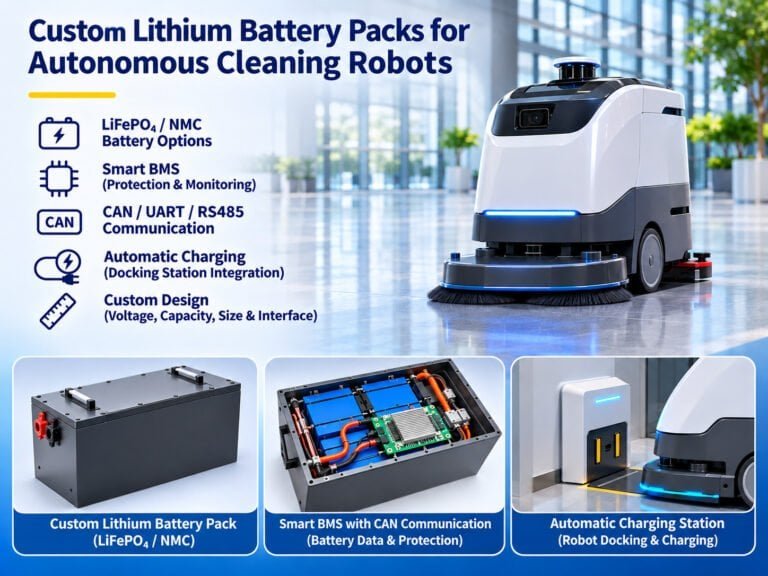
Custom lithium battery packs for autonomous cleaning robots are designed according to the electrical and mechanical requirements of each robotic platform.
This article explains the battery design considerations for commercial autonomous floor scrubbers, robotic sweepers, and industrial cleaning robots.

1. Battery Applications in Autonomous Cleaning Robots
Autonomous cleaning equipment includes several types of robotic platforms.
Autonomous Floor Scrubbing Robots
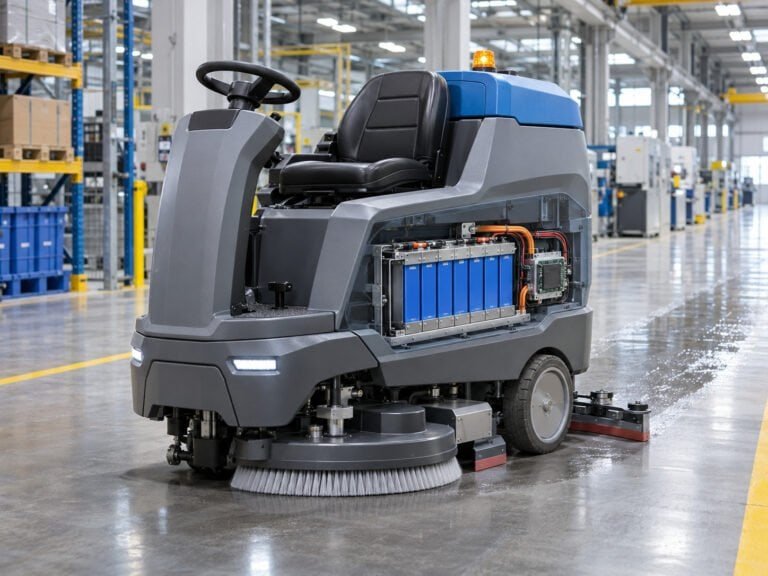
Autonomous floor scrubbers use electrically powered brushes, water delivery systems, vacuum motors, and drive motors.
They also require electrical power for navigation sensors, controllers, and communication equipment.
Battery design must consider the combined power demand during cleaning and movement.
Autonomous Floor Sweeping Robots
Robotic sweepers use brush motors, dust collection systems, and traction motors to collect debris from floor surfaces.
Battery requirements depend on the cleaning mechanism, equipment mass, operating cycle, and specified runtime.
Industrial Warehouse Cleaning Robots
Cleaning robots operating in warehouses may follow scheduled cleaning routes while navigating around equipment and personnel.
The battery pack must support the expected cleaning cycle, navigation system, and return-to-charge operation.
Commercial Service Cleaning Robots
Cleaning robots deployed in hotels, shopping centers, hospitals, and office buildings may operate according to programmed schedules.
Battery capacity and charging arrangements should be evaluated according to the required operating hours and equipment utilization.
Each robotic platform requires a battery configuration based on its electrical system and intended operating conditions.
2. Selecting Battery Voltage for Autonomous Cleaning Robots
Battery voltage is determined by the robot’s electrical architecture.
The battery supplies power to components such as traction motor controllers, cleaning motors, control electronics, and DC-DC converters.
Depending on the robot design, the electrical system may use 24V, 36V, or 48V-class battery arrangements.
Lithium Battery Voltage Configurations
Examples of nominal lithium battery configurations include:
| Battery Configuration | Chemistry | Nominal Voltage |
|---|---|---|
| 7S | Ternary Lithium-Ion | 25.2V |
| 10S | Ternary Lithium-Ion | 36V |
| 13S | Ternary Lithium-Ion | 46.8V |
| 8S | LiFePO4 | 25.6V |
| 12S | LiFePO4 | 38.4V |
| 15S | LiFePO4 | 48V |
| 16S | LiFePO4 | 51.2V |
The calculations assume nominal cell voltages of 3.6V for ternary lithium-ion cells and 3.2V for LiFePO4 cells.
These configurations are engineering examples rather than specifications for existing products.
Voltage Compatibility
Before selecting the battery configuration, the robot manufacturer should confirm:
- Nominal battery voltage
- Permitted operating voltage range
- Motor controller voltage limits
- Maximum charging voltage
- Minimum operating voltage
- DC-DC converter input range
- Charging station electrical requirements
The battery’s voltage range must be compatible with the complete robot electrical system.
3. Calculating Battery Capacity and Runtime
Battery capacity should be calculated using the robot’s electrical power consumption and required operating time.
Autonomous cleaning robots may operate several electrical systems simultaneously.
Main Electrical Loads
The battery may supply:
- Traction motors
- Brush motors
- Vacuum motors
- Water pumps
- Navigation sensors
- LiDAR equipment
- Cameras
- Onboard computers
- Communication modules
- Control electronics
Power consumption varies according to the operating mode.
Battery Energy Calculation
Nominal battery energy is estimated using:
Battery Energy (Wh) = Nominal Voltage (V) × Capacity (Ah)
For example, a theoretical 25.6V 100Ah LiFePO4 battery pack has a nominal energy of:
25.6V × 100Ah = 2,560Wh
Actual usable energy depends on the battery configuration, discharge conditions, temperature, and BMS operating limits.
Example: Autonomous Cleaning Robot Runtime
Assume a cleaning robot has the following average electrical loads during operation:
| Component | Average Power |
|---|---|
| Drive Motors | 150W |
| Brush Motors | 250W |
| Vacuum System | 200W |
| Navigation and Control Electronics | 40W |
| Pumps and Auxiliary Equipment | 20W |
| Total | 660W |
If the required operating duration is three hours:
Required Energy = 660W × 3h = 1,980Wh
For a 25.6V battery:
Theoretical Capacity = 1,980Wh ÷ 25.6V = 77.3Ah
If an illustrative usable energy fraction of 90% is assumed:
Required Nominal Capacity = 1,980Wh ÷ (25.6V × 0.90)
Required Nominal Capacity ≈ 85.9Ah
The 90% figure is a design assumption for this calculation.
The actual usable energy fraction must be determined according to the selected battery cells, BMS configuration, discharge profile, and project requirements.
These values do not represent a verified product or guaranteed robot runtime.
4. Cleaning Cycles and Battery Energy Consumption
Autonomous cleaning robots may operate according to programmed cleaning routes.
Their power consumption depends on the cleaning activity, movement, standby conditions, and return-to-charge operation.
Operating Modes
A robot operating cycle may include:
- Active cleaning
- Traveling between cleaning areas
- Turning and repositioning
- Obstacle avoidance
- Standby
- Returning to the charging station
- Charging
Each operating mode can have a defined power requirement.
Duty Cycle Calculation
The energy consumption for each mode can be estimated using:
Energy (Wh) = Power Consumption (W) × Operating Time (h)
Total energy is the sum of energy consumed across the operating modes.
This approach can be used when the robot’s actual power profile is available.
Energy Reserve for Docking
The battery system should maintain sufficient energy for the robot to return to its charging station under the specified operating conditions.
The required reserve depends on the navigation route, return distance, surface conditions, and electrical load.
The robot controller and BMS should be evaluated together to establish the appropriate battery status reporting and return-to-charge strategy.
5. Continuous and Peak Discharge Current Requirements
Battery current requirements must be evaluated separately from energy capacity.
Autonomous cleaning robots may draw current through multiple motors at the same time.
Continuous Discharge Current
Continuous discharge current is the electrical current required during sustained robot operation.
It affects:
- Cell selection
- Series and parallel cell configuration
- BMS current rating
- Cable specifications
- Electrical connectors
- Busbar design
- Thermal management
Peak Discharge Current
Peak current may occur during:
- Robot acceleration
- Motor startup
- Brush motor engagement
- Changes in floor resistance
- Movement over surface transitions
- Temporary load changes
The peak discharge requirement should include current amplitude, duration, and repetition frequency.
Example Electrical Requirements
| Parameter | Illustrative Requirement |
|---|---|
| Nominal Voltage | 25.6V |
| Battery Capacity | 100Ah |
| Continuous Discharge Current | 50A |
| Peak Discharge Current | 100A |
| Peak Duration | 3 seconds |
These figures are illustrative and must be evaluated according to the actual robot electrical load.
The battery cells, BMS, electrical connections, and thermal design should support the agreed current profile.
6. LiFePO4 and Ternary Lithium-Ion Cell Selection
Battery chemistry selection is part of autonomous cleaning robot development.
LiFePO4 and ternary lithium-ion cells are used in industrial and robotic equipment.
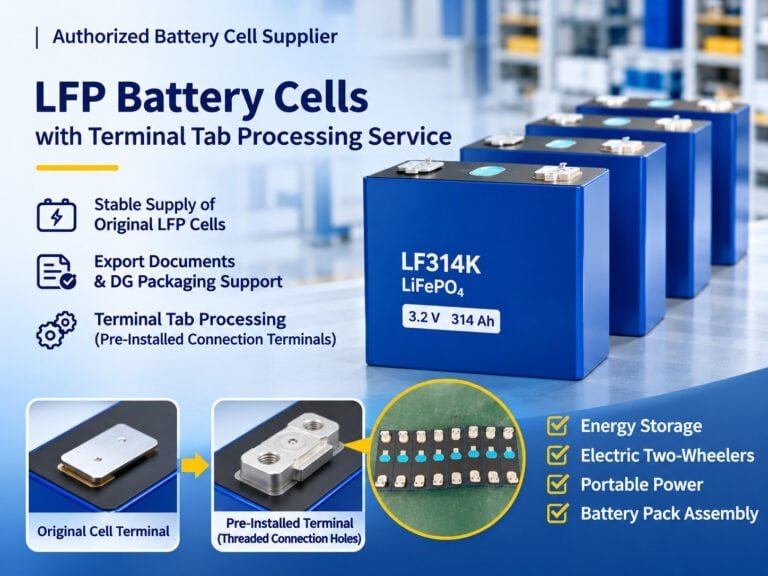
LiFePO4 Battery Cells
LiFePO4 cells may be considered for autonomous cleaning robots according to their electrical specifications and mechanical requirements.
Important selection parameters include:
- Nominal capacity
- Charging current
- Continuous discharge current
- Pulse discharge capability
- Cell dimensions
- Operating temperature
- Manufacturer cycle life specifications
- Terminal structure
Prismatic LiFePO4 cells can be evaluated for equipment with defined battery compartment dimensions.
Ternary Lithium-Ion Battery Cells
Ternary lithium-ion cells, including NMC chemistry, may be considered for robot battery designs.
Cylindrical cell configurations are commonly evaluated for robotic equipment with specific shape and packaging requirements.
Cell selection should consider electrical demand, installation dimensions, operating temperature, current capability, and approved safety requirements.
Series and Parallel Configuration
Series connections determine battery voltage.
Parallel connections determine nominal capacity and contribute to the current capability.
The final configuration should be evaluated according to cell manufacturer specifications, electrical connections, insulation, and thermal conditions.
7. Battery Management System Requirements
The Battery Management System (BMS) monitors battery operating conditions and provides protection functions according to its hardware and software design.
For an autonomous cleaning robot, BMS requirements may include:
- Cell voltage monitoring
- Overcharge protection
- Over-discharge protection
- Overcurrent protection
- Short-circuit protection
- Temperature monitoring
- Low-temperature charging protection
- Cell balancing
- Battery fault reporting
Battery State of Charge
The robot may require State of Charge (SOC) information for operation scheduling and return-to-charge decisions.
SOC estimation depends on BMS hardware, firmware, measurement methodology, and cell characteristics.
Its required accuracy should be defined during robot system development.
Battery Temperature
Temperature sensors may be used to monitor selected battery locations.
The BMS should apply protection thresholds consistent with the selected battery cells and agreed operating conditions.
Fault Reporting
Battery fault information may be transmitted to the robot controller when an appropriate communication interface is provided.
The required fault categories and communication behavior should be included in the project specification.
8. CAN Communication Between Battery and Robot Controller
Autonomous cleaning robots may require battery information to be transmitted to the robot’s main control system.
Depending on the equipment design, communication interfaces may include CAN, UART, or RS485.
A CAN-enabled BMS can provide battery status information according to an agreed protocol.
Battery Data Available Through CAN
Depending on the BMS configuration, reported information may include:
- Total battery voltage
- Battery current
- State of Charge
- Battery temperature
- Protection status
- Fault codes
The data transmitted must be defined according to the battery’s hardware, firmware, and communication protocol.
CAN Protocol Requirements
The robot manufacturer should confirm:
- CAN bit rate
- CAN message identifiers
- Data frame structure
- Signal scaling
- Transmission intervals
- Connector pin assignments
CAN communication compatibility should be verified during battery and robot integration.
Monitoring and Battery Control
In a monitoring-only configuration, CAN transmits battery operating information to the robot controller.
Charging and discharging are not automatically controlled through CAN communication.
If the robot requires communication-based control functions, these must be defined and evaluated as separate hardware and firmware requirements.
9. Automatic Charging Station Integration
Automatic charging is an important design consideration for autonomous cleaning robots.
Depending on the system, a robot may return to a charging station after completing its cleaning route or when a defined battery charge threshold is reached.
The charging system and battery pack must be electrically compatible.
Charging Voltage and Current
The charging station must provide a charging profile suitable for the selected battery chemistry and configuration.
The design should define:
- Maximum charging voltage
- Charging current
- Charging termination conditions
- Charging temperature limits
- Battery protection behavior
- Charging communication requirements, where applicable
Charging Contacts and Connectors
Automatic docking may involve spring-loaded contacts or another specified electrical connection system.
Contact design should account for alignment, mechanical movement, electrical current, contact resistance, and the operating environment.
Charging Safety
The system should define how charging is enabled and interrupted during docking, undocking, and fault conditions.
Charging current should not be applied through exposed or misaligned contacts in a manner that creates an electrical hazard.
The charging station, robot controller, battery protection system, and connector arrangement require coordinated system-level design.
Charge Scheduling
Battery capacity and charging current should be evaluated according to the cleaning schedule and available charging intervals.
For applications involving repeated charging sessions, the cell manufacturer’s charging specifications and thermal conditions must be considered.
10. Mechanical Battery Pack Design for Cleaning Robots
Autonomous cleaning robots have defined installation dimensions and internal component arrangements.
The battery pack must fit within the designated battery compartment.
Installation Dimensions
The equipment manufacturer should provide:
- Maximum battery length
- Maximum battery width
- Maximum battery height
- Required mounting orientation
- Mounting points
- Available connector space
- Cable routing requirements
- Maintenance access
Battery Enclosure
Plastic and metal battery enclosures may be considered according to the robot’s mechanical and environmental requirements.
The enclosure must provide appropriate support, insulation, and protection for the selected components.
Robot Weight Distribution
Battery mass and mounting position can influence robot balance, traction, and stability.
The mechanical design should account for the robot’s structure, operating surface, and specified movement conditions.
Vibration and Movement
Cleaning robots may travel across floor joints, thresholds, and uneven surfaces.
Battery mounting and internal cell retention should be evaluated according to expected mechanical loads and vibration conditions.
11. Environmental Protection for Autonomous Cleaning Robot Batteries
Cleaning robots may operate around water, cleaning solutions, dust, and floor debris.
Battery environmental protection depends on the robot’s structure and installation location.
Moisture Protection
Battery packs positioned near water tanks, pumps, or cleaning mechanisms may require protection against splashes or moisture exposure.
The required enclosure Ingress Protection (IP) rating should be specified according to the intended application.
Cleaning Chemical Exposure
The battery enclosure and connectors may be exposed to cleaning agents under certain operating conditions.
Material compatibility should be evaluated where chemical exposure is expected.
Thermal Conditions
Battery cells and electrical components generate heat during charging and discharging.
The battery pack should be evaluated under the robot’s expected duty cycle and ambient temperature.
Dust and Debris
The enclosure and connector design should account for dust or debris exposure where relevant.
Environmental protection requirements must be confirmed for the complete battery assembly rather than inferred solely from individual component ratings.
12. Battery Testing and Applicable Standards
Autonomous cleaning robot battery development may involve electrical, mechanical, environmental, and safety validation.
Applicable standards depend on the robot’s application, target market, battery configuration, and equipment classification.
Electrical Testing
Battery testing may include:
- Capacity verification
- Energy measurement
- Continuous current testing
- Peak current testing
- Charging evaluation
- BMS protection verification
- Communication verification
Mechanical Testing
Evaluation may include:
- Battery enclosure inspection
- Mounting verification
- Vibration testing
- Connector inspection
- Electrical insulation assessment
Robot Integration Testing
System-level evaluation may include:
- Operating runtime
- Battery SOC reporting
- Return-to-charge operation
- Charging station compatibility
- Fault reporting
- Charging interruption behavior
Applicable Standards
The following standards may be relevant according to the project:
| Standard | General Application |
|---|---|
| IEC 62619 | Safety requirements for industrial secondary lithium cells and batteries |
| IEC 63327 | Safety requirements for applicable commercial automatic floor treatment machines |
| IEC 60335-2-72 | Requirements for applicable commercial floor treatment machines |
| IEC 60529 | Enclosure ingress protection classification |
| UN38.3 | Lithium battery transportation testing |
The applicable editions and requirements should be confirmed for the target market and equipment classification.
Battery-level testing does not automatically establish compliance for the complete autonomous cleaning robot.
13. Information Required for a Custom Cleaning Robot Battery Quotation
OEM manufacturers requesting custom battery packs can provide the following technical information.
| Item | Required Information |
|---|---|
| Robot Application | Autonomous floor scrubber, sweeper, or other cleaning robot |
| Nominal Voltage | Required battery voltage |
| Voltage Range | Minimum and maximum permitted voltage |
| Battery Capacity | Ah or Wh |
| Required Runtime | Hours per operating cycle |
| Average Power | W |
| Continuous Discharge Current | A |
| Peak Discharge Current | A and duration |
| Battery Chemistry | LiFePO4 or ternary lithium-ion |
| Battery Dimensions | Maximum length × width × height |
| Battery Weight | Specified mass limit or range |
| BMS Functions | Protection and monitoring requirements |
| Communication | CAN, UART, RS485, or specified interface |
| Charging Method | External charger or automatic docking station |
| Charging Voltage and Current | V and A |
| Charging Contacts | Mechanical and electrical specifications |
| Connectors | Power and communication interfaces |
| Environmental Requirements | IP rating, moisture, temperature, and chemical exposure |
| Mechanical Requirements | Mounting, vibration, and installation orientation |
| Certification | Applicable standards and target market |
| Sample Quantity | Prototype requirements |
| Production Forecast | Estimated annual demand |
| Delivery Destination | Country and address |
Battery drawings, robot electrical schematics, and charging station specifications can support technical evaluation.
14. Custom Cleaning Robot Battery Pack Development at Dongguan Yizhan Electronics Technology Co., Ltd.
Dongguan Yizhan Electronics Technology Co., Ltd. provides OEM and ODM lithium battery pack development and manufacturing services for robotics, industrial equipment, electric mobility, and energy storage applications.
For autonomous cleaning robot projects, battery specifications can be evaluated according to the equipment’s electrical load, runtime, continuous current, peak current, mechanical dimensions, and charging requirements.
Our battery customization services include:
- LiFePO4 and ternary lithium-ion configurations
- Customized voltage and capacity
- Battery cell selection
- BMS configuration according to project requirements
- CAN, UART, and RS485 communication options
- Temperature monitoring
- Customized connectors and wiring
- Plastic and metal battery enclosures
- Battery pack assembly
- Technical documentation and testing coordination
Battery communication, charging interfaces, environmental protection, and mechanical arrangements are evaluated according to individual project requirements.
For OEM and ODM projects, customers can provide their robot specifications and development schedule for an initial technical discussion.
Conclusion
Custom lithium battery pack design for autonomous cleaning robots involves electrical, mechanical, thermal, and system integration requirements.
Battery voltage, energy capacity, discharge current, and cell selection determine the electrical configuration.
BMS protection, battery status monitoring, communication interfaces, and automatic charging compatibility must be evaluated according to the robot’s operating system.
Mechanical dimensions, environmental exposure, and battery mounting influence the pack construction.
For autonomous floor scrubbers and cleaning robots, battery development should begin with confirmed equipment specifications, operating profiles, and charging requirements.
Looking for a custom lithium battery pack for an autonomous cleaning robot?
Contact Dongguan Yizhan Electronics Technology Co., Ltd. with your robot’s battery voltage, required runtime, average electrical power, continuous and peak current, installation dimensions, BMS communication requirements, and estimated production quantity.
 English
 Chinese
 Japanese
 German
 French
 Korean

