
Inspection robots are used in industrial facilities, warehouses, power plants, pipelines, outdoor infrastructure, and other environments where regular monitoring is required. These robots often operate with cameras, LiDAR, sensors, communication modules, motors, and onboard computing systems.
The battery is therefore an important part of the robot’s overall design. A suitable battery needs to provide enough energy for the required operating time while also meeting the robot’s voltage, discharge current, size, weight, charging, communication, and environmental requirements.
Lithium batteries, particularly lithium iron phosphate (LiFePO4) batteries, are used in some inspection robot applications because of their cycle life, thermal characteristics, and ability to support rechargeable operation.
This guide explains the key factors to consider when choosing a battery for an inspection robot.
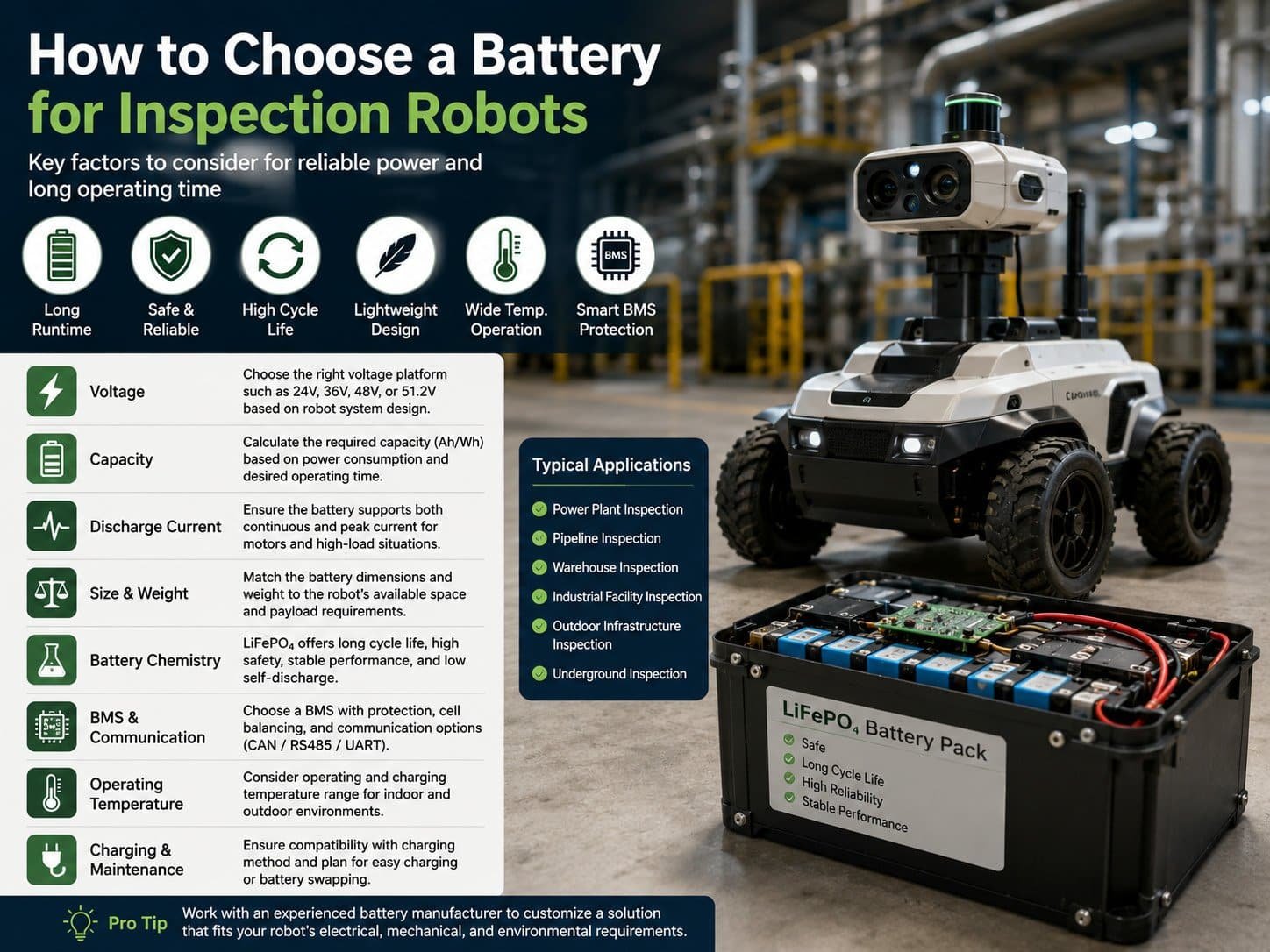
Part 1.What Battery Does an Inspection Robot Need?
There is no single battery specification suitable for every inspection robot.
Battery requirements depend on the robot’s:
- 电机功率
- 运行时间
- Travel speed
- Payload
- Sensors
- Computing system
- Communication equipment
- 运行环境
- 充电方式
- Available battery space
For example, a compact indoor inspection robot may require a relatively small battery pack, while an outdoor inspection robot designed for extended operation may require a larger battery with higher capacity.
The first step is therefore to determine the robot’s electrical and mechanical requirements before selecting individual cells or a battery pack.
Part 2.Why Is the Battery Important for Inspection Robots?
Inspection robots may need to operate for several hours while continuously powering multiple systems.
A typical inspection robot may include:
- Drive motors
- Cameras
- LiDAR
- Infrared sensors
- Gas sensors
- Industrial sensors
- Wireless communication modules
- GPS
- Embedded computers
- 控制系统
- Lighting systems
The battery must provide stable power to these components while also supporting the robot’s movement.
A battery with insufficient capacity can reduce operating time, while insufficient discharge capability can affect acceleration, climbing, or other high-load operations.
Part 3.Key Factors When Choosing an Inspection Robot Battery
1. Battery Voltage
Voltage should be selected according to the robot’s electrical system.
Inspection robots may use different voltage platforms depending on their motors, controllers, sensors, and system architecture. Common battery configurations can include 24V, 36V, 48V, and 51.2V systems, although the correct voltage must be determined by the equipment design.
When selecting a replacement or custom battery, check:
- Motor controller voltage
- Motor operating voltage
- Electronic component requirements
- 充电电压
- Battery nominal voltage
- Maximum and minimum system voltage
The battery voltage should be compatible with the complete electrical system rather than selected independently.
2.电池容量
Capacity is usually expressed in ampere-hours (Ah) or watt-hours (Wh).
For robot applications, watt-hours can be particularly useful because the energy requirement depends on both voltage and current.
基本关系是:
能量 (Wh) = 电压 (V) × 容量 (Ah)
For example, a 24V 40Ah battery has a nominal energy capacity of approximately:
24V × 40Ah = 960Wh
Actual usable energy will depend on the battery chemistry, operating conditions, discharge rate, BMS settings, and other system factors.
When estimating battery capacity, consider the average power consumption and expected operating time.
Required Energy ≈ Average Power × Operating Time
A suitable design should also account for energy consumed by acceleration, slopes, sensors, computing equipment, communication systems, and other loads.
3. Continuous and Peak Discharge Current
Capacity is not the only important electrical specification.
The battery must also provide sufficient current for the robot’s highest expected load.
Drive motors can create short periods of increased current during:
- 开始
- 加速度
- 攀岩
- 转动
- Carrying payloads
- Crossing uneven surfaces
因此,电池规格应同时包括以下两项:
- 连续放电电流
- 峰值放电电流
The BMS must also be capable of handling the required current without unnecessarily disconnecting the battery during normal robot operation.
4. Battery Size and Weight
Inspection robots have limited internal space, and battery weight can directly affect mobility.
When designing a battery pack, measure:
- 长度
- 宽度
- 高度
- 安装位置
- 安装点
- 连接器位置
- 电缆布线
Weight distribution should also be considered.
A battery installed too far from the intended center of gravity may affect the robot’s stability or movement characteristics.
For mobile inspection robots, a compact battery design can help the equipment use its available internal space more efficiently.
5. Battery Chemistry
Different battery chemistries provide different characteristics.
Lithium-Ion Batteries
NMC and other lithium-ion chemistries can provide relatively high energy density, which can be useful when battery space and weight are limited.
LiFePO4 Batteries
LiFePO4, or lithium iron phosphate, is another lithium-ion chemistry used in rechargeable battery systems.
Potential characteristics include:
- 循环寿命长
- Stable thermal characteristics
- Low self-discharge
- Good discharge performance
- Suitable performance for repeated charging and discharging
LiFePO4 can be considered when an inspection robot requires regular cycling and a rechargeable battery system designed for repeated operation.
However, battery chemistry should be selected based on the complete robot design rather than assuming that one chemistry is suitable for every application.
6. Battery Management System
A Battery Management System (BMS) is an important component of a lithium battery pack.
The BMS can monitor and manage parameters such as:
- 细胞电位
- 电池组电压
- 充电电流
- 放电电流
- 温度
- 充电状态 (SOC)
- 细胞平衡
Protection functions can include:
- 过充电保护
- 过放电保护
- 过流保护
- 短路保护
- 过温保护
- 低温保护
For inspection robots, BMS communication can also be useful.
Depending on the robot controller, communication interfaces may include:
- CAN
- CAN FD
- RS485
- UART
- Modbus
The communication protocol should be matched with the robot’s control architecture.
7. Operating Temperature
Inspection robots may work indoors or outdoors.
Outdoor applications can expose the battery to:
- High temperatures
- Low temperatures
- 温度波动
- 湿度
- 灰尘
- Rain or moisture
Temperature affects battery performance and charging behavior.
For lithium batteries, low-temperature charging requires particular attention. A custom battery pack can incorporate temperature monitoring and appropriate BMS protection based on the expected operating conditions.
The battery’s operating and charging temperature ranges should be confirmed before finalizing the battery design.
8. Charging Requirements
Charging time can affect robot availability.
Before selecting a battery, determine:
- 充电电压
- 充电电流
- 充电时间
- 充电方式
- Charger type
- 充电频率
- Automatic charging requirements
Some inspection robots return to a docking station automatically when the battery reaches a defined SOC.
For this type of application, the battery and charger need to be designed as a compatible system.
If the robot operates continuously, battery swapping can also be considered. A removable battery pack can allow one battery to operate while another is being charged.
9. Battery Communication
Advanced inspection robots may require the battery to communicate with the main controller.
电池通信可提供以下信息:
- SOC
- 电池电压
- 当前
- 温度
- 充电状态
- 故障状态
- 剩余容量
CAN and RS485 are commonly considered for industrial battery communication, depending on the equipment architecture.
Communication requirements should be defined during the battery design stage rather than added after the pack has already been finalized.
10. Mechanical Protection
Inspection robots can experience vibration and mechanical impact during operation.
The battery enclosure should therefore be designed according to the robot’s operating environment.
Depending on the application, the battery may require:
- Protective housing
- Secure mounting
- Vibration-resistant construction
- Appropriate connectors
- Cable protection
- Moisture protection
- 防尘
For outdoor inspection robots, enclosure and sealing requirements should be evaluated together with the robot’s overall protection design.
Part 4.How to Calculate the Required Battery Capacity
A basic capacity calculation can begin with the robot’s average power consumption.
For example, if an inspection robot consumes an average of 400W and needs to operate for 4 hours:
400W × 4h = 1,600Wh
A battery system providing approximately 1,600Wh of nominal energy would be the starting point for the calculation.
However, the actual battery capacity should normally include an appropriate design margin because not all nominal battery energy is necessarily available for practical operation.
Factors such as:
- Battery discharge limits
- 温度
- Motor load
- 电池老化
- BMS 设置
- 地形
- Payload
- Sensor load
can affect actual operating time.
Part 5.Example: 48V Inspection Robot Battery
Suppose an inspection robot uses a 48V electrical system and has an average power consumption of 500W.
If the target operating time is 4 hours:
500W × 4h = 2,000Wh
A 48V 40Ah battery provides approximately:
48V × 40Ah = 1,920Wh
This may be close to the calculated energy requirement, but the final battery capacity should be determined after considering usable energy, operating conditions, and system losses.
For a custom battery pack, the cell configuration can then be selected according to the required voltage, capacity, discharge current, physical dimensions, and BMS requirements.
Part 6.Why LiFePO4 Can Be Considered for Inspection Robots
LiFePO4 batteries can be considered for inspection robots that require frequent charging and discharging.
Potential advantages include:
长使用寿命
Inspection robots may operate frequently, resulting in repeated battery cycles. A battery chemistry designed for repeated cycling can be useful in these applications.
Stable Thermal Characteristics
LiFePO4 is known for its thermal characteristics, which can be relevant to mobile equipment operating in variable environments.
Low Self-Discharge
Lower self-discharge can help reduce energy loss during periods when the robot is not operating.
BMS 集成
A LiFePO4 battery pack can incorporate a BMS to monitor cell and pack conditions and provide protection functions.
These characteristics do not eliminate the need for correct battery design. Cell selection, electrical configuration, BMS parameters, enclosure design, charging strategy, and operating temperature still need to be evaluated.
Part 7.Custom Battery Packs for Inspection Robots
Robot manufacturers may have different requirements for voltage, capacity, size, current, communication, and installation.
A custom battery pack can be designed around these requirements.
The customization process may include:
- Define the robot’s electrical requirements
- Determine voltage and energy requirements
- Calculate continuous and peak current
- Select battery cells
- Design the cell configuration
- Configure the BMS
- Design the battery enclosure
- Select connectors and cables
- Conduct electrical and mechanical testing
- Verify charging and communication functions
This approach can be useful when a standard battery cannot fit the robot’s available space or does not meet its current and communication requirements.
Part 8.Battery Testing for Inspection Robot Applications
Before deployment, the battery pack should be evaluated under conditions representative of the intended application.
测试可能包括:
- 能力测试
- 充放电测试
- Overcurrent protection testing
- Short-circuit protection testing
- 温度测试
- BMS communication testing
- 振动测试
- Connector testing
- Enclosure testing
The specific tests and applicable certifications depend on the battery design, transportation requirements, target market, and final application.
Part 9.How to Choose an Inspection Robot Battery Manufacturer
When sourcing a custom inspection robot battery, consider whether the manufacturer can support the technical requirements of the project.
重要因素包括:
- 电池单元的选型
- PACK design capability
- BMS 开发
- Mechanical design
- 通信协议
- 原型开发
- Battery testing
- 质量管理
- 认证支持
- OEM/ODM capability
It is also useful to provide the battery manufacturer with detailed equipment information, including voltage, power consumption, operating time, peak current, dimensions, charging method, operating temperature, and communication requirements.
The more complete the technical information is, the easier it is to develop a battery pack that matches the robot.
常见问题
What type of battery is suitable for an inspection robot?
Lithium-ion and LiFePO4 batteries can be considered for inspection robots. The appropriate chemistry depends on energy requirements, weight, operating environment, cycle requirements, and the robot’s electrical system.
Is LiFePO4 suitable for inspection robots?
LiFePO4 can be suitable for inspection robots that require rechargeable battery systems with repeated cycling. The final battery design should consider voltage, capacity, discharge current, BMS, charging, temperature, and mechanical requirements.
How long can an inspection robot run on one battery?
Operating time depends on battery energy and the robot’s average power consumption. A basic estimate can be made using battery energy in Wh divided by average power consumption in W.
What voltage does an inspection robot battery use?
There is no universal voltage. Inspection robots can use different voltage platforms depending on their motors, controllers, sensors, and system architecture.
Does an inspection robot need a BMS?
Lithium battery packs generally require an appropriate BMS to monitor and protect the battery. For robotic applications, the BMS may also communicate with the robot’s main controller.
Can an inspection robot use a custom battery pack?
Yes. A custom battery pack can be designed around the robot’s voltage, capacity, current, dimensions, connectors, BMS, communication protocol, and installation requirements.
结论
Choosing a battery for an inspection robot requires an evaluation of the entire power system rather than focusing on capacity alone.
Voltage, energy capacity, discharge current, dimensions, weight, battery chemistry, BMS, charging, temperature, communication, and mechanical protection should all be considered during the design process.
LiFePO4 batteries can be considered for inspection robots that require repeated charging and discharging, stable battery operation, and an integrated battery management system. For OEM robot manufacturers, a custom battery pack can also be designed around the robot’s electrical, mechanical, and environmental requirements.
A well-designed battery pack can provide the electrical characteristics needed by the robot while fitting the available installation space and supporting its intended operating cycle.
 English
  Chinese
  Japanese
  German
  French
  Korean
