
A UPS (Uninterruptible Power Supply) provides backup power when the main power supply is interrupted or unstable. It can help keep equipment running during short power outages, voltage fluctuations, and other power supply interruptions.
However, choosing a UPS is not simply a matter of selecting a unit with a suitable wattage. The actual requirements depend on the connected load, backup time, battery chemistry, output waveform, transfer time, operating environment, communication interface, and installation space.
For equipment manufacturers and industrial users, the battery system is also an important part of UPS selection. A UPS with the correct inverter specifications but an unsuitable battery configuration may not provide the required runtime or operating reliability.
This guide explains the main factors to consider when selecting a UPS power supply and introduces how customized lithium battery solutions can be integrated into UPS applications.
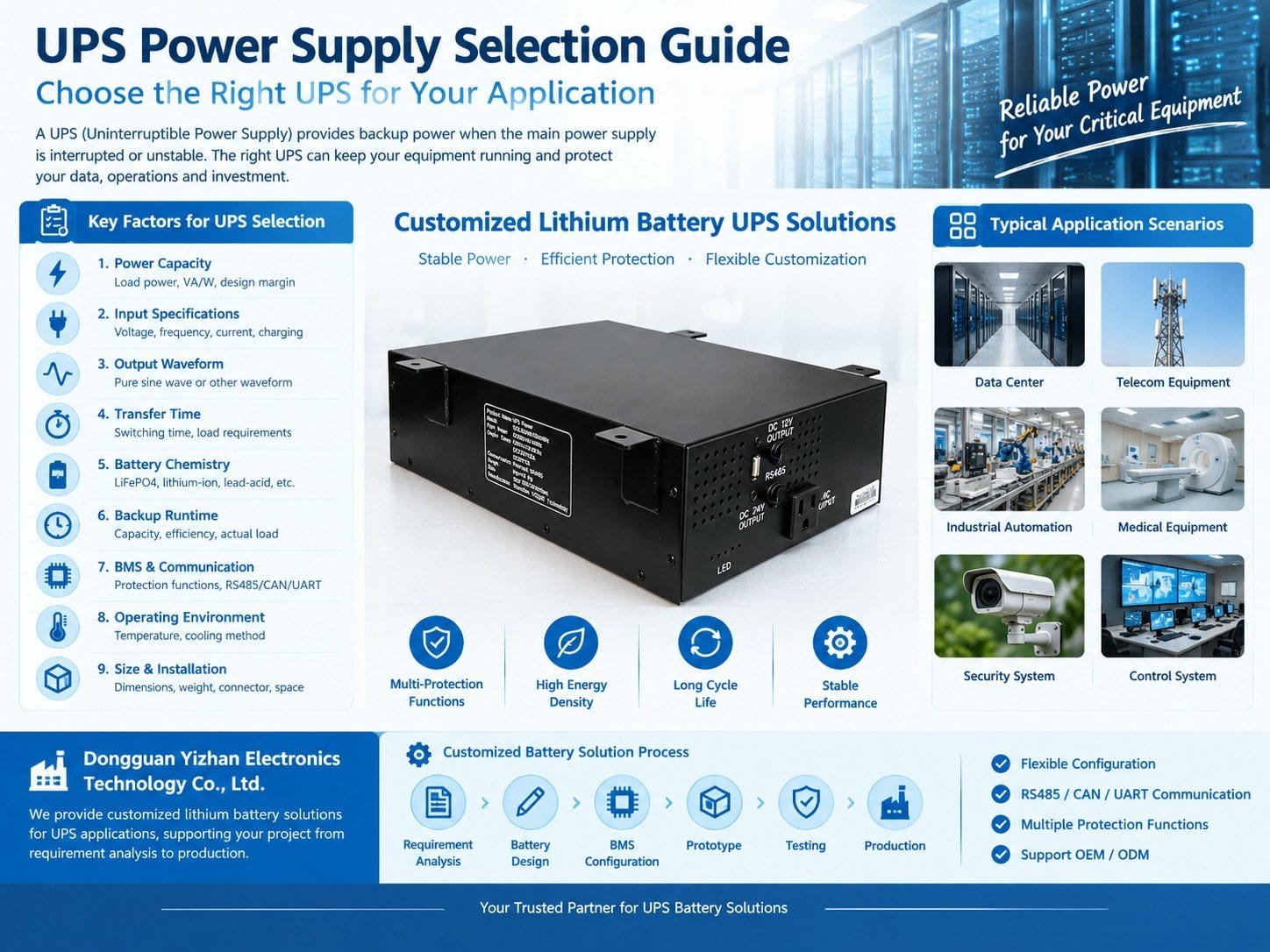
1. Determine the Required UPS Power Capacity
The first step is to determine the power consumption of the equipment that the UPS needs to support.
UPS specifications may use VA (Volt-Ampere), W (Watts), or both. These two values are related but are not interchangeable.
For example, a device may have:
- Rated power: 300 W
- Apparent power: 400 VA
- Power factor: 0.75
When selecting a UPS, both the actual power consumption and apparent power should be considered.
A practical calculation can start with:
Required UPS capacity ≥ Total load power × Design margin
The design margin provides additional capacity for startup current, load changes, and future equipment changes.
For equipment with motors, pumps, compressors, printers, or other inductive loads, startup current may be significantly higher than normal operating current. In these applications, the UPS should be evaluated according to both continuous and transient load requirements.
2. Check the Input Voltage and Frequency
UPS systems are designed around specific input voltage and frequency ranges.
Before selecting a UPS, confirm:
- AC input voltage
- Input voltage range
- 50 Hz or 60 Hz operation
- Maximum input current
- 充电电压
- Charging power
For example, the UPS specification provided for reference uses AC100–120V input, with a nominal AC110V, 50/60Hz system. Its charging voltage is specified at approximately DC29.2V, with charging power up to 300W.
This type of information is important when integrating a UPS into a specific electrical system.
A mismatch between the UPS input requirements and the site’s power supply can affect charging, conversion efficiency, or system operation.
3. Choose the Appropriate Output Waveform
The output waveform is another important selection factor.
Common UPS output waveforms include:
- Pure sine wave
- Modified sine wave
- Square wave
For sensitive electronic equipment, communication equipment, industrial controllers, medical devices, and equipment containing motors or switching power supplies, a pure sine wave output can be an appropriate requirement.
The supplied UPS specification uses an AC110V pure sine wave output, with an output power rating of up to 500W.
When selecting a UPS, users should therefore confirm not only the output voltage and power but also the waveform.
4. Consider UPS Transfer Time
For many applications, the transition from grid power to battery power needs to happen within a specified period.
The transfer time indicates how long the UPS takes to switch between the normal power supply and backup power.
The appropriate transfer time depends on the load.
Equipment with internal capacitors or its own short-term power hold-up may tolerate a longer transition. Sensitive control systems or equipment with strict power continuity requirements may need a shorter transfer time.
The reference UPS specification defines a switching time of ≤10 ms.
Therefore, transfer time should be checked against the actual requirements of the equipment rather than considered as an isolated specification.
5. Select the Right Battery Chemistry
The battery is the energy storage component of a battery-based UPS system.
Common battery technologies include:
铅酸电池
Lead-acid batteries have traditionally been used in UPS systems because of their established supply chain and cost structure.
They can be suitable for stationary backup applications, particularly where weight and installation space are not major constraints.
Lithium-Ion Batteries
Lithium batteries can provide a different combination of energy density, weight, cycle performance, and system integration options.
Lithium battery UPS systems can use different chemistries depending on the application.
LiFePO4 Batteries
LiFePO4, or lithium iron phosphate, is one lithium battery chemistry used in UPS applications.
Its characteristics can make it suitable for applications requiring repeated charging and discharging, compact battery integration, and controlled battery management.
The supplied UPS specification uses a LiFePO4 battery with a rated voltage of 25.6V and rated capacity of 12Ah. The specified minimum capacity is 11Ah.
The battery system also includes protection functions such as over-voltage, low-voltage, overload, short circuit, over-temperature, and reverse-polarity protection.
6. Calculate the Required Backup Runtime
UPS power determines how much load the system can support. Battery capacity determines, together with load and system efficiency, how long the equipment can operate during an outage.
A simplified energy calculation is:
Battery energy (Wh) = Battery voltage (V) × Battery capacity (Ah)
For a 25.6V, 12Ah battery:
25.6V × 12Ah = 307.2Wh
The actual usable energy will be affected by factors such as:
- Inverter efficiency
- Battery discharge characteristics
- Load power
- 电池温度
- Battery protection settings
- 电池老化
- 放电速率
For this reason, the theoretical battery energy should not be treated as the actual backup time.
For example, the reference UPS has a maximum inverter efficiency specification of 90%.
When selecting a UPS, it is therefore better to calculate runtime based on the actual load rather than simply comparing battery Ah values.
7. Check the Battery Discharge Current
Battery discharge current is particularly important for higher-power UPS systems.
If the UPS needs to provide 500W output from a battery system with a nominal voltage of 25.6V, the battery current can be estimated using:
I ≈ P ÷ V
Ignoring conversion losses:
500W ÷ 25.6V ≈ 19.5A
Actual battery current will be higher after considering inverter losses.
The reference battery specification defines a maximum discharge current of 30A, while the inverter output is specified at up to 500W.
This illustrates why UPS selection should consider the relationship between inverter power and battery discharge capability.
8. Pay Attention to the BMS
When a lithium battery is used in a UPS, the Battery Management System (BMS) becomes an important part of the system.
The BMS can monitor and manage parameters such as:
- 电池电压
- 细胞电位
- 温度
- 充电状态
- Discharge status
- 过电流
- Over-voltage
- Under-voltage
- 短路
- 温度过高
For applications requiring communication between the battery and UPS controller, the communication protocol should also be confirmed.
The supplied UPS specification uses RS485通信.
Different UPS systems may use different communication requirements, so the battery BMS should be designed around the actual UPS communication protocol rather than treated as a standalone component.
9. Consider the Operating Temperature
Temperature can affect both battery performance and UPS electronics.
Before selecting a UPS, check:
- 充电温度
- 卸料温度
- Inverter operating temperature
- 储存温度
- Cooling method
The reference battery specifies a charging temperature range of 0°C 至 45°C and a discharge temperature range of -20°C to 55°C.
The UPS inverter specification lists an operating temperature range of -20°C to 45°C.
For equipment installed in factories, warehouses, outdoor cabinets, communication rooms, or other environments with temperature changes, these parameters should be evaluated before finalizing the battery and UPS configuration.
10. Consider Size, Weight and Installation Space
UPS systems are often integrated into equipment with limited internal space.
The battery pack therefore needs to match the available enclosure.
Important mechanical parameters include:
- 长度
- 宽度
- 高度
- Battery mounting method
- 连接器位置
- 电缆长度
- Ventilation space
- Service access
The reference UPS has dimensions of ≤312 × 218 × 90 mm and a weight of approximately 6.1 kg.
For OEM equipment manufacturers, these mechanical requirements can be defined at the beginning of battery development.
11. When Should You Consider a Customized UPS Battery?
A standard UPS battery may not always match the actual equipment requirements.
A customized battery solution can be considered when the project has specific requirements for:
- 电池电压
- 电池容量
- 电池尺寸
- 细胞化学
- Maximum discharge current
- 充电电流
- BMS 功能
- 通信协议
- 连接器
- Cable configuration
- Installation structure
- 工作温度
- 保护功能
For example, a UPS manufacturer may have a fixed enclosure but require a battery pack with a specific height, connector position, RS485 communication function, and discharge current.
In this situation, the battery pack needs to be developed around the UPS system instead of simply selecting an off-the-shelf battery.
12. Custom UPS Lithium Battery Solutions from Dongguan Yizhan Electronics
For projects requiring a customized lithium battery for UPS applications, 东莞一展电子科技有限公司 can participate in the battery development process from requirement definition and battery pack design to sampling and production.
The customization process can be based on the UPS electrical and mechanical requirements, including:
Requirement analysis → Battery design → BMS configuration → Prototype → Testing → Production
For UPS applications, the engineering team can evaluate parameters such as voltage, capacity, discharge current, charging requirements, enclosure dimensions, connector configuration, and communication requirements.
For lithium battery systems using communication functions, the BMS can also be configured according to the system’s communication requirements.
This approach is useful when the UPS manufacturer needs a battery pack that fits an existing enclosure or when the battery needs to communicate with the UPS control system.
For example, a UPS project using a 25.6V LiFePO4 battery may require a 12Ah configuration, RS485 communication, defined charging voltage, controlled discharge current, and multiple protection functions. These parameters can be incorporated into the battery pack design based on the UPS system requirements.
13. UPS Selection Checklist
Before purchasing or developing a UPS system, it is useful to confirm the following information:
| 参数 | 需要检查的内容 |
|---|---|
| 输入电压 | AC voltage range |
| Input Frequency | 50Hz / 60Hz |
| UPS Capacity | VA and W |
| 输出电压 | Required AC/DC voltage |
| Output Waveform | Pure sine wave or other waveform |
| Transfer Time | Required switching time |
| 电池化学 | LiFePO4, lithium-ion, lead-acid, etc. |
| 电池电压 | Nominal battery voltage |
| 电池容量 | Ah / Wh |
| Backup Runtime | Required operating time |
| 放电电流 | Continuous and peak current |
| 充电电流 | Required charging rate |
| BMS | Protection and monitoring functions |
| 交流 | RS485, CAN, UART, etc. |
| 工作温度 | Charging and discharging range |
| 尺寸 | 可用安装空间 |
| 连接器 | Type and position |
| Cooling | Fan cooling or other method |
结论
Choosing a UPS requires more than matching a wattage number. The complete system should be evaluated from the perspective of power capacity, input and output specifications, waveform, transfer time, battery chemistry, backup runtime, discharge current, BMS, communication, temperature, and mechanical installation.
For standard applications, an existing UPS configuration may meet the requirements. For equipment manufacturers and OEM projects with specific space, runtime, battery, or communication requirements, a customized lithium battery pack can be considered as part of the UPS system design.
Dongguan Yizhan Electronics Technology Co., Ltd. can support customized lithium battery development for UPS applications, including battery configuration, BMS design, structural requirements, communication functions, prototype development, and production according to project specifications.
If you are selecting a UPS battery for a new project, providing the required voltage, capacity, load power, backup time, dimensions, communication protocol, and connector information can help define the battery configuration before development.
 English
  Chinese
  Japanese
  German
  French
  Korean
