
Part 1. Why Sailboats Are Transitioning from Lead-Acid to Lithium Batteries
Traditional sailboat electrical systems mainly rely on lead-acid batteries, but their limitations are becoming increasingly evident.
1. Heavy Weight Affects Sailing Performance
Lead-acid batteries have low energy density. For the same capacity, they can weigh 2–3 times more than lithium batteries.
On a sailboat, this means:
- Increased hull draft
- Higher sailing resistance
- Reduced speed and stability

2. Low Usable Capacity (Shallow Depth of Discharge)
Lead-acid batteries typically allow only about 50% usable capacity, otherwise lifespan drops significantly.
In contrast, lithium batteries (especially LiFePO4) offer:
- 80%–90% usable capacity
- Significantly improved real-world endurance
3. Huge Difference in Cycle Life
- Lead-acid: 300–500 cycles
- Lithium: 2000–6000 cycles (depending on system design)
Over the long term, lithium batteries are significantly more cost-effective.
4. Higher Charging Efficiency
Lithium batteries achieve up to 95% charging efficiency, while lead-acid batteries are typically only 70–80%.
This results in much better onboard energy utilization.
Part 2. Is a Lithium Battery System Compatible with a Sailboat? Key Factors
Not all sailboats can directly replace lead-acid batteries with lithium batteries. System compatibility is critical.
1. Voltage System Matching (Most Important)
Common sailboat electrical systems:
- 12V / 24V / 48V
Retrofit principle:
- Maintain the same system voltage
- Or redesign the inverter/charging architecture
Incorrect matching may cause:
- Inverter damage
- Navigation system failure
- Charging failure
2. Charging System Compatibility with Lithium Profiles
Lead-acid and lithium batteries use completely different charging logic:
| Battery Type | Charging Method |
| Lead-acid | Multi-stage float charging |
| Lithium (LiFePO4) | CC/CV (Constant Current / Constant Voltage) |
If replacing directly, you must:
- Upgrade to a lithium-compatible charger
- Or install a marine DC-DC charging module
3. Whether the BMS Supports Marine Applications
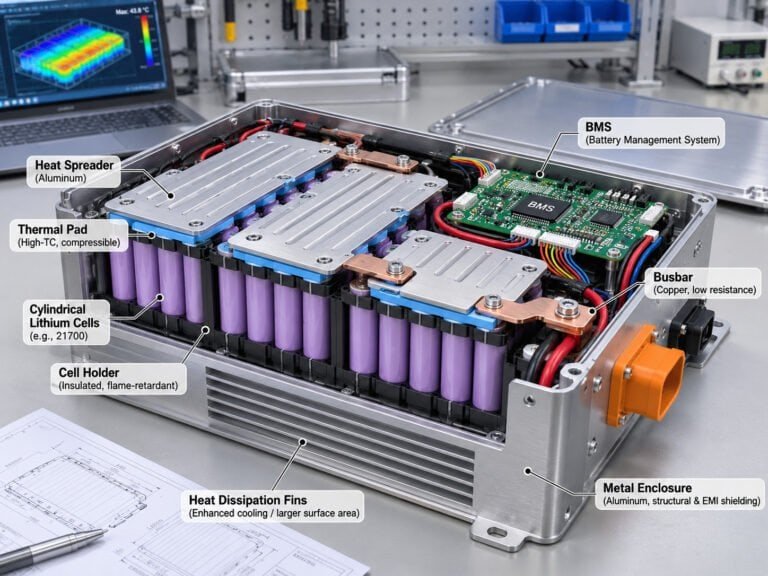
Marine lithium batteries must include a smart Battery Management System (BMS):
Key functions:
- Overcharge / over-discharge protection
- Temperature protection (marine environments have large temperature variations)
- Overcurrent protection
- Cell balancing
- Fault alarm output
Especially important for sailboats, because:
starter motors, thrusters, and radios create high instantaneous current surges.
Part 3. How to Choose the Best Lithium Battery for a Sailboat
Selection is not about “bigger is better,” but about system compatibility and marine adaptability.
1. Battery Chemistry Selection
LiFePO4 (Lithium Iron Phosphate) — The First Choice for Sailboats
Advantages:
- Extremely high safety (thermal stability)
- Long lifespan
- Stable output
- Ideal for long-term marine environments
Best for:
- Cruising sailboats
- Offshore sailboats
- Recreational yachts
NMC (Nickel Manganese Cobalt)
Advantages:
- Higher energy density
- Lighter weight
Disadvantages:
- Lower safety margin
- More sensitive to temperature
Best for:
- Racing sailboats
- Lightweight performance upgrades
2. Capacity Calculation (Key Formula)
Simple estimation method:
Daily consumption (Ah) × Days of autonomy × Safety factor (1.2–1.5)
Example:
- Daily usage: 100Ah
- 3 days autonomy
- Safety factor: 1.3
Required capacity:
100 × 3 × 1.3 = 390Ah
3. Waterproofing & Salt Spray Resistance
Sailboat environments are extremely harsh:
- Salt corrosion
- High humidity
- Constant vibration
Key requirements:
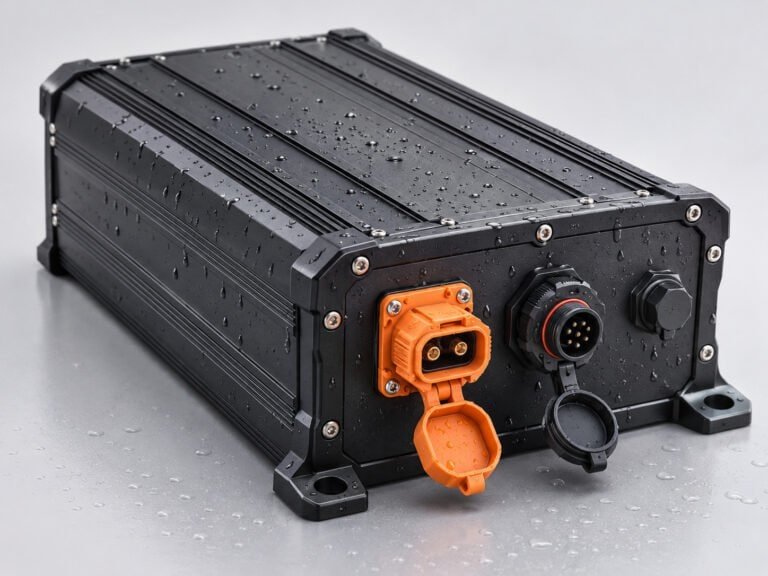
- IP65–IP67 protection rating
- Anti-corrosion housing (aluminum or engineering plastics)
- Anti-oxidation terminals
4. Discharge Capability (Determines Power Output)
Sailboats require not only energy supply but also power bursts.
Key parameters:
- Continuous discharge rate (1C–2C)
- Peak discharge capability
- High surge current support (thrusters / winches)
Part 4. System-Level Optimization for Sailboat Lithium Retrofit
To maximize performance, three levels of upgrades are recommended:
1. Energy Structure Upgrade
- Lead-acid → LiFePO4
- Add solar charging system (highly recommended)
2. Smart Power Management
- Install marine battery monitoring system (BMS visualization)
- Real-time SOC monitoring
- Load distribution management
3. Hybrid Energy System
Ideal sailboat energy architecture:
- Lithium battery (main storage)
- Solar panels (energy replenishment)
- Generator (backup power)
Forms a “marine microgrid” reducing reliance on shore power.
Part 5. Conclusion: Core Logic of Sailboat Lithium Battery Retrofit
In one sentence:
Sailboat lithium upgrade is not just a battery replacement, but a complete energy system transformation ⚡⛵
Key success factors:
- Voltage system matching
- Lithium-compatible charging system & BMS
- Marine-grade structural design
FAQ
Q1: Can lithium batteries directly replace lead-acid batteries on sailboats?
Not completely. Voltage compatibility must be confirmed, and charging systems and BMS may need upgrades.
Q2: Are LiFePO4 batteries safe for marine use?
Yes. LiFePO4 is widely recognized as one of the safest lithium battery chemistries for marine environments.
Q3: What is the lifespan of sailboat lithium batteries?
Typically 8–12 years under normal use, significantly longer than lead-acid batteries.
Q4: Do they support solar charging?
Yes. They can be integrated into hybrid solar energy systems.
Q5: Can battery size and structure be customized?
Yes. Custom design based on installation space is fully supported.
 English
 Chinese
 Japanese
 German
 French
 Korean

