
What is a Battery Management System (BMS)?
Battery Management System (BMS) is an intelligent electronic system designed to monitor, control, and protect lithium battery packs.
It ensures that every battery cell operates within safe electrical and thermal limits, preventing failures while optimizing performance and lifespan.
In simple terms, a lithium battery without a BMS is powerful but uncontrolled. With a BMS, it becomes a safe, stable, and intelligent energy system.
Why BMS is Important for Lithium Batteries
Lithium batteries are widely used in 2-wheeled vehicle vehicles, robotics, and energy storage systems, but they are highly sensitive to voltage, current, and temperature changes.
Without proper management, they may suffer from:
Overcharging
Over-discharging
Thermal runaway
Cell imbalance
This is where BMS becomes essential.

1. Prevents Battery Failures and Safety Risks
One of the most important roles of BMS is protection.
It continuously monitors battery conditions and prevents:
Overcharge damage
Over-discharge failure
Short circuits
Excessive current flow
This significantly reduces the risk of battery failure and thermal incidents.
2. Controls Temperature and Prevents Thermal Runaway
Temperature is one of the most critical factors affecting lithium battery safety.
BMS monitors real-time temperature and responds by:
Reducing power output at high temperature
Limiting charging at low temperature
Shutting down system when necessary
This helps prevent overheating, fire risk, and performance degradation.
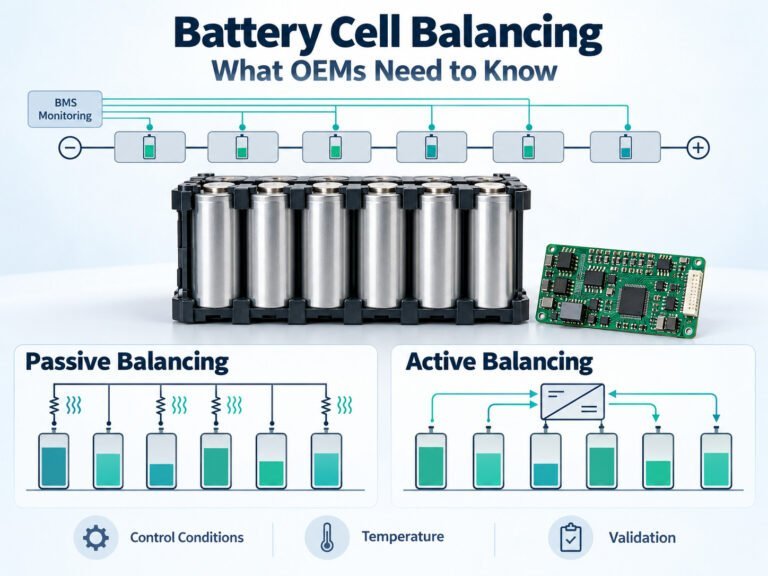
3. Balances Battery Cells for Longer Lifespan
A battery pack is made of multiple cells, and no two cells are exactly identical.
Over time, differences in:
Internal resistance
Capacity
Voltage behavior
can lead to imbalance.
BMS solves this problem through:
Passive balancing
Active balancing (advanced systems)
This improves battery consistency and extends overall cycle life.
4. Ensures Stable Power Output
In high-demand applications such as electric bikes, AGVs, and industrial equipment, sudden current spikes can occur.
BMS protects the system by:
Limiting overcurrent
Preventing voltage collapse
Stabilizing power output
This ensures reliable performance under all load conditions.
5. Provides Smart Battery Monitoring
Modern BMS systems provide real-time data such as:
SOC (State of Charge)
SOH (State of Health)
SOF (State of Function)
These metrics allow users and systems to accurately understand battery status and usage capability.
6. Enables System-Level Communication
Advanced BMS supports communication protocols such as:
CAN bus
RS485
Modbus
This allows integration with:
Electric vehicles
Energy storage systems
Robotics and industrial systems
Making the battery part of a smart energy ecosystem.
Applications of BMS
A high-quality BMS is essential in many industries:
🚲 eBikes and electric scooters
🤖 AGV and AMR robotics
⚡ Energy storage systems (ESS)
🚗 Electric vehicles
🏭 Industrial equipment
🩺 Medical devices
💡 Key Benefits of BMS
Improved battery safety
Longer cycle life
Stable performance
Reduced failure rate
Intelligent system control
FAQ
What does a BMS do in a lithium battery?
A BMS monitors and controls voltage, current, temperature, and cell balance to ensure safe and efficient operation.
Can a lithium battery work without a BMS?
Yes, but it is unsafe. Without a BMS, the battery is exposed to risks such as overheating, overcharging, and failure.
Does BMS improve battery life?
Yes. By balancing cells and preventing extreme conditions, BMS significantly extends battery lifespan.
What industries use BMS systems?
BMS is widely used in electric mobility, energy storage systems, robotics, and industrial applications.
Conclusion
Battery Management System (BMS) is not just a supporting component—it is the core intelligence of modern lithium battery systems.
It transforms high-energy battery packs into safe, stable, and reliable power solutions suitable for industrial and commercial applications.
Without BMS, lithium batteries are risky and unstable. With BMS, they become controlled energy systems that can power the future.


 English
  Chinese
  Japanese
  German
  French
  Korean
