
1re partie. Pourquoi les voiliers abandonnent les batteries au plomb au profit des batteries au lithium
Les installations électriques des voiliers traditionnels reposent principalement sur des batteries au plomb, mais leurs limites apparaissent de plus en plus clairement.
1. Un poids élevé affecte les performances de navigation
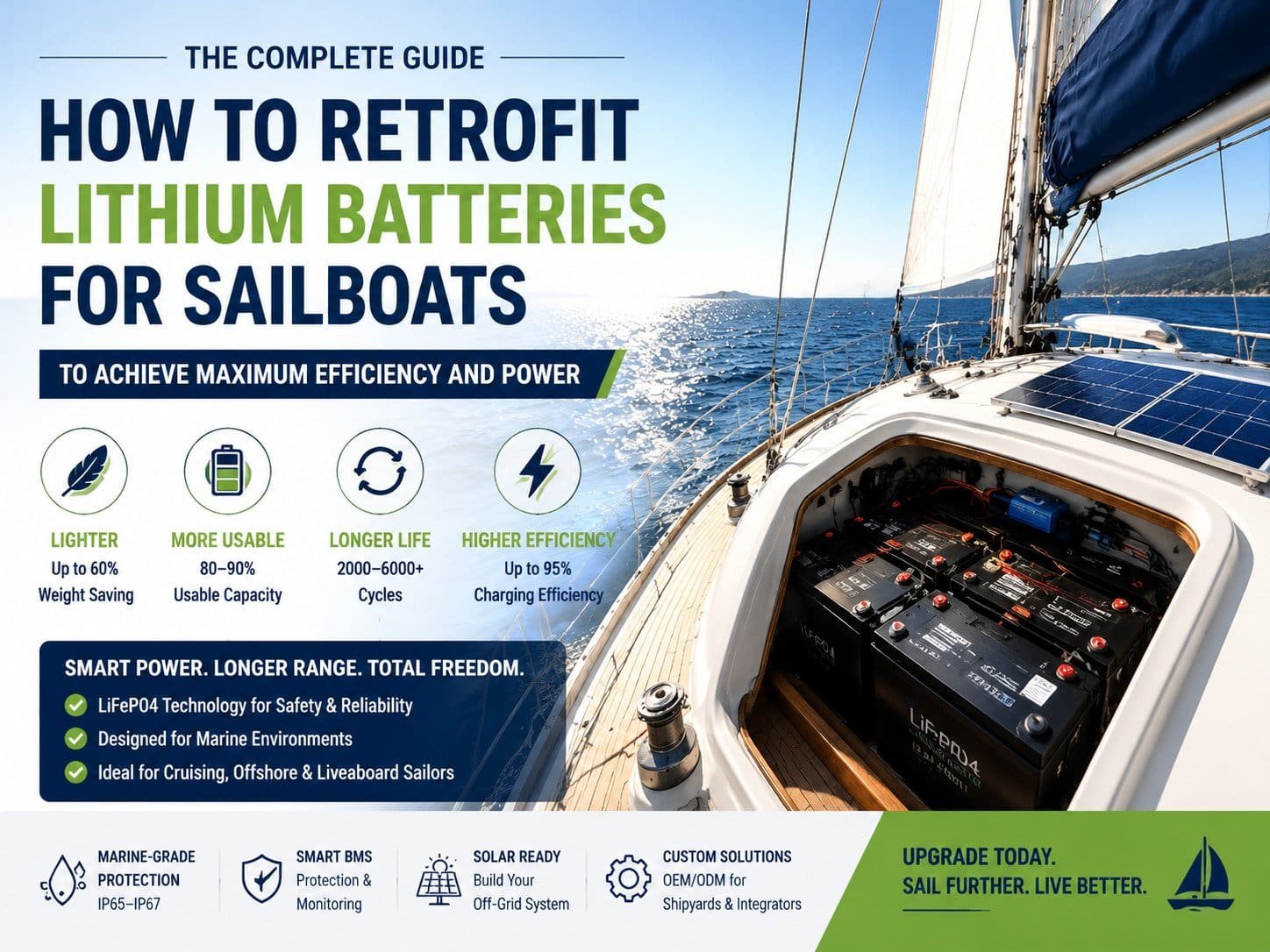
Les batteries au plomb ont une faible densité énergétique. À capacité égale, elles peuvent peser 2 à 3 fois plus que les batteries au lithium.
Sur un voilier, cela signifie :
- Augmentation du tirant d'eau de la coque
- Résistance à la navigation plus élevée
- Baisse de la vitesse et de la stabilité
2. Faible capacité utile (faible profondeur de décharge)
Les batteries au plomb ne permettent généralement que d'environ Capacité utile du 50%, sinon sa durée de vie diminue considérablement.
En revanche, les batteries au lithium (notamment celles au LiFePO₄) offrent :
- Capacité utile 80%–90%
- Une autonomie nettement améliorée en conditions réelles
3. Une différence considérable en termes de durée de vie
- Plomb-acide : 300-500 cycles
- Lithium : 2 000 à 6 000 cycles (selon la conception du système)
À long terme, les batteries au lithium sont nettement plus rentables.
4. Meilleur rendement de charge
Les batteries au lithium peuvent atteindre jusqu'à Rendement de charge du 95%, alors que les batteries au plomb ne durent généralement que 70-80%.
Cela permet une bien meilleure utilisation de l'énergie à bord.
Partie 2. Un système de batteries au lithium est-il compatible avec un voilier ? Facteurs clés
Tous les voiliers ne peuvent pas remplacer directement leurs batteries au plomb par des batteries au lithium. La compatibilité des systèmes est essentielle.
1. Compatibilité des systèmes de tension (le plus important)
Systèmes électriques courants sur les voiliers :
- 12 V / 24 V / 48 V
Principe de modernisation :
- Maintenir la même tension du réseau
- Ou repenser l'architecture de l'onduleur et du système de recharge
Une mise en correspondance incorrecte peut entraîner :
- Dommages subis par l'onduleur
- Panne du système de navigation
- Problème de recharge
2. Compatibilité du système de recharge avec les profils au lithium
Les batteries au plomb et les batteries au lithium fonctionnent selon des principes de charge totalement différents :
| Type de batterie | Méthode de chargement |
| Plomb-acide | Charge à flotteur en plusieurs étapes |
| Lithium (LiFePO₄) | CC/CV (courant constant / tension constante) |
Si vous procédez à un remplacement direct, vous devez :
- Passez à un chargeur compatible avec les batteries au lithium
- Ou installez un module de charge CC-CC marin
3. Le système de gestion de batterie (BMS) est-il compatible avec les applications maritimes ?
Les batteries au lithium destinées à un usage maritime doivent être équipées d'un système intelligent de gestion de batterie (BMS) :
Principales fonctions :
- Protection contre la surcharge et la décharge excessive
- Protection thermique (les environnements marins sont caractérisés par d'importantes variations de température)
- Protection contre les surintensités
- Équilibre cellulaire
- Sortie d'alarme de défaut
C'est particulièrement important pour les voiliers, car :
Les démarreurs, les propulseurs et les radios génèrent des pics de courant instantanés élevés.
Partie 3. Comment choisir la meilleure batterie au lithium pour un voilier
Le choix ne repose pas sur le principe “ plus c'est grand, mieux c'est ”, mais sur la compatibilité avec le système et l'adaptabilité au milieu marin.
1. Choix de la composition chimique de la batterie
LiFePO4 (phosphate de lithium et de fer) — Le choix numéro un pour les voiliers
Avantages :
- Sécurité extrêmement élevée (stabilité thermique)
- Longue durée de vie
- Rendement stable
- Idéal pour une utilisation à long terme en milieu marin
Idéal pour :
- Voiliers de croisière
- Voiliers hauturiers
- Yachts de plaisance
NMC (nickel-manganèse-cobalt)
Avantages :
- Densité énergétique plus élevée
- Poids plus léger
Inconvénients :
- Marge de sécurité réduite
- Plus sensible à la température
Idéal pour :
- Voiliers de course
- Améliorations de performances sans alourdir le véhicule
2. Calcul de la capacité (formule clé)
Méthode d'estimation simple :
Consommation journalière (Ah) × Nombre de jours d'autonomie × Coefficient de sécurité (1,2–1,5)
Exemple :
- Consommation quotidienne : 100 Ah
- 3 jours d'autonomie
- Coefficient de sécurité : 1,3
Capacité requise :
100 × 3 × 1,3 = 390 Ah
3. Étanchéité et résistance au brouillard salin
Les conditions de navigation à la voile sont extrêmement difficiles :
- Corrosion saline
- Humidité élevée
- Vibration constante
Exigences clés :
- Indice de protection IP65–IP67
- Boîtier anticorrosion (en aluminium ou en plastiques techniques)
- Bornes anti-oxydation
4. Capacité de décharge (détermine la puissance de sortie)
Les voiliers ont besoin non seulement d'un approvisionnement en énergie, mais aussi de pics de puissance.
Paramètres clés :
- Débit de décharge continu (1C–2C)
- Capacité de débit maximale
- Haute résistance aux pics de courant (propulseurs / treuils)
Partie 4. Optimisation au niveau du système pour la modernisation des batteries au lithium des voiliers
Pour optimiser les performances, trois niveaux de mises à niveau sont recommandés :
1. Modernisation du système énergétique
- Plomb-acide → LiFePO₄
- Ajouter un système de recharge solaire (fortement recommandé)
2. Gestion intelligente de l'énergie
- Installation d'un système de surveillance des batteries marines (visualisation du BMS)
- Surveillance en temps réel du SOC
- Gestion de la répartition de la charge
3. Système énergétique hybride
Architecture énergétique idéale d'un voilier :
- Batterie au lithium (stockage principal)
- Panneaux solaires (recharge d'énergie)
- Générateur (alimentation de secours)
Permet de créer un “ micro-réseau maritime ” réduisant la dépendance vis-à-vis de l'alimentation à quai.
Partie 5. Conclusion : principes fondamentaux de la mise à niveau des batteries au lithium des voiliers
En un mot :
La modernisation au lithium d'un voilier ne se résume pas à un simple remplacement de batterie, mais constitue une transformation complète du système énergétique ⚡⛵
Facteurs clés de réussite :
- Adaptation du système de tension
- Système de charge compatible avec le lithium et BMS
- Conception structurelle de qualité marine
FAQ
Q1 : Les batteries au lithium peuvent-elles remplacer directement les batteries au plomb sur les voiliers ?
Pas tout à fait. Il faut vérifier la compatibilité des tensions, et il se peut que les systèmes de charge et le BMS doivent être mis à niveau.
Q2 : Les batteries LiFePO4 sont-elles sûres pour une utilisation maritime ?
Oui. Le LiFePO4 est largement reconnu comme l'une des compositions chimiques de batteries au lithium les plus sûres pour les environnements marins.
Q3 : Quelle est la durée de vie des batteries au lithium des voiliers ?
En général, entre 8 et 12 ans dans des conditions normales d'utilisation, soit une durée de vie nettement supérieure à celle des batteries au plomb.
Q4 : Prise en charge de la recharge solaire ?
Oui. Ils peuvent être intégrés dans des systèmes hybrides d'énergie solaire.
Q5 : La taille et la structure de la batterie peuvent-elles être personnalisées ?
Oui. Nous proposons une conception sur mesure adaptée à l'espace d'installation.
 English
  Chinese
  Japanese
  German
  French
  Korean
