Sailboat Lithium Battery Retrofit Solutions for Shipyards and Yacht Conversion Projects

Part 1. Why Sailboats Are Transitioning from Lead-Acid to Lithium Batteries

Traditional sailboat electrical systems mainly rely on lead-acid batteries, but their limitations are becoming increasingly evident.

1. Heavy Weight Affects Sailing Performance

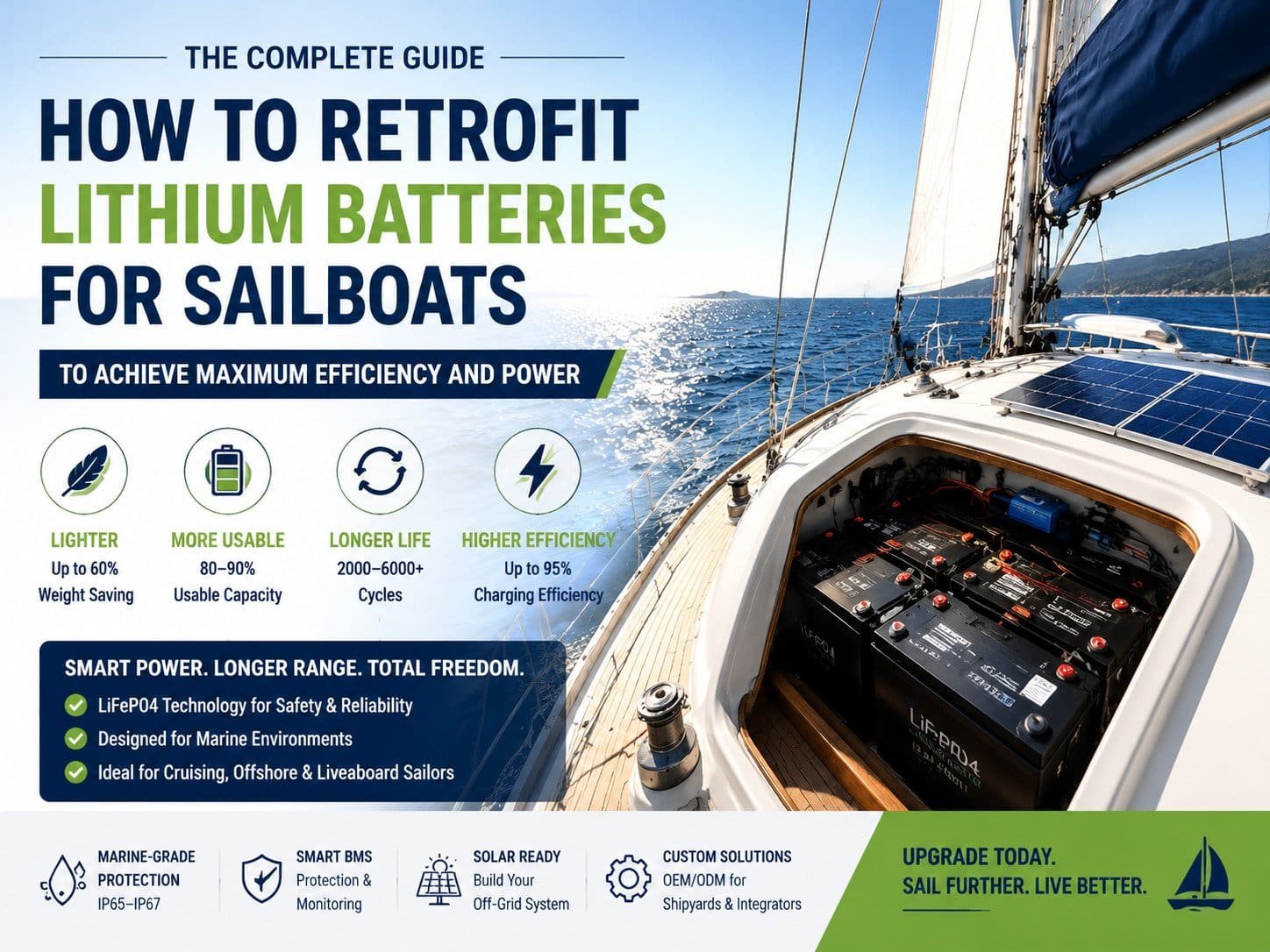
Lead-acid batteries have low energy density. For the same capacity, they can weigh 2–3 times more than lithium batteries.

On a sailboat, this means:

  • Increased hull draft
  • Higher sailing resistance
  • Reduced speed and stability

Lithium Batteries for Sailboats

 2. Low Usable Capacity (Shallow Depth of Discharge)

Lead-acid batteries typically allow only about 50% usable capacity, otherwise lifespan drops significantly.

In contrast, lithium batteries (especially LiFePO4) offer:

  • 80%–90% usable capacity
  • Significantly improved real-world endurance


 3. Huge Difference in Cycle Life

  • 납산: 300-500주기
  • Lithium: 2000–6000 cycles (depending on system design)

Over the long term, lithium batteries are significantly more cost-effective.


4. Higher Charging Efficiency

Lithium batteries achieve up to 95% charging efficiency, while lead-acid batteries are typically only 70-80%.

This results in much better onboard energy utilization.


Part 2. Is a Lithium Battery System Compatible with a Sailboat? Key Factors

Not all sailboats can directly replace lead-acid batteries with lithium batteries. System compatibility is critical.


1. Voltage System Matching (Most Important)

Common sailboat electrical systems:

  • 12V / 24V / 48V

Retrofit principle:

  • Maintain the same system voltage
  • Or redesign the inverter/charging architecture

Incorrect matching may cause:

  • Inverter damage
  • Navigation system failure
  • Charging failure


2. Charging System Compatibility with Lithium Profiles

Lead-acid and lithium batteries use completely different charging logic:

배터리 유형 충전 방법
납산 Multi-stage float charging
Lithium (LiFePO4) CC/CV(정전류/정전압)

If replacing directly, you must:

  • Upgrade to a lithium-compatible charger
  • Or install a marine DC-DC charging module


 3. Whether the BMS Supports Marine Applications

Marine lithium batteries must include a smart Battery Management System (BMS):

Key functions:

  • Overcharge / over-discharge protection
  • Temperature protection (marine environments have large temperature variations)
  • 과전류 보호
  • 셀 밸런싱
  • Fault alarm output

Especially important for sailboats, because:
starter motors, thrusters, and radios create high instantaneous current surges.


Part 3. How to Choose the Best Lithium Battery for a Sailboat

Selection is not about “bigger is better,” but about system compatibility and marine adaptability.


 1. Battery Chemistry Selection

LiFePO4 (Lithium Iron Phosphate) — The First Choice for Sailboats

장점:

  • Extremely high safety (thermal stability)
  • 긴 수명
  • Stable output
  • Ideal for long-term marine environments

Best for:

  • Cruising sailboats
  • Offshore sailboats
  • Recreational yachts


 NMC (Nickel Manganese Cobalt)

장점:

  • 더 높은 에너지 밀도
  • 더 가벼워진 무게

Disadvantages:

  • Lower safety margin
  • More sensitive to temperature

Best for:

  • Racing sailboats
  • Lightweight performance upgrades


2. Capacity Calculation (Key Formula)

Simple estimation method:

Daily consumption (Ah) × Days of autonomy × Safety factor (1.2–1.5)

예시:

  • Daily usage: 100Ah
  • 3 days autonomy
  • Safety factor: 1.3

Required capacity:
100 × 3 × 1.3 = 390Ah


3. Waterproofing & Salt Spray Resistance

Sailboat environments are extremely harsh:

  • Salt corrosion
  • 높은 습도
  • Constant vibration

주요 요구 사항:

  • IP65–IP67 protection rating
  • Anti-corrosion housing (aluminum or engineering plastics)
  • Anti-oxidation terminals


4. Discharge Capability (Determines Power Output)

Sailboats require not only energy supply but also power bursts.

Key parameters:

  • Continuous discharge rate (1C–2C)
  • Peak discharge capability
  • High surge current support (thrusters / winches)


Part 4. System-Level Optimization for Sailboat Lithium Retrofit

To maximize performance, three levels of upgrades are recommended:


1. Energy Structure Upgrade

  • Lead-acid → LiFePO4
  • Add solar charging system (highly recommended)


 2. Smart Power Management

  • Install marine battery monitoring system (BMS visualization)
  • Real-time SOC monitoring
  • Load distribution management

 3. Hybrid Energy System

Ideal sailboat energy architecture:

  • Lithium battery (main storage)
  • Solar panels (energy replenishment)
  • Generator (backup power)

Forms a “marine microgrid” reducing reliance on shore power.

Part 5. Conclusion: Core Logic of Sailboat Lithium Battery Retrofit

In one sentence:

Sailboat lithium upgrade is not just a battery replacement, but a complete energy system transformation ⚡⛵

Key success factors:

  • Voltage system matching
  • Lithium-compatible charging system & BMS
  • Marine-grade structural design

자주 묻는 질문

Q1: Can lithium batteries directly replace lead-acid batteries on sailboats?

Not completely. Voltage compatibility must be confirmed, and charging systems and BMS may need upgrades.

Q2: Are LiFePO4 batteries safe for marine use?

Yes. LiFePO4 is widely recognized as one of the safest lithium battery chemistries for marine environments.

Q3: What is the lifespan of sailboat lithium batteries?

Typically 8–12 years under normal use, significantly longer than lead-acid batteries.

Q4: Do they support solar charging?

Yes. They can be integrated into hybrid solar energy systems.

Q5: Can battery size and structure be customized?

Yes. Custom design based on installation space is fully supported.


Professional sailboat lithium battery retrofit solutions for shipyards and yacht conversion projects. High-performance LiFePO4 marine battery systems with smart BMS, CAN communication, and IP67 protection for reliable offshore energy integration.
2026-06-23
+
Learn why Battery Management System (BMS) is essential for lithium batteries. Discover how BMS prevents failures, improves safety, balances cells, and extends battery life in LEV, AGV, and energy storage systems.
2026-06-23
+
Dongguan Yizhan Electronics Technology Co., Ltd.sincerely invites you to visit us at EUROBIKE 2026 in Frankfurt, Germany. Explore our latest e-bike battery solutions, Smart BMS technology, OEM/ODM lithium battery packs, and certified energy solutions at Hall E8, Booth G30.
2026-06-15
+
Looking for the ideal golf cart battery manufacturer in 2026? Dongguan Yizhan Electronics Technology Co., Ltd. offers custom lithium-ion and LiFePO4 battery packs, tailored voltage, capacity, and smart BMS for optimal performance, safety, and reliability.
2026-06-09
+