
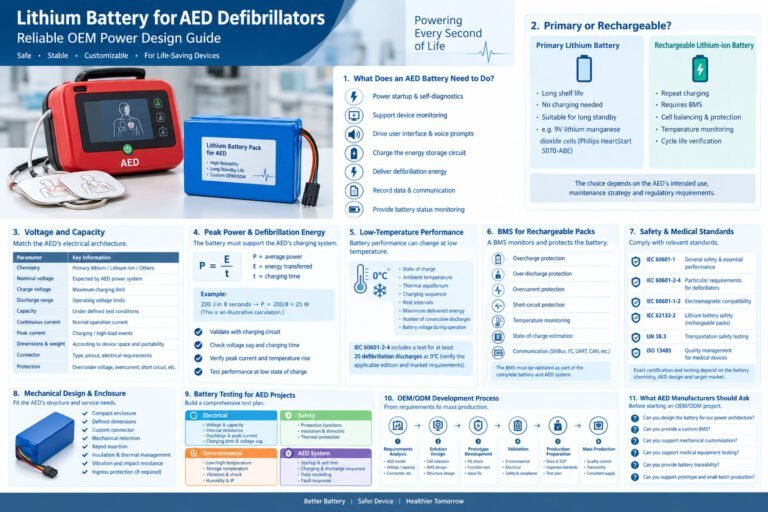
An automated external defibrillator (AED) must be ready to deliver emergency treatment when needed. Its battery supports daily self-tests, device monitoring, charging circuits, and defibrillation energy delivery. For AED manufacturers and medical equipment developers, battery selection is therefore a product design consideration rather than a simple component purchase.
A suitable lithium battery for an AED must match the defibrillator’s electrical architecture, operating conditions, energy requirements, safety controls, and service strategy. The battery pack also needs to support the device’s intended standby period and emergency operating performance.
This guide explains the key considerations for designing a custom AED lithium battery pack, including battery chemistry, voltage, capacity, peak power, BMS integration, safety testing, and OEM/ODM manufacturing.

1. What Does an AED Battery Need to Do?
An AED is designed to analyze a patient’s heart rhythm and deliver an electrical shock when indicated. The battery provides power for several functions:
- Device startup and self-diagnostics
- Internal monitoring and readiness checks
- User interface and voice prompts
- Charging the defibrillation energy storage circuit
- Delivering energy through the defibrillation system
- Data recording and communication
- Battery status monitoring
The power requirements of these functions are different. Electronics may consume relatively low power during standby, while the charging circuit can require substantial power for a short period.
This creates two important design requirements: sufficient stored energy and the ability to deliver the required power without unacceptable voltage drop.
The battery must also work with the AED’s charging system. A battery that has adequate nominal capacity may still be unsuitable if its voltage falls too far during charging or if its protection circuit interrupts the required current.
For this reason, battery design should begin with the AED’s electrical requirements rather than a nominal voltage or capacity selected from a catalog.
2. Primary or Rechargeable Lithium Battery?
AED manufacturers generally evaluate two battery architectures: primary lithium batteries and rechargeable lithium-ion battery packs.
Primary lithium batteries
Primary lithium batteries are designed for one-time use and are not intended to be recharged. They can be useful for AEDs that spend long periods in standby and require a replacement battery after a defined service interval.
A documented example is the Philips HeartStart 5070-ABE battery, which uses 9 V lithium manganese dioxide primary cells. Its published specifications include a minimum of 200 shocks or four hours of operating time at 25°C, with a stated five-year shelf life before insertion under specified storage conditions. These figures belong to that particular battery and AED system, not to all primary lithium batteries.
For a primary battery, the design evaluation should include:
- Shelf life
- Standby life after installation
- Operating temperature
- Maximum shock count
- Charging time
- Leakage and enclosure protection
- Transportation and storage requirements
Rechargeable lithium-ion batteries
Rechargeable lithium-ion battery packs can support AED platforms designed for repeated charging and battery replacement. They may be suitable for professional emergency equipment, training units, and systems with a rechargeable power architecture.
A rechargeable pack requires additional design work, including:
- Battery management system
- Charging control
- Cell balancing where applicable
- Overcharge and over-discharge protection
- Temperature monitoring
- Connector and charging interface
- Cycle life verification
The choice between primary and rechargeable chemistry should be made according to the AED’s intended use, maintenance strategy, charging architecture, and regulatory requirements.
3. Voltage and Capacity: Start With the AED Electrical Architecture
The battery’s nominal voltage must match the AED’s power system.
For a lithium-ion battery pack, the nominal voltage depends on the cell chemistry and series configuration. For example, a conventional lithium-ion cell with a nominal voltage around 3.6–3.7 V may be assembled into a multi-cell series pack. The actual operating voltage varies with state of charge, load, temperature, and cell characteristics.
A custom AED battery specification should identify:
| Parameter | Information Required |
|---|---|
| Battery chemistry | Primary lithium, lithium-ion, or another approved chemistry |
| Nominal voltage | Voltage expected by the AED power system |
| Maximum charge voltage | Required charging limit |
| Discharge voltage range | Operating voltage limits |
| Rated capacity | Capacity under defined test conditions |
| Continuous discharge current | Current required during operation |
| Peak discharge current | Maximum current during charging or other high-load events |
| Battery dimensions | Maximum allowable pack size |
| Weight | Mechanical and portability limits |
| Connector | Type, pinout, and electrical requirements |
| Protection | Required protection and monitoring functions |
Capacity alone does not determine whether a battery can power an AED.
For example, two packs with the same nominal voltage and ampere-hour rating may have different internal resistance, discharge performance, temperature behavior, and protection settings. These differences can affect the AED’s charging time and operation.
A battery supplier should therefore evaluate the complete electrical load profile.
4. Peak Power and Defibrillation Energy Delivery
The battery powering an AED must support the energy delivery system specified by the equipment manufacturer.
A simplified relationship between energy and power is:
P=EtP=\frac{E}{t}
Where:
- PP is average power during the charging interval.
- EE is the energy transferred to the AED’s energy storage system.
- tt is the charging time.
The actual battery current depends on the charging circuit, conversion efficiency, battery voltage, and control strategy.
For example, if an AED’s charging system transfers 200 J of energy in 8 seconds, the average power transferred to the storage circuit is:
P=2008=25 WP=\frac{200}{8}=25\text{ W}
This is an illustrative calculation, not a specification for a particular AED. The battery current may be higher because of conversion losses and changes in battery voltage.
The design should also consider the difference between energy stored in the battery and energy delivered to the patient. The battery supplies the AED’s internal energy storage system, while the defibrillator controls the delivered waveform.
A battery pack should be validated together with the AED charging circuit. This helps identify:
- Voltage sag during charging
- Charging time variation
- Peak current requirements
- Protection circuit interruptions
- Battery temperature rise
- Performance at low state of charge
5. AED Battery Performance at Low Temperature
AEDs may be stored in ambulances, public buildings, workplaces, outdoor facilities, and other environments where temperature varies.
Battery performance can change with temperature. Low temperatures may increase internal resistance and reduce available capacity. These effects can influence charging time and the number of available shocks.
IEC 60601-2-4 includes specific requirements for the internal electrical power source of defibrillators. For a frequent-use AED, the standard describes a test involving at least 20 defibrillation discharges at 0°C using the maximum delivered energy and a defined discharge sequence. The applicable edition and requirements should be confirmed for the specific product and market.
A battery OEM should evaluate the complete AED system at its specified low-temperature condition.
Important test conditions include:
- Battery state of charge
- Ambient temperature
- Battery thermal equilibrium
- Charging sequence
- Rest intervals
- Maximum delivered energy
- Number of consecutive discharges
- Battery voltage during operation
A battery that performs well at room temperature may require additional validation at low temperature.
6. Battery Management System Design for Rechargeable AED Packs
A BMS can monitor battery conditions and communicate with the AED control system.
For rechargeable lithium-ion battery packs, common BMS functions include:
Overcharge protection
The BMS monitors cell voltage and helps prevent charging beyond the defined limit.
Over-discharge protection
The BMS can disconnect the battery when the voltage falls below the specified protection threshold.
Overcurrent protection
The BMS monitors current and responds when the current exceeds the configured protection limits.
Short-circuit protection
The protection system can interrupt the circuit when a short-circuit condition is detected.
Temperature monitoring
Temperature sensors help the BMS monitor charging and discharging conditions.
State-of-charge estimation
A battery fuel-gauge system can estimate remaining capacity and provide battery status information to the AED.
Communication
Depending on the AED architecture, the battery may communicate through SMBus, I²C, UART, CAN, or another interface.
The communication protocol must be agreed with the AED manufacturer. A BMS that uses an incompatible communication protocol or incorrect battery status logic may prevent the AED from recognizing the pack.
For emergency medical equipment, the BMS should be validated as part of the complete battery and AED system.
7. Battery Safety and Medical Equipment Standards
AED battery development involves both battery safety requirements and medical electrical equipment requirements.
IEC 60601-1
IEC 60601-1 establishes general requirements for basic safety and essential performance of medical electrical equipment. The standard should be considered together with applicable collateral and particular standards.
IEC 60601-2-4
IEC 60601-2-4 addresses particular requirements for cardiac defibrillators. It includes requirements related to essential performance, including battery-supported operation.
IEC 60601-1-2
This standard addresses electromagnetic compatibility for medical electrical equipment. The battery pack and its associated electronics should be evaluated as part of the AED system where applicable.
IEC 62133-2
IEC 62133-2 covers safety requirements for portable sealed secondary lithium batteries. It may be relevant to rechargeable lithium-ion battery packs, depending on the battery design and applicable regulatory pathway.
UN 38.3
UN 38.3 testing is relevant to the transportation of lithium batteries. It covers transportation-related test requirements, including altitude simulation, thermal testing, vibration, shock, external short circuit, impact or crush where applicable, overcharge for rechargeable batteries, and forced discharge.
ISO 13485
ISO 13485 is a quality management standard for medical devices. For AED manufacturers and battery suppliers operating within a medical-device supply chain, quality system requirements should be reviewed according to the product and regulatory responsibilities.
The exact certification and testing requirements depend on the battery chemistry, AED design, intended market, and applicable regulatory pathway. A battery supplier should not assume that a battery certificate automatically establishes compliance of the complete AED.
8. Mechanical Design and Battery Enclosure
An AED battery must fit the device’s mechanical structure and service requirements.
A custom battery pack may require:
- Compact enclosure
- Defined battery dimensions
- Custom connector
- Mechanical retention
- Keyed insertion
- Battery identification
- Protection against incorrect installation
- Insulation between cells and conductive parts
- Thermal management
- Resistance to vibration and impact
The battery enclosure should be designed according to the AED’s operating environment.
For example, a battery intended for ambulance use may need to tolerate transportation vibration and temperature variation. A battery for an indoor workplace AED may have different environmental requirements.
The battery enclosure and the AED housing should be evaluated together when ingress protection is required.
IEC 60601-1 includes battery marking and replacement-related requirements. Where incorrect lithium battery replacement could create an unacceptable risk, appropriate warnings and replacement instructions are required.
9. Battery Testing for AED OEM Projects
Testing should be planned from the early design stage.
A suitable validation program may include the following areas.
Electrical testing
- Nominal voltage verification
- Capacity testing
- Internal resistance measurement
- Continuous discharge testing
- Peak current testing
- Charging time verification
- Voltage sag evaluation
Safety testing
- Overcharge protection
- Over-discharge protection
- Overcurrent protection
- Short-circuit protection
- Temperature protection
- Insulation and dielectric testing where applicable
Environmental testing
- Low-temperature operation
- High-temperature operation
- Storage temperature
- Vibration
- Mechanical shock
- Humidity
- Enclosure protection where applicable
AED system testing
The battery should be tested in the actual AED or an appropriate representative test system.
The test program may include:
- Fully charge the battery according to the approved charging procedure.
- Install the battery in the AED.
- Confirm startup and self-test behavior.
- Operate the AED at the specified environmental condition.
- Execute the defined charging and discharge sequence.
- Record charging time, battery voltage, current, and temperature.
- Repeat the test at different states of charge.
- Evaluate battery and AED fault responses.
For the exact test procedure, the AED manufacturer should use the applicable standard and product-specific verification plan.
10. OEM/ODM Custom AED Battery Development Process
A battery manufacturer can support AED projects through a structured OEM/ODM development process.
Step 1: Collect AED requirements
The AED manufacturer provides information about:
- AED model
- Power architecture
- Battery type
- Voltage range
- Capacity target
- Charging method
- Maximum charging time
- Required operating time
- Shock count
- Operating temperature
- Battery dimensions
- Connector
- Communication requirements
Step 2: Battery solution design
The engineering team evaluates suitable cell chemistry, cell configuration, BMS architecture, mechanical structure, and electrical protection.
For a rechargeable battery, the design may include a custom BMS and charging interface.
Step 3: Prototype development
The supplier prepares prototype batteries for mechanical fit checks and electrical evaluation.
Prototype testing may identify issues with:
- Connector placement
- Battery dimensions
- Current capability
- Charging behavior
- Temperature rise
- AED battery recognition
Step 4: Engineering validation
The battery and AED are tested together according to the approved validation plan.
This stage may include environmental testing, electrical testing, safety verification, and relevant medical equipment compliance work.
Step 5: Production preparation
After design approval, the supplier prepares manufacturing documentation, inspection standards, assembly procedures, and production testing requirements.
Step 6: Mass production and quality control
Production inspection should verify the battery configuration, cell consistency, welding quality, BMS function, electrical performance, and final appearance.
For medical equipment, traceability and documented quality controls are important for managing production consistency and supplier responsibilities.
11. What AED Manufacturers Should Ask a Battery Supplier
Before starting an OEM/ODM project, AED manufacturers should ask the supplier:
Can you design the battery according to our AED power architecture?
The supplier should be able to evaluate voltage, capacity, peak current, charging requirements, and battery protection.
Can you provide a custom BMS?
For rechargeable battery packs, BMS design may include protection thresholds, temperature monitoring, battery identification, and communication.
Can you support mechanical customization?
The supplier should be able to design the battery enclosure, connector, dimensions, and mounting structure.
Can you support medical equipment testing?
The supplier should explain which tests it can perform internally and which require external laboratories or testing agencies.
Can you provide battery traceability?
For OEM projects, traceability may include cell batch information, production records, inspection results, and battery identification.
Can you support prototype and small-batch production?
A flexible development process can help AED manufacturers evaluate the battery before committing to mass production.
12. Custom Lithium Battery Solutions for AED Manufacturers
Dongguan Yizhan Electronics Technology Co., Ltd. provides custom lithium battery pack development and OEM/ODM manufacturing for equipment manufacturers.
Our battery development process can support:
- Battery requirement analysis
- Cell selection
- Battery pack structure design
- BMS development
- Prototype sampling
- Electrical testing
- Battery pack assembly
- Production inspection
- OEM/ODM manufacturing
For AED projects, the battery design should be based on the actual equipment requirements. Our engineering team can work with AED manufacturers to evaluate voltage, capacity, charging performance, mechanical structure, BMS functions, and applicable testing requirements.
The battery specification should be confirmed through engineering validation before production.
FAQ
What type of lithium battery is used in an AED?
AEDs may use primary lithium batteries or rechargeable lithium-ion battery packs. The choice depends on the AED’s electrical architecture, intended use, service interval, and regulatory requirements.
Can a lithium-ion battery be customized for an AED?
Yes. A rechargeable lithium-ion battery pack can be customized according to the AED’s voltage, capacity, current, dimensions, connector, BMS, and charging requirements.
How many shocks can an AED battery support?
The shock count depends on the battery, AED model, operating conditions, energy setting, and testing procedure. It should be confirmed through the manufacturer’s specifications and system validation.
Does an AED battery need a BMS?
A rechargeable lithium-ion battery pack generally requires appropriate battery management and protection functions. A primary lithium battery has different electrical and safety requirements.
Can an AED battery work in cold environments?
Battery performance can change at low temperature. The battery and AED should be evaluated at the specified operating temperature and discharge conditions.
What information is needed for an AED battery quotation?
A supplier typically needs the AED model, battery chemistry, voltage, capacity, charging method, peak current, dimensions, connector, BMS requirements, operating temperature, and required certifications or testing.
Conclusion
AED battery design requires coordination between the battery, charging circuit, defibrillation system, BMS, mechanical enclosure, and medical equipment requirements.
For OEM/ODM projects, the battery should be developed around the AED’s actual operating conditions. Electrical performance, safety protection, environmental behavior, and production quality should be verified through a documented engineering process.
A custom lithium battery manufacturer can support this process from initial requirements and prototype design through validation and mass production.


 English
  Chinese
  Japanese
  German
  French
  Korean
