
Operating temperature is an important factor in custom battery pack design. Temperature conditions influence lithium battery capacity, discharge performance, charging behavior, cycle life, and safety.
For applications such as electric bicycles, electric scooters, AGVs, AMRs, service robots, industrial equipment, and energy storage systems, lithium battery packs must be designed according to their actual operating environments.
A battery pack used in a temperature-controlled warehouse may have different design requirements from one installed in outdoor equipment exposed to cold winters or summer heat.
Understanding how temperature affects lithium batteries helps OEM and ODM customers select suitable battery cells, Battery Management Systems (BMS), and pack structures for their applications.

1. How Operating Temperature Affects Lithium Battery Performance
Lithium-ion batteries rely on electrochemical reactions to store and release energy. Temperature changes influence these reactions and affect battery performance during charging and discharging.
Low-Temperature Effects on Lithium Batteries
When lithium batteries operate in cold environments, internal resistance increases and electrochemical activity slows down.
This may cause:
- Reduced available capacity: The battery may deliver less usable energy during discharge.
- Voltage drop: Increased internal resistance can cause voltage sag under load.
- Discharge current limitations: Available output power may decrease in cold conditions.
- Charging restrictions: Charging at low temperatures may cause lithium plating, which can affect battery life and safety.
- BMS protection activation: Voltage or temperature protection may interrupt battery operation.
For example, a 48V lithium battery pack used in an outdoor delivery robot at -10°C may require specific cell selection and BMS protection settings to support its operating conditions.
High-Temperature Effects on Lithium Batteries
High operating temperatures accelerate chemical reactions inside lithium battery cells. Prolonged exposure can contribute to battery aging and capacity degradation.
Potential effects include:
- Accelerated capacity loss
- Increased internal heat accumulation
- Changes in cell resistance and performance
- Reduced battery cycle life
- Activation of BMS over-temperature protection
For custom lithium battery packs operating inside enclosed industrial equipment, thermal management should be evaluated during the design process.
2. Lithium Battery Operating Temperature Ranges
Different lithium battery chemistries have different operating temperature requirements.
The following table provides general reference ranges for common lithium battery types.
| Battery Type | Typical Discharge Temperature | Typical Charging Temperature |
|---|---|---|
| NMC Lithium-ion | -20°C to 60°C | 0°C to 45°C |
| LiFePO4 (LFP) | -20°C to 55°C | 0°C to 55°C |
| Low-Temperature Lithium Cells | Depends on cell specification | Depends on cell specification |
Note: The actual operating temperature range depends on the battery cell manufacturer, cell model, charging current, and battery pack configuration.
Battery charging and discharging temperatures must be considered separately.
For example, a lithium battery may support discharge at -20°C but require charging to be disabled when the cell temperature falls below the manufacturer’s specified limit.
3. How Temperature Influences Custom Battery Pack Design
Temperature requirements affect several components of a custom lithium battery pack, including battery cells, BMS, mechanical structure, and thermal protection.
Battery Cell Selection
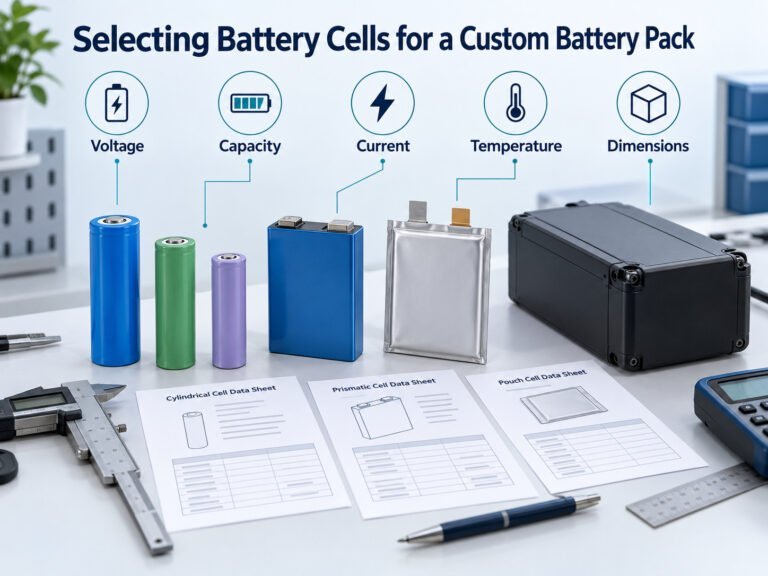
Selecting suitable lithium battery cells is an important step in custom battery pack development.
Cell selection should consider:
- Operating temperature range
- Nominal voltage and capacity
- Continuous discharge current
- Peak discharge current
- Internal resistance
- Charging temperature requirements
- Cycle life requirements
For example, a custom 48V battery pack for an industrial robot may use NMC or LiFePO4 cells depending on the application, power demand, available installation space, and operating environment.
For outdoor applications exposed to cold temperatures, the battery manufacturer may evaluate cells with specified low-temperature discharge characteristics.
Battery Management System (BMS) Temperature Protection
A Battery Management System monitors battery operating conditions and provides electrical and thermal protection.
In custom battery pack design, BMS temperature management may include:
- Cell temperature monitoring using NTC sensors
- Over-temperature charging protection
- Over-temperature discharge protection
- Low-temperature charging protection
- Temperature-based current limitation
- Temperature data communication through CAN, UART, or RS485
For robotic applications, temperature information can be transmitted to the equipment controller through CAN communication when supported by the BMS design.
The equipment can use this information for battery status monitoring and system-level thermal management.
Battery Pack Enclosure and Thermal Management
The battery enclosure also influences thermal performance.
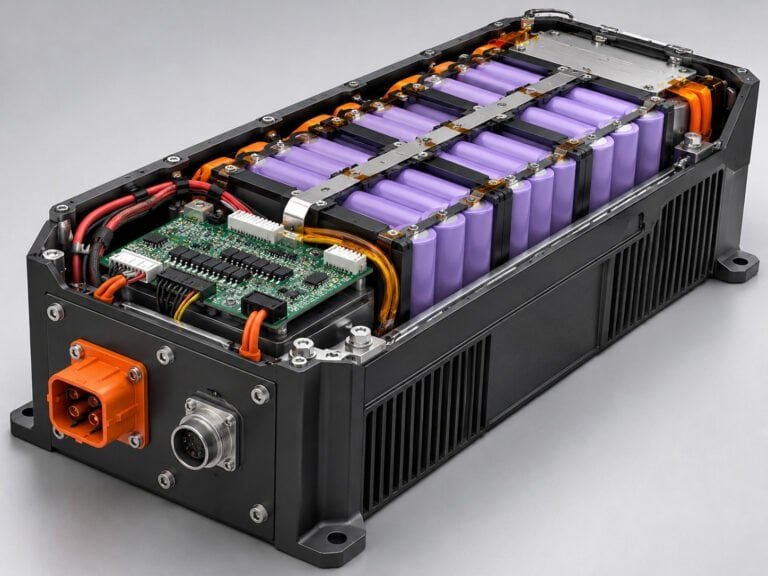
A custom lithium battery pack may use a plastic enclosure, aluminum housing, or application-specific mechanical structure.
During enclosure design, engineers should consider:
- Battery cell arrangement
- Heat transfer between cells
- Cell spacing and insulation
- Heat generated by electrical connections
- Enclosure materials
- Waterproof and dustproof requirements
- Installation orientation
- Available ventilation
For sealed battery packs, heat dissipation requires attention because the enclosure restricts airflow.
Depending on the operating conditions, thermal management may involve heat-conductive materials, mechanical heat transfer structures, or other application-specific solutions.
4. How Discharge Current Affects Battery Temperature
Discharge current is another important factor in battery thermal design.
During operation, lithium battery cells generate heat due to internal resistance and electrochemical processes.
A simplified relationship for resistive heat generation is:
P = I² × R
Where:
- P = Heat generation (W)
- I = Discharge current (A)
- R = Electrical resistance (Ω)
As discharge current increases, resistive heat generation increases.
For example, a 48V lithium battery pack supplying 100A during an industrial robot’s acceleration may generate significant heat within its cells and electrical connections.
The thermal design should consider continuous operating current, peak current duration, and the equipment’s duty cycle.
This is particularly relevant for AGV batteries, AMR batteries, electric motorcycles, and other applications involving high-current discharge.
5. Operating Temperature Requirements for Different Applications
Different battery-powered equipment operates under different environmental and electrical conditions.
Electric Bicycle Battery Packs
Electric bicycle batteries may be exposed to outdoor temperatures, sunlight, rain, and seasonal temperature changes.
Custom e-bike battery design should consider low-temperature charging protection, waterproof enclosure construction, BMS temperature monitoring, and battery cell discharge performance.
For OEM electric bicycle projects, the battery pack must also fit the bicycle frame and support the required motor current.
AGV and AMR Battery Packs
Automated Guided Vehicles (AGVs) and Autonomous Mobile Robots (AMRs) often operate in warehouses, factories, and logistics facilities.
Battery temperature management should account for continuous operation, repeated charging cycles, acceleration current, and installation inside the equipment.
Custom AGV and AMR lithium battery packs may include CAN communication, temperature monitoring, and BMS protection functions according to the customer’s system requirements.
Service Robot Battery Packs
Service robots may operate indoors or outdoors, depending on their intended applications.
For outdoor robots, temperature requirements may include winter operation, charging conditions, and protection against environmental exposure.
Custom robot battery packs can be developed according to voltage, capacity, discharge current, enclosure dimensions, and communication requirements.
Industrial Equipment Battery Packs
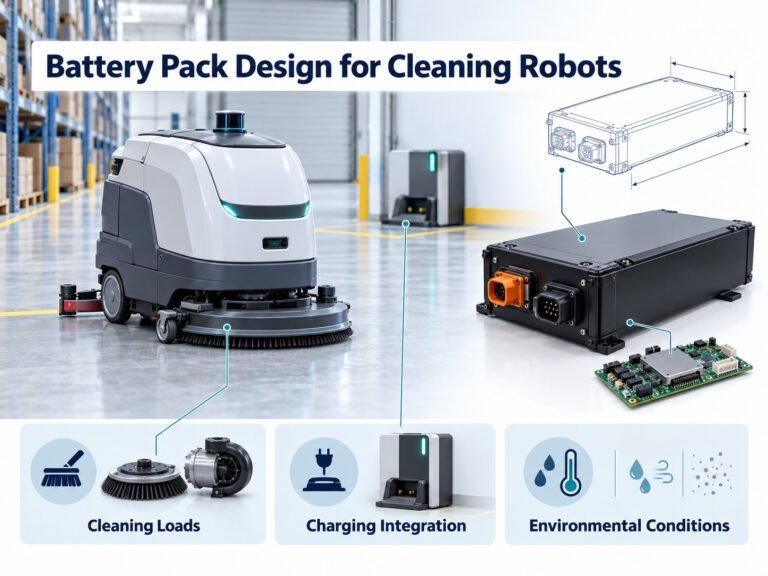
Industrial equipment such as floor-cleaning machines, electric forklifts, and automated machinery may experience continuous electrical loads and heat accumulation.
Battery pack design should consider equipment operating cycles, enclosure ventilation, temperature protection thresholds, and charging requirements.
Energy Storage Battery Systems
LiFePO4 battery packs are commonly used in energy storage applications.
For energy storage systems, temperature affects charging performance, discharge efficiency, and long-term battery aging.
Battery system design may include temperature monitoring, BMS control, thermal management, and communication with inverters or system controllers.
6. Temperature Testing for Custom Lithium Battery Packs
Temperature testing helps verify whether a custom battery pack meets its intended operating requirements.
Depending on the application and project specifications, battery testing may include:
Low-Temperature Discharge Testing
Evaluates battery capacity, voltage behavior, and discharge performance at specified low temperatures.
High-Temperature Discharge Testing
Evaluates battery operation and thermal behavior under elevated ambient temperature conditions.
Temperature Protection Testing
Verifies that the BMS responds to temperature conditions according to the approved protection settings.
Thermal Cycling Testing
Evaluates the battery pack’s response to repeated temperature changes.
Temperature Rise Testing
Measures temperature changes within the battery pack during specified charge or discharge conditions.
Testing requirements should be defined based on the cell specifications, final battery configuration, equipment application, and applicable standards.
7. What Information Is Needed for Temperature-Based Battery Pack Customization?
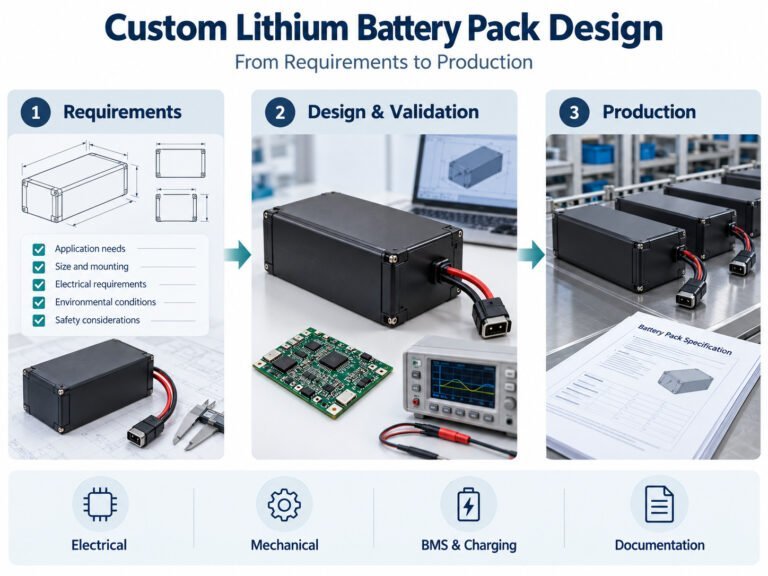
Before developing a custom lithium battery pack, OEM customers should provide information about the operating environment and electrical requirements.
Key information includes:
- Battery voltage and capacity: Required nominal voltage, Ah, or Wh.
- Operating temperature: Minimum and maximum ambient temperatures during equipment operation.
- Charging temperature: Environmental conditions during battery charging.
- Discharge current: Continuous current, peak current, and peak current duration.
- Application: E-bike, AGV, AMR, service robot, industrial equipment, or energy storage system.
- Installation conditions: Available space, enclosure requirements, and mounting orientation.
- Communication requirements: CAN, UART, RS485, or other interfaces.
- Certification requirements: Applicable standards and target markets.
This information allows battery engineers to evaluate cell selection, BMS functionality, thermal management, and mechanical design before producing prototypes.
8. Custom Lithium Battery Pack Manufacturing at First Power
Dongguan Yizhan Electronics Technology Co., Ltd.provides OEM and ODM custom lithium battery pack development and manufacturing services for electric mobility, robotics, industrial equipment, and energy storage applications.
With over 13 years of battery pack manufacturing experience, First Power supports customers with battery cell selection, pack configuration, BMS customization, enclosure development, and battery assembly.
Our custom battery pack solutions can be developed with:
- NMC and LiFePO4 battery cells
- Customized voltage and capacity configurations
- Application-specific BMS protection functions
- CAN, UART, and RS485 communication options
- Customized plastic or metal enclosures
- Temperature monitoring and protection
- Electrical and environmental testing according to project requirements
Each battery project is evaluated according to the customer’s technical specifications, operating environment, and equipment integration requirements.
Conclusion
Operating temperature influences lithium battery performance, charging behavior, battery aging, and thermal safety.
For custom battery pack design, temperature requirements should be evaluated alongside voltage, capacity, discharge current, BMS functions, and mechanical installation conditions.
Whether the application involves an electric bicycle, AGV, AMR, service robot, or energy storage system, understanding the operating environment helps define the battery pack’s engineering requirements.
Looking for a custom lithium battery pack for your equipment?
Contact Yizhan to discuss your battery voltage, capacity, operating temperature, BMS communication, and enclosure requirements. Our engineering team can evaluate a battery pack solution based on your project specifications.
 English
 Chinese
 Japanese
 German
 French
 Korean

