
Electric forklifts are used in warehouses, manufacturing facilities, distribution centers, logistics operations, and other material-handling environments. Different forklift models can have very different requirements for battery voltage, capacity, dimensions, discharge current, charging methods, and communication.
For this reason, a standard lithium battery may not always fit the equipment or operating conditions.
A customized lithium battery pack can be designed around the forklift’s electrical system, available installation space, operating schedule, charging method, and control requirements.
LiFePO4 is one battery chemistry that can be considered for electric forklift applications, particularly when the application requires repeated charging and discharging. However, battery customization should involve more than simply selecting a cell chemistry.
This article explains the main factors to consider when developing a custom lithium battery for an electric forklift.
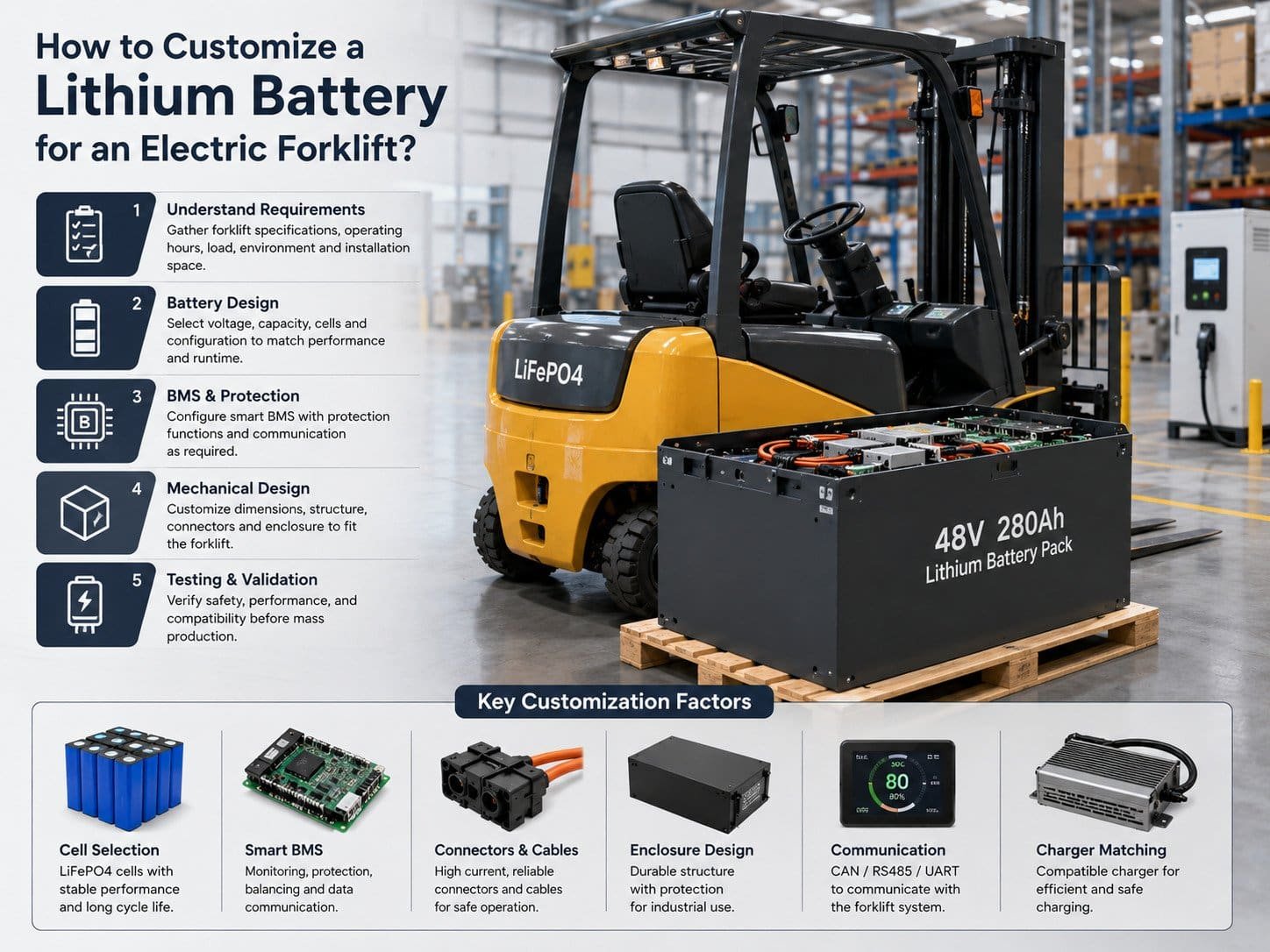
1. Start With the Forklift’s Electrical Requirements
The first step is to determine the forklift’s electrical specifications.
The battery voltage must be compatible with the forklift’s motor, controller, charger, and electrical system.
Common industrial forklift battery voltage ranges include:
- 24V
- 36V
- 48V
- 60V
- 72V
- 80V
The actual voltage should be selected according to the forklift manufacturer’s requirements.
A battery with an incorrect voltage can affect equipment operation and may cause compatibility or safety problems.
Before starting customization, the battery manufacturer should obtain the forklift’s original battery specifications or electrical system information.
2. Determine the Required Battery Capacity
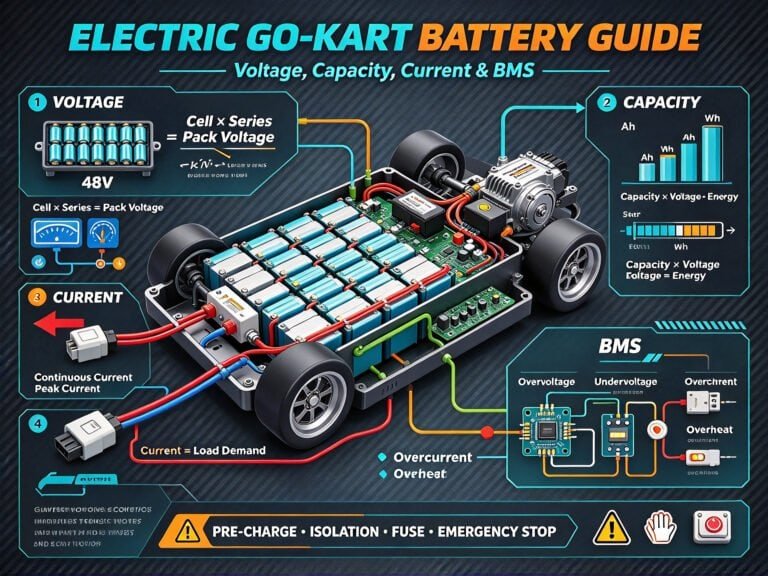
Battery capacity is normally expressed in ampere-hours (Ah) or watt-hours (Wh).
예를 들어
Battery Energy (Wh) = Nominal Voltage (V) × Capacity (Ah)
A 48V 100Ah battery has a nominal energy of approximately:
48 × 100 = 4,800 Wh
However, battery selection should not be based only on the rated energy.
The actual requirement depends on:
- Forklift power consumption
- Load weight
- Average operating time
- 이동 거리
- Lifting frequency
- 운영 환경
- Number of shifts
- Charging opportunities
- Required reserve capacity
An undersized battery may require frequent charging, while an unnecessarily oversized battery can increase weight, cost, and installation requirements.
The target capacity should therefore be based on the forklift’s actual duty cycle.
3. Consider the Forklift’s Operating Schedule
The operating schedule is particularly important for battery customization.
A forklift operating for several hours per day has different battery requirements from one operating continuously across multiple shifts.
For example, a warehouse may use electric forklifts for:
- One shift per day
- Two shifts per day
- Three shifts per day
- 24/7 operation
For multi-shift applications, the battery design should consider how and when charging will take place.
If the forklift has scheduled idle periods, opportunity charging may be possible.
This can change the required battery capacity because the battery does not necessarily need to provide energy for an entire shift before charging.
4. Select the Appropriate Lithium Battery Chemistry
Lithium-ion batteries use different chemistries, each with different characteristics.
For industrial forklift applications, LiFePO4 is one option to evaluate.
LiFePO4 batteries are often considered for applications requiring repeated charge and discharge cycles and a stable operating profile.
When selecting the chemistry, the battery manufacturer should consider:
- Required energy density
- 작동 온도
- 충전 요건
- 방전 전류
- Cycle requirements
- 사용 가능한 설치 공간
- 안전 요건
- Expected operating conditions
The best chemistry depends on the specific forklift and operating environment rather than on the chemistry alone.
5. Select the Battery Cells
Cell selection is an important part of custom battery design.
The battery manufacturer needs to determine:
- Cell format
- Cell capacity
- 세포 화학
- Continuous discharge capability
- 최대 방류 용량
- 충전 전류
- 작동 온도
- 셀 일관성
- Expected application requirements
For example, a high-capacity LiFePO4 cell may be suitable for a forklift requiring relatively high energy capacity, while a different cell configuration may be more appropriate for an application with high peak power requirements.
Cell selection should therefore be based on the complete battery specification.
6. Design the Battery Pack Configuration
After selecting the cells, the battery manufacturer can determine the series and parallel configuration.
The number of cells connected in series determines the battery voltage, while parallel connections determine the available capacity and current capability.
The basic concept is:
Series connection → Voltage
Parallel connection → Capacity and current capability
The final configuration must also consider:
- Cell voltage range
- Battery nominal voltage
- 최대 충전 전압
- Maximum discharge current
- Pack dimensions
- 열 관리
- BMS requirements
A properly designed configuration helps the battery match the forklift’s electrical system and physical requirements.
7. Customize the Battery Dimensions
Physical dimensions are often one of the most important requirements for forklift battery customization.
The battery must fit inside the forklift’s existing battery compartment or designated installation area.
The manufacturer may need to customize:
- 길이
- 너비
- 높이
- 배터리 케이스
- 장착 지점
- Handle positions
- 케이블 배선
- Connector location
- Service access
The battery weight should also be considered.
A forklift is designed around a specific battery weight range. Changing the battery weight significantly may affect the equipment’s weight distribution and operating characteristics.
Therefore, the battery manufacturer should evaluate both electrical compatibility and mechanical compatibility.
8. Design the BMS According to Forklift Requirements
The Battery Management System, or BMS, is an important part of a lithium forklift battery.
A BMS can monitor parameters such as:
- 개별 세포 전압
- 패키지 전압
- 충전 전류
- 방전 전류
- 세포 온도
- 배터리 온도
- 충전 상태
- 고장 상태
Protection functions may include:
- 과충전 방지
- 과방전 방지
- 과전류 보호
- 단락 보호
- 과열 보호
- Under-temperature protection
The BMS parameters should be configured according to the selected cells and the forklift’s operating requirements.
For industrial applications, the relevant battery safety requirements should also be considered during the design and validation process.
9. Consider Communication With the Forklift
Modern electric forklifts may require communication between the battery and the vehicle controller.
Depending on the equipment, communication can use protocols such as:
- CAN
- CAN FD
- RS485
- UART
Through communication, the battery can provide information such as:
- SOC
- SOH
- 배터리 전압
- 현재
- 온도
- 잔여 용량
- 오류 정보
- 충전 상태
For example, the forklift controller can use battery SOC information to determine when the vehicle should return for charging.
If the original forklift uses CAN communication, the custom battery should be designed and tested according to the vehicle’s communication requirements.
10. Customize the Battery Connector
The connector should also be considered during battery development.
The battery connector needs to match the forklift’s electrical and mechanical requirements.
주요 매개변수로는 다음이 있습니다:
- 정격 전압
- 정격 전류
- Connector dimensions
- Polarity
- Cable size
- 연결 방법
- 보호 요건
For applications with high discharge current, cable and connector selection should be based on the expected continuous and peak current.
Poorly matched connectors or cables can lead to increased resistance and heat generation.
11. Match the Battery With the Charger
The charger is another important part of a customized lithium forklift battery system.
The charger should match:
- 배터리 화학
- 공칭 전압
- 최대 충전 전압
- 충전 전류
- BMS requirements
- 충전 온도 범위
- 통신 요구 사항
For example, a LiFePO4 battery pack requires charging parameters appropriate for its cell configuration.
The battery, BMS, and charger should therefore be evaluated as one system.
For opportunity charging applications, the charging current and charging frequency also need to be considered during battery design.
12. Consider Temperature Management
Forklifts may operate in warehouses, cold storage facilities, manufacturing plants, or outdoor loading areas.
Temperature can affect battery performance and charging conditions.
Battery customization should therefore consider:
- Minimum operating temperature
- Maximum operating temperature
- 충전 온도
- 방전 온도
- Heat generation during high-current operation
- Enclosure ventilation
- 열 모니터링
For low-temperature applications, especially cold-storage warehouses, the battery may require a heating solution or charging restrictions.
The BMS can monitor battery temperature and apply protection according to the configured operating limits.
13. Consider Safety and Protection Requirements
A custom lithium forklift battery should include appropriate electrical and mechanical protection.
Depending on the battery design, protection may include:
- BMS 보호
- 퓨즈
- Contactor
- Circuit protection
- 온도 센서
- 단열
- Enclosure protection
- Emergency disconnect
- 적합한 커넥터
Mechanical protection is also important because forklifts operate in industrial environments where vibration, impact, dust, and moisture may occur.
The battery enclosure should therefore be designed according to the forklift’s installation environment.
14. Design for the Actual Duty Cycle
Battery customization should focus on the forklift’s real operating pattern rather than only its nominal specifications.
For example, consider two 48V forklifts.
Forklift A
- 48V system
- Short operating periods
- Light loads
- Several charging opportunities
- Indoor warehouse
Forklift B
- 48V system
- 무거운 짐
- Long operating periods
- Frequent lifting
- Multiple shifts
- Limited charging time
Although both forklifts use a 48V system, their battery requirements can be significantly different.
This demonstrates why battery customization should begin with application data.
15. Information Required for a Custom Forklift Battery
When contacting a battery manufacturer, forklift manufacturers and system integrators should provide as much application information as possible.
유용한 정보는 다음과 같습니다:
| 매개변수 | 필수 정보 |
|---|---|
| Forklift type | Counterbalance, reach truck, pallet truck, etc. |
| 전압 | 24V / 36V / 48V / 72V / 80V |
| 용량 | Required Ah or operating energy |
| 최대 전류 | 연속 전류 및 피크 전류 |
| 운영 시간 | Hours per shift |
| Workload | Average and maximum load |
| 충전 | Standard or opportunity charging |
| 충전 시간 | Available charging window |
| Installation | 배터리 수납부 치수 |
| 무게 | Required battery weight range |
| 커뮤니케이션 | CAN, RS485, or other protocol |
| 환경 | Indoor, outdoor, cold storage, etc. |
| 커넥터 | Required connector type |
| BMS | Required protection and communication functions |
The more complete the application information, the easier it is to develop a battery that matches the forklift.
16. Testing Before Mass Production
Before a customized battery enters mass production, prototype testing should be performed.
Testing may include:
Electrical Testing
- 전압
- 용량
- 충전 전류
- 방전 전류
- 내부 저항
- BMS 보호
열 테스트
- 충전 온도
- 방전 온도
- 고부하 운전
- 기온 상승
Mechanical Testing
- 진동
- Impact
- Connector stability
- Enclosure strength
통신 테스트
- CAN 통신
- SOC data
- 오류 정보
- Charging communication
System Testing
The battery should also be tested together with the actual forklift, charger, and control system.
This can help identify compatibility problems before mass production.
17. Why Customization Can Be Useful for Electric Forklifts
A customized lithium battery allows the battery design to be adapted to the actual forklift rather than requiring the equipment to accommodate a generic battery.
Customization can cover:
- 전압
- 용량
- 셀 유형
- Pack dimensions
- 배터리 무게
- BMS
- 통신 프로토콜
- 커넥터
- 충전 방법
- 온도 관리
- 인클로저 설계
This approach can be particularly useful for OEM forklift manufacturers, warehouse automation companies, and equipment integrators developing different vehicle models.
결론
Customizing a lithium battery for an electric forklift requires more than selecting a voltage and capacity.
The battery should be designed around the forklift’s complete operating requirements, including:
- 전압
- 용량
- Load
- 운영 시간
- 충전 전략
- 세포 화학
- 셀 구성
- BMS
- 커뮤니케이션
- 치수
- 무게
- 커넥터
- 온도
- 보호 요건
LiFePO4 can be considered for forklift applications that require repeated cycling and regular charging, but the final battery configuration should always be based on the actual equipment and operating conditions.
For forklift manufacturers and system integrators, providing detailed vehicle and operating data at the beginning of the project can help the battery manufacturer develop a battery pack that is electrically, mechanically, and operationally compatible with the forklift.
A well-designed custom battery is therefore not simply a collection of lithium cells. It is a complete power system designed around the equipment.
 English
  Chinese
  Japanese
  German
  French
  Korean
