
An electric go-kart battery is a key component of the vehicle’s power system. The battery needs to work with the motor, controller, charger, BMS, wiring, and electrical components. Choosing a battery only by voltage or capacity may not provide a suitable solution for the actual application.
For electric go-kart manufacturers, rental operators, racing applications, recreational vehicles, and battery replacement projects, the battery selection process should consider voltage, capacity, discharge current, battery chemistry, dimensions, charging requirements, BMS configuration, and operating conditions.
This guide explains the main factors involved in selecting or developing an electric go-kart battery.
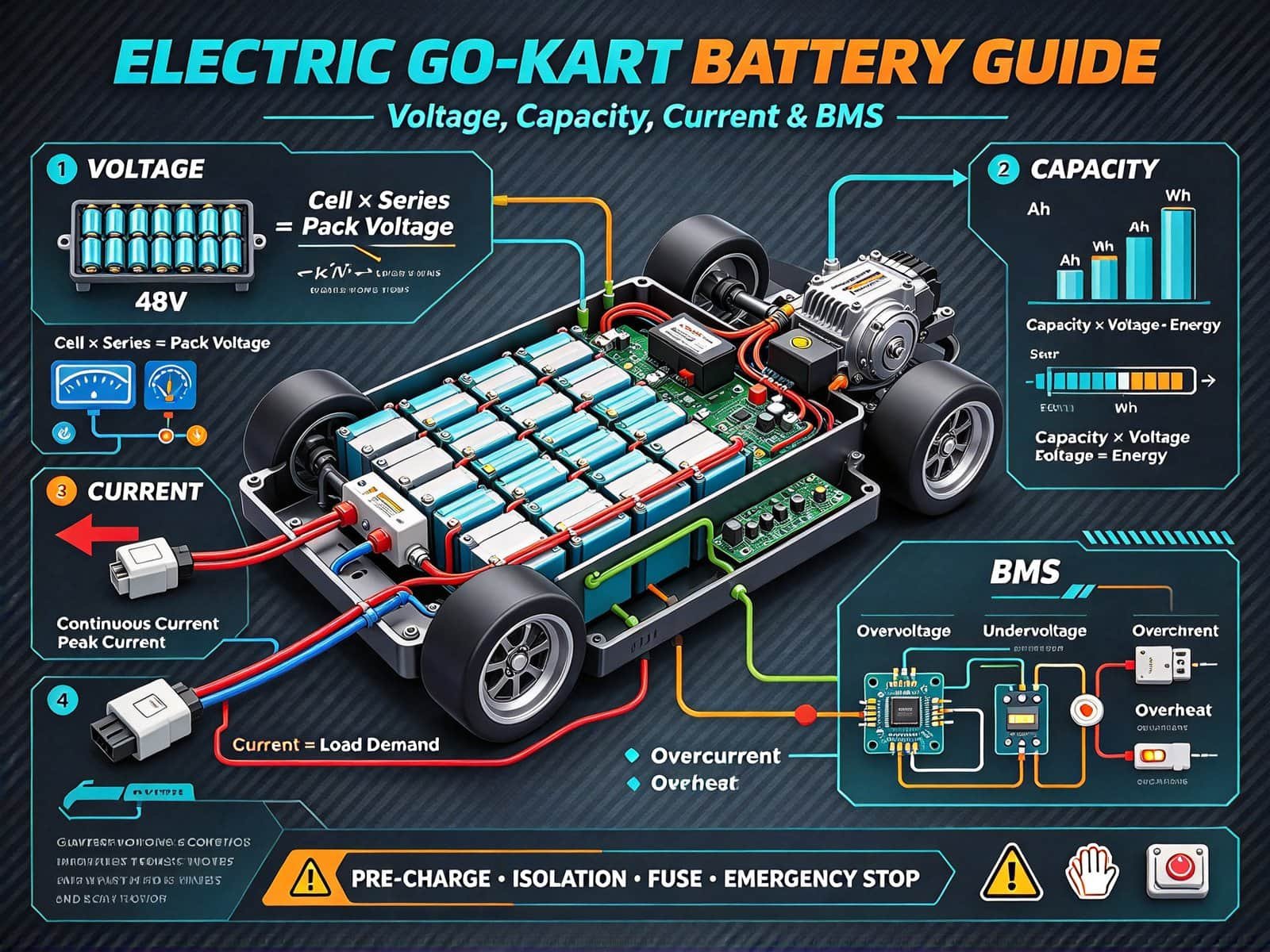
What Is an Electric Go-Kart Battery?
An electric go-kart battery is a rechargeable battery pack designed to supply electrical energy to the vehicle’s motor and electrical system.
A complete battery pack can include:
- Lithium battery cells
- 배터리 관리 시스템(BMS)
- Busbars or nickel strips
- Wires and connectors
- 퓨즈 또는 보호 부품
- 온도 센서
- Battery housing
- 충전 인터페이스
- 통신 인터페이스
The battery specification should match the electrical requirements of the go-kart.
For custom battery projects, the design normally starts with the motor and controller requirements and then determines the appropriate battery configuration.
1. Determine the Required Battery Voltage
Voltage is one of the first parameters to confirm when selecting a go-kart battery.
Electric go-karts may use battery systems such as:
- 24V
- 36V
- 48V
- 60V
- 72V
The required voltage depends on the motor, controller, charger, and vehicle electrical system.
For example, if a go-kart is designed around a 48V electrical system, the battery should have a voltage range compatible with the controller and motor.
A battery labeled 48V cannot automatically be treated as a universal 48V replacement. Different battery packs can have different nominal voltage, full-charge voltage, discharge characteristics, BMS settings, connectors, communication protocols, and physical dimensions.
For replacement projects, the original battery label and controller specifications should be checked before selecting a replacement battery.
2. How to Choose Battery Capacity
Battery capacity is normally measured in ampere-hours (Ah).
예를 들어
48V 20Ah
The nominal energy can be calculated as:
48V × 20Ah = 960Wh
A 48V 30Ah battery provides:
48V × 30Ah = 1,440Wh
A 48V 40Ah battery provides:
48V × 40Ah = 1,920Wh
The Wh value represents nominal stored energy.
Actual operating time depends on the power consumption of the go-kart and the operating conditions.
Factors affecting runtime include:
- 모터 출력
- Vehicle weight
- Driver weight
- Driving speed
- Acceleration frequency
- Driving surface
- 타이어 상태
- 배터리 온도
- 배터리 사용 기간
- Controller settings
For this reason, battery capacity should be selected according to the actual operating profile rather than using Ah as the only parameter.
3. Check Motor Power and Battery Discharge Current
Battery current is an important parameter for electric go-karts.
The theoretical current required by a motor can be estimated using:
I = P ÷ V
For example, a 48V 1,000W motor has a theoretical current of approximately:
1,000W ÷ 48V = 20.8A
However, the actual battery current can be affected by motor efficiency, controller settings, acceleration, load, terrain, and operating conditions.
During acceleration or startup, the current can temporarily increase.
따라서 배터리를 선정할 때는 다음 사항을 고려해야 합니다:
- 연속 방전 전류
- 최대 방전 전류
- 피크 전류 지속 시간
- Controller current limit
- 모터 출력
- Operating load
The cells, BMS, wires, connectors, fuse, and internal busbars should all be designed for the required current.
4. Lithium-Ion or LiFePO4 for Go-Karts?
Two common lithium battery chemistries for electric mobility applications are lithium-ion and lithium iron phosphate (LiFePO4).
Lithium-Ion Battery
Lithium-ion cells can be used for applications that require a compact battery design and a suitable energy-to-weight ratio.
Depending on the application, manufacturers may use cylindrical cells such as 18650 or 21700 cells.
The final cell selection should consider:
- 공칭 전압
- 용량
- 연속 방전 전류
- 최대 방전 전류
- 작동 온도
- Cycle requirements
- Available space
LiFePO4 배터리
LiFePO4 is another battery chemistry used in electric mobility and industrial applications.
A LiFePO4 battery pack has different voltage characteristics from a typical 3.7V-class lithium-ion battery.
For example, a 16S LiFePO4 configuration has a nominal voltage of approximately 51.2V.
A 16S configuration can therefore be used for a 48V-class system when the motor, controller, charger, and BMS are designed for the corresponding voltage range.
Battery chemistry should be selected together with the vehicle’s electrical system rather than treated as an independent choice.
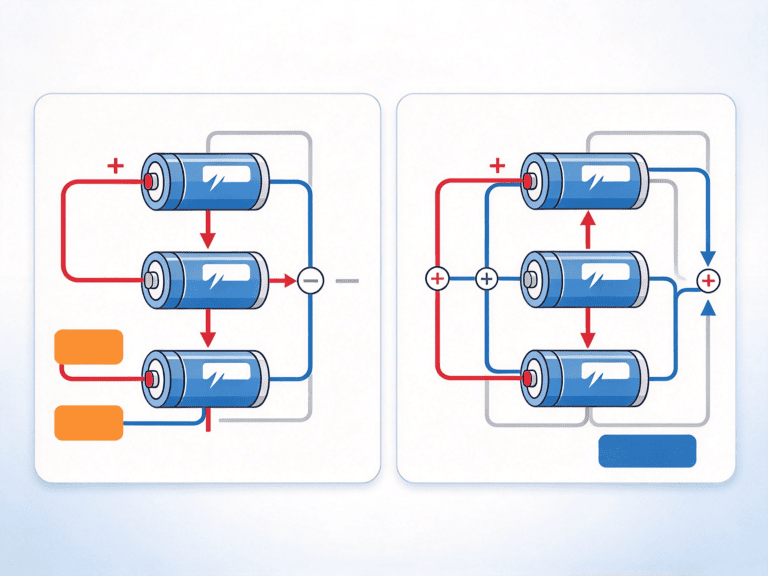
5. Understand Series and Parallel Configuration
Lithium battery packs are normally built using series and parallel connections.
Series connection determines the battery voltage.
Parallel connection increases capacity and supports current requirements.
For example, using 3.7V 5Ah lithium-ion cells:
13S4P
means:
- 13 cells or parallel groups connected in series
- 4 cells connected in parallel in each group
The nominal voltage is:
3.7V × 13 = 48.1V
The capacity is:
5Ah × 4 = 20Ah
The total number of cells is:
13 × 4 = 52 cells
This configuration can produce a 48V-class 20Ah battery pack.
The actual configuration should also consider cell discharge capability, thermal conditions, BMS current rating, housing dimensions, and application requirements.
6. Select the Correct BMS
The Battery Management System is an important part of a lithium go-kart battery.
A BMS can provide functions such as:
- 과충전 방지
- 과방전 방지
- 과전류 보호
- 단락 보호
- 과열 보호
- 저온 보호 기능
- 셀 밸런싱
- 전압 모니터링
- 온도 모니터링
The BMS needs to match the battery’s series configuration.
예를 들어
- 10S battery → 10S BMS
- 13S battery → 13S BMS
- 16S battery → 16S BMS
Current rating is also important.
A go-kart that requires 40A continuous current and 80A peak current needs a BMS and battery system designed around these operating conditions.
Selecting a BMS only according to the nominal battery voltage does not provide enough information for a complete battery design.
7. BMS Communication for Electric Go-Karts
Some electric go-karts use a simple battery system without external communication.
Other systems may require communication between the battery and vehicle controller.
일반적인 통신 인터페이스에는 다음이 포함됩니다:
- CAN
- UART
- RS485
Communication may be used to transmit information such as:
- 배터리 전압
- Battery current
- 충전 상태
- 온도
- 고장 상태
- BMS protection status
- Battery alarms
If communication is required, the BMS communication protocol should be compatible with the vehicle controller.
For a replacement battery, the original communication protocol should be confirmed before production.
8. Battery Dimensions and Installation
Electrical specifications are only one part of battery selection.
The battery must also fit the available installation space.
Important dimensions include:
- Battery length
- Battery width
- Battery height
- 장착 지점
- Cable outlet position
- 커넥터 위치
- Battery housing structure
- Ventilation or thermal management space
For custom go-kart batteries, engineers can develop the housing according to the available battery compartment.
Customers can provide the original battery, battery compartment dimensions, equipment photos, or 3D drawings.
These materials can help determine the appropriate battery structure.
9. Choose a Compatible Charger
The charger needs to match the battery chemistry and charging voltage.
A charger should be selected according to:
- 배터리 화학
- Battery series count
- Full-charge voltage
- 충전 전류
- BMS requirements
- 충전 커넥터
For example, a lithium-ion battery and a LiFePO4 battery can have different charging voltage requirements even when they are used in a similar voltage-class application.
Using an incompatible charger can affect battery protection and charging performance.
The charger specification should therefore be confirmed during battery system design.
10. Battery Safety Design for Electric Go-Karts
Electric go-karts can experience vibration, acceleration, impact, outdoor temperature changes, and high current loads.
The battery design should consider the operating environment.
Depending on the application, the battery pack may require:
- 기계적 보호
- Insulated housing
- Secure cell fixation
- 온도 모니터링
- 과전류 보호
- 단락 보호
- Water and dust protection
- 진동 내성
- Appropriate cable protection
The battery housing should also provide a suitable installation method to prevent movement during operation.
For outdoor or rental go-karts, environmental conditions should be included in the battery design requirements.
11. How to Estimate Go-Kart Battery Runtime
Battery runtime can be estimated from battery energy and average power consumption.
예를 들어
48V × 30Ah = 1,440Wh
If the average electrical power consumption is approximately 720W:
1,440Wh ÷ 720W = 2 hours
This is a theoretical estimate.
Actual runtime can be affected by:
- 모터 효율
- Controller efficiency
- Driving speed
- 가속
- 차량 적재량
- 배터리 온도
- 배터리 잔량
- 지형
- Driving style
For applications requiring a specific operating time, testing under representative conditions is recommended.
12. Common Electric Go-Kart Battery Configurations
Battery configurations vary according to the vehicle design.
Examples include:
36V Battery
Suitable for some low-power recreational or compact electric vehicles.
The actual capacity and current rating should be selected according to the motor and controller.
48V Battery
A 48V-class battery can be designed for various electric go-kart applications.
Possible specifications include:
- 48V 20Ah
- 48V 30Ah
- 48V 40Ah
- 48V 50Ah
The required specification depends on the vehicle’s power and operating time.
60V Battery
A 60V-class system can be used when the motor and controller are designed for the corresponding voltage range.
The battery series configuration and BMS need to match the system.
72V Battery
72V-class battery systems can be used for applications requiring a higher system voltage.
The battery design should be developed together with the motor, controller, charger, BMS, and electrical protection system.
13. What Information Is Needed for a Custom Go-Kart Battery?
When requesting a custom battery quotation, providing complete technical information can help the battery manufacturer evaluate the project.
Recommended information includes:
- Equipment type
- 배터리 전압
- 필요 용량
- 모터 출력
- 정류 전류
- 피크 전류
- 필수 작동 시간
- 배터리 수납부 치수
- 커넥터 유형
- 충전기 사양
- 통신 프로토콜
- Expected sample quantity
- Estimated annual quantity
Photos of the vehicle and original battery are also useful.
For replacement projects, the original battery label should be photographed clearly so the voltage, capacity, model, and other information can be reviewed.
Custom Electric Go-Kart Battery OEM/ODM
Dongguan Yizhan Electronics Technology Co., Ltd. provides custom lithium battery pack development for equipment manufacturers and application projects.
A custom electric go-kart battery can be developed around requirements such as:
- 전압
- 용량
- 세포 화학
- Cell model
- 연속 방전 전류
- 최대 방전 전류
- BMS
- CAN/UART/RS485 communication
- 주택
- 커넥터
- 케이블
- 충전 인터페이스
- 장착 구조
- Label and logo
The development process can include:
Requirement Analysis → Electrical Design → Cell Selection → BMS Design → Structural Design → Prototype → Testing → Mass Production
The battery structure can be designed around the available installation space, while the electrical configuration can be developed according to the motor, controller, charger, and operating requirements.
For electric go-kart manufacturers and battery replacement projects, providing the original battery information and equipment specifications gives engineers a practical starting point for battery design.
FAQ About Electric Go-Kart Batteries
What voltage battery does an electric go-kart use?
Electric go-karts can use different voltage systems, including 24V, 36V, 48V, 60V, and 72V. The correct voltage depends on the motor, controller, charger, and vehicle electrical system.
How many Ah does a go-kart battery need?
The required capacity depends on the expected operating time, motor power, vehicle load, driving conditions, and available installation space. The required capacity should be calculated from the actual application.
Is LiFePO4 suitable for an electric go-kart?
LiFePO4 can be used for electric go-kart applications when its voltage, capacity, discharge current, charging requirements, dimensions, and BMS are compatible with the vehicle system.
Can I replace a lead-acid go-kart battery with a lithium battery?
A lithium battery can be developed as a replacement in some applications, but voltage, capacity, discharge current, charger, dimensions, mounting structure, and electrical connections should be checked before replacement.
Can a 48V battery be used on any 48V go-kart?
Not necessarily. The battery’s voltage range, capacity, discharge current, BMS, connector, communication protocol, charger, and dimensions all need to match the vehicle.
How do I order a custom electric go-kart battery?
Provide the required voltage, capacity, motor power, current requirements, battery dimensions, connector information, charger specification, and photos of the original battery or vehicle. A battery manufacturer can then evaluate the required configuration and develop a suitable OEM/ODM solution.
 English
  Chinese
  Japanese
  German
  French
  Korean
