
Electric forklifts are used in warehouses, manufacturing facilities, distribution centers, logistics operations, and other material-handling environments. Different forklift models can have very different requirements for battery voltage, capacity, dimensions, discharge current, charging methods, and communication.
For this reason, a standard lithium battery may not always fit the equipment or operating conditions.
A customized lithium battery pack can be designed around the forklift’s electrical system, available installation space, operating schedule, charging method, and control requirements.
LiFePO4 is one battery chemistry that can be considered for electric forklift applications, particularly when the application requires repeated charging and discharging. However, battery customization should involve more than simply selecting a cell chemistry.
This article explains the main factors to consider when developing a custom lithium battery for an electric forklift.
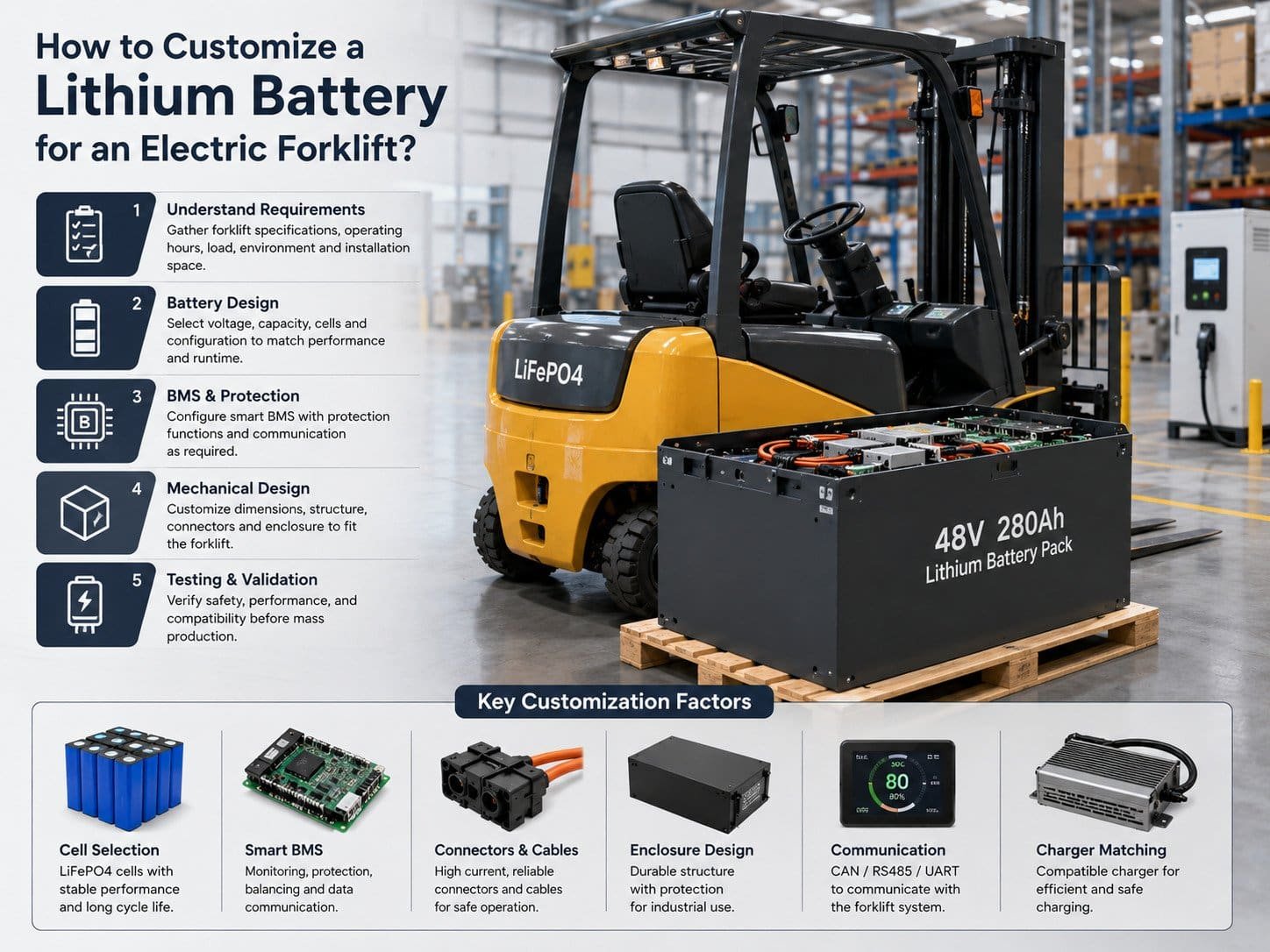
1. Start With the Forklift’s Electrical Requirements
The first step is to determine the forklift’s electrical specifications.
The battery voltage must be compatible with the forklift’s motor, controller, charger, and electrical system.
Common industrial forklift battery voltage ranges include:
- 24V
- 36V
- 48V
- 60V
- 72V
- 80V
The actual voltage should be selected according to the forklift manufacturer’s requirements.
A battery with an incorrect voltage can affect equipment operation and may cause compatibility or safety problems.
Before starting customization, the battery manufacturer should obtain the forklift’s original battery specifications or electrical system information.
2. Determine the Required Battery Capacity
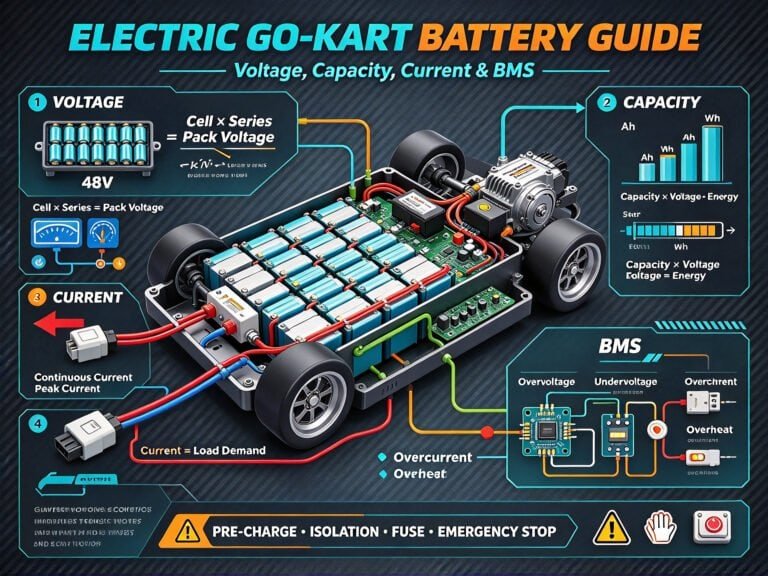
Battery capacity is normally expressed in ampere-hours (Ah) or watt-hours (Wh).
例如
Battery Energy (Wh) = Nominal Voltage (V) × Capacity (Ah)
A 48V 100Ah battery has a nominal energy of approximately:
48 × 100 = 4,800 Wh
However, battery selection should not be based only on the rated energy.
The actual requirement depends on:
- Forklift power consumption
- 载重
- Average operating time
- 旅行距离
- 起重频率
- 运行环境
- 班次数量
- 充电机会
- Required reserve capacity
An undersized battery may require frequent charging, while an unnecessarily oversized battery can increase weight, cost, and installation requirements.
The target capacity should therefore be based on the forklift’s actual duty cycle.
3. Consider the Forklift’s Operating Schedule
The operating schedule is particularly important for battery customization.
A forklift operating for several hours per day has different battery requirements from one operating continuously across multiple shifts.
For example, a warehouse may use electric forklifts for:
- One shift per day
- Two shifts per day
- Three shifts per day
- 全天候运营
For multi-shift applications, the battery design should consider how and when charging will take place.
If the forklift has scheduled idle periods, opportunity charging may be possible.
This can change the required battery capacity because the battery does not necessarily need to provide energy for an entire shift before charging.
4. Select the Appropriate Lithium Battery Chemistry
Lithium-ion batteries use different chemistries, each with different characteristics.
For industrial forklift applications, LiFePO4 is one option to evaluate.
LiFePO4 batteries are often considered for applications requiring repeated charge and discharge cycles and a stable operating profile.
When selecting the chemistry, the battery manufacturer should consider:
- Required energy density
- 工作温度
- Charging requirements
- 放电电流
- 周期要求
- 可用安装空间
- 安全要求
- Expected operating conditions
The best chemistry depends on the specific forklift and operating environment rather than on the chemistry alone.
5. Select the Battery Cells
Cell selection is an important part of custom battery design.
The battery manufacturer needs to determine:
- Cell format
- 电池容量
- 细胞化学
- Continuous discharge capability
- 峰值放电能力
- 充电电流
- 工作温度
- 细胞一致性
- Expected application requirements
For example, a high-capacity LiFePO4 cell may be suitable for a forklift requiring relatively high energy capacity, while a different cell configuration may be more appropriate for an application with high peak power requirements.
Cell selection should therefore be based on the complete battery specification.
6. Design the Battery Pack Configuration
After selecting the cells, the battery manufacturer can determine the series and parallel configuration.
The number of cells connected in series determines the battery voltage, while parallel connections determine the available capacity and current capability.
The basic concept is:
Series connection → Voltage
Parallel connection → Capacity and current capability
The final configuration must also consider:
- Cell voltage range
- Battery nominal voltage
- 最大充电电压
- Maximum discharge current
- Pack dimensions
- 热管理
- BMS 要求
A properly designed configuration helps the battery match the forklift’s electrical system and physical requirements.
7. Customize the Battery Dimensions
Physical dimensions are often one of the most important requirements for forklift battery customization.
The battery must fit inside the forklift’s existing battery compartment or designated installation area.
The manufacturer may need to customize:
- 长度
- 宽度
- 高度
- 电池盒
- 安装点
- Handle positions
- 电缆布线
- 连接器位置
- Service access
The battery weight should also be considered.
A forklift is designed around a specific battery weight range. Changing the battery weight significantly may affect the equipment’s weight distribution and operating characteristics.
Therefore, the battery manufacturer should evaluate both electrical compatibility and mechanical compatibility.
8. Design the BMS According to Forklift Requirements
The Battery Management System, or BMS, is an important part of a lithium forklift battery.
A BMS can monitor parameters such as:
- 单个电池电压
- 电池组电压
- 充电电流
- 放电电流
- 细胞温度
- 电池温度
- 电量状态
- 故障状况
Protection functions may include:
- 过充电保护
- 过放电保护
- 过流保护
- 短路保护
- 过温保护
- Under-temperature protection
The BMS parameters should be configured according to the selected cells and the forklift’s operating requirements.
For industrial applications, the relevant battery safety requirements should also be considered during the design and validation process.
9. Consider Communication With the Forklift
Modern electric forklifts may require communication between the battery and the vehicle controller.
Depending on the equipment, communication can use protocols such as:
- CAN
- CAN FD
- RS485
- UART
Through communication, the battery can provide information such as:
- SOC
- SOH
- 电池电压
- 当前
- 温度
- 剩余容量
- 故障信息
- 充电状态
For example, the forklift controller can use battery SOC information to determine when the vehicle should return for charging.
If the original forklift uses CAN communication, the custom battery should be designed and tested according to the vehicle’s communication requirements.
10. Customize the Battery Connector
The connector should also be considered during battery development.
The battery connector needs to match the forklift’s electrical and mechanical requirements.
重要参数包括:
- 额定电压
- 额定电流
- Connector dimensions
- Polarity
- 电缆规格
- Connection method
- 防护要求
For applications with high discharge current, cable and connector selection should be based on the expected continuous and peak current.
Poorly matched connectors or cables can lead to increased resistance and heat generation.
11. Match the Battery With the Charger
The charger is another important part of a customized lithium forklift battery system.
The charger should match:
- 电池化学
- 额定电压
- 最大充电电压
- 充电电流
- BMS 要求
- Charging temperature range
- 通信要求
For example, a LiFePO4 battery pack requires charging parameters appropriate for its cell configuration.
The battery, BMS, and charger should therefore be evaluated as one system.
For opportunity charging applications, the charging current and charging frequency also need to be considered during battery design.
12. Consider Temperature Management
Forklifts may operate in warehouses, cold storage facilities, manufacturing plants, or outdoor loading areas.
Temperature can affect battery performance and charging conditions.
Battery customization should therefore consider:
- 最低工作温度
- 最高工作温度
- 充电温度
- 卸料温度
- Heat generation during high-current operation
- Enclosure ventilation
- Thermal monitoring
For low-temperature applications, especially cold-storage warehouses, the battery may require a heating solution or charging restrictions.
The BMS can monitor battery temperature and apply protection according to the configured operating limits.
13. Consider Safety and Protection Requirements
A custom lithium forklift battery should include appropriate electrical and mechanical protection.
Depending on the battery design, protection may include:
- BMS 保护
- Fuse
- Contactor
- Circuit protection
- 温度传感器
- 隔热
- Enclosure protection
- Emergency disconnect
- Appropriate connectors
Mechanical protection is also important because forklifts operate in industrial environments where vibration, impact, dust, and moisture may occur.
The battery enclosure should therefore be designed according to the forklift’s installation environment.
14. Design for the Actual Duty Cycle
Battery customization should focus on the forklift’s real operating pattern rather than only its nominal specifications.
For example, consider two 48V forklifts.
Forklift A
- 48V system
- Short operating periods
- Light loads
- Several charging opportunities
- Indoor warehouse
Forklift B
- 48V system
- 重载
- Long operating periods
- Frequent lifting
- 多班制
- Limited charging time
Although both forklifts use a 48V system, their battery requirements can be significantly different.
This demonstrates why battery customization should begin with application data.
15. Information Required for a Custom Forklift Battery
When contacting a battery manufacturer, forklift manufacturers and system integrators should provide as much application information as possible.
Useful information includes:
| 参数 | Information Required |
|---|---|
| Forklift type | Counterbalance, reach truck, pallet truck, etc. |
| 电压 | 24V / 36V / 48V / 72V / 80V |
| 容量 | Required Ah or operating energy |
| 最大电流 | Continuous and peak current |
| 运行时间 | Hours per shift |
| Workload | Average and maximum load |
| 充电 | Standard or opportunity charging |
| 充电时间 | Available charging window |
| 安装 | 电池仓尺寸 |
| 重量 | Required battery weight range |
| 交流 | CAN, RS485, or other protocol |
| Environment | Indoor, outdoor, cold storage, etc. |
| 连接器 | Required connector type |
| BMS | Required protection and communication functions |
The more complete the application information, the easier it is to develop a battery that matches the forklift.
16. Testing Before Mass Production
Before a customized battery enters mass production, prototype testing should be performed.
测试可能包括:
电气测试
- 电压
- 容量
- 充电电流
- 放电电流
- 内部电阻
- BMS 保护
热测试
- 充电温度
- 卸料温度
- 重载运行
- 温度上升
机械测试
- 振动
- 影响
- Connector stability
- Enclosure strength
通信测试
- CAN 通信
- SOC data
- 故障信息
- Charging communication
System Testing
The battery should also be tested together with the actual forklift, charger, and control system.
This can help identify compatibility problems before mass production.
17. Why Customization Can Be Useful for Electric Forklifts
A customized lithium battery allows the battery design to be adapted to the actual forklift rather than requiring the equipment to accommodate a generic battery.
Customization can cover:
- 电压
- 容量
- 细胞类型
- Pack dimensions
- 电池重量
- BMS
- 通信协议
- 连接器
- 充电方式
- 温度管理
- 外壳设计
This approach can be particularly useful for OEM forklift manufacturers, warehouse automation companies, and equipment integrators developing different vehicle models.
结论
Customizing a lithium battery for an electric forklift requires more than selecting a voltage and capacity.
The battery should be designed around the forklift’s complete operating requirements, including:
- 电压
- 容量
- Load
- 工作时间
- 充电策略
- 细胞化学
- 单元配置
- BMS
- 交流
- 尺寸
- 重量
- 连接器
- 温度
- 防护要求
LiFePO4 can be considered for forklift applications that require repeated cycling and regular charging, but the final battery configuration should always be based on the actual equipment and operating conditions.
For forklift manufacturers and system integrators, providing detailed vehicle and operating data at the beginning of the project can help the battery manufacturer develop a battery pack that is electrically, mechanically, and operationally compatible with the forklift.
A well-designed custom battery is therefore not simply a collection of lithium cells. It is a complete power system designed around the equipment.
 English
  Chinese
  Japanese
  German
  French
  Korean
