
Electric scissor lifts are used in construction, warehouse maintenance, facility management, equipment installation, and other elevated work applications. Electric models use batteries to supply power to drive motors, lifting systems, controllers, safety systems, and auxiliary electrical components.
Battery selection can affect operating time, lifting performance, charging requirements, equipment weight, and system compatibility. The selection process involves several parameters, including voltage, capacity, discharge current, operating time, dimensions, weight, charging requirements, battery chemistry, and operating temperature.
Lithium iron phosphate (LiFePO4) is one battery chemistry used in some electric scissor lift applications. Depending on the equipment design, LiFePO4 battery packs can be configured with a Battery Management System (BMS), specific connectors, communication interfaces, and custom dimensions.
This guide explains the main factors to consider when selecting or designing a battery for an electric scissor lift.
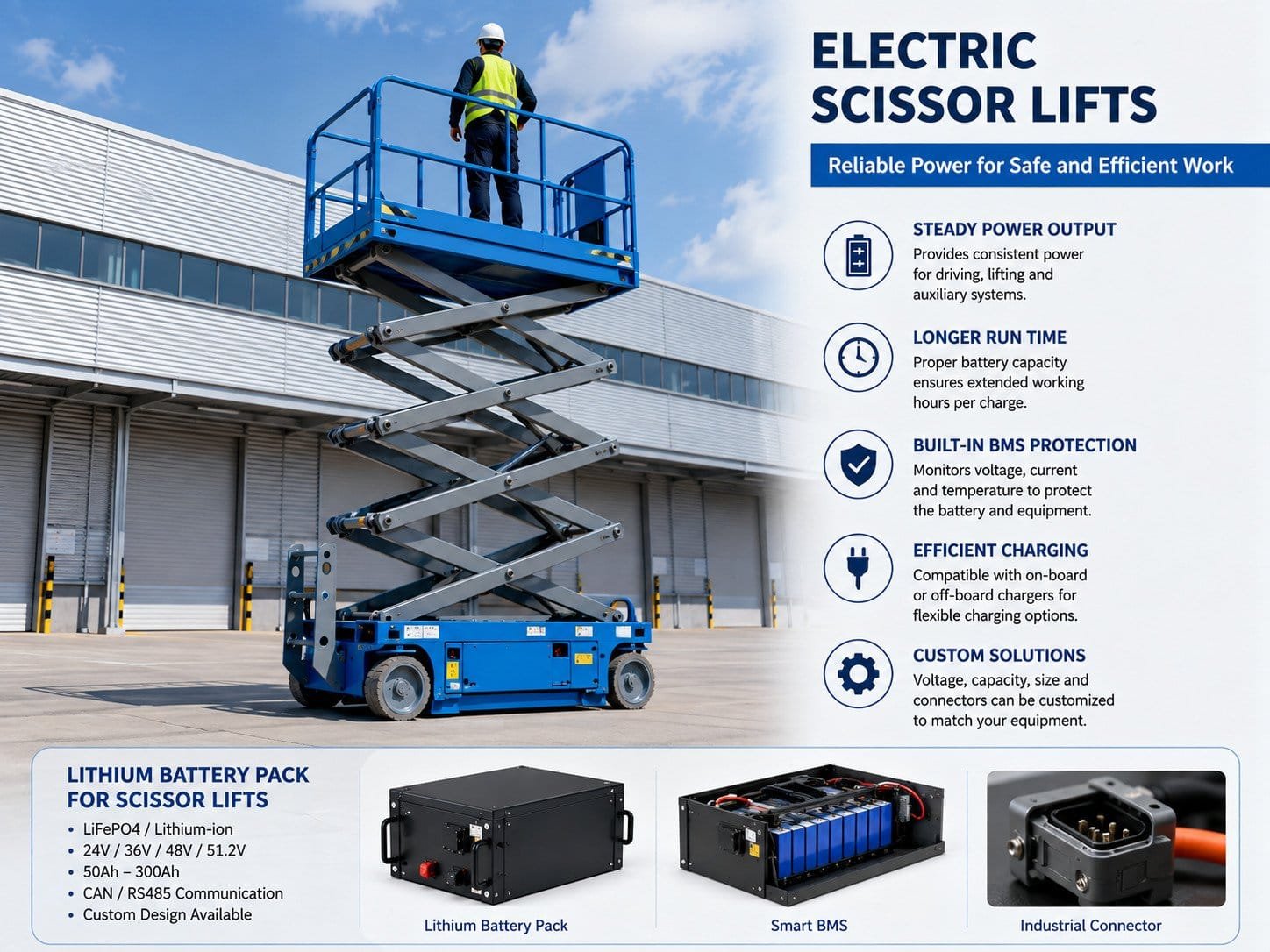
Part 1.What Is an Electric Scissor Lift?
An electric scissor lift is an aerial work platform that uses a scissor mechanism to move a working platform vertically.
Electric scissor lifts are used for applications such as:
- Building maintenance
- 창고 운영
- Factory maintenance
- Lighting installation
- Electrical work
- Equipment installation
- Facility maintenance
- Indoor construction
- Inspection work
A typical electric scissor lift may include:
- Drive motors
- Lifting motors or hydraulic systems
- Motor controllers
- Steering systems
- Control panels
- Safety systems
- 센서
- Emergency systems
- Battery chargers
The battery supplies electrical energy to these systems. Power demand can change according to the equipment’s operating condition. Driving, lifting, steering, standby operation, and auxiliary functions can require different amounts of power.
Part 2.What Type of Battery Does an Electric Scissor Lift Use?
Electric scissor lifts can use different battery technologies depending on the equipment design, operating conditions, and charging system.
납축 배터리
Lead-acid batteries are used in various electric industrial vehicles and access platforms.
Their characteristics include:
- Established battery technology
- Wide availability
- Different capacity options
- Compatibility with many existing equipment designs
- Higher weight in some configurations compared with lithium battery systems
Flooded lead-acid batteries require specific maintenance procedures. Sealed lead-acid and AGM batteries have different maintenance requirements and charging characteristics.
AGM 배터리
Absorbent Glass Mat (AGM) batteries are a type of valve-regulated lead-acid battery.
Their characteristics include:
- Sealed construction
- 정기적인 유지보수가 거의 필요 없음
- Resistance to vibration
- Different capacity and current options
Battery weight, charging voltage, charging current, installation space, and operating conditions should be checked for the specific scissor lift.
LiFePO4 배터리
Lithium iron phosphate, or LiFePO4, is a lithium-ion battery chemistry used in rechargeable battery systems.
A LiFePO4 battery pack for an electric scissor lift can be configured according to requirements such as:
- 공칭 전압
- 용량
- 연속 방전 전류
- 최대 방전 전류
- 배터리 치수
- BMS parameters
- 통신 프로토콜
- 커넥터 유형
- 작동 온도
LiFePO4 can be considered for equipment with regular charging and discharging requirements.
Its suitability depends on the equipment’s electrical system, charger, operating conditions, installation space, and battery specifications.
Part 3.How to Choose a Battery for an Electric Scissor Lift
Battery selection should begin with the equipment specifications rather than a standard battery size.
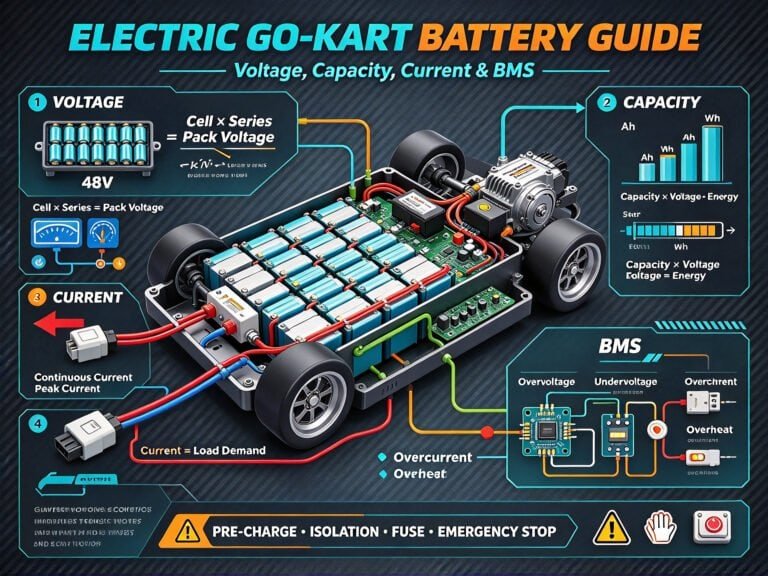
1. Confirm the Battery Voltage
The battery voltage should correspond to the equipment’s electrical system.
Electric scissor lifts can use different voltage platforms. Depending on the equipment design, configurations may include 24V, 36V, 48V, or 51.2V.
The required voltage should be confirmed from the equipment documentation or existing battery specification.
확인:
- Nominal battery voltage
- 모터 전압
- 컨트롤러 전압
- 충전기 출력 전압
- Maximum system voltage
- Minimum operating voltage
When changing from lead-acid to LiFePO4, the battery voltage range and charger requirements should also be evaluated.
A similar nominal voltage does not necessarily mean that two battery chemistries can use the same charging system.
2. Determine Battery Capacity
Battery capacity is commonly expressed in ampere-hours (Ah).
배터리 에너지는 다음 공식을 사용하여 추정할 수 있습니다:
에너지(Wh) = 전압(V) × 용량(Ah)
예를 들어
48V × 100Ah = 4,800Wh
A 48V 100Ah battery has a nominal energy value of approximately 4.8kWh.
The amount of energy available during actual operation can differ from the nominal value. Factors include:
- 방전 전류
- 방전 깊이
- 온도
- BMS settings
- 배터리 노화
- 시스템 효율
For this reason, battery capacity should be selected according to the equipment’s operating cycle.
3. Calculate the Required Operating Time
A basic operating-time estimate can be calculated using:
Operating Time = Battery Energy (Wh) ÷ Average Power Consumption (W)
For example, if the average power consumption is 1,000W and the battery has 4,800Wh of nominal energy:
4,800Wh ÷ 1,000W = 4.8 hours
This is a theoretical estimate.
Actual operating time depends on how the scissor lift is used. Driving, lifting, steering, stopping, standby operation, payload, and auxiliary equipment can all affect energy consumption.
For OEM development, measuring energy consumption during representative operating cycles can provide data for battery capacity selection.
4. 연속 방전 전류 및 피크 방전 전류 확인
Battery capacity does not determine whether a battery can support the motor load.
The battery should be selected to meet the required discharge current.
Higher current can occur during:
- 모터 시동
- 가속
- Platform lifting
- Driving on slopes
- Carrying loads
- Operation on uneven surfaces
Two current specifications should be evaluated:
Continuous discharge current: the current that the battery can provide during normal operation.
Peak discharge current: the current available for a specified period under temporary high-load conditions.
The BMS discharge-current limit should also correspond to the equipment requirements.
For a custom battery project, current requirements can be determined from motor-controller specifications and measurements during equipment operation.
5. Check Battery Dimensions
The battery needs to fit within the available battery compartment.
Measure:
- 길이
- 너비
- 높이
- 장착 지점
- Terminal position
- 커넥터 위치
- 케이블 배선
A custom battery pack can be designed when the available installation space does not match a standard battery format.
The mechanical design should also provide suitable access for installation, charging, inspection, and replacement.
6. Consider Battery Weight
Battery weight contributes to the overall equipment weight.
Lead-acid battery systems are generally heavier than some lithium battery configurations with comparable energy specifications. The actual difference depends on the battery design.
When comparing battery weight, consider the complete battery assembly:
- Cells
- BMS
- 첨부 파일
- 버스바
- 커넥터
- 케이블
- Protection components
The final battery weight should be checked against the equipment’s mechanical, load, and stability requirements.
Part 5.LiFePO4 Battery Characteristics for Electric Scissor Lifts
LiFePO4 can be considered for electric scissor lift applications with regular charge and discharge cycles.
주기 수명
Battery cycle life depends on several factors, including:
- 방전 깊이
- 충전 방법
- 방전율
- 작동 온도
- Cell characteristics
- BMS settings
A cycle-life specification should therefore be evaluated according to the manufacturer’s test conditions.
Actual service life can vary depending on how the battery is used.
무게
A LiFePO4 battery pack can have a lower weight than some lead-acid configurations with similar energy capacity.
The actual weight depends on:
- Cell capacity
- 셀 구성
- BMS
- 주택
- 커넥터
- Protection components
The complete battery assembly should be considered when comparing different battery systems.
Self-Discharge
LiFePO4 batteries generally have relatively low self-discharge compared with lead-acid batteries.
For equipment that remains unused for periods of time, storage conditions and recommended state of charge should follow the battery manufacturer’s specifications.
BMS
A LiFePO4 battery pack normally includes a BMS.
The BMS can monitor:
- 세포 전위
- 패키지 전압
- 충전 전류
- 방전 전류
- 배터리 온도
- 충전 상태
- 고장 상태
Protection functions may include:
- 과충전 방지
- 과방전 방지
- 과전류 보호
- 단락 보호
- 과열 보호
- 저온 보호 기능
The exact protection parameters should be configured according to the cells and equipment requirements.
Part 6.LiFePO4 vs. Lead-Acid for Electric Scissor Lifts
| 기능 | 납산 | LiFePO4 |
|---|---|---|
| 무게 | 일반적으로 더 높다 | Depends on battery configuration |
| Initial cost | 일반적으로 더 낮음 | 일반적으로 더 높다 |
| 주기 수명 | Depends on operating conditions | Depends on operating conditions |
| 자기 방전 | 상대적으로 더 높은 | 비교적 낮은 |
| 유지 관리 | Depends on battery type | Generally low routine maintenance |
| BMS | Usually separate or not integrated | Normally integrated |
| 충전 | Requires compatible charging system | Requires compatible lithium charging system |
| Low-temperature charging | Depends on battery type | Requires appropriate temperature control |
Battery chemistry should be evaluated together with the equipment’s operating cycle, charging system, installation space, temperature range, current requirements, and budget.
Part 7.BMS Requirements for Electric Scissor Lift Batteries
The BMS is a component of a lithium battery pack that monitors battery conditions and controls protection functions.
For an electric scissor lift, the BMS may monitor:
- 세포 전위
- 패키지 전압
- 충전 전류
- 방전 전류
- 세포 온도
- 배터리 온도
- 충전 상태
- 고장 상태
The BMS can also communicate with the equipment controller when the control system supports battery communication.
Possible communication interfaces include:
- CAN
- CAN FD
- RS485
- UART
- Modbus
The required communication interface depends on the control system.
Battery communication may provide information such as:
- 충전 상태
- 전압
- 현재
- 온도
- 충전 상태
- 오류 정보
Communication requirements should be defined during battery development.
Part 8.Charging Requirements
Charging compatibility should be checked when selecting a battery.
For a LiFePO4 battery, check:
- 충전기 출력 전압
- 충전 전류
- 충전 프로필
- 충전 시간
- 커넥터
- 통신 요구 사항
- 충전 온도
A charger designed for lead-acid batteries should not automatically be considered suitable for LiFePO4 batteries.
For fleet applications, the charging method can also affect battery capacity requirements.
Possible charging methods include:
- Scheduled charging
- Overnight charging
- 기회 충전
- Automatic charging
- Battery replacement
The charging method should correspond to the equipment’s working schedule and charging infrastructure.
Part 9.Operating Temperature
Electric scissor lifts may operate indoors or outdoors.
Battery design should consider:
- 작동 온도
- 충전 온도
- 보관 온도
- 온도 변화
- 습도
- 먼지
- 수분
LiFePO4 batteries require specific consideration during low-temperature charging. The BMS can use temperature measurements to restrict charging when conditions fall outside the specified range.
For outdoor equipment, battery housing and environmental protection should also be considered.
Part 10.Battery Enclosure and Mechanical Protection
Electric scissor lifts can experience vibration and mechanical movement during operation.
The battery housing can be designed according to the equipment environment.
Depending on the application, the battery may require:
- Protective housing
- Secure mounting
- 진동 내성
- Moisture protection
- 먼지 방지
- Cable protection
- 적합한 커넥터
- 열 관리
The required enclosure protection level should be determined from the actual operating environment and equipment design.
Part 11.How to Customize a LiFePO4 Battery for an Electric Scissor Lift
OEM manufacturers may have battery requirements that cannot be met by an off-the-shelf battery.
A custom battery pack can be developed according to the equipment specifications.
Step 1: Collect Equipment Information
유용한 정보는 다음과 같습니다:
- Equipment voltage
- Existing battery specification
- 모터 출력
- 피크 전류
- 필수 작동 시간
- 배터리 수납부 치수
- Charger information
- Connector specifications
- 통신 프로토콜
- 작동 온도
Step 2: Calculate Energy Requirements
Start with the estimated power consumption and operating time.
Required Energy = Average Power × Operating Time
The result can be used as a starting point for selecting battery capacity.
Step 3: Select Battery Cells
세포 선정 시 다음 사항을 고려해야 합니다:
- 배터리 화학
- 공칭 전압
- 용량
- 연속 방전 전류
- 최대 방전 전류
- 온도 범위
- Expected cycle conditions
Step 4: Design the Cell Configuration
Cells can be connected in series and parallel according to the required voltage and capacity.
The configuration should be checked against:
- Motor requirements
- 컨트롤러 요구 사항
- Charger requirements
- 건전지 수납공간
- BMS specifications
Step 5: Configure the BMS
BMS parameters can be set according to:
- Cell voltage limits
- 충전 전류
- 방전 전류
- Temperature limits
- 셀 밸런싱
- 통신 요구 사항
Step 6: Design the Battery Housing
The enclosure can be designed according to:
- Available space
- 장착 방법
- 커넥터 위치
- 케이블 배선
- 환경 조건
- Service requirements
Step 7: Test the Battery Pack
Battery testing can include:
- 용량 테스트
- 충전 및 방전 테스트
- BMS 보호 기능 테스트
- 온도 시험
- 통신 테스트
- 진동 테스트
- 커넥터 테스트
- 인클로저 시험
Testing methods should be selected according to the battery design and intended application.
Example of Battery Capacity Calculation
Consider an electric scissor lift with:
- System voltage: 48V
- Average power consumption: 1,200W
- Required operating time: 5 hours
The estimated energy requirement is:
1,200W × 5h = 6,000Wh
At 48V:
6,000Wh ÷ 48V = 125Ah
This provides an initial reference of approximately 48V 125Ah.
The final capacity may need to be adjusted after considering:
- Usable battery energy
- 모터 효율
- Controller efficiency
- Lifting-system efficiency
- 배터리 온도
- 방전 깊이
- 배터리 노화
- Operating load
- Standby consumption
Actual equipment testing can provide additional information for final battery selection.
Part 12.Battery Testing During Product Development
Battery testing can be used to evaluate electrical, thermal, mechanical, and communication requirements.
Testing may include:
- 배터리 용량
- 충방전 성능
- 현재 역량
- BMS 보호
- Temperature behavior
- 통신 기능
- 진동 내성
- Connector performance
- Enclosure protection
For OEM equipment, prototype testing under representative operating conditions can help determine whether the battery configuration meets the equipment requirements.
For batteries intended for transportation, applicable transport testing and documentation should also be considered.
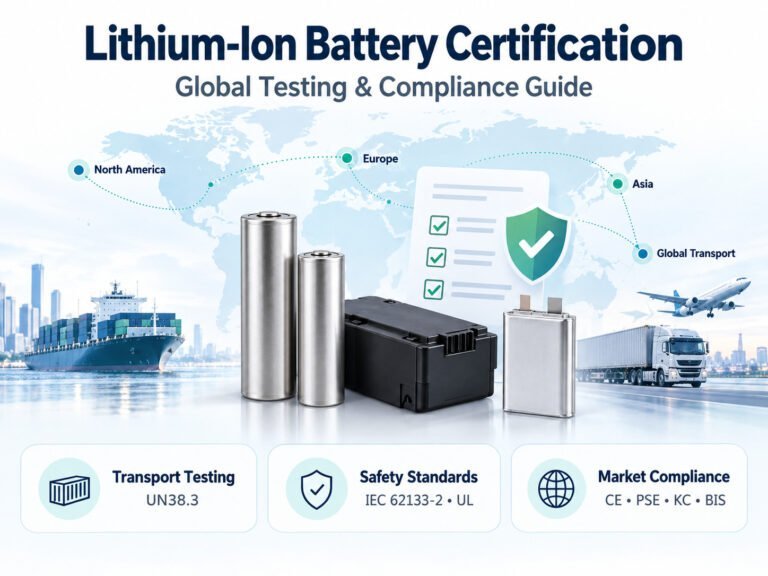
Part 13.Certifications and Compliance
Battery requirements depend on the battery design, application, transportation method, and destination market.
Depending on the project, manufacturers may need to evaluate:
- UN 38.3 운송 시험
- 적용되는 IEC 표준
- 지역별 안전 요건
- 전자기 호환성 요구 사항
- 환경 요건
- Machinery or equipment regulations
For batteries placed on the European market, the applicability of requirements under EU 배터리 규정(EU) 2023/1542 배터리 종류와 용도에 따라 평가되어야 합니다.
Certification requirements should be identified during product development so that relevant design requirements can be considered during battery development.
Part 14.How to Choose an Electric Scissor Lift Battery Manufacturer
For OEM projects, battery suppliers can be evaluated according to their technical and production capabilities.
Relevant areas include:
- 세포 선택
- Battery PACK design
- BMS 구성
- 기계 설계
- Communication development
- 시제품 생산
- 전기 시험
- 환경 시험
- 인증 지원
- Production quality control
Manufacturers should also provide technical documentation related to battery specifications, charging requirements, protection functions, and operating conditions.
For custom battery projects, the manufacturer should be able to explain how the proposed configuration corresponds to the equipment’s electrical and mechanical requirements.
Part 15.Information to Provide When Requesting a Custom Battery
Providing complete equipment information can reduce repeated specification checks during battery development.
OEM buyers can provide:
| 요구사항 | Example Information |
|---|---|
| 전압 | 24V / 36V / 48V / 51.2V |
| 용량 | Ah or Wh |
| 모터 출력 | W or kW |
| 피크 전류 | A |
| 운영 시간 | Hours per shift |
| 충전 | Charger voltage/current |
| 치수 | L × W × H |
| 커뮤니케이션 | CAN / RS485 / UART |
| 온도 | Operating and charging range |
| Installation | Mounting and connector requirements |
| 환경 | Indoor / outdoor / dust / moisture |
Equipment drawings, photos, existing battery specifications, motor data, and operating measurements can also be provided during the battery design process.
자주 묻는 질문
What type of battery is used in an electric scissor lift?
Electric scissor lifts can use lead-acid, AGM, or lithium battery systems depending on the equipment design. LiFePO4 is one lithium chemistry that can be considered for suitable applications.
Is LiFePO4 suitable for electric scissor lifts?
LiFePO4 can be considered for electric scissor lifts that require rechargeable batteries and repeated charge-discharge cycles. Voltage, capacity, current, BMS, charging, dimensions, and operating temperature should be evaluated for the specific equipment.
What voltage does an electric scissor lift battery use?
There is no single voltage specification for all electric scissor lifts. Equipment can use different voltage platforms depending on the motor, controller, and electrical architecture.
How do I calculate battery capacity for a scissor lift?
A basic calculation is:
Battery Energy (Wh) = Voltage (V) × Capacity (Ah)
Required energy can be estimated using:
Required Energy (Wh) = Average Power (W) × Operating Time (h)
The result should then be evaluated against the equipment’s actual operating conditions.
Can I replace lead-acid batteries with LiFePO4?
A lead-acid battery may be replaced with LiFePO4 when the battery voltage, charger, current requirements, BMS, dimensions, connectors, and operating conditions are compatible.
The complete electrical system should be evaluated before changing battery chemistry.
Does a LiFePO4 scissor lift battery need a BMS?
A lithium battery pack normally uses a BMS to monitor battery conditions and provide protection functions. The BMS can also communicate with the equipment controller when required.
How long does a scissor lift battery last?
Battery service life depends on battery chemistry, depth of discharge, charging conditions, operating temperature, discharge rate, storage, and usage frequency. Actual service life varies between applications.
Can an electric scissor lift use a custom battery pack?
Yes. A custom battery pack can be designed according to the equipment’s voltage, capacity, current, dimensions, connectors, BMS, communication, charging, and environmental requirements.
결론
Choosing a battery for an electric scissor lift requires consideration of the complete equipment system. Voltage, capacity, energy consumption, continuous and peak current, operating time, weight, dimensions, battery chemistry, BMS, charging, temperature, communication, and mechanical protection all affect battery selection.
LiFePO4 is one battery chemistry that can be considered for electric scissor lift applications. Its suitability depends on the equipment’s operating cycle, electrical architecture, charging system, installation space, temperature range, and battery requirements.
For OEM equipment manufacturers, a custom battery pack can be designed according to the lift’s electrical and mechanical specifications. The development process may include cell selection, PACK configuration, BMS setup, enclosure design, prototype production, and application testing.
Battery calculations provide an initial reference, while actual operating data and prototype testing can be used to verify the final configuration. Battery specifications should be confirmed against the equipment manufacturer’s requirements and applicable safety, transportation, and market-access requirements.
 English
  Chinese
  Japanese
  German
  French
  Korean
