
Autonome mobile Roboter (AMRs) werden zu einem wichtigen Bestandteil moderner Lagerhäuser, intelligenter Fabriken, Logistikzentren und Produktionsumgebungen. Im Gegensatz zu herkömmlichen fahrerlosen Transportfahrzeugen (AGVs) können AMRs mithilfe von Sensoren, Kameras, KI-Algorithmen und intelligenten Steuerungssystemen selbstständig navigieren.
Hinter jedem effizienten AMR-System steht eine zuverlässige Energiequelle. Die Batterie wirkt sich unmittelbar aus auf:
- Betriebszeit
- Effizienz der Aufladung
- Nutzlastkapazität
- Sicherheitsleistung
- Wartungsanforderungen
- Gesamtsystemproduktivität
Unter den verschiedenen Batterietechnologien, LiFePO4-Batterien (Lithium-Eisenphosphat) haben sich aufgrund ihrer langen Lebensdauer, ihrer hervorragenden thermischen Stabilität, ihrer zuverlässigen Leistung und ihrer Eignung für häufige Ladevorgänge als bevorzugte Wahl für industrielle AMR-Anwendungen etabliert.
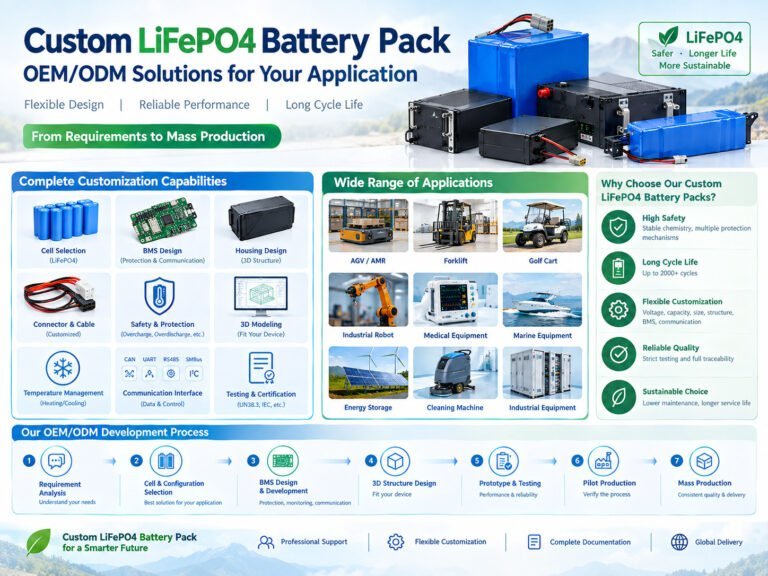
In diesem Leitfaden werden die wichtigsten Faktoren erläutert, die bei der Auswahl einer LiFePO4-Batterie für AMR-Roboter zu berücksichtigen sind, darunter die Batteriechemie, die Spannungsauswahl, die Kapazitätsberechnung, die BMS-Funktionen, Sicherheitsstandards und Anforderungen an die individuelle Anpassung.

Teil 1. Was ist ein AMR-Roboter-Akku?
Ein AMR-Roboterakku ist ein wiederaufladbares Energiespeichersystem, das dafür ausgelegt ist, autonome mobile Roboter stabil mit Strom zu versorgen.
Im Gegensatz zu Verbraucherbatterien müssen industrielle AMR-Batterien folgende Anforderungen erfüllen:
- Lange Arbeitszeiten
- Häufige Ladezyklen
- Hohe Ausgangsstromstärke
- Dauerbetrieb
- Raue industrielle Umgebungen
Ein vollständiger AMR-Akku besteht in der Regel aus:
1.1 LiFePO₄-Batteriezellen
Die Batteriezelle ist die grundlegende Energiespeichereinheit.
Zu den gängigen Spezifikationen von LiFePO4-Zellen gehören:
| Zellentyp | Spannung | Typische Kapazität |
|---|---|---|
| Prismatische Zelle | 3.2V | 50 Ah–280 Ah |
| Zylindrische Zelle | 3.2V | Maßgeschneidert |
| Großformatige Zelle | 3.2V | 100 Ah+ |
Mehrere Zellen werden in Reihe und parallel geschaltet, um die erforderliche Spannung und Kapazität zu erreichen.
Beispiele:
- 24-V-LiFePO4-Akku
- 36-V-LiFePO4-Akku
- 48-V-LiFePO4-Akku
- 72-V-LiFePO4-Akku
Teil 2. Warum sollte man sich bei AMR-Robotern für LiFePO4-Akkus entscheiden?
2.1 Hohe Sicherheitsleistung
Sicherheit ist eine der wichtigsten Anforderungen an Industrieroboter.
AMRs kommen häufig in folgenden Bereichen zum Einsatz:
- Lagerhallen
- Fabriken
- Krankenhäuser
- Produktionswerkstätten
Die LiFePO₄-Chemie zeichnet sich durch eine stabile Molekülstruktur und eine hohe thermische Stabilität aus.
Im Vergleich zu anderen Lithium-Chemien, LiFePO4-Batterien vorsehen:
- Bessere Wärmebeständigkeit
- Stabile chemische Leistung
- Geringeres Risiko unter außergewöhnlichen Bedingungen
- Zuverlässiger Betrieb in industriellen Umgebungen
Bei Anwendungen, bei denen Roboter kontinuierlich in der Nähe von Menschen und Geräten arbeiten, ist die Batteriesicherheit ein entscheidender Faktor.
2.2 Lange Lebensdauer
AMR-Roboter sind in der Regel täglich im Einsatz, manchmal sogar rund um die Uhr.
Häufiges Laden und Entladen erfordert Batterien mit einer hervorragenden Zyklenbeständigkeit.
Ein hochwertiger LiFePO4-Akku bietet folgende Vorteile:
- Tausende Ladezyklen
- Stabile Kapazitätserhaltung
- Geringere Austauschhäufigkeit
Im Vergleich zu herkömmlichen Blei-Säure-Batterien können LiFePO4-Batterien den Aufwand für Batteriewechsel und Wartung erheblich reduzieren.
2.3 Schnellladefunktion
Moderne Lager erfordern eine hohe Auslastung der Anlagen.
AMR-Roboter nutzen häufig:
Gelegenheitsladung
Der Roboter lädt sich während kurzer Ruhephasen automatisch auf.
Automatisches Laden über die Dockingstation
Der Roboter kehrt zur Ladestation zurück, wenn der Akkustand niedrig ist.
Batteriewechselsysteme
Das Betriebspersonal ersetzt leere Akkus durch voll aufgeladene Akkusätze.
LiFePO4-Akkus unterstützen diese Betriebsmodi, da sie für häufiges Laden ausgelegt sind.
2.4 Stabiler Hochstromausgang
AMR-Roboter benötigen dynamische Leistung während:
- Start
- Beschleunigung
- Drehen
- Schwere Lasten tragen
- Kletterrampen
Die Batterie muss einen stabilen Strom ohne nennenswerten Spannungsabfall liefern.
LiFePO4-Akkupacks bieten eine zuverlässige Entladeleistung für industrielle Antriebssysteme.
Teil 3. Gängige Lösungen für die Batteriespannung bei AMR-Geräten
Die Wahl der richtigen Spannung ist einer der ersten Schritte bei der Entwicklung einer Batterie.
3.1 24-V-LiFePO4-Akku für AMR-Roboter
24-V-Batteriesysteme werden üblicherweise für folgende Zwecke eingesetzt:
- Kleine AMR-Roboter
- Lieferroboter für den Innenbereich
- Inspektionsroboter
- Serviceroboter
Vorteile:
- Kompakte Größe
- Geringeres Gewicht
- Geeignet für leichte Anwendungen
Typische Spezifikationen:
- 24 V, 20 Ah
- 24 V, 40 Ah
- 24 V, 60 Ah
3.2 48-V-LiFePO₄-Akku für AMR-Roboter
48 V ist eine der gängigsten Lösungen für industrielle AMR-Systeme.
Anwendungen:
- AMR im Lager
- Materialtransportroboter
- Logistikroboter für die Fertigung
- Intelligente Verkehrssysteme
Typische Modelle:
- 48V 30Ah
- 48 V, 50 Ah
- 48 V, 100 Ah
Vorteile:
- Ausgewogenes Verhältnis zwischen Leistung und Effizienz
- Kompatibel mit vielen industriellen Motorsystemen
- Geeignet für mittlere und schwere Lasten
3.3 72-V-LiFePO4-Akku für hochbelastbare AMR
72-V-Systeme werden eingesetzt für:
- AMRs für schwere Lasten
- Autonome Gabelstapler
- Mobile Roboter für den Außenbereich
Vorteile:
- Höhere Leistung
- Geeignet für anspruchsvolle Anwendungen
- Sorgt für eine längere Betriebsdauer
Teil 4. Wie berechnet man die Kapazität eines AMR-Akkus?
Die Akkukapazität bestimmt, wie lange der Roboter vor dem Aufladen betrieben werden kann.
Zu den wichtigsten Faktoren zählen:
- Leistungsaufnahme des Motors
- Nutzlastgewicht
- Arbeitszeiten
- Betriebsumgebung
- Effizienzsteigerung
Grundlegende Berechnung:
Batteriekapazität (Ah) = Leistungsaufnahme × Betriebszeit ÷ Batteriespannung
Beispiel:
Ein AMR-Roboter:
- Leistungsaufnahme: 500 W
- Betriebsdauer: 8 Stunden
- Batteriespannung: 48 V
Energiebedarf:
500 W × 8 h = 4000 Wh
Akkukapazität:
4000 Wh ÷ 48 V ≈ 83 Ah
Eine geeignete Lösung könnte sein:
48 V, 100 Ah LiFePO₄-Akku
Teil 5. Wichtige Merkmale eines AMR-Batteriemanagementsystems (BMS)
Das BMS ist die intelligente Steuerzentrale des Akkupakets.
Ein professioneller AMR-Akku sollte über ein intelligentes BMS verfügen, das folgende Funktionen bietet:
5.1 Schutzfunktionen
Einschließlich:
- Schutz vor Überladung
- Schutz vor Überentladung
- Überstromschutz
- Kurzschlussschutz
- Schutz vor Überhitzung
- Kälteschutz
5.2 Kommunikationsfunktionen
Industrielle AMR-Systeme erfordern häufig die Kommunikation über Batterien.
Gängige Protokolle:
- CAN-Kommunikation
- RS485
- UART
- Modbus
Das BMS kann unter anderem folgende Informationen bereitstellen:
- SOC (Ladezustand)
- SOH (Gesundheitszustand)
- Spannung
- Aktuell
- Temperatur
- Verbleibende Laufzeit
Dadurch kann die Robotersteuerung den Betrieb optimieren.
Teil 6. Überlegungen zum Design von AMR-Akkupacks
Eine zuverlässige AMR-Batterie erfordert professionelles PACK-Engineering.
6.1 Konstruktion der mechanischen Struktur
Bei der Gestaltung des Batteriegehäuses sollte Folgendes berücksichtigt werden:
- Aufstellfläche für den Roboter
- Schockfestigkeit
- Schutz vor Vibrationen
- Wärmeableitung
- Wartungszugang
6.2 Wärmemanagement
Obwohl LiFePO₄-Batterien eine gute thermische Stabilität aufweisen, können industrielle Anwendungen Folgendes erfordern:
- Überwachung der Temperatur
- Kühlkonzept
- Heizsystem für kalte Umgebungen
Besonders geeignet für:
- Kühlhausroboter
- AMRs für den Außenbereich
- Umgebungen mit niedrigen Temperaturen
6.3 Schutz vor Wasser und Staub
In industriellen Umgebungen können folgende Stoffe vorkommen:
- Staub
- Feuchtigkeit
- Ölverschmutzung
Für Akkus kann Folgendes erforderlich sein:
- Schutzklasse IP65
- Schutzklasse IP67
- Schutzklasse IP68
Teil 7. Anforderungen an die Prüfung von AMR-Batterien
Vor dem Versand sollten professionelle Hersteller umfassende Tests durchführen.
Prüfung auf Zellebene
Einschließlich:
- Prüfung der Kapazität
- Prüfung des Innenwiderstands
- Prüfung der Spannungskonstanz
- Inspektion des Aussehens
PACK-Level-Prüfung
Einschließlich:
Elektrotechnik Testen
- Lade- und Entladetest
- BMS-Funktionsprüfung
- Kommunikationstest
Sicherheitsprüfungen
- Kurzschlusstest
- Überladungsprüfung
- Temperaturtest
Zuverlässigkeitsprüfungen
- Vibrationstest
- Alterungstest
- Zyklustest
Diese Tests tragen dazu bei, eine stabile Leistung im Langzeitbetrieb zu gewährleisten.
Teil 8. LiFePO₄-Akku vs. Blei-Säure-Akku für AMR-Roboter
| Artikel | LiFePO4-Akku | Blei-Säure-Batterie |
|---|---|---|
| Gewicht | Leichtgewicht | Schwer |
| Zyklus Leben | Lang | Kurz |
| Ladegeschwindigkeit | Schneller | Langsamer |
| Wartung | Niedrig | Höher |
| Energieeffizienz | Höher | Nach unten |
| Automatisches Aufladen | Geeignet | Begrenzt |
| Raumausnutzung | Besser | Größer |
Bei modernen Automatisierungssystemen bietet die Lithium-Batterietechnologie eine bessere Kompatibilität mit intelligenten Logistikgeräten.
Teil 9. Wie wählt man einen Hersteller für AMR-LiFePO4-Akkus aus?
Bei der Auswahl eines Batterielieferanten sollten Sie Folgendes berücksichtigen:
9.1 Technische Kompetenz
Ein qualifizierter Lieferant sollte Folgendes bereitstellen:
- Batterie-Design
- Elektrotechnik
- BMS-Entwicklung
- Strukturelle Anpassung
9.2 Zertifizierungsfähigkeit
Zu den gängigen Zertifizierungen gehören:
- UN38.3
- IEC 62133
- CE
- RoHS
- UL-Normen
- EMV-Prüfung
9.3 OEM-/ODM-Anpassung
Hersteller von AMR benötigen häufig maßgeschneiderte Lösungen:
- Sonderabmessungen
- Benutzerdefinierte Spannung
- Individuelle Kapazität
- Kommunikationsprotokolle
- Batterieanschlüsse
Ein professioneller Hersteller kann komplette Batterielösungen vom Prototyp bis zur Serienfertigung anbieten.
Teil 10. Zukünftige Trends bei Batterien für AMR-Roboter
Intelligentes Batteriemanagement
Zukünftige AMR-Batterien werden folgende Komponenten integrieren:
- Fernüberwachung
- Cloud-Datenanalyse
- Vorausschauende Wartung
- Intelligente Diagnostik
Modulares Batteriekonzept
Modulare Lösungen bieten folgende Vorteile:
- Schneller Austausch
- Flexible Kapazitätserweiterung
- Einfache Wartung
Höhere Energieeffizienz
Batteriesysteme werden sich weiter verbessern:
- Energieverwendung
- Ladegeschwindigkeit
- Thermisches Management
- Sicherheitskonzeption
Schlussfolgerung
Die Wahl der richtigen LiFePO4-Batterie ist entscheidend für die Leistung von AMR-Robotern. Eine geeignete Batterielösung sollte folgende Aspekte in Einklang bringen:
- Spannungsanforderungen
- Kapazitätsbedarf
- Sicherheitsleistung
- Lebensdauer des Zyklus
- Kommunikationsfähigkeit
- Umgebungsbedingungen
Für Hersteller von AMR-Systemen und Automatisierungsunternehmen kann die Zusammenarbeit mit einem erfahrenen Lieferanten von Lithium-Batterien dazu beitragen, zuverlässige, maßgeschneiderte Batteriesysteme zu entwickeln, die einen langfristigen industriellen Betrieb gewährleisten.
FAQ: AMR-Roboter-LiFePO4-Akku
Frage 1: Warum werden LiFePO4-Akkus häufig in AMR-Robotern eingesetzt?
LiFePO4-Batterien zeichnen sich durch hervorragende Sicherheit, eine lange Zyklenlebensdauer und ein stabiles Entladungsverhalten aus und sind für häufiges Laden geeignet, wodurch sie sich ideal für industrielle Automatisierungsgeräte eignen.
Frage 2: Welche Batteriespannung wird bei einem AMR-Roboter üblicherweise verwendet?
Zu den gängigen Lösungen gehören:
- 24V
- 36V
- 48V
- 72V
Die richtige Spannung hängt von den Anforderungen des Motors und der Konstruktion des Roboters ab.
Frage 3: Wie lange hält eine AMR-LiFePO₄-Batterie?
Die Lebensdauer der Batterie hängt von den Betriebsbedingungen, der Ladestrategie und der Wartung ab. Industrielle LiFePO4-Akkupacks sind für langfristigen, wiederholten Ladezyklusbetrieb ausgelegt.
Frage 4: Können AMR-Batterien individuell angepasst werden?
Ja. Batteriehersteller können folgende Anpassungen vornehmen:
- Spannung
- Kapazität
- Größe
- Anschluss
- Kommunikationsprotokoll
- BMS-Funktionen
Frage 5: Unterstützt der AMR-Akku die CAN-Kommunikation?
Ja. Industrielle AMR-Akkupacks unterstützen in der Regel die Kommunikationsprotokolle CAN, RS485, UART und Modbus.
 English
  Chinese
  Japanese
  German
  French
  Korean
