AMR Robot LiFePO4 Battery Selection Guide: How to Choose the Right Battery for AMR

Autonomous Mobile Robots (AMRs) are becoming an important part of modern warehouses, smart factories, logistics centers, and manufacturing environments. Unlike traditional automated guided vehicles (AGVs), AMRs can navigate independently using sensors, cameras, AI algorithms, and intelligent control systems.

Behind every efficient AMR system is a reliable energy source. The battery directly affects:

  • Operating time
  • 充电效率
  • Payload capability
  • 安全性能
  • Maintenance requirements
  • Overall system productivity

Among various battery technologies, LiFePO4 (Lithium Iron Phosphate) batteries have become a preferred choice for industrial AMR applications because of their long cycle life, excellent thermal stability, reliable performance, and compatibility with frequent charging operations.

This guide explains the key factors to consider when selecting a LiFePO4 battery for AMR robots, including battery chemistry, voltage selection, capacity calculation, BMS functions, safety standards, and customization requirements.

AMR Robot LiFePO4 Battery Selection Guide1

Part 1. What Is an AMR Robot Battery?

An AMR robot battery is a rechargeable energy storage system designed to provide stable power for autonomous mobile robots.

Unlike consumer batteries, industrial AMR batteries must support:

  • Long working hours
  • 频繁充电
  • High current output
  • Continuous operation
  • Harsh industrial environments

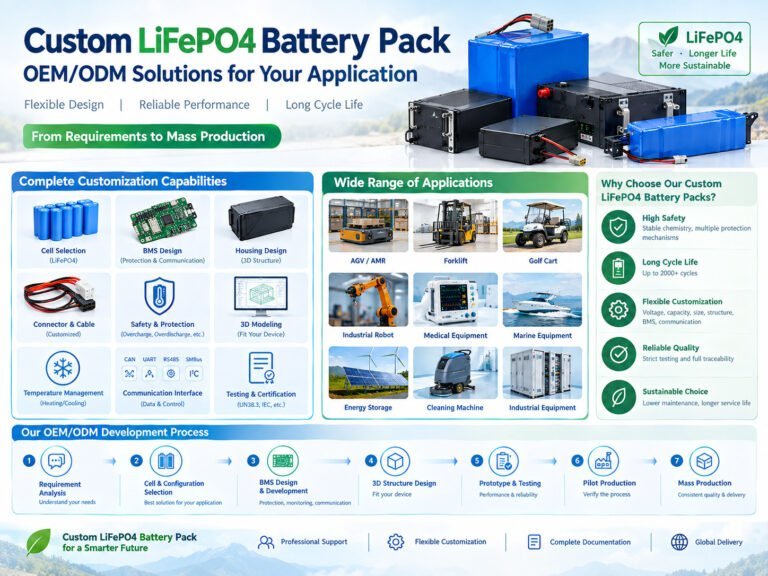
A complete AMR battery pack normally consists of:

1.1 LiFePO4 Battery Cells

The battery cell is the basic energy storage unit.

Common LiFePO4 cell specifications include:

电池类型 电压 典型容量
Prismatic Cell 3.2V 50Ah-280Ah
Cylindrical Cell 3.2V Customized
Large Format Cell 3.2V 100Ah+

Multiple cells are connected in series and parallel to achieve the required voltage and capacity.

例如

  • 24V LiFePO4 battery pack
  • 36V LiFePO4 battery pack
  • 48V LiFePO4 battery pack
  • 72V LiFePO4 battery pack

Part 2. Why Choose LiFePO4 Batteries for AMR Robots?

2.1 High Safety Performance

Safety is one of the most important requirements for industrial robots.

AMRs often operate in:

  • 仓库
  • 工厂
  • 医院
  • Production workshops

LiFePO4 chemistry has a stable molecular structure and strong thermal stability.

Compared with other lithium chemistries, 磷酸铁锂电池 provide:

  • Better thermal resistance
  • 稳定的化学性能
  • Lower risk under abnormal conditions
  • Reliable operation in industrial environments

For applications where robots work continuously around people and equipment, battery safety is a critical consideration.

2.2 Long Cycle Life

AMR robots typically operate every day, sometimes 24 hours per day.

Frequent charging and discharging require batteries with excellent cycle durability.

A quality LiFePO4 battery pack can provide:

  • Thousands of charge cycles
  • 稳定的容量保持
  • Reduced replacement frequency

Compared with traditional lead-acid batteries, LiFePO4 batteries can significantly reduce battery replacement and maintenance requirements.

2.3 Fast Charging Capability

Modern warehouses require high equipment utilization.

AMR robots often use:

Opportunity Charging

The robot automatically charges during short idle periods.

Automatic Dock Charging

The robot returns to the charging station when the battery level is low.

Battery Swap Systems

Operators replace depleted batteries with fully charged packs.

LiFePO4 batteries support these operation modes because they can handle frequent charging.

2.4 Stable High Current Output

AMR robots require dynamic power during:

  • Starting
  • 加速度
  • 转动
  • Carrying heavy loads
  • Climbing ramps

The battery must provide stable current without significant voltage drop.

LiFePO4 battery packs offer reliable discharge performance for industrial motion systems.

Part 3. Common AMR Battery Voltage Solutions

Selecting the correct voltage is one of the first steps in battery design.

3.1 24V LiFePO4 Battery for AMR Robots

24V battery systems are commonly used for:

  • Small AMR robots
  • Indoor delivery robots
  • 检测机器人
  • Service robots

优势

  • Compact size
  • Lower weight
  • Suitable for light-duty applications

Typical specifications:

  • 24V 20Ah
  • 24V 40Ah
  • 24V 60Ah

3.2 48V LiFePO4 Battery for AMR Robots

48V is one of the most common solutions for industrial AMR systems.

应用:

  • Warehouse AMR
  • Material handling robots
  • Factory logistics robots
  • Smart transportation systems

Typical models:

  • 48V 30Ah
  • 48V 50Ah
  • 48V 100Ah

优势

  • Good balance between power and efficiency
  • Compatible with many industrial motor systems
  • Suitable for medium and heavy loads

3.3 72V LiFePO4 Battery for Heavy-Duty AMR

72V systems are used for:

  • Heavy payload AMRs
  • Autonomous forklifts
  • Outdoor mobile robots

好处

  • Higher power output
  • Suitable for demanding applications
  • Supports longer operating time

Part 4. How to Calculate AMR Battery Capacity?

Battery capacity determines how long the robot can operate before charging.

The main factors include:

  • Motor power consumption
  • Payload weight
  • Working hours
  • 运行环境
  • Driving efficiency

Basic calculation:

Battery Capacity (Ah) = Power Consumption × Working Time ÷ Battery Voltage

例如

An AMR robot:

  • Power consumption: 500W
  • Operating time: 8 hours
  • Battery voltage: 48V

Required energy:

500W × 8h = 4000Wh

Battery capacity:

4000Wh ÷ 48V ≈ 83Ah

A suitable solution could be:

48V 100Ah LiFePO4 battery pack


Part 5. Important Features of an AMR Battery Management System (BMS)

The BMS is the intelligent control center of the battery pack.

A professional AMR battery should include a smart BMS with:

5.1 Protection Functions

包括

  • 过充电保护
  • 过放电保护
  • 过流保护
  • 短路保护
  • 过温保护
  • Low-temperature protection

5.2 Communication Functions

Industrial AMR systems often require battery communication.

Common protocols:

  • CAN 通信
  • RS485
  • UART
  • Modbus

The BMS can provide information including:

  • SOC(电量状态)
  • SOH(健康状况)
  • 电压
  • Current
  • 温度
  • Remaining runtime

This allows the robot controller to optimize operation.


Part 6. AMR Battery Pack Design Considerations

A reliable AMR battery requires professional PACK engineering.

6.1 Mechanical Structure Design

The battery enclosure should consider:

  • Robot installation space
  • 抗冲击性
  • Vibration protection
  • Heat dissipation
  • Maintenance access

6.2 Thermal Management

Although LiFePO4 batteries have good thermal stability, industrial applications may require:

  • 温度监测
  • Cooling design
  • Heating system for cold environments

Especially for:

  • Cold storage robots
  • Outdoor AMRs
  • Low-temperature environments

6.3 Waterproof and Dustproof Protection

Industrial environments may contain:

  • 灰尘
  • Moisture
  • Oil contamination

Battery packs may require:

  • IP65 protection
  • IP67 protection
  • IP68 protection

Part 7. AMR Battery Testing Requirements

Before shipment, professional manufacturers should conduct comprehensive testing.

Cell-Level Testing

包括

  • 能力测试
  • 内部电阻测试
  • Voltage consistency testing
  • 外观检查

PACK-Level Testing

包括

Electrical Testing

  • Charge and discharge test
  • BMS function test
  • Communication test

安全测试

  • 短路测试
  • Overcharge test
  • Temperature test

Reliability Testing

  • Vibration test
  • 老化试验
  • 循环测试

These tests help ensure stable performance during long-term operation.


Part 8. LiFePO4 Battery vs Lead Acid Battery for AMR Robots

项目 LiFePO4 Battery Lead Acid Battery
重量 重量轻 重型
周期寿命 Long Short
Charging Speed Faster Slower
维护 Higher
能源效率 Higher Lower
Automatic Charging Suitable 由于可
Space Utilization Better Larger

For modern automation systems, lithium battery technology provides better compatibility with intelligent logistics equipment.


Part 9. How to Select an AMR LiFePO4 Battery Manufacturer?

When choosing a battery supplier, consider:

9.1 Engineering Capability

A qualified supplier should provide:

  • 电池设计
  • Electrical engineering
  • BMS 开发
  • Structural customization

9.2 Certification Capability

常见的认证包括

  • UN38.3
  • IEC 62133
  • CE
  • RoHS
  • UL standards
  • EMC testing

9.3 OEM/ODM Customization

AMR manufacturers often need customized solutions:

  • Special dimensions
  • 定制电压
  • Custom capacity
  • 通信协议
  • Battery connectors

A professional manufacturer can provide complete battery solutions from prototype to mass production.


Part 10. Future Trends of AMR Robot Batteries

Intelligent Battery Management

Future AMR batteries will integrate:

  • Remote monitoring
  • Cloud data analysis
  • 预测性维护
  • 智能诊断

Modular Battery Design

Modular solutions will support:

  • Quick replacement
  • Flexible capacity expansion
  • 易于维护

Higher Energy Efficiency

Battery systems will continue improving:

  • Energy utilization
  • Charging speed
  • 热管理
  • Safety design

结论

Choosing the right LiFePO4 battery is essential for AMR robot performance. A suitable battery solution should balance:

  • Voltage requirements
  • Capacity needs
  • 安全性能
  • 周期寿命
  • Communication capability
  • Environmental conditions

For AMR manufacturers and automation companies, working with an experienced lithium battery supplier can help develop reliable, customized battery systems that support long-term industrial operation.


FAQ: AMR Robot LiFePO4 Battery

Q1: Why are LiFePO4 batteries commonly used in AMR robots?

LiFePO4 batteries provide excellent safety, long cycle life, stable discharge performance, and support frequent charging, making them suitable for industrial automation equipment.

Q2: What voltage battery does an AMR robot usually use?

Common solutions include:

  • 24V
  • 36V
  • 48V
  • 72V

The correct voltage depends on motor requirements and robot design.

Q3: How long does an AMR LiFePO4 battery last?

Battery lifespan depends on operating conditions, charging strategy, and maintenance. Industrial LiFePO4 battery packs are designed for long-term repeated cycling.

Q4: Can AMR batteries be customized?

Yes. Battery manufacturers can customize:

  • 电压
  • 容量
  • 尺寸
  • 连接器
  • 通信协议
  • BMS functions

Q5: Does AMR battery support CAN communication?

Yes. Industrial AMR battery packs commonly support CAN, RS485, UART, and Modbus communication.

Discover why customized lithium battery solutions are ideal for AGVs. Learn how tailored battery packs, smart BMS, LiFePO4 cells, and flexible designs improve AGV efficiency, safety, and operating performance.
2026-07-17
+
Learn how to choose the right AMR Robot LiFePO4 Battery.This complete guide covers battery voltage, capacity, BMS, safety, charging, testing, and OEM customization for industrial AMR applications.
2026-07-17
+
Discover how lithium batteries improve AGV and AMR performance through longer runtime, fast charging, intelligent BMS, higher energy efficiency, and lower maintenance costs. Learn how customized lithium battery solutions support industrial automation.
2026-07-16
+
Discover the differences between 51.2V and 48V home energy storage batteries. Learn about voltage design, efficiency, LiFePO4 advantages, inverter compatibility, and how to choose the right residential energy storage solution.
2026-07-16
+