
Uninterruptible Power Supply (UPS) systems provide backup power when the primary power source is interrupted, unstable, or unavailable. The battery pack is a key component of a UPS system because it stores electrical energy and supplies power to connected equipment when mains power fails.
Lithium battery technology is increasingly used in UPS applications where system designers require a compact battery configuration, controlled charging and discharging, battery monitoring, and integration with electronic equipment.
For OEM and ODM projects, a UPS lithium battery pack cannot be selected only by voltage and capacity. The battery must be designed around the UPS electrical architecture, installation space, load profile, charging system, communication requirements, protection strategy, and operating environment.
This guide explains the main considerations involved in designing and customizing lithium battery packs for UPS applications.
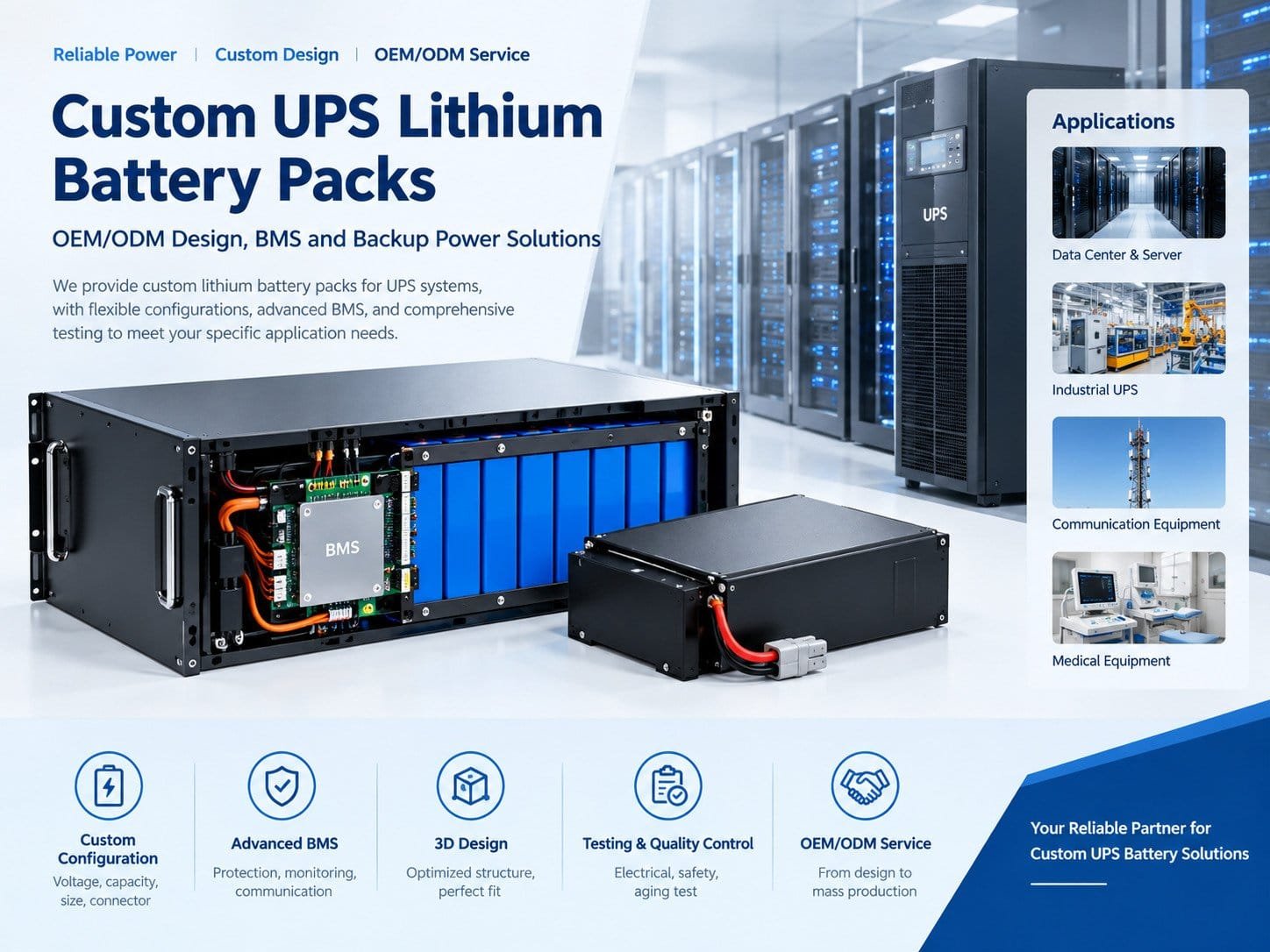
What Is a Lithium Battery Pack for a UPS?
A UPS lithium battery pack is a rechargeable battery assembly designed to provide backup energy to a UPS system.
A typical battery pack can include:
- Lithium-ion or LiFePO4 cells
- Batterie-Management-System (BMS)
- Cell holders or structural components
- Nickel or copper busbars
- Wires and connectors
- Fuse or circuit protection
- Temperatursensoren
- Kommunikationsschnittstelle
- Batteriegehäuse
- Charging and discharge terminals
During normal operation, the UPS system charges the battery while supplying power to the connected load. When the input power is interrupted, the UPS switches to battery operation and draws energy from the battery pack.
The battery pack therefore needs to work within the electrical and communication parameters defined by the UPS system.
Why Use Lithium Batteries for UPS Applications?
Lithium battery packs can be designed in different voltage, capacity, and mechanical configurations, making them suitable for various UPS applications.
Compared with traditional battery technologies, lithium battery systems can provide several design characteristics that may be useful for UPS equipment:
Compact Battery Configuration
Lithium cells can provide a high amount of stored energy within a relatively compact battery structure. This can be useful when UPS equipment has limited internal installation space.
Battery Monitoring
A BMS can monitor parameters such as:
- Zellspannung
- Pack-Spannung
- Strom aufladen
- Entladungsstrom
- Cell temperature
- MOSFET temperature
- Ladezustand (State of Charge, SOC)
- Gesundheitszustand (SOH)
The available monitoring functions depend on the BMS architecture.
Controlled Charging and Discharging
The BMS can manage charging and discharging conditions according to predefined protection parameters.
This can include overcharge, over-discharge, over-current, short-circuit, and temperature protection.
Communication Capability
For UPS systems requiring battery information, the battery pack can be designed with communication interfaces such as CAN, RS485, or UART.
This allows the battery and UPS control system to exchange information when the communication protocol is properly matched.
How to Select UPS Battery Voltage and Capacity
Voltage and capacity are two fundamental parameters when designing a UPS battery pack.
Akku-Spannung
The battery voltage must be compatible with the UPS DC bus voltage and charging architecture.
Common battery configurations can include:
- 12V
- 24V
- 36V
- 48V
- 51.2V
- 72V
- 96 V
The actual nominal voltage depends on the cell chemistry and series configuration.
For example, a LiFePO4 cell has a nominal voltage of approximately 3.2V. A 16-series configuration can therefore form a nominal battery voltage of approximately 51.2V.
The final battery configuration should be confirmed according to the UPS manufacturer’s electrical specifications rather than selected from nominal voltage alone.
Batteriekapazität
Capacity is generally expressed in ampere-hours (Ah).
Zum Beispiel:
48 V, 50 Ah
The theoretical stored energy can be estimated as:
48V × 50Ah = 2,400Wh
However, the usable energy available to the UPS will depend on the battery operating voltage range, discharge current, temperature, conversion efficiency, BMS settings, and other system parameters.
How to Calculate UPS Battery Backup Time
A basic estimation can use the following formula:
Backup Time ≈ Battery Voltage × Battery Capacity × System Efficiency ÷ Load Power
For example, consider a 48V 50Ah battery connected to a UPS with a 1,000W load.
Battery energy:
48V × 50Ah = 2,400Wh
Assuming a system efficiency of 90%:
2,400Wh × 90% = 2,160Wh
Estimated backup time:
2,160Wh ÷ 1,000W = 2.16 hours
This is a theoretical calculation rather than a guaranteed operating time.
Actual backup time may vary because of:
- UPS conversion efficiency
- Battery discharge current
- Batterietemperatur
- Batteriealterung
- Abschaltspannung
- BMS-Schutz-Einstellungen
- Load fluctuations
- Cable and connector losses
For an OEM project, runtime should therefore be validated through an actual discharge test under the customer’s expected load conditions.
BMS Design for UPS Lithium Battery Packs
The Battery Management System is an important part of a custom UPS battery pack.
A BMS can monitor individual cells and control battery operating conditions.
Cell Voltage Monitoring
The BMS monitors individual cell voltages to identify abnormal voltage conditions.
Cell voltage information can also be used for balancing and protection.
Schutz vor Überladung
If the battery reaches a defined charging voltage limit, the BMS can interrupt or control the charging path according to the BMS architecture.
Schutz vor Überentladung
The BMS can disconnect the discharge circuit when the battery reaches a defined low-voltage threshold.
This helps prevent operation outside the specified battery voltage range.
Over-Current Protection
UPS systems can experience changes in load current during operation.
The BMS can be configured with charge and discharge current limits based on the battery cells, MOSFETs, wiring, connectors, and system requirements.
Kurzschlussschutz
Short-circuit protection can be incorporated into the BMS and battery protection architecture.
The response time and protection threshold should be validated according to the battery design and application requirements.
Überwachung der Temperatur
Temperature sensors can be positioned at selected locations within the battery pack.
Temperature protection can be configured for:
- Aufladen
- Discharging
- High temperature
- Low temperature
- Cell temperature
- MOSFET temperature
The exact protection thresholds depend on the selected cell chemistry and system requirements.
UPS Battery Communication: CAN, RS485 and UART
Some UPS systems require communication between the battery pack and the UPS controller.
Common interfaces include:
CAN
CAN communication is widely used in industrial battery systems and allows the battery BMS to transmit information such as:
- SOC
- Spannung
- Aktuell
- Temperatur
- Alarm status
- Protection status
- Battery fault information
RS485
RS485 can be used for communication between the BMS and UPS controller when the system protocol supports it.
UART
UART may be used for internal communication, configuration, diagnostics, or communication with external control electronics.
The physical interface alone is not enough to guarantee compatibility.
The communication protocol, baud rate, data format, command structure, register definition, and fault-response logic should also be confirmed during the development stage.
Selecting Cells for a Custom UPS Battery
Cell selection should be based on the electrical and operating requirements of the UPS system.
Zu den wichtigen Parametern gehören:
- Cell chemistry
- Nennspannung
- Kapazität
- Maximaler Dauer-Abgabestrom
- Spitzenableitstrom
- Ladestrom
- Cycle requirements
- Betriebstemperatur
- Cell dimensions
- Innerer Widerstand
- Supplier consistency
- Required certifications
For applications requiring a long service life and stable thermal characteristics, LiFePO4 cells may be considered depending on the UPS architecture.
For compact battery designs, lithium-ion cells can also be evaluated according to the required energy density and discharge characteristics.
The battery manufacturer should select cells according to the complete application requirements rather than capacity alone.
Mechanical Design of a UPS Battery Pack
Mechanical design is another important part of battery customization.
A battery may need to fit inside a specific UPS enclosure or battery compartment.
The design process can include:
- Abmessungen der Batterie
- Zellanordnung
- Mounting holes
- Brackets
- Steckverbinder
- Kabelverlegung
- Fuse location
- BMS position
- Cooling space
- Service access
- Battery replacement method
For OEM projects, 3D design can be used to confirm the battery structure before prototype production.
This helps engineers review installation space, connector positioning, cable routing, and interference with surrounding components.
Safety and Protection Design
UPS battery safety depends on the complete battery system rather than one individual component.
A custom battery pack may incorporate multiple layers of protection, including:
- BMS-Schutz
- Fuse protection
- Überstromschutz
- Kurzschlussschutz
- Schutz vor Überladung
- Schutz vor Überentladung
- Temperaturschutz
- Zellausgleich
- Structural insulation
- Electrical insulation
- Connector protection
The protection design should be matched to the battery chemistry, cell configuration, operating current, enclosure, charger, UPS controller, and application environment.
LiFePO4 Battery Packs for UPS Applications
LiFePO4 is one of the lithium battery chemistries that can be evaluated for UPS applications.
A LiFePO4 battery pack can be configured in different series and parallel combinations to meet the required voltage and capacity.
Zum Beispiel:
16S1P LiFePO4
can provide approximately:
51.2V nominal voltage
A parallel configuration can then be added when additional capacity or current capability is required.
Zum Beispiel:
16S2P
uses two parallel cell strings and provides approximately twice the capacity of a corresponding 16S1P configuration when using identical cells.
The actual configuration must be determined according to the UPS charging voltage, load current, available space, thermal conditions, and required backup runtime.
UPS Lithium Battery Testing
Testing is an important part of OEM/ODM battery development.
Depending on the application, testing can include:
Electrical Testing
- Nennspannung
- Kapazität
- Charge performance
- Entladungsleistung
- Innerer Widerstand
- Current response
- Konsistenz der Spannung
BMS Testing
- Schutz vor Überladung
- Schutz vor Überentladung
- Überstromschutz
- Kurzschlussschutz
- Temperaturschutz
- Zellausgleich
- Kommunikationsfunktionen
Battery Aging
Battery aging or burn-in testing can help identify abnormal behavior before shipment.
Structural Inspection
Mechanical inspection can include:
- Abmessungen der Batterie
- Anschlussposition
- Cable length
- Gehäusebaugruppe
- Insulation
- Labels
- Befestigungspunkte
The final test plan should be created according to the customer’s battery specification and application requirements.
UPS Battery OEM/ODM Customization Process
A structured development process can help reduce communication errors between the battery manufacturer and equipment manufacturer.
Schritt 1: Bestätigung der Anforderungen
The customer provides information such as:
- UPS model
- Rated power
- Batteriespannung
- Required capacity
- Load profile
- Backup runtime
- Einbauraum
- Maximaler Entladestrom
- Ladestrom
- Kommunikationsanforderungen
- Betriebstemperatur
- Estimated order quantity
Photos, drawings, existing battery samples, and UPS technical documentation can also help engineers understand the application.
Schritt 2: Entwurf der Batterielösung
The engineering team evaluates:
- Zellkonfiguration
- Akkukapazität
- BMS
- Elektrischer Schutz
- Mechanical structure
- Steckverbinder
- Kommunikation
- Ladevorgaben
Step 3: 3D and Structural Design
A 3D battery model can be developed according to the available installation space.
This allows the customer to confirm the battery dimensions and mounting structure before physical sampling.
Step 4: Prototype Development
After the technical specification is confirmed, a prototype battery pack can be assembled for functional testing.
Step 5: Testing and Validation
The prototype can be evaluated under the expected operating conditions.
Testing can include capacity, charging, discharging, BMS protection, communication, temperature behavior, and mechanical requirements.
Step 6: Sample Confirmation
The customer evaluates the sample in the actual UPS system.
Feedback from the system test can then be incorporated into the battery design.
Step 7: Mass Production
After technical approval, the battery specification is transferred into production.
Production controls can cover cell matching, welding, BMS assembly, wiring, insulation, testing, aging, and final inspection.
Applications of Custom UPS Lithium Battery Packs
Custom lithium battery packs can be designed for different backup power applications, including:
- Server UPS systems
- Industrielle USV-Anlagen
- Kommunikationsgeräte
- Network equipment
- Medizinische Ausrüstung
- Sicherheitssysteme
- Notfallausrüstung
- Steuerungssysteme
- Data acquisition equipment
- Automation equipment
- Laborausstattung
- Portable backup power systems
Each application can require different battery specifications.
For example, a medical device may require a compact battery with communication and controlled discharge characteristics, while an industrial UPS may require a higher-capacity battery pack with a different mechanical structure and thermal design.
What Information Is Needed for a Custom UPS Battery?
For an accurate battery solution, customers can provide the following information:
| Spezifikation | Beispiel |
|---|---|
| UPS power | 1,000W |
| Batteriespannung | 48V |
| Akkukapazität | 50 Ah |
| Required backup time | 2 hours |
| Maximaler Entladestrom | Application dependent |
| Ladestrom | Application dependent |
| Chemie der Batterie | LiFePO4 / Li-ion |
| Einbauraum | L × W × H |
| Kommunikation | CAN / RS485 / UART |
| Anschluss | Customer specification |
| Betriebstemperatur | Application dependent |
| Sample quantity | Project requirement |
| Annual quantity | Project estimate |
The more complete the initial information, the easier it is to evaluate the electrical and mechanical requirements.
Why Work With a Custom Battery Manufacturer?
A custom battery manufacturer can integrate cell selection, BMS development, mechanical design, prototype assembly, testing, and production into one development process.
For UPS OEM projects, this can be useful when the original battery does not meet the required capacity, dimensions, communication protocol, runtime, or installation requirements.
Dongguan Yizhan Electronics Technology Co., Ltd. provides custom lithium battery pack development for equipment manufacturers and engineering projects.
The customization process can cover:
- Auswahl der Batteriezellen
- Konfiguration von Spannung und Kapazität
- BMS design
- CAN / RS485 / UART Kommunikation
- Elektrischer Schutz
- 3D structural design
- Entwicklung von Prototypen
- Batterieprüfung
- OEM-/ODM-Fertigung
- Custom labels and packaging
The final battery configuration is developed according to the customer’s UPS specifications and application requirements.
Frequently Asked Questions
Can you customize a lithium battery for an existing UPS?
Yes. A battery can be developed according to the UPS voltage, charging requirements, load characteristics, installation dimensions, connector, and communication protocol.
Can LiFePO4 batteries be used in UPS systems?
LiFePO4 can be used in suitable UPS systems when the UPS charging voltage, BMS settings, current requirements, and communication functions are compatible with the battery configuration.
Can the battery communicate with the UPS?
Yes. When required, the battery BMS can be designed with CAN, RS485, or UART communication. The communication protocol must be matched with the UPS controller.
How do I calculate the required UPS battery capacity?
A basic estimation can use:
Battery Capacity (Wh) ≈ Load Power (W) × Required Runtime (h) ÷ System Efficiency
The actual battery capacity should also consider the battery voltage range, discharge current, temperature, aging, and reserve capacity.
Can you design the battery structure according to our UPS enclosure?
Yes. Battery dimensions, mounting points, connector position, cable routing, and other mechanical requirements can be incorporated into the custom battery design.
What information should I provide for a UPS battery quotation?
Provide the UPS model, rated power, battery voltage, required backup time, installation dimensions, existing battery information, discharge requirements, communication protocol, and estimated quantity. Photos or drawings of the UPS and original battery are also useful.
Schlussfolgerung
A UPS lithium battery pack should be designed as part of the complete backup power system rather than treated as a standalone battery.
Voltage, capacity, discharge current, charging conditions, BMS protection, communication, mechanical dimensions, thermal conditions, and testing requirements all influence the final battery configuration.
For OEM and ODM projects, a structured development process from requirement analysis and 3D design to prototype testing and mass production can help align the battery with the UPS system.
If you are developing a UPS system or replacing an existing battery with a custom lithium battery pack, provide the UPS specifications, battery requirements, installation dimensions, and expected runtime. The battery configuration can then be evaluated according to the actual application.
 English
  Chinese
  Japanese
  German
  French
  Korean
