
Warehouse automation is rapidly changing the way goods are stored, transported, and delivered. Automated Guided Vehicles (AGVs), Autonomous Mobile Robots (AMRs), robotic forklifts, and smart material handling systems are becoming essential equipment for modern logistics operations.
At the center of every automated system is the battery pack.
A reliable battery solution directly affects:
- Operating uptime
- Effizienz der Aufladung
- Robot availability
- Instandhaltungskosten
- Warehouse productivity
Traditional lead-acid batteries were once widely used in industrial vehicles. However, as warehouses require longer operating hours, faster charging, and lower maintenance, LiFePO4 battery packs are becoming the preferred power solution for AGV and robotics applications.
Combined with Opportunitätskosten, LFP battery systems allow robots to operate continuously with minimal downtime.

1. Why Battery Selection Matters for AGV and Robotics Systems
AGVs and AMRs operate differently from traditional vehicles.
Unlike forklifts that may run in fixed shifts, autonomous robots often work:
- 24/7 warehouse environments
- Multiple operation cycles per day
- Dynamic routes
- High-frequency acceleration and braking
- Automated charging schedules
A poor battery choice can cause:
- Unexpected shutdowns
- Reduced robot efficiency
- Increased labor costs
- Shorter equipment lifespan
For warehouse automation, batteries need to provide:
| Requirement | Battery Performance Needed |
|---|---|
| Long operation time | Hohe Energiedichte |
| Frequent charging | High cycle life |
| Safe indoor operation | Stabile Chemie |
| Dauerbetrieb | Schnellladefunktion |
| Smart management | Intelligent BMS communication |
This is why lithium battery technology has become a key component of warehouse automation.
2. Why LiFePO4 Batteries Are Preferred for AGV and Robotics
Among different lithium battery chemistries, LiFePO4 has become one of the most widely adopted solutions for industrial robots and AGV systems.
2.1 Long Cycle Life Reduces Replacement Costs
AGVs frequently charge and discharge throughout the day.
A typical LFP battery pack can provide:
- 3,000–8,000+ charge cycles depending on design and operating conditions
- Stabile Kapazitätserhaltung
- Lange Lebensdauer
Compared with lead-acid batteries, LFP batteries reduce battery replacement frequency and improve total cost efficiency.
2.2 High Safety Performance for Indoor Applications
Safety is a critical factor in warehouses.
LiFePO4 chemistry provides:
- Stabile thermische Eigenschaften
- Low risk of thermal runaway
- Reliable performance under continuous operation
For warehouses where hundreds of robots may operate simultaneously, battery safety is a key consideration.
2.3 Higher Usable Energy Capacity
Traditional lead-acid batteries usually cannot use their full rated capacity without affecting lifespan.
LiFePO4 battery packs offer:
- Higher usable capacity
- Stabilere Ausgangsspannung
- Bessere Energienutzung
This allows AGVs and robots to maintain consistent performance during long working cycles.
2.4 Lightweight Design Improves Robot Efficiency
Battery weight directly affects:
- Robot payload capacity
- Energieverbrauch
- Movement efficiency
Compared with lead-acid alternatives, lithium battery packs can reduce system weight while maintaining equivalent or higher energy output.
This provides more design flexibility for:
- AMRs
- Mobile robots
- Robotic arms
- Autonome Gabelstapler
3. Opportunity Charging: The Key to 24/7 Warehouse Automation
What Is Opportunity Charging?
Opportunity charging means robots recharge their batteries during short breaks instead of waiting for a full charging session.
Zum Beispiel:
- Robot finishes a delivery task
- Robot automatically returns to charging station
- Battery receives a short charging boost
- Robot immediately returns to operation
This charging method supports continuous warehouse operation.
4. Why Opportunity Charging Works Better With LFP Battery Packs
Opportunity charging requires batteries that can handle frequent charging cycles.
LiFePO4 batteries provide several advantages:
High Charging Acceptance
LFP batteries can accept higher charging currents compared with traditional batteries.
This enables:
- Short charging windows
- Faster energy recovery
- Reduzierte Ausfallzeiten
Excellent Partial State of Charge Performance
Many warehouse robots rarely discharge completely.
They often operate between:
- 20%–80% state of charge
- Multiple short charging cycles
LFP batteries perform well under partial charging conditions.
Intelligent BMS Control
Modern AGV battery packs use smart Battery Management Systems (BMS).
A smart BMS can monitor:
- Spannung
- Aktuell
- Temperatur
- Ladezustand (State of Charge, SOC)
- Gesundheitszustand (SOH)
Zu den Kommunikationsmöglichkeiten gehören:
- CAN-Bus
- RS485
- UART
- Modbus
This allows robots and warehouse management systems to optimize charging schedules.
5. Key Design Requirements for AGV Battery Packs
A professional AGV battery pack is more than simply connecting battery cells together.
It requires:
5.1 High-Quality Battery Cells
Common choices include:
- LiFePO4 cylindrical cells
- LiFePO4 prismatic cells
Cell matching is important:
- Konsistenz der Spannung
- Anpassung des Innenwiderstands
- Capacity balance
5.2 Customized Battery Structure
AGV battery packs often require customized designs according to:
- Robot dimensions
- Einbauraum
- Spannungsanforderungen
- Kommunikationsprotokolle
Gemeinsame Konfigurationen:
- 24V AGV battery pack
- 36V robot battery pack
- 48V AGV battery system
- 51.2V industrial battery pack
- 72V heavy-duty robot battery
5.3 Industrial Protection Design
Warehouse environments require durable battery systems.
Typical features include:
- IP65/IP67 protection
- Vibration resistance
- Temperaturschutz
- Kurzschlussschutz
- Schutz vor Überladung
- Schutz vor Überentladung
6. AGV and Robotics Battery Market Opportunities
The growth of warehouse automation is creating increasing demand for customized lithium battery solutions.
Main Application Areas
Automatisch gesteuerte Fahrzeuge (AGVs)
Verwendungszweck:
- Material transportation
- Manufacturing logistics
- Warehouse movement
Autonomous Mobile Robots (AMRs)
Verwendungszweck:
- Picking
- Sorting
- Delivery
- Verwaltung der Bestände
Robotic Forklifts
Verwendungszweck:
- Pallet transportation
- Automated storage systems
- Heavy-duty material handling
Industrial Robots
Battery systems support:
- Mobile robotic platforms
- Inspektionsroboter
- Serviceroboter
7. Future Trends of AGV Battery Technology
Intelligentes Batteriemanagement
Future AGV batteries will integrate more intelligence:
- Fernüberwachung
- Vorausschauende Wartung
- Cloud-based battery analytics
Höhere Energiedichte
Battery manufacturers continue improving:
- Cell chemistry
- Pack structure
- Thermisches Management
Battery Standardization
More automation companies are looking for:
- Modular battery packs
- Quick replacement systems
- Standard communication interfaces
Sustainable Warehouse Operations
Lithium battery solutions support greener warehouses through:
- Geringerer Wartungsaufwand
- Längere Nutzungsdauer
- Höhere Energieeffizienz
8. How to Choose an AGV Battery Pack Supplier
When selecting a battery partner, companies should evaluate:
Manufacturing Capability
Look for suppliers with:
- Automatisierte Produktionslinien
- Systeme zur Zellsortierung
- Laserschweißtechnik
- Aging test facilities
Qualitätszertifizierungen
Important certifications include:
- UN38.3
- IEC 62133
- CE
- RoHS
- UL-Zertifizierung
- ISO quality management systems
Custom Engineering Support
Ein zuverlässiger Lieferant sollte dies bieten:
- Unterstützung bei der Entwicklung von Batterien
- BMS-Anpassung
- Entwicklung von Prototypen
- Testing services
FAQ: AGV & Robotics Battery Pack
Q1: Why are LiFePO4 batteries used in AGVs?
LiFePO4 batteries provide long cycle life, stable performance, safety advantages, and support frequent charging, making them suitable for continuous warehouse operations.
Q2: Can AGV batteries support opportunity charging?
Yes. LiFePO4 battery packs are designed to handle frequent short charging cycles, making them suitable for opportunity charging systems.
Q3: How long does an AGV lithium battery last?
A properly designed LiFePO4 AGV battery pack can typically operate for several years depending on usage conditions, charging strategy, and maintenance.
Q4: What voltage batteries are commonly used in AGV robots?
Common AGV battery voltages include:
- 24V
- 36V
- 48V
- 51.2V
- 72V
Q5: Can AGV batteries be customized?
Ja. Batteriehersteller können folgende Anpassungen vornehmen:
- Spannung
- Kapazität
- Größe
- Kommunikationsprotokoll
- BMS-Funktionen
- Steckverbinderkonstruktion
Conclusion: LFP Battery Packs Enable the Future of Warehouse Automation
As warehouses move toward higher levels of automation, battery technology becomes a critical factor in system reliability.
LiFePO4 battery packs combined with opportunity charging provide AGV and robotics systems with:
- Längere Betriebszeiten
- Reduzierte Ausfallzeiten
- Improved safety
- Geringerer Wartungsaufwand
- Better operational efficiency
For companies developing AGVs, AMRs, robotic forklifts, or automated warehouse equipment, choosing the right lithium battery partner is an important step toward building reliable automation solutions.
Customized AGV & Robotics LiFePO4 Battery Solutions
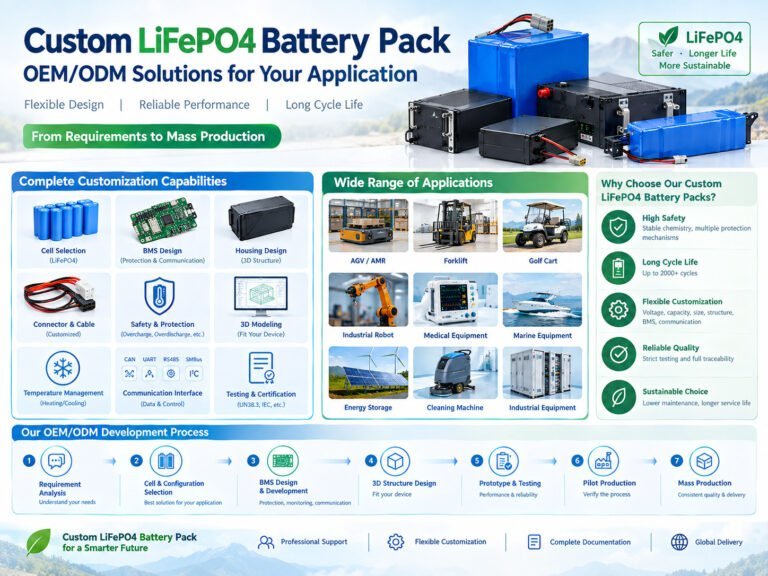
Dongguan Yizhan Electronics Technology Co., Ltd. provides customized lithium battery packs for AGV, AMR, robotics, forklifts, and industrial equipment.
With expertise in LiFePO4 battery design, smart BMS integration, OEM/ODM manufacturing, and quality testing, we help global customers develop reliable power solutions for warehouse automation.
 English
  Chinese
  Japanese
  German
  French
  Korean
