As warehouses, manufacturing plants, and distribution centers continue to automate their operations, 自动导引车 (AGV) 和 Autonomous Mobile Robots (AMRs) have become essential for improving efficiency and reducing labor costs.
While navigation systems, sensors, and software receive much attention, the battery system is equally critical. It directly affects runtime, charging efficiency, payload capacity, maintenance requirements, and overall operational reliability.
Compared with traditional lead-acid batteries, 锂离子电池, especially 磷酸铁锂(LiFePO4) batteries, offer significant advantages that help AGVs and AMRs achieve higher productivity and lower total operating costs.

Why Battery Technology Matters for AGV & AMR
AGVs and AMRs typically operate:
- 24/7 production environments
- Multi-shift warehouse operations
- Automated manufacturing lines
- Cold storage logistics
- E-commerce fulfillment centers
These applications require batteries that provide:
- Long operating time
- 快速充电
- High reliability
- Stable power output
- 最少维护
- Long service life
A battery failure can stop an entire logistics workflow, making battery performance a key factor in system reliability.
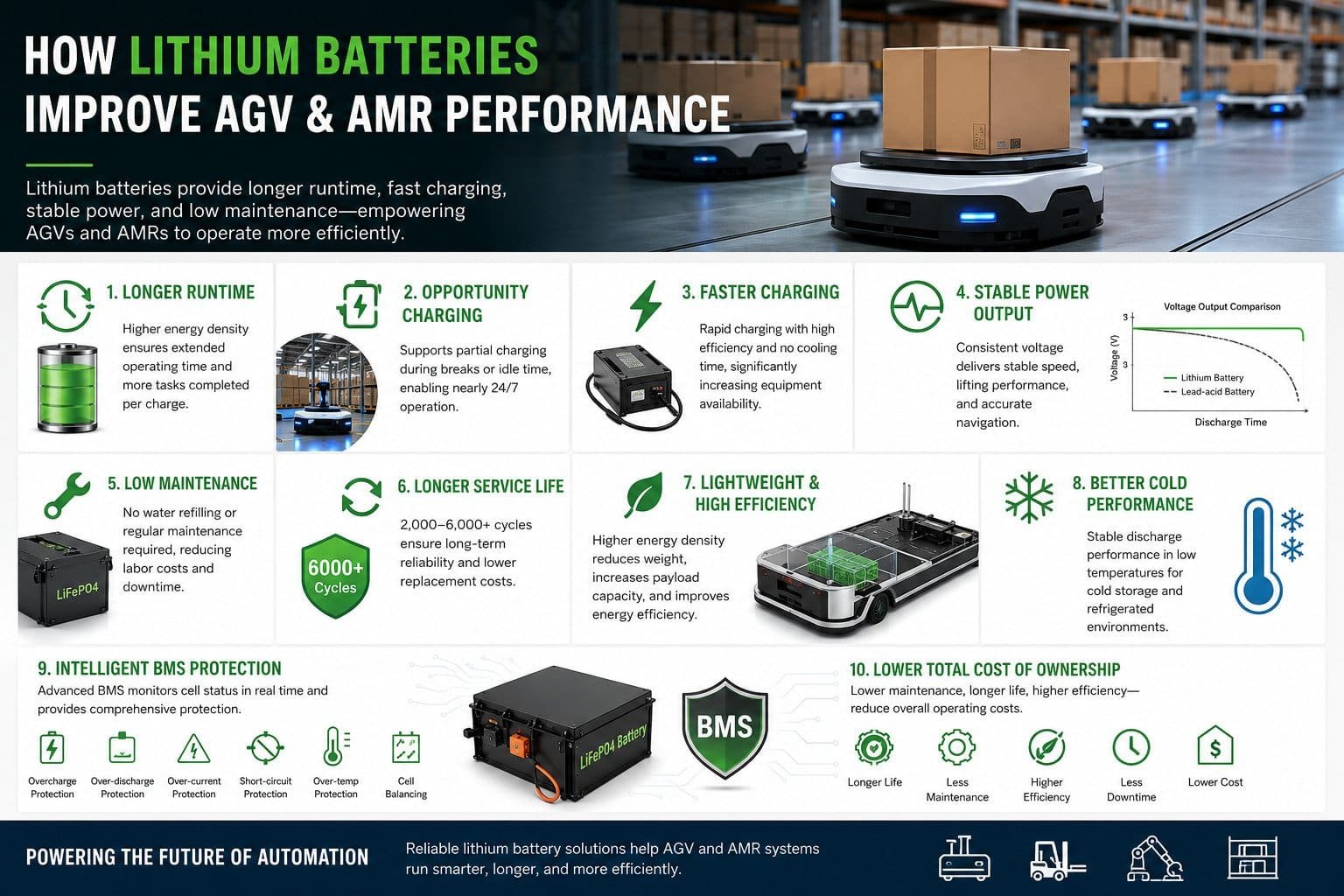
1. Longer Operating Time
Lithium batteries have a much higher energy density than lead-acid batteries.
福利包括
- Longer runtime per charge
- Reduced charging frequency
- Increased daily productivity
- Extended operating shifts
For AGVs and AMRs working across large facilities, longer runtime means fewer interruptions and more completed tasks.
2. Opportunity Charging Increases Productivity
One of the biggest advantages of lithium batteries is 机会收费.
Unlike lead-acid batteries, lithium batteries can be recharged during short breaks without damaging battery life.
Examples include:
- During loading
- During unloading
- Lunch breaks
- Shift changes
- Idle waiting periods
This enables nearly continuous operation without battery replacement.
好处
- 减少停机时间
- 提高车队利用率
- Smaller battery inventory
- Improved warehouse efficiency
3. Faster Charging
Lead-acid batteries often require:
- 8–10 hours charging
- 6–8 hours cooling
- Dedicated charging rooms
Lithium batteries typically support:
- Rapid charging
- High charging efficiency
- No cooling period
- Flexible charging schedules
This significantly increases equipment availability.
4. Stable Voltage Output
Lead-acid battery voltage gradually drops during discharge.
As voltage decreases:
- Driving speed may reduce
- Lifting performance may decline
- Robot accuracy may decrease
Lithium batteries maintain a relatively stable voltage throughout most of the discharge cycle.
福利包括
- Consistent travel speed
- Stable lifting capability
- Reliable sensor performance
- Better navigation accuracy
This is especially important for precision warehouse automation.
5. Reduced Maintenance Costs
Lead-acid batteries require:
- 加水
- 终端清洁
- 均衡充电
- Corrosion inspection
- Ventilation management
Lithium batteries are virtually maintenance-free.
This reduces:
- Labor costs
- Maintenance downtime
- Human error
- Service interruptions
For fleets with dozens or hundreds of AGVs, maintenance savings can be substantial.
6. Longer Service Life
Battery replacement is a major operating expense.
Typical cycle life:
| 电池类型 | 典型循环寿命 |
|---|---|
| 铅酸 | 500-1,000 个循环 |
| 磷酸铁锂 | 2,000–6,000+ cycles |
A longer lifespan means:
- Fewer battery replacements
- Lower lifecycle costs
- 更好的投资回报
- More predictable maintenance planning
7. Higher Energy Density Reduces Vehicle Weight
Lithium batteries store more energy in a smaller and lighter package.
优势包括
- Lower vehicle weight
- 提高能源效率
- Higher payload capacity
- Better acceleration
- Reduced mechanical wear
Manufacturers can also design more compact AGVs and AMRs while maintaining the same runtime.
8. Better Performance in Cold Environments
Cold-chain logistics and refrigerated warehouses require batteries that can operate reliably at low temperatures.
Modern lithium battery systems can include:
- Low-temperature cells
- Self-heating functions
- Intelligent temperature monitoring
- Thermal protection
These features help maintain stable performance in challenging environments.
9. Intelligent Battery Management System (BMS)
A high-quality lithium battery pack includes an intelligent Battery Management System (BMS).
The BMS continuously monitors:
- Cell voltage
- Current
- 温度
- 充电状态 (SOC)
- State of Health (SOH)
Protection functions include:
- 过充电保护
- 过放电保护
- 过流保护
- 短路保护
- 过温保护
- 细胞平衡
Many industrial battery packs also support communication protocols such as:
- CAN总线
- CAN FD
- RS485
- Modbus RTU
This allows seamless integration with AGV and AMR fleet management systems for real-time battery monitoring and predictive maintenance.
10. Improved Safety
Safety is essential in automated facilities.
LiFePO4 batteries offer:
- 卓越的热稳定性
- 降低热失控风险
- High mechanical durability
- Stable chemical structure
Combined with advanced BMS protection and quality manufacturing processes, lithium battery packs provide reliable operation in demanding industrial environments.
11. Lower Total Cost of Ownership (TCO)
Although lithium batteries generally have a higher upfront cost than lead-acid batteries, they can reduce overall operating expenses over time through:
- 使用寿命更长
- 充电更快
- 减少维护
- 更高的能源效率
- 减少停机时间
- Lower replacement frequency
For facilities operating multiple AGVs or AMRs around the clock, these savings can significantly improve long-term cost efficiency.
Choosing the Right Lithium Battery for AGVs and AMRs
When selecting a battery solution, consider the following factors:
- System voltage (24V, 36V, 48V, 60V, 72V, etc.)
- Required capacity (Ah)
- 连续和峰值放电电流
- Available installation space
- Weight limitations
- Charging strategy
- 工作温度范围
- Communication protocol compatibility
- Required certifications
- Expected service life
Working with an experienced battery manufacturer can help ensure the battery pack is optimized for your vehicle and application.
结论
Lithium battery technology has become a key enabler of high-performance AGV and AMR systems. Compared with traditional lead-acid batteries, lithium solutions provide longer runtime, faster charging, reduced maintenance, consistent power output, and longer service life. These advantages help automated vehicles operate more efficiently while lowering total ownership costs.
For manufacturers, warehouse operators, and system integrators, choosing a reliable lithium battery solution is an important step toward improving automation performance and supporting long-term operational efficiency.
常见问题
1. Why are lithium batteries preferred for AGVs and AMRs?
Lithium batteries offer higher energy density, faster charging, longer cycle life, and lower maintenance requirements than lead-acid batteries, making them well suited for continuous industrial operation.
2. Can AGV lithium batteries support opportunity charging?
Yes. Lithium batteries can be recharged during short idle periods without significantly affecting battery life, helping maximize equipment uptime.
3. Which lithium chemistry is commonly used in AGV and AMR batteries?
LiFePO4 (Lithium Iron Phosphate) is widely used because of its long cycle life, thermal stability, and safety characteristics.
4. What communication interfaces are commonly available?
Industrial lithium battery packs often support CAN Bus, CAN FD, RS485, or Modbus RTU for communication with vehicle controllers and fleet management systems.
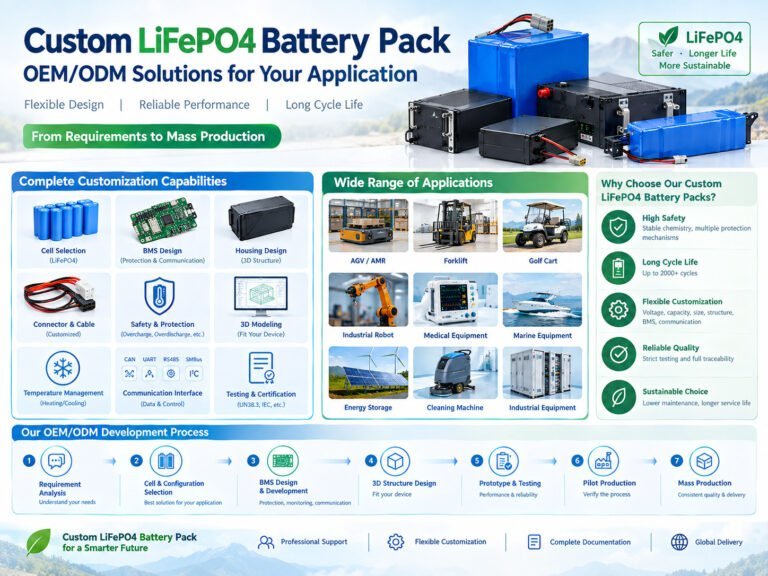
5. Can lithium batteries be customized for AGV and AMR applications?
Yes. Battery manufacturers can provide customized voltage, capacity, dimensions, discharge performance, communication protocols, enclosure protection ratings, and BMS functions to meet specific vehicle requirements.