
In today’s digital world, electricity reliability has become essential. Data centers, hospitals, factories, communication systems, financial institutions, and smart devices all depend on continuous power supply.
A sudden power outage can cause:
- Data loss
- Equipment damage
- Production interruption
- Network downtime
- Financial losses
A UPS (Uninterruptible Power Supply) system solves this problem by providing instant backup power when the main electricity supply fails.
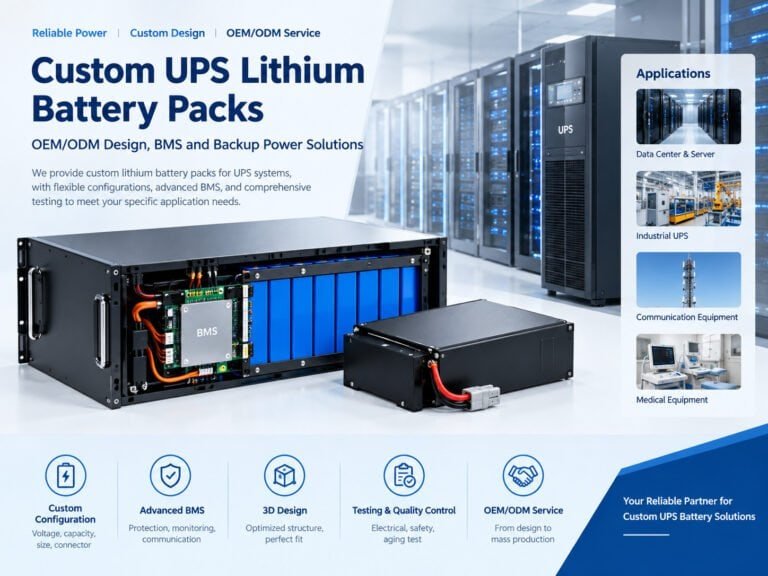
At the heart of every UPS system is the UPS battery, which stores electrical energy and delivers backup power during outages.
In 2026, lithium batteries, especially LiFePO4 UPS batteries, are increasingly replacing traditional lead-acid batteries because of their longer lifespan, higher efficiency, and lower maintenance requirements.

Part 1. What Is a UPS Battery?
A UPS battery is an energy storage device used inside an uninterruptible power supply system.
Under normal conditions:
Grid Power → UPS → Connected Equipment
The UPS continuously supplies stable electricity while charging the battery.
During a power failure:
Power Outage → UPS Battery → Equipment
The battery instantly provides backup power, allowing critical equipment to continue operating.
Part 2. Main Functions of UPS Battery Backup Systems
2.1 Providing Emergency Backup Power
The primary function of a UPS battery is to maintain power during unexpected outages.
Common applications include:
- Data centers
- Servers
- Medical equipment
- Security systems
- Industrial automation
- Communication networks
A UPS battery provides enough backup time for:
- Safe shutdown
- Generator startup
- Continued operation during short outages
2.2 Protecting Sensitive Equipment
UPS systems do more than provide backup power.
They also protect devices from:
- Voltage fluctuations
- Power surges
- Electrical noise
- Frequency instability
Sensitive electronics require clean and stable power.
Examples:
- Servers
- PLC systems
- Precision instruments
- Laboratory equipment
2.3 Preventing Data Loss
For IT systems, even a few seconds of power interruption can cause:
- Server crashes
- Corrupted files
- Lost transactions
- System downtime
UPS batteries provide seamless power transfer, helping businesses maintain operational continuity.
Part 3. Types of UPS Batteries
3.1 Lead-Acid UPS Batteries
Lead-acid batteries have traditionally dominated the UPS market.
Common types:
- VRLA AGM batteries
- Gel batteries
- Flooded lead-acid batteries
Advantages:
✅ Lower initial cost
✅ Mature technology
✅ Widely available
Disadvantages:
❌ Shorter lifespan
❌ Heavy weight
❌ Regular replacement required
❌ Lower energy efficiency
Typical lifespan:
3–5 years
3.2 Lithium UPS Batteries
Lithium batteries are becoming the preferred UPS solution for modern applications.
Common chemistry:
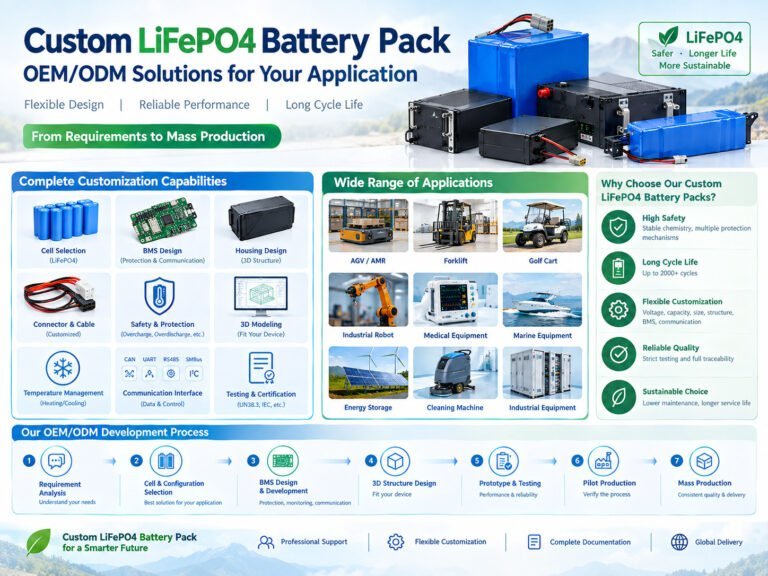
LiFePO4 (Lithium Iron Phosphate)
Advantages:
✅ 8–10+ years lifespan
✅ 3,000–5,000+ cycles
✅ Lightweight design
✅ Faster charging
✅ Higher energy efficiency
✅ Smart battery monitoring
Lithium UPS batteries are especially suitable for:
- Data centers
- Telecom systems
- Industrial equipment
- Renewable energy systems
Part 4. Lithium UPS Battery vs Lead-Acid Battery Comparison
| Feature | Lithium UPS Battery | Lead-Acid UPS Battery |
|---|---|---|
| Lifespan | 8–10+ years | 3–5 years |
| Cycle Life | 3000–5000+ cycles | 500–1000 cycles |
| Weight | Lightweight | Heavy |
| Charging Speed | Fast | Slow |
| Efficiency | 90–95% | 70–85% |
| Maintenance | Low | Higher |
| Space Requirement | Smaller | Larger |
| Monitoring | Smart BMS available | Limited |
| Total Cost | Lower long-term | Higher replacement cost |
Part 5. Advantages of Lithium UPS Batteries
5.1 Longer Service Life
Battery replacement is one of the biggest operating costs of UPS systems.
Lithium batteries can last significantly longer than lead-acid batteries.
Benefits:
- Reduced replacement frequency
- Lower maintenance labor
- Less downtime
- Better investment return
5.2 Higher Energy Density
Lithium batteries store more energy in a smaller and lighter package.
This is valuable for:
- Compact server rooms
- Edge computing facilities
- Telecom cabinets
- Industrial control systems
More power can be installed in less space.
5.3 Faster Recharge Capability
After a power event, UPS batteries need to recover quickly.
Lithium batteries support:
- Higher charging current
- Shorter recovery time
- More frequent backup cycles
This improves system availability.
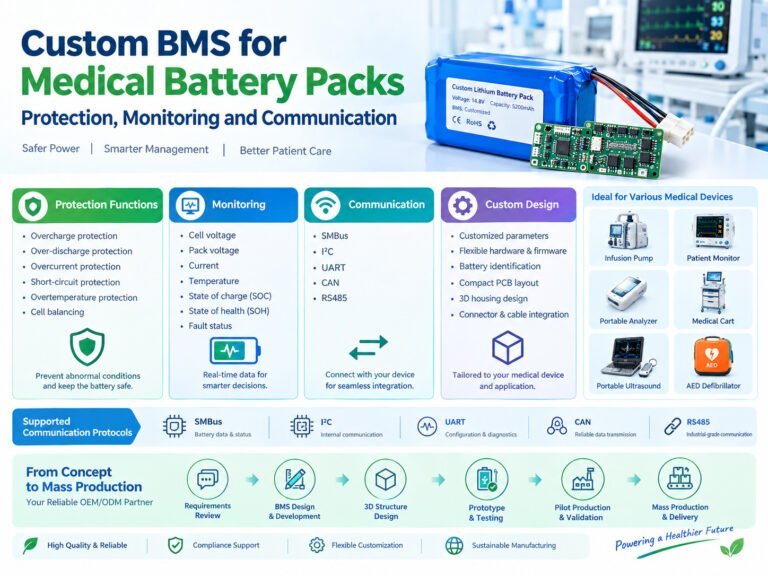
5.4 Smart Battery Management System (BMS)
Modern lithium UPS batteries include intelligent BMS technology.
The BMS monitors:
- Voltage
- Current
- Temperature
- State of Charge (SOC)
- State of Health (SOH)
Protection functions:
- Overcharge protection
- Over-discharge protection
- Short-circuit protection
- Thermal protection
- Cell balancing
Part 6. Common UPS Battery Applications
Data Centers
Requirements:
- High reliability
- Long backup time
- Low maintenance
Lithium UPS batteries help reduce:
- Cooling requirements
- Battery room space
- Replacement costs
Telecommunications
Used for:
- Base stations
- Communication networks
- Remote equipment
Advantages:
- Long standby time
- High reliability
- Remote monitoring
Industrial Automation
Applications:
- Factory control systems
- Robots
- PLC equipment
- Manufacturing lines
UPS batteries prevent production interruptions.
Medical Equipment
Hospitals require uninterrupted power for:
- Monitoring systems
- Emergency equipment
- Laboratory instruments
UPS systems provide critical backup protection.
Part 7. How to Choose the Right UPS Battery
Selecting the correct UPS battery requires evaluating several factors.
7.1 Determine Required Backup Time
First calculate:
- Equipment power consumption (W)
- Required backup duration
- Battery capacity needed
Example:
A higher load requires:
- Larger battery capacity
- More battery modules
- Longer backup time
7.2 Select the Correct Battery Voltage
Common UPS battery voltages:
- 12V
- 24V
- 48V
- 96V
- 192V
- 384V
The battery voltage must match UPS system requirements.
7.3 Choose Battery Chemistry
Lead-Acid:
Suitable for:
- Small UPS systems
- Low-budget projects
- Short-term applications
LiFePO4 Lithium:
Suitable for:
- Data centers
- Industrial UPS
- Long-term operation
- High reliability applications
7.4 Consider Operating Environment
Check:
- Temperature range
- Installation space
- Ventilation conditions
- Safety requirements
Industrial environments may require:
- IP-rated enclosure
- Thermal management
- Communication functions
7.5 Check Certifications
For global UPS battery applications, common certifications include:
- UN38.3
- CE
- IEC 62619
- UL 1973
- RoHS
- MSDS
Part 8. Future Trend: Lithium UPS Batteries Are Becoming the Standard
As industries demand:
- Higher reliability
- Lower operating costs
- Smaller equipment footprint
- Smart energy management
Lithium UPS batteries are becoming the next-generation backup power solution.
The transition from lead-acid to lithium is accelerating in:
- Data centers
- Telecom
- Industrial automation
- Renewable energy storage
The future UPS system is moving toward:
Longer lifespan + Higher efficiency + Intelligent monitoring + Lower maintenance
FAQ: UPS Battery Backup Power
Q1: How long does a UPS battery last?
Lead-acid UPS batteries usually last 3–5 years, while lithium LiFePO4 UPS batteries can last 8–10 years or longer.
Q2: Are lithium batteries better for UPS systems?
Yes. Lithium batteries provide longer lifespan, faster charging, higher efficiency, and lower maintenance compared with traditional lead-acid batteries.
Q3: Can lithium batteries replace lead-acid UPS batteries?
In many applications, yes. However, UPS voltage, charging parameters, BMS communication, and installation requirements must be compatible.
Q4: What is the best battery chemistry for UPS?
LiFePO4 is one of the most widely used lithium chemistries for UPS systems due to its safety, stability, and long cycle life.
Q5: How do I calculate UPS battery capacity?
Battery capacity depends on:
- UPS power rating
- Load consumption
- Backup time requirement
- Battery voltage
- System efficiency
 English
  Chinese
  Japanese
  German
  French
  Korean
