
Material handling equipment and robotics are used across warehouses, distribution centers, factories, logistics facilities, and automated production environments.
Equipment such as forklifts, electric walkie stackers, AGVs, AMRs, logistics robots, and inspection robots requires a battery system that matches its electrical, mechanical, communication, and operating requirements.
Lithium-ion batteries can be configured for different material handling and robotic applications. Depending on the equipment design, the battery pack may include lithium-ion or LiFePO4 cells, a Battery Management System (BMS), communication interfaces, protection components, connectors, and a customized enclosure.
For OEM equipment manufacturers, battery selection should begin with the equipment requirements rather than a standard battery model.
This guide explains how lithium battery packs can be designed for material handling equipment and robotics, including battery chemistry, voltage, capacity, current, BMS, communication, charging, mechanical integration, testing, and certification.
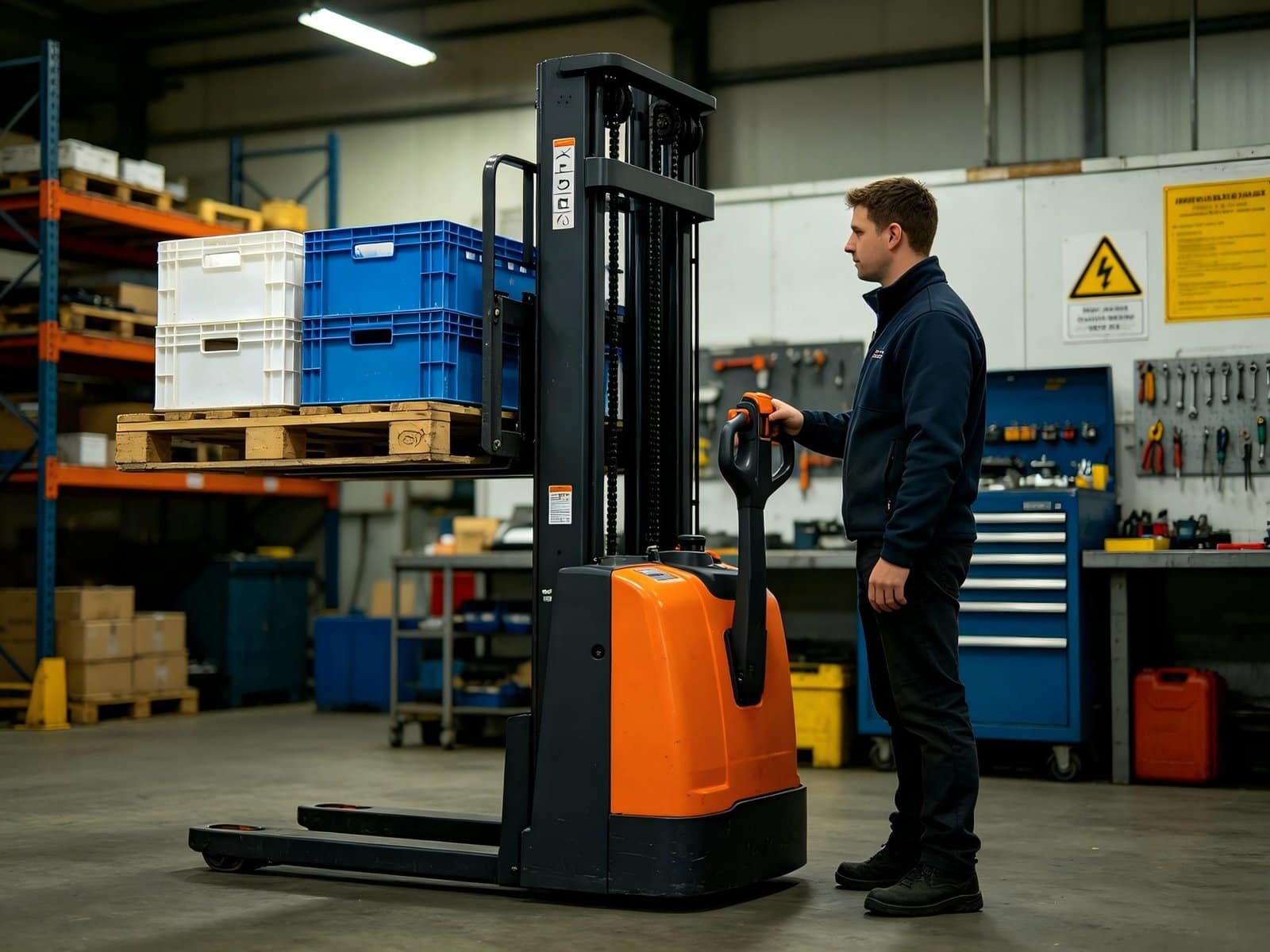
What Are Material Handling and Robotics Batteries?
Material handling and robotics batteries are rechargeable battery systems designed to supply electrical power to equipment used for transportation, lifting, automation, inspection, and warehouse operations.
주요 적용 분야는 다음과 같습니다:
- 전동 지게차
- Electric walkie stackers
- 팔레트 트럭
- AGV
- AMR
- 물류 로봇
- 창고용 로봇
- 검사 로봇
- Autonomous handling equipment
- 산업용 로봇
- Cleaning robots
- Mobile platforms
Depending on the application, the battery may power:
- Traction motors
- Lifting systems
- Hydraulic systems
- Robotic actuators
- Controllers
- 센서
- 통신 시스템
- Displays
- Safety systems
- Computing equipment
The battery configuration should be matched to the equipment’s electrical architecture and operating profile.
Lithium-Ion Batteries for Material Handling Equipment
Lithium-ion batteries are used in material handling equipment where rechargeable electrical power is required for repeated operation.
A lithium battery system can be designed around:
- Required voltage
- 배터리 용량
- 정류 전류
- 피크 전류
- 운영 시간
- 충전 요건
- 배터리 치수
- 통신 프로토콜
- 환경 조건
For industrial equipment, battery selection involves more than choosing an Ah rating.
The battery must work with the motor, controller, charger, BMS, mechanical structure, and other electrical components.
Lithium Battery Applications in Material Handling
전동 지게차
Electric forklifts require battery systems for traction and lifting functions.
A custom lithium battery can be designed according to:
- Forklift voltage
- 모터 출력
- 운영 시간
- 로드 요구 사항
- Charging schedule
- 건전지 수납공간
- BMS requirements
Battery configurations may include LiFePO4 or other lithium-ion chemistries according to the application.
Electric Walkie Stackers
Electric walkie stackers are used for pallet transportation and lifting in warehouses and production environments.
A battery system can be customized according to:
- 전압
- 용량
- Motor current
- Lifting current
- 배터리 치수
- 커넥터
- 충전기
- 통신 인터페이스
Smart BMS functions can also be integrated when battery information needs to be exchanged with the equipment controller.
팔레트 트럭
Electric pallet trucks use batteries for traction and lifting functions.
Battery design can consider:
- Compact installation space
- Operating cycle
- 피크 전류
- 충전 빈도
- 배터리 무게
- 커넥터 구성
A custom battery enclosure can be designed according to the pallet truck’s available installation space.
Lithium Batteries for AGV Systems
AGV stands for Automated Guided Vehicle.
AGVs are used for automated material transportation in factories and warehouses.
AGV battery systems may need to support:
- Repeated driving
- Automated charging
- 기회 충전
- Long operating schedules
- BMS 통신
- 차량 관리 시스템
A custom AGV battery pack can include:
- LiFePO4 셀
- 스마트 BMS
- CAN 통신
- RS485 통신
- 맞춤형 커넥터
- Battery monitoring
- Customized enclosure
The battery configuration should be based on the AGV’s motor power, route, payload, operating cycle, and charging system.
Lithium Batteries for AMR Systems
AMR stands for Autonomous Mobile Robot.
AMRs are used for automated transportation and logistics tasks.
Compared with a basic mobile platform, an AMR may include additional electrical loads such as:
- Navigation sensors
- Cameras
- LiDAR
- Industrial computers
- Wireless communication
- Safety sensors
- Drive motors
- Control systems
Therefore, the battery capacity calculation should include both the motion system and auxiliary electrical loads.
A battery pack for an AMR can be configured according to the robot’s:
- 운영 시간
- Average power consumption
- 최대 전력
- Charging schedule
- Payload
- 이동 거리
- 건전지 수납공간
- 통신 요구 사항
Lithium Battery for Logistics Robots
Logistics robots are used for material transportation, sorting, warehouse operations, and internal logistics.
A logistics robot battery may need to provide power to:
- Drive motors
- Control systems
- 센서
- Communication modules
- Industrial computers
- Lifting mechanisms
Battery customization can include:
- 전압
- 용량
- 셀 구성
- BMS
- CAN
- RS485
- UART
- 커넥터
- 주택
- 장착 구조
The battery can be designed according to the robot’s operating cycle and available installation space.
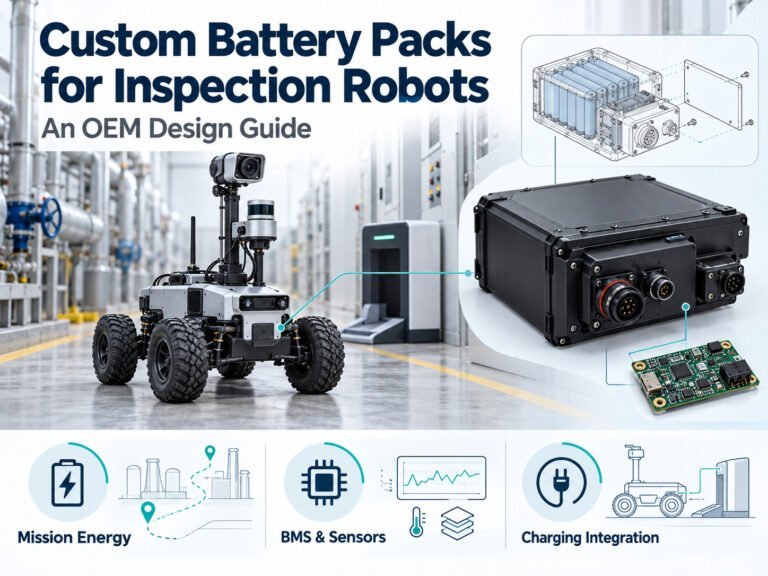
Lithium Battery for Inspection Robots
Inspection robots are used to monitor industrial facilities, warehouses, power systems, pipelines, infrastructure, and other environments.
Depending on the robot design, the battery may supply power to:
- Drive motors
- Cameras
- LiDAR
- 센서
- Industrial computers
- 통신 시스템
- Robotic mechanisms
Inspection robot batteries can be designed around the required operating time and equipment power consumption.
A smart BMS can provide battery information such as:
- 전압
- 현재
- 온도
- SOC
- 고장 상태
Communication can be implemented through CAN, RS485, or another compatible interface.
Lithium Battery for Industrial Robots
Industrial robots can use battery systems when they operate on mobile platforms, autonomous systems, robotic carts, or other battery-powered equipment.
Battery requirements depend on:
- 모터 출력
- Robot payload
- Operating cycle
- Movement pattern
- Control system
- Auxiliary equipment
- 근무 환경
For mobile industrial robotics, battery design may include a customized enclosure and BMS communication system.
LiFePO4 Battery for Material Handling and Robotics
LiFePO4, or lithium iron phosphate, is a lithium-ion battery chemistry used in many industrial applications.
LiFePO4 characteristics include:
- 열 안정성
- Stable discharge behavior
- Rechargeable operation
- Cycle characteristics suitable for repeated use
- Compatibility with BMS systems
A LiFePO4 battery pack can be configured according to the required voltage and capacity.
예를 들어
25.6V 100Ah LiFePO4 Battery
Nominal energy:
25.6V × 100Ah = 2,560Wh
or:
2.56kWh
The actual operating time depends on the equipment’s average power consumption, operating cycle, temperature, load, and battery utilization.
How to Calculate Battery Capacity
배터리 에너지는 다음 공식을 사용하여 추정할 수 있습니다:
에너지(Wh) = 전압(V) × 용량(Ah)
예를 들어
48V × 100Ah = 4,800Wh
This represents approximately 4.8kWh of nominal energy.
For operating time:
Operating Time = Available Energy ÷ Average Power Consumption
For example, an equipment system with an average power consumption of 800W and a nominal battery energy of 4,800Wh has a theoretical operating time of:
4,800Wh ÷ 800W = 6 hours
Actual operating time depends on:
- Motor operation
- Payload
- 이동 거리
- 가속
- 리프팅
- Auxiliary loads
- 온도
- Battery operating window
- 시스템 효율
Therefore, capacity should be determined using actual equipment operating data.
Continuous and Peak Current
Battery sizing also requires current analysis.
Material handling equipment and robots may have different current requirements during:
- Startup
- 가속
- Braking
- 리프팅
- 회전
- Ramp operation
- Motor loading
- Robotic movement
The battery pack should therefore be evaluated according to:
Continuous Current
그리고
Peak Current
The following components should also be matched to the electrical load:
- 배터리 셀
- BMS
- 퓨즈
- Busbar
- 케이블
- 커넥터
- Protection components
Smart BMS for Industrial Battery Packs
A Battery Management System is an important component of a lithium battery pack.
Depending on the design, the BMS can monitor:
- 개별 세포 전압
- 패키지 전압
- 충전 전류
- 방전 전류
- 세포 온도
- 배터리 온도
- SOC
- SOH
Protection functions may include:
- 과충전 방지
- 과방전 방지
- 과전류 보호
- 단락 보호
- 과열 보호
- Under-temperature protection
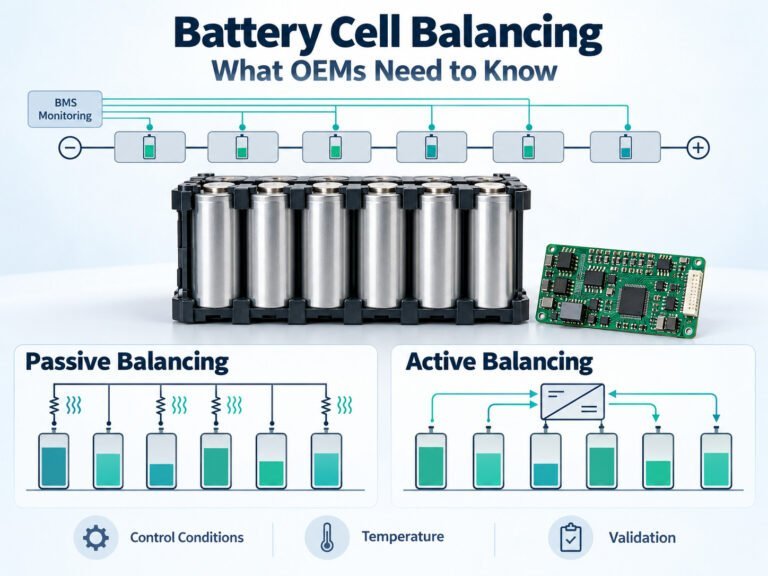
Cell balancing can also be included according to the battery design.
CAN Communication for Robotics and Material Handling
CAN communication is used in many industrial control systems.
A smart battery BMS with CAN can communicate battery information to an equipment controller.
Possible data includes:
- 배터리 전압
- 현재
- SOC
- 온도
- 충전 상태
- 오류 정보
- 배터리 상태
The BMS communication parameters and data format need to match the equipment controller.
For OEM projects, the communication protocol should be confirmed before BMS development.
RS485 and UART Communication
RS485 can also be used for industrial battery communication.
Depending on the equipment system, communication may use:
- RS485
- Modbus RTU
- UART
- CAN
The required interface depends on the equipment architecture.
For a custom battery project, the customer should provide the communication protocol or equipment communication specifications when available.
Battery Charging for Robotics and Material Handling Equipment
The charger is part of the complete battery system.
주요 충전 매개변수는 다음과 같습니다:
- 배터리 화학
- 공칭 전압
- 충전 전압
- 충전 전류
- 충전 프로필
- 커넥터
- BMS 통신
- 충전 온도 범위
For automated equipment, charging can be integrated into the operating process.
Charging methods may include:
- Standard charging
- 기회 충전
- Scheduled charging
- Automated charging
The charging method should be compatible with the battery, BMS, charger, and equipment control system.
기회 충전
Opportunity charging allows equipment to receive charging during available idle periods.
It may be considered for:
- AGV
- AMR
- 전동 팔레트 트럭
- Walkie stackers
- 창고용 로봇
- Automated material handling systems
Charging may take place during:
- Breaks
- Shift changes
- Waiting periods
- Loading operations
- Automated docking
The battery manufacturer should define charging current and operating limits according to the battery design.
Automated Charging for AGV and AMR Batteries
AGV and AMR systems may use automated charging stations.
The battery system may need to communicate with the charging system to provide information such as:
- SOC
- 충전 상태
- 배터리 온도
- 고장 상태
- Charging permission
The battery, BMS, charging station, and robot controller should be designed as a compatible system.
Custom Battery Dimensions
Industrial robots and material handling equipment often have limited battery installation space.
A custom battery pack can be designed according to:
- 길이
- 너비
- 높이
- Mounting holes
- Battery tray
- 커넥터 위치
- 케이블 콘센트
- Handle
- 첨부 파일
Mechanical drawings or 3D models can be useful during the battery design process.
The battery should be securely mounted to handle expected vibration, acceleration, braking, and equipment movement.
Battery Enclosure Design
The battery enclosure provides mechanical protection for internal components.
Depending on the application, enclosure materials may include:
- ABS
- PC
- 알루미늄
- 강철
- Other engineering materials
The enclosure design can consider:
- 기계적 보호
- 열 방출
- 수자원 보호
- 먼지 방지
- 커넥터 배치
- 케이블 배선
- Mounting
- Service access
The final material and enclosure structure should be selected according to the application.
환경 요건
Material handling equipment may operate in:
- 창고
- 공장
- Cold storage
- 물류 센터
- Outdoor logistics areas
- Industrial facilities
Environmental conditions may include:
- 먼지
- 습도
- 온도 변화
- 물 노출
- 진동
- Mechanical impact
Battery design should consider the actual operating environment.
For applications requiring dust and water protection, an IP-rated enclosure can be evaluated.
The required IP rating should be determined according to the equipment environment and verified through appropriate testing.
Battery Safety Design
Battery safety should be considered throughout the entire development process.
Important areas include:
세포 선택
Cells should be evaluated according to:
- 용량
- 전압
- 정류 전류
- 피크 전류
- Cycle requirements
- 온도 범위
- Manufacturer specifications
BMS
The BMS should be configured according to:
- 셀 구성
- 전압
- 현재
- 온도
- Protection limits
- 통신 요구 사항
Electrical Protection
The battery may include:
- 퓨즈
- 보호 회로
- Busbar
- 단열
- Rated connectors
- Appropriate cables
열 관리
Thermal design should consider:
- 셀 유형
- 현재
- Operating cycle
- 주변 온도
- 첨부 파일
- 열 방출
기계적 보호
The enclosure and mounting structure should protect the battery from expected mechanical conditions.
Custom Lithium Battery Development Process
A structured development process can help define battery requirements before production.
Step 1: Equipment Requirement Analysis
수집:
- Equipment model
- 전압
- 모터 출력
- 현재
- 운영 시간
- 건전지 수납공간
- 충전기
- 통신 프로토콜
Step 2: Operating Profile
평가:
- Daily operating time
- Operating cycles
- Payload
- 이동 거리
- Lifting frequency
- Charging opportunities
- 주변 온도
Step 3: Battery Chemistry
평가:
- LiFePO4
- NMC
- Other lithium-ion chemistries
The chemistry should be selected according to the equipment requirements.
Step 4: Cell Selection
평가:
- Cell capacity
- 전압
- 현재
- 내부 저항
- Cycle characteristics
- Temperature specifications
- 물리적 치수
Step 5: Battery Configuration
Determine:
- Series connection
- Parallel connection
- 공칭 전압
- 용량
- 에너지
- 현재 역량
Step 6: BMS Design
Define:
- Protection parameters
- 정격 전류
- 온도 센서
- SOC
- SOH
- CAN
- RS485
- UART
Step 7: Mechanical Design
개발:
- 첨부 파일
- 장착 구조
- 커넥터
- 케이블
- 배선 하네스
- 배터리 치수
Step 8: Prototype
Build a prototype for:
- Installation verification
- 전기 시험
- Charging verification
- 통신 테스트
- Runtime evaluation
- Temperature evaluation
Step 9: Validation
Complete the applicable:
- Electrical tests
- BMS tests
- Communication tests
- Environmental tests
- Mechanical tests
Step 10: Production
After validation, the battery design can move into production with defined quality control and inspection procedures.
Battery Testing
Testing should be defined according to the battery design and application.
Electrical Testing
- 용량 테스트
- Charge testing
- Discharge testing
- 전압 테스트
- Current testing
- BMS 보호 기능 테스트
BMS Testing
- 과충전 방지
- 과방전 방지
- 과전류 보호
- 단락 보호
- 온도 보호
- 셀 밸런싱
통신 테스트
- CAN
- RS485
- UART
- SOC communication
- Fault reporting
- Data transmission
환경 테스트
Depending on the application:
- 고온 시험
- 저온 시험
- Temperature cycling
- Humidity testing
- Water protection testing
- Dust protection testing
Mechanical Testing
- 진동 테스트
- Impact testing
- 커넥터 테스트
- Mounting testing
- Enclosure inspection
인증 및 규정 준수
Lithium battery requirements depend on the battery design, application, transportation method, and target market.
For lithium batteries transported internationally, UN 38.3 is an important transportation testing requirement.
Depending on the product and destination market, applicable requirements may include:
- CE
- IEC 표준
- UL 표준
- RoHS
- EMC requirements
- Regional battery regulations
For products placed on the European market, applicable requirements under EU 배터리 규정(EU) 2023/1542 should also be evaluated.
Certification requirements should be considered during the product development stage.
What Information Is Required for a Custom Battery?
For an OEM or ODM battery project, the following information can help the engineering team define the battery system:
| 매개변수 | Information |
|---|---|
| Equipment type | Forklift / AGV / AMR / Robot |
| 배터리 화학 | LiFePO4 / Li-ion |
| 공칭 전압 | V |
| 용량 | 아 |
| 정류 전류 | A |
| 피크 전류 | A |
| 운영 시간 | Hours |
| 충전 시간 | Hours |
| 충전기 | Model / Specifications |
| 커뮤니케이션 | CAN / RS485 / UART |
| 배터리 치수 | L × W × H |
| 커넥터 | Model / Custom |
| 작동 온도 | °C |
| IP requirement | 응용 프로그램에 따라 다름 |
| 목표 시장 | EU / US / Other |
| Quantity | Prototype / Production |
Additional information can include:
- Equipment datasheet
- Original battery label
- Charger datasheet
- Motor specifications
- 컨트롤러 사양
- Battery compartment drawing
- Connector drawing
- 통신 프로토콜
- 3D model
- Required certifications
How to Select a Lithium Battery Manufacturer
Selecting a battery manufacturer involves evaluating engineering capability, manufacturing processes, quality management, testing, and technical support.
Engineering Capability
The manufacturer should be able to evaluate:
- 배터리 화학
- 셀 구성
- BMS
- Current requirements
- 커뮤니케이션
- 충전기 호환성
- 기계적 구조
- Thermal requirements
제조 역량
Relevant production capabilities may include:
- 세포 선별
- 용접
- PACK assembly
- BMS 설치
- 배터리 노화
- 전기 시험
- 기능 테스트
- 최종 검사
Testing Capability
The manufacturer should have testing processes appropriate to the battery application.
These may include:
- 용량 테스트
- 에이징 테스트
- BMS 테스트
- 온도 시험
- 진동 테스트
- 방수 테스트
- 통신 테스트
인증 지원
The manufacturer should be able to explain:
- Existing certification
- Applicable standards
- Testing requirements
- Documentation
- 교통 수단 요건
Certification claims should be supported by appropriate documentation.
OEM and ODM Lithium Battery Pack Solutions
OEM and ODM battery development allows equipment manufacturers to define battery specifications according to their products.
Customization can include:
전기
- 전압
- 용량
- 현재
- 셀 구성
BMS
- Protection parameters
- SOC
- SOH
- CAN
- RS485
- UART
기계
- 치수
- 첨부 파일
- Mounting
- 커넥터
- 케이블
- 배선 하네스
충전
- 충전 전압
- 충전 전류
- 충전 커넥터
- Charging communication
Branding
Depending on the project, OEM customization may include:
- Battery label
- Product identification
- 포장
- User documentation
About Our Lithium Battery Manufacturing Experience
동관 이잔 전자 기술 유한 공사(동관 이잔 전자 기술 유한 공사) provides customized lithium battery PACK solutions for industrial and OEM applications.
Our battery development process can cover:
Requirement Analysis → Cell Selection → Battery Configuration → BMS Design → Mechanical Design → Prototype → Testing → Certification Evaluation → Production
Battery solutions can be developed for applications including:
- 전동 지게차
- Walkie stackers
- 팔레트 트럭
- AGV
- AMR
- 물류 로봇
- 검사 로봇
- 산업용 로봇
- 창고 장비
- Other mobile industrial equipment
Depending on project requirements, battery packs can be configured with:
- LiFePO4 셀
- 리튬 이온 전지
- 스마트 BMS
- CAN 통신
- RS485 통신
- UART 통신
- 맞춤형 커넥터
- Custom wiring harnesses
- Custom enclosures
- Customized battery dimensions
The final battery configuration is determined according to the customer’s equipment specifications, operating conditions, and target market.
Why Battery Development Should Start With Equipment Requirements
A lithium battery is part of the equipment’s power system.
It interacts with:
- 모터
- 컨트롤러
- 충전기
- BMS
- 센서
- 디스플레이
- 통신 시스템
- Safety system
- 기계적 구조
For this reason, battery development should begin with equipment requirements.
Early technical evaluation can help define:
- 전압
- 용량
- 현재
- 배터리 치수
- BMS
- 커뮤니케이션
- 충전기
- 커넥터
- Mounting
- 환경 요건
This process provides a technical foundation for prototype development and production.
자주 묻는 질문
What lithium battery is used for material handling equipment?
LiFePO4 and other lithium-ion chemistries can be evaluated for material handling equipment. The battery chemistry should be selected according to voltage, capacity, current, operating cycle, temperature, installation space, and equipment requirements.
Can lithium batteries be used in forklifts?
Yes. Lithium battery systems can be designed for electric forklifts according to the forklift’s electrical and mechanical requirements.
Can I use a lithium battery in an electric walkie stacker?
A lithium battery can be considered for an electric walkie stacker after evaluating voltage, charger, controller, current requirements, battery dimensions, BMS, and communication requirements.
What lithium battery is used for AGVs?
AGVs can use LiFePO4 or other lithium-ion battery configurations depending on their voltage, capacity, current, operating cycle, charging system, and installation space.
What battery does an AMR need?
An AMR battery should be sized according to the robot’s average power consumption, peak power, operating hours, payload, travel distance, auxiliary loads, and charging schedule.
Can a robot battery use CAN communication?
Yes. A smart BMS can use CAN communication when the battery and robot controller use compatible communication parameters and data formats.
Can the battery dimensions be customized?
Yes. Battery dimensions, enclosure, mounting structure, connector, cable length, and wiring can be customized according to the equipment.
Can the battery use LiFePO4 cells?
Yes. LiFePO4 cells can be used for many industrial battery applications. The final cell selection should be based on the equipment requirements and operating conditions.
Can lithium batteries support opportunity charging?
Lithium batteries can support opportunity charging when the battery, BMS, charger, and equipment are designed for this charging method.
What information is needed for a custom battery quote?
Useful information includes voltage, capacity, continuous current, peak current, operating time, charging requirements, battery dimensions, connector, communication protocol, operating temperature, equipment model, and target market.
결론
Lithium batteries can be configured for a wide range of material handling equipment and robotics applications.
여기에는 다음이 포함됩니다:
Forklifts | Walkie Stackers | Pallet Trucks | AGVs | AMRs | Logistics Robots | Inspection Robots | Industrial Robots
The battery system should be designed according to:
Chemistry + Voltage + Capacity + Current + BMS + Communication + Charger + Dimensions + Environment + Safety + Certification
LiFePO4 is one battery chemistry that can be evaluated for industrial applications. Other lithium-ion chemistries may also be considered according to the equipment’s technical requirements.
For OEM and ODM projects, a custom lithium battery pack can integrate cell selection, battery configuration, smart BMS, communication, charger compatibility, mechanical design, testing, and certification evaluation.
A structured development process helps align the battery with the equipment’s electrical, mechanical, charging, communication, and operating requirements.
Custom lithium battery solutions can be developed according to your material handling equipment or robotics specifications.
 English
  Chinese
  Japanese
  German
  French
  Korean
