
Material handling equipment and robotics are used across warehouses, distribution centers, factories, logistics facilities, and automated production environments.
Equipment such as forklifts, electric walkie stackers, AGVs, AMRs, logistics robots, and inspection robots requires a battery system that matches its electrical, mechanical, communication, and operating requirements.
Lithium-ion batteries can be configured for different material handling and robotic applications. Depending on the equipment design, the battery pack may include lithium-ion or LiFePO4 cells, a Battery Management System (BMS), communication interfaces, protection components, connectors, and a customized enclosure.
For OEM equipment manufacturers, battery selection should begin with the equipment requirements rather than a standard battery model.
This guide explains how lithium battery packs can be designed for material handling equipment and robotics, including battery chemistry, voltage, capacity, current, BMS, communication, charging, mechanical integration, testing, and certification.
What Are Material Handling and Robotics Batteries?
Material handling and robotics batteries are rechargeable battery systems designed to supply electrical power to equipment used for transportation, lifting, automation, inspection, and warehouse operations.
应用包括
- 电动叉车
- Electric walkie stackers
- 托盘搬运车
- AGV
- AMR
- Logistics robots
- 仓库机器人
- 检测机器人
- Autonomous handling equipment
- 工业机器人
- 清洁机器人
- Mobile platforms
Depending on the application, the battery may power:
- Traction motors
- Lifting systems
- Hydraulic systems
- Robotic actuators
- Controllers
- Sensors
- Communication systems
- Displays
- Safety systems
- Computing equipment
The battery configuration should be matched to the equipment’s electrical architecture and operating profile.
Lithium-Ion Batteries for Material Handling Equipment
Lithium-ion batteries are used in material handling equipment where rechargeable electrical power is required for repeated operation.
A lithium battery system can be designed around:
- Required voltage
- 电池容量
- 连续电流
- 峰值电流
- 运行时间
- Charging requirements
- 电池尺寸
- 通信协议
- 环境条件
For industrial equipment, battery selection involves more than choosing an Ah rating.
The battery must work with the motor, controller, charger, BMS, mechanical structure, and other electrical components.
Lithium Battery Applications in Material Handling
电动叉车
Electric forklifts require battery systems for traction and lifting functions.
A custom lithium battery can be designed according to:
- Forklift voltage
- 电机功率
- 工作时间
- 负载要求
- Charging schedule
- 电池仓
- BMS 要求
Battery configurations may include LiFePO4 or other lithium-ion chemistries according to the application.
Electric Walkie Stackers
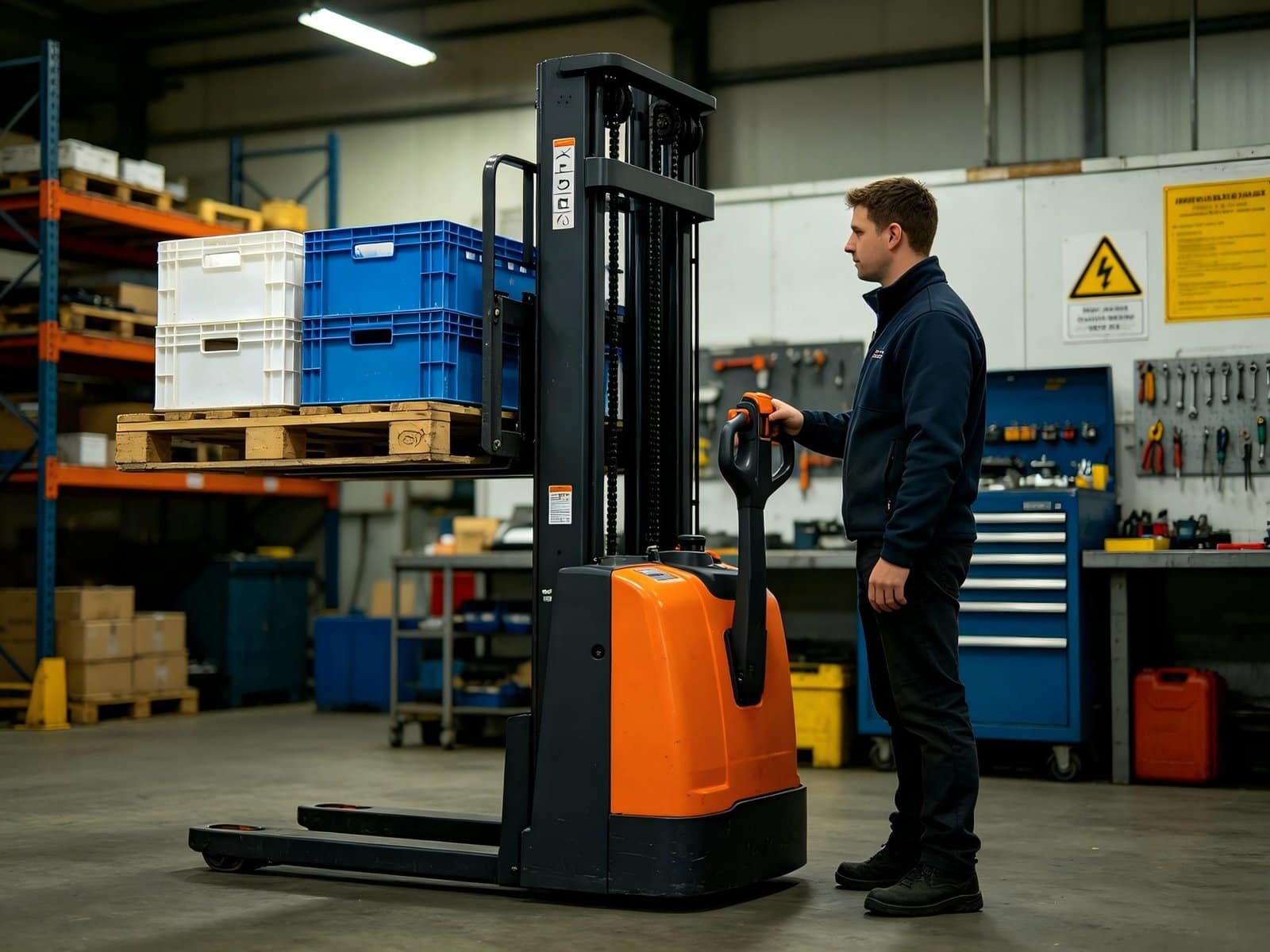
Electric walkie stackers are used for pallet transportation and lifting in warehouses and production environments.
A battery system can be customized according to:
- 电压
- 容量
- Motor current
- Lifting current
- 电池尺寸
- 连接器
- 充电器
- 通信接口
Smart BMS functions can also be integrated when battery information needs to be exchanged with the equipment controller.
托盘搬运车
Electric pallet trucks use batteries for traction and lifting functions.
Battery design can consider:
- Compact installation space
- Operating cycle
- 峰值电流
- 充电频率
- 电池重量
- Connector configuration
A custom battery enclosure can be designed according to the pallet truck’s available installation space.
Lithium Batteries for AGV Systems
AGV stands for Automated Guided Vehicle.
AGVs are used for automated material transportation in factories and warehouses.
AGV battery systems may need to support:
- Repeated driving
- Automated charging
- 机会收费
- Long operating schedules
- BMS通信
- 车队管理系统
A custom AGV battery pack can include:
- 磷酸铁锂电池
- 智能 BMS
- CAN 通信
- RS485通信
- 定制连接器
- 电池监控
- Customized enclosure
The battery configuration should be based on the AGV’s motor power, route, payload, operating cycle, and charging system.
Lithium Batteries for AMR Systems
AMR stands for Autonomous Mobile Robot.
AMRs are used for automated transportation and logistics tasks.
Compared with a basic mobile platform, an AMR may include additional electrical loads such as:
- Navigation sensors
- Cameras
- LiDAR
- Industrial computers
- Wireless communication
- Safety sensors
- Drive motors
- 控制系统
Therefore, the battery capacity calculation should include both the motion system and auxiliary electrical loads.
A battery pack for an AMR can be configured according to the robot’s:
- 工作时间
- 平均功耗
- 峰值功率
- Charging schedule
- Payload
- 旅行距离
- 电池仓
- 通信要求
Lithium Battery for Logistics Robots
Logistics robots are used for material transportation, sorting, warehouse operations, and internal logistics.
A logistics robot battery may need to provide power to:
- Drive motors
- 控制系统
- Sensors
- 通信模块
- Industrial computers
- Lifting mechanisms
Battery customization can include:
- 电压
- 容量
- 单元配置
- BMS
- CAN
- RS485
- UART
- 连接器
- 住房
- 安装结构
The battery can be designed according to the robot’s operating cycle and available installation space.
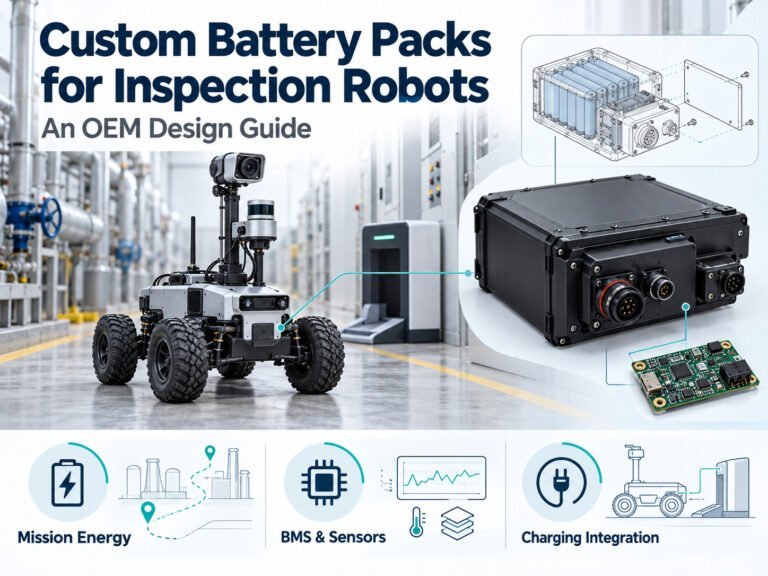
Lithium Battery for Inspection Robots
Inspection robots are used to monitor industrial facilities, warehouses, power systems, pipelines, infrastructure, and other environments.
Depending on the robot design, the battery may supply power to:
- Drive motors
- Cameras
- LiDAR
- Sensors
- Industrial computers
- Communication systems
- Robotic mechanisms
Inspection robot batteries can be designed around the required operating time and equipment power consumption.
A smart BMS can provide battery information such as:
- 电压
- 当前
- 温度
- SOC
- 故障状态
Communication can be implemented through CAN, RS485, or another compatible interface.
Lithium Battery for Industrial Robots
Industrial robots can use battery systems when they operate on mobile platforms, autonomous systems, robotic carts, or other battery-powered equipment.
Battery requirements depend on:
- 电机功率
- Robot payload
- Operating cycle
- Movement pattern
- Control system
- Auxiliary equipment
- 工作环境
For mobile industrial robotics, battery design may include a customized enclosure and BMS communication system.
LiFePO4 Battery for Material Handling and Robotics
LiFePO4, or lithium iron phosphate, is a lithium-ion battery chemistry used in many industrial applications.
LiFePO4 characteristics include:
- 热稳定性
- Stable discharge behavior
- Rechargeable operation
- Cycle characteristics suitable for repeated use
- Compatibility with BMS systems
A LiFePO4 battery pack can be configured according to the required voltage and capacity.
例如
25.6V 100Ah LiFePO4 Battery
Nominal energy:
25.6V × 100Ah = 2,560Wh
or:
2.56kWh
The actual operating time depends on the equipment’s average power consumption, operating cycle, temperature, load, and battery utilization.
How to Calculate Battery Capacity
Battery energy can be estimated using:
能量 (Wh) = 电压 (V) × 容量 (Ah)
例如
48V × 100Ah = 4,800Wh
This represents approximately 4.8kWh of nominal energy.
For operating time:
Operating Time = Available Energy ÷ Average Power Consumption
For example, an equipment system with an average power consumption of 800W and a nominal battery energy of 4,800Wh has a theoretical operating time of:
4,800Wh ÷ 800W = 6 hours
Actual operating time depends on:
- Motor operation
- Payload
- 旅行距离
- 加速度
- 举重
- Auxiliary loads
- 温度
- Battery operating window
- 系统效率
Therefore, capacity should be determined using actual equipment operating data.
Continuous and Peak Current
Battery sizing also requires current analysis.
Material handling equipment and robots may have different current requirements during:
- Startup
- 加速度
- Braking
- 举重
- 转动
- Ramp operation
- Motor loading
- Robotic movement
The battery pack should therefore be evaluated according to:
Continuous Current
和
Peak Current
The following components should also be matched to the electrical load:
- 电池单元
- BMS
- Fuse
- Busbar
- 电缆
- 连接器
- 保护组件
Smart BMS for Industrial Battery Packs
A Battery Management System is an important component of a lithium battery pack.
Depending on the design, the BMS can monitor:
- 单个电池电压
- 电池组电压
- 充电电流
- 放电电流
- 细胞温度
- 电池温度
- SOC
- SOH
Protection functions may include:
- 过充电保护
- 过放电保护
- 过流保护
- 短路保护
- 过温保护
- Under-temperature protection
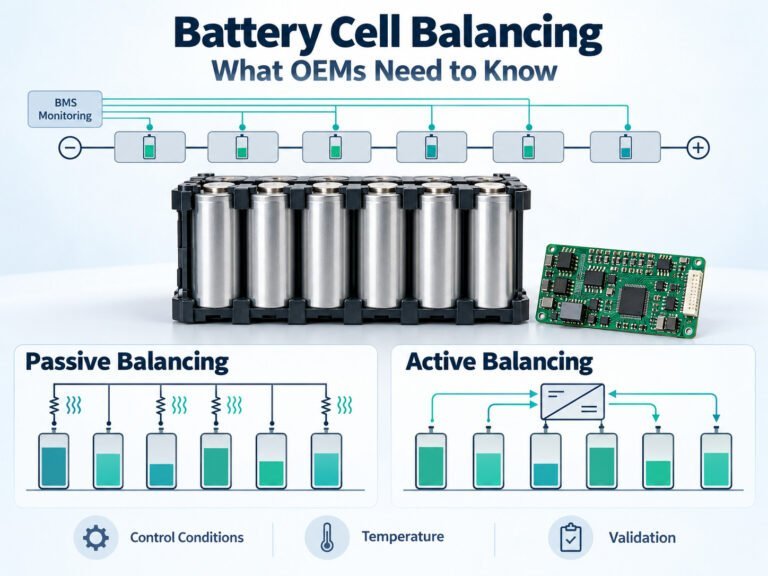
Cell balancing can also be included according to the battery design.
CAN Communication for Robotics and Material Handling
CAN communication is used in many industrial control systems.
A smart battery BMS with CAN can communicate battery information to an equipment controller.
Possible data includes:
- 电池电压
- 当前
- SOC
- 温度
- 充电状态
- 故障信息
- 电池状态
The BMS communication parameters and data format need to match the equipment controller.
For OEM projects, the communication protocol should be confirmed before BMS development.
RS485 and UART Communication
RS485 can also be used for industrial battery communication.
Depending on the equipment system, communication may use:
- RS485
- Modbus RTU
- UART
- CAN
The required interface depends on the equipment architecture.
For a custom battery project, the customer should provide the communication protocol or equipment communication specifications when available.
Battery Charging for Robotics and Material Handling Equipment
The charger is part of the complete battery system.
Important charging parameters include:
- 电池化学
- 额定电压
- 充电电压
- 充电电流
- 充电配置文件
- 连接器
- BMS通信
- Charging temperature range
For automated equipment, charging can be integrated into the operating process.
Charging methods may include:
- Standard charging
- 机会收费
- Scheduled charging
- Automated charging
The charging method should be compatible with the battery, BMS, charger, and equipment control system.
机会充电
Opportunity charging allows equipment to receive charging during available idle periods.
It may be considered for:
- AGV
- AMR
- 电动托盘车
- 步行式堆高机
- 仓库机器人
- Automated material handling systems
Charging may take place during:
- Breaks
- 班次交接
- Waiting periods
- Loading operations
- Automated docking
The battery manufacturer should define charging current and operating limits according to the battery design.
Automated Charging for AGV and AMR Batteries
AGV and AMR systems may use automated charging stations.
The battery system may need to communicate with the charging system to provide information such as:
- SOC
- 充电状态
- 电池温度
- 故障状态
- Charging permission
The battery, BMS, charging station, and robot controller should be designed as a compatible system.
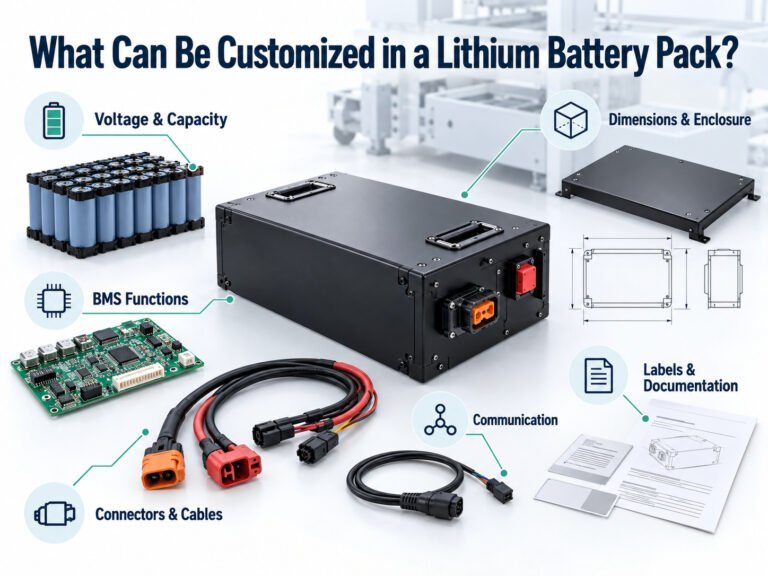
Custom Battery Dimensions
Industrial robots and material handling equipment often have limited battery installation space.
A custom battery pack can be designed according to:
- 长度
- 宽度
- 高度
- 安装孔
- Battery tray
- 连接器位置
- 电缆出口
- 手柄
- 附件
Mechanical drawings or 3D models can be useful during the battery design process.
The battery should be securely mounted to handle expected vibration, acceleration, braking, and equipment movement.
Battery Enclosure Design
The battery enclosure provides mechanical protection for internal components.
Depending on the application, enclosure materials may include:
- ABS
- PC
- Aluminum
- Steel
- Other engineering materials
The enclosure design can consider:
- 机械保护
- 散热
- Water protection
- 防尘
- 连接器位置
- 电缆布线
- Mounting
- Service access
The final material and enclosure structure should be selected according to the application.
环境要求
Material handling equipment may operate in:
- 仓库
- 工厂
- Cold storage
- 配送中心
- Outdoor logistics areas
- Industrial facilities
Environmental conditions may include:
- 灰尘
- 湿度
- 温度变化
- 接触水
- 振动
- Mechanical impact
Battery design should consider the actual operating environment.
For applications requiring dust and water protection, an IP-rated enclosure can be evaluated.
The required IP rating should be determined according to the equipment environment and verified through appropriate testing.
Battery Safety Design
Battery safety should be considered throughout the entire development process.
Important areas include:
细胞选择
Cells should be evaluated according to:
- 容量
- 电压
- 连续电流
- 峰值电流
- 周期要求
- 温度范围
- Manufacturer specifications
BMS
The BMS should be configured according to:
- 单元配置
- 电压
- 当前
- 温度
- Protection limits
- 通信要求
Electrical Protection
The battery may include:
- Fuse
- Protection circuit
- Busbar
- 隔热
- Rated connectors
- Appropriate cables
热管理
Thermal design should consider:
- 细胞类型
- 当前
- Operating cycle
- 环境温度
- 附件
- 散热
Mechanical Protection
The enclosure and mounting structure should protect the battery from expected mechanical conditions.
Custom Lithium Battery Development Process
A structured development process can help define battery requirements before production.
Step 1: Equipment Requirement Analysis
收集:
- Equipment model
- 电压
- 电机功率
- 当前
- 工作时间
- 电池仓
- 充电器
- 通信协议
Step 2: Operating Profile
Evaluate:
- Daily operating time
- Operating cycles
- Payload
- 旅行距离
- 起重频率
- 充电机会
- 环境温度
Step 3: Battery Chemistry
Evaluate:
- 磷酸铁锂
- NMC
- Other lithium-ion chemistries
The chemistry should be selected according to the equipment requirements.
Step 4: Cell Selection
Evaluate:
- 电池容量
- 电压
- 当前
- 内部电阻
- Cycle characteristics
- Temperature specifications
- Physical dimensions
Step 5: Battery Configuration
Determine:
- 串联
- 并联连接
- 额定电压
- 容量
- 能源
- 当前能力
Step 6: BMS Design
Define:
- 保护参数
- Current rating
- 温度传感器
- SOC
- SOH
- CAN
- RS485
- UART
Step 7: Mechanical Design
Develop:
- 附件
- 安装结构
- 连接器
- 电缆
- 线束
- 电池尺寸
Step 8: Prototype
Build a prototype for:
- Installation verification
- 电气测试
- Charging verification
- 通信测试
- Runtime evaluation
- Temperature evaluation
Step 9: Validation
Complete the applicable:
- Electrical tests
- BMS tests
- Communication tests
- Environmental tests
- Mechanical tests
Step 10: Production
After validation, the battery design can move into production with defined quality control and inspection procedures.
Battery Testing
Testing should be defined according to the battery design and application.
电气测试
- 能力测试
- Charge testing
- Discharge testing
- 电压测试
- Current testing
- BMS保护测试
BMS 测试
- 过充电保护
- 过放电保护
- 过流保护
- 短路保护
- 温度保护
- 细胞平衡
通信测试
- CAN
- RS485
- UART
- SOC communication
- Fault reporting
- Data transmission
环境测试
Depending on the application:
- 高温测试
- 低温测试
- 温度循环
- 湿度测试
- Water protection testing
- 防尘测试
机械测试
- 振动测试
- 冲击试验
- Connector testing
- Mounting testing
- Enclosure inspection
认证与合规
Lithium battery requirements depend on the battery design, application, transportation method, and target market.
For lithium batteries transported internationally, 联合国 38.3 is an important transportation testing requirement.
Depending on the product and destination market, applicable requirements may include:
- CE
- IEC 标准
- UL标准
- RoHS
- EMC requirements
- Regional battery regulations
For products placed on the European market, applicable requirements under 欧盟电池法规(EU)2023/1542 should also be evaluated.
Certification requirements should be considered during the product development stage.
What Information Is Required for a Custom Battery?
For an OEM or ODM battery project, the following information can help the engineering team define the battery system:
| 参数 | Information |
|---|---|
| Equipment type | Forklift / AGV / AMR / Robot |
| 电池化学 | LiFePO4 / Li-ion |
| 额定电压 | V |
| 容量 | 啊 |
| 连续电流 | A |
| 峰值电流 | A |
| 运行时间 | Hours |
| 充电时间 | Hours |
| 充电器 | Model / Specifications |
| 交流 | CAN / RS485 / UART |
| 电池尺寸 | L × W × H |
| 连接器 | Model / Custom |
| 工作温度 | °C |
| IP requirement | Application dependent |
| 目标市场 | EU / US / Other |
| Quantity | Prototype / Production |
Additional information can include:
- Equipment datasheet
- Original battery label
- Charger datasheet
- Motor specifications
- 控制器规格
- Battery compartment drawing
- Connector drawing
- 通信协议
- 3D model
- 必备证书
How to Select a Lithium Battery Manufacturer
Selecting a battery manufacturer involves evaluating engineering capability, manufacturing processes, quality management, testing, and technical support.
Engineering Capability
The manufacturer should be able to evaluate:
- 电池化学
- 单元配置
- BMS
- Current requirements
- 交流
- 充电器兼容性
- Mechanical structure
- Thermal requirements
Manufacturing Capability
Relevant production capabilities may include:
- 细胞分选
- 焊接
- PACK assembly
- BMS 安装
- 电池老化
- 电气测试
- 功能测试
- 最终检查
Testing Capability
The manufacturer should have testing processes appropriate to the battery application.
These may include:
- 能力测试
- 老化测试
- BMS测试
- 温度测试
- 振动测试
- 防水测试
- 通信测试
认证支持
The manufacturer should be able to explain:
- Existing certification
- Applicable standards
- Testing requirements
- Documentation
- 运输要求
Certification claims should be supported by appropriate documentation.
OEM and ODM Lithium Battery Pack Solutions
OEM and ODM battery development allows equipment manufacturers to define battery specifications according to their products.
Customization can include:
电气
- 电压
- 容量
- 当前
- 单元配置
BMS
- 保护参数
- SOC
- SOH
- CAN
- RS485
- UART
Mechanical
- 尺寸
- 附件
- Mounting
- 连接器
- 电缆
- 线束
充电
- 充电电压
- 充电电流
- 充电接口
- Charging communication
Branding
Depending on the project, OEM customization may include:
- Battery label
- Product identification
- 包装
- User documentation
About Our Lithium Battery Manufacturing Experience
东莞一展电子科技有限公司 provides customized lithium battery PACK solutions for industrial and OEM applications.
Our battery development process can cover:
Requirement Analysis → Cell Selection → Battery Configuration → BMS Design → Mechanical Design → Prototype → Testing → Certification Evaluation → Production
Battery solutions can be developed for applications including:
- 电动叉车
- 步行式堆高机
- 托盘搬运车
- AGV
- AMR
- Logistics robots
- 检测机器人
- 工业机器人
- 仓库设备
- Other mobile industrial equipment
Depending on project requirements, battery packs can be configured with:
- 磷酸铁锂电池
- 锂离子电池
- 智能 BMS
- CAN 通信
- RS485通信
- UART通信
- 定制连接器
- Custom wiring harnesses
- Custom enclosures
- Customized battery dimensions
The final battery configuration is determined according to the customer’s equipment specifications, operating conditions, and target market.
Why Battery Development Should Start With Equipment Requirements
A lithium battery is part of the equipment’s power system.
It interacts with:
- 电机
- 控制器
- 充电器
- BMS
- Sensors
- 显示屏
- Communication system
- Safety system
- Mechanical structure
For this reason, battery development should begin with equipment requirements.
Early technical evaluation can help define:
- 电压
- 容量
- 当前
- 电池尺寸
- BMS
- 交流
- 充电器
- 连接器
- Mounting
- 环境要求
This process provides a technical foundation for prototype development and production.
常见问题
What lithium battery is used for material handling equipment?
LiFePO4 and other lithium-ion chemistries can be evaluated for material handling equipment. The battery chemistry should be selected according to voltage, capacity, current, operating cycle, temperature, installation space, and equipment requirements.
Can lithium batteries be used in forklifts?
Yes. Lithium battery systems can be designed for electric forklifts according to the forklift’s electrical and mechanical requirements.
Can I use a lithium battery in an electric walkie stacker?
A lithium battery can be considered for an electric walkie stacker after evaluating voltage, charger, controller, current requirements, battery dimensions, BMS, and communication requirements.
What lithium battery is used for AGVs?
AGVs can use LiFePO4 or other lithium-ion battery configurations depending on their voltage, capacity, current, operating cycle, charging system, and installation space.
What battery does an AMR need?
An AMR battery should be sized according to the robot’s average power consumption, peak power, operating hours, payload, travel distance, auxiliary loads, and charging schedule.
Can a robot battery use CAN communication?
Yes. A smart BMS can use CAN communication when the battery and robot controller use compatible communication parameters and data formats.
Can the battery dimensions be customized?
Yes. Battery dimensions, enclosure, mounting structure, connector, cable length, and wiring can be customized according to the equipment.
Can the battery use LiFePO4 cells?
Yes. LiFePO4 cells can be used for many industrial battery applications. The final cell selection should be based on the equipment requirements and operating conditions.
Can lithium batteries support opportunity charging?
Lithium batteries can support opportunity charging when the battery, BMS, charger, and equipment are designed for this charging method.
What information is needed for a custom battery quote?
Useful information includes voltage, capacity, continuous current, peak current, operating time, charging requirements, battery dimensions, connector, communication protocol, operating temperature, equipment model, and target market.
结论
Lithium batteries can be configured for a wide range of material handling equipment and robotics applications.
其中包括
Forklifts | Walkie Stackers | Pallet Trucks | AGVs | AMRs | Logistics Robots | Inspection Robots | Industrial Robots
The battery system should be designed according to:
Chemistry + Voltage + Capacity + Current + BMS + Communication + Charger + Dimensions + Environment + Safety + Certification
LiFePO4 is one battery chemistry that can be evaluated for industrial applications. Other lithium-ion chemistries may also be considered according to the equipment’s technical requirements.
For OEM and ODM projects, a custom lithium battery pack can integrate cell selection, battery configuration, smart BMS, communication, charger compatibility, mechanical design, testing, and certification evaluation.
A structured development process helps align the battery with the equipment’s electrical, mechanical, charging, communication, and operating requirements.
Custom lithium battery solutions can be developed according to your material handling equipment or robotics specifications.
 English
  Chinese
  Japanese
  German
  French
  Korean
