
Cold chain logistics depends on reliable temperature control throughout transportation, storage, and distribution. Refrigerated trucks, freezer vehicles, cold storage warehouses, AGVs, forklifts, and mobile refrigeration systems all require dependable electrical power to maintain operating conditions.
As logistics fleets become increasingly electrified, lithium battery systems are being used to supply power to refrigeration equipment, material-handling vehicles, auxiliary systems, and monitoring devices. However, selecting a suitable battery requires more than choosing a voltage and capacity. The battery must be matched to the equipment’s power demand, operating temperature, installation space, charging conditions, communication requirements, and safety strategy.
This guide explains how lithium battery systems can be designed for cold chain logistics and what equipment manufacturers should consider when developing a battery-powered solution.
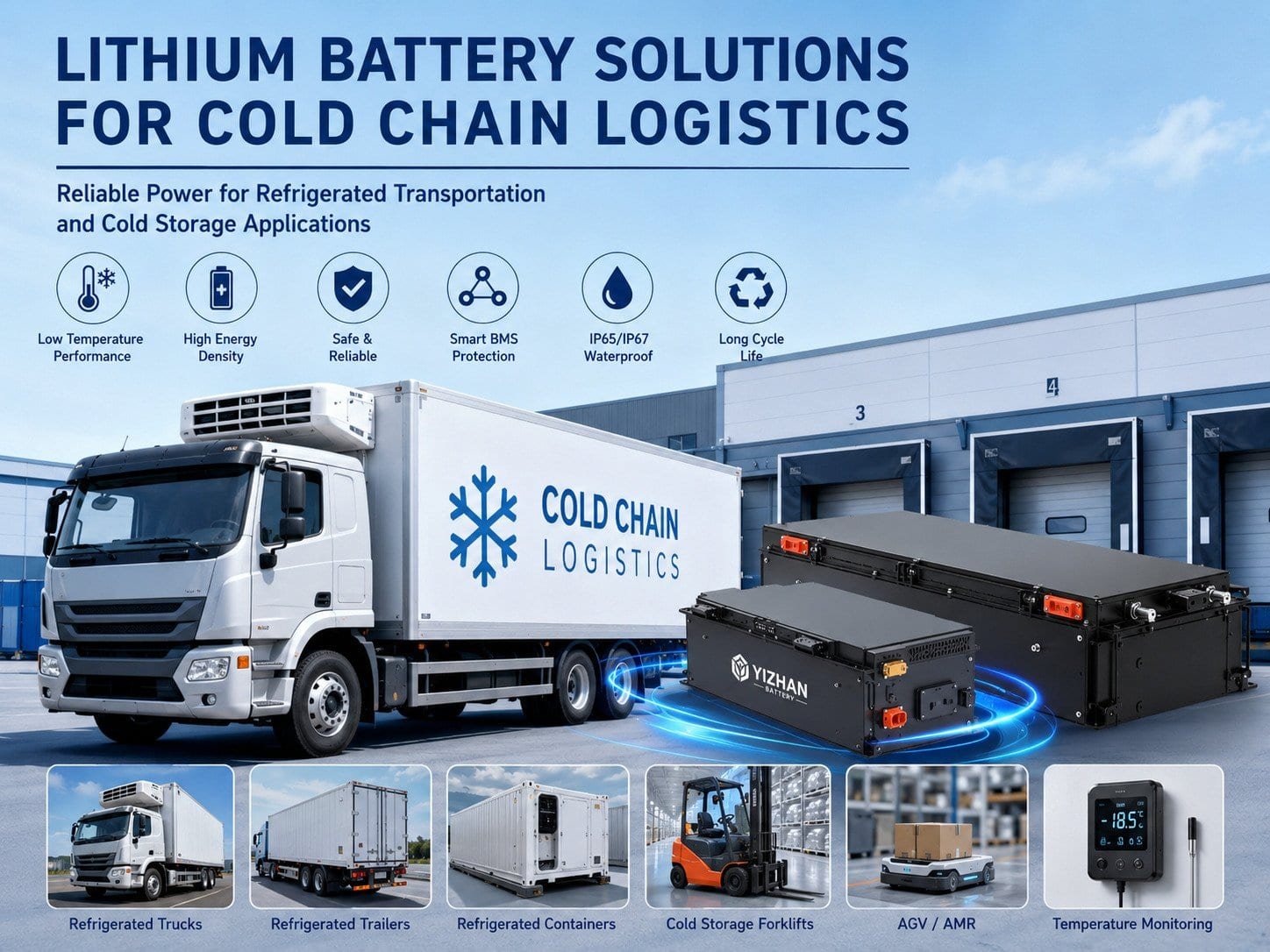
What Is a Lithium Battery Power Solution for Cold Chain Logistics?
A lithium battery power solution is a rechargeable battery system designed to provide electrical energy for equipment used in refrigerated transportation and cold storage.
Depending on the application, the system may power:
- Refrigeration units
- Electric compressors
- Refrigerated trucks
- Refrigerated trailers
- Cold storage AGVs
- 전동 지게차
- 팔레트 트럭
- 온도 모니터링 시스템
- Auxiliary vehicle equipment
- Refrigerated containers
- Mobile refrigeration equipment
A typical battery system consists of several components:
Lithium-ion cells → Battery Pack → BMS → Protection System → Power Output → Refrigeration or Logistics Equipment
The battery chemistry, cell configuration, BMS, thermal management system, enclosure, connectors, and charging system should be selected according to the actual application.
Why Lithium Batteries Are Used in Cold Chain Logistics
Cold chain equipment can operate for long periods and may need to maintain a controlled temperature while a vehicle is loading, unloading, parked, or moving.
A battery-based power system can provide an independent electrical power source for equipment that would otherwise rely on an engine-driven generator or another power supply.
Common reasons for adopting lithium battery systems include:
- Reduced dependence on engine operation
- Support for electric refrigeration equipment
- Flexible installation options
- Battery monitoring through a BMS
- Compatibility with automated logistics equipment
- Support for frequent charging applications
- Integration with vehicle or warehouse energy systems
However, lithium batteries are not automatically suitable for every cold-chain application. Low-temperature charging, thermal management, electrical protection, and mechanical protection must be addressed during the design stage.
Lithium Battery Applications in Cold Chain Logistics
1. Refrigerated Trucks
Refrigerated trucks require a refrigeration system to maintain the desired cargo temperature.
A dedicated lithium battery can supply power to an electrically driven refrigeration unit.
A simplified system can be represented as:
Battery Pack → BMS → Power Distribution → Refrigeration Controller → Compressor / Refrigeration System
The battery capacity depends on the refrigeration load and required operating time.
For example, if a refrigeration system has an average electrical load of 3 kW and needs to operate from the battery for 8 hours, the theoretical energy requirement is:
3 kW × 8 h = 24 kWh
The actual battery specification must account for system efficiency, usable SOC range, environmental temperature, battery aging, peak loads, and operating conditions.
Therefore, 24 kWh should not automatically be treated as the required nominal battery capacity.
2. Refrigerated Trailers
Refrigerated trailers may require an independent power source for their refrigeration systems.
Battery design needs to consider:
- Refrigeration power
- Operating duration
- Trailer installation space
- 충전 방법
- 최대 전류
- Environmental temperature
- 진동
- 방수
- 통신 요구 사항
For a trailer application, the battery enclosure also needs a suitable mechanical mounting system because the battery is exposed to road vibration and mechanical shock.
3. Refrigerated Containers
Battery systems can also be considered for refrigerated containers and other mobile refrigeration applications.
These systems may require relatively high energy capacity because refrigeration can continue for extended periods.
A container battery system may include:
- 고용량 리튬 셀
- BMS
- 퓨즈
- Contactor
- 예충전 회로
- 온도 센서
- 통신 인터페이스
- External charging interface
- Protective enclosure
The final architecture depends on the refrigeration equipment and container electrical system.
Lithium Batteries for Cold Storage AGVs and Forklifts
Cold chain logistics is not limited to transportation.
Inside refrigerated warehouses, AGVs, AMRs, forklifts, pallet trucks, and other material-handling equipment may operate at reduced temperatures.
This creates a different battery design requirement.
Low-Temperature Operation
Low temperatures can affect lithium-ion battery performance.
Potential effects include:
- 내부 저항 증가
- Reduced available capacity
- Lower power capability
- Changes in charging behavior
- Increased voltage drop under load
Most importantly, charging at low temperatures requires particular attention.
The allowable charging temperature must be based on the selected cell manufacturer’s specifications and the BMS protection strategy.
For equipment operating inside freezer environments, a battery with an integrated heating function may be considered.
Self-Heating Lithium Battery Packs for Cold Environments
A self-heating battery pack uses a heating element to raise the cell temperature before or during permitted charging conditions.
A typical control sequence can be:
Temperature Detection
↓
BMS Determines Cell Temperature
↓
Heating System Activated
↓
Cell Temperature Reaches Permitted Range
↓
Charging Enabled
This approach can be useful for applications where the battery regularly operates in low-temperature environments.
The heating system should be designed together with the BMS rather than treated as a separate component.
The design may include:
- Heating film or heating pad
- 온도 센서
- Heating control circuit
- BMS logic
- Thermal insulation
- Heating power management
The heating strategy should be validated through temperature testing under the actual operating conditions.
How to Calculate the Battery Capacity for Refrigeration Equipment
Battery sizing should begin with the refrigeration load rather than the battery model.
A basic calculation is:
Battery Energy = Load Power × Operating Time ÷ System Efficiency
예를 들어
- Average load: 4 kW
- Required operating time: 6 hours
- Estimated system efficiency: 90%
The theoretical battery energy requirement is:
4 × 6 ÷ 0.90 = 26.67 kWh
This is a starting point rather than a final battery specification.
Additional factors should be evaluated.
1. Peak Power
Compressors and other electrical equipment may have startup or transient power requirements.
2. Usable SOC Range
The battery may not use its entire nominal capacity during normal operation.
3. Temperature
Low or high temperatures can affect available battery energy and power.
4. Battery Aging
The required capacity may need to account for capacity degradation over the expected service life.
5. Auxiliary Loads
Fans, pumps, controllers, displays, communication equipment, and heating systems can also consume energy.
A detailed battery sizing calculation should therefore use the complete electrical load profile.
How to Choose Lithium Battery Cells for Cold Chain Applications
The cell is one of the most important components in a battery PACK.
Cell selection should consider several technical parameters.
용량
The cell capacity determines the required number of cells and the resulting battery energy.
For example, a high-capacity prismatic cell can reduce the number of cells required in some PACK designs.
연속 방전 전류
The cell must support the required continuous operating current.
The approximate discharge rate can be calculated as:
C-rate = Discharge Current ÷ Cell Capacity
For example, if a 100 Ah cell supplies 100 A:
100 A ÷ 100 Ah = 1C
The actual allowable current must always be checked against the cell manufacturer’s specifications.
Peak Current
The battery should also be evaluated against short-duration peak loads.
The design should distinguish between:
- 정류 전류
- 피크 전류
- Peak duration
- Peak frequency
작동 온도
For cold-chain applications, temperature specifications deserve particular attention.
The cell datasheet should be reviewed for:
- Charge temperature
- 방전 온도
- 보관 온도
- Low-temperature capacity
- Low-temperature charging limitations
LiFePO4 vs NMC for Cold Chain Battery Packs
Both LiFePO4 and NMC lithium-ion technologies can be considered for logistics applications, but the appropriate chemistry depends on the system requirements.
| Factor | LiFePO4 | NMC |
|---|---|---|
| 에너지 밀도 | 일반적으로 더 낮음 | 일반적으로 더 높다 |
| Thermal characteristics | Suitable for many stationary and mobile applications | Suitable for applications requiring higher energy density |
| Cycle-life considerations | Often suitable for frequent cycling | Depends on cell design and operating conditions |
| Weight-sensitive applications | May require more space | Can offer higher energy per unit mass |
| Cold-chain use | Suitable when temperature requirements are addressed | Suitable when temperature requirements are addressed |
The chemistry should not be selected based on the name alone.
The actual cell model, manufacturer specifications, current requirements, temperature range, mechanical design, BMS strategy, and certification requirements should all be considered.
BMS Design for Cold Chain Lithium Batteries
The Battery Management System is responsible for monitoring and protecting the battery.
For cold-chain applications, the BMS may monitor:
- 개별 세포 전압
- 패키지 전압
- 충전 전류
- 방전 전류
- 세포 온도
- BMS 온도
- SOC
- SOH
- 고장 상태
Protection functions may include:
- Overvoltage protection
- Undervoltage protection
- 과전류 보호
- 단락 보호
- Overtemperature protection
- 저온 충전 보호 기능
- Temperature sensor fault detection
For refrigeration equipment and commercial vehicles, communication may also be required.
일반적인 통신 인터페이스에는 다음이 포함됩니다:
CAN
RS485
UART
The communication protocol should be agreed with the equipment controller before BMS development begins.
Mechanical Design for Refrigerated Vehicle Battery Packs
A cold-chain battery is often installed in a mobile environment, so mechanical design is an important part of the PACK.
The enclosure may need to protect the battery from:
- Road vibration
- 기계적 충격
- 수분
- 먼지
- Condensation
- 온도 변화
- External impact
A customized battery enclosure may include:
- Aluminum or steel housing
- End plates
- Cell holders
- Insulation materials
- Vibration-damping materials
- Sealing structures
- 방수 커넥터
- 장착 브라켓
- Pressure management components
The target IP rating should be determined according to the installation environment and verified through appropriate testing.
Vibration Testing for Cold Chain Battery Packs
Refrigerated truck batteries are exposed to repeated vibration during transportation.
Therefore, vibration testing should be incorporated into the validation process.
The test program can evaluate:
- Cell movement
- Busbar connections
- Welded joints
- Connector retention
- BMS mounting
- Housing strength
- 케이블 배선
- Insulation integrity
A battery that performs well in a laboratory under static conditions may still require additional mechanical validation for vehicle applications.
Charging System Design
The charger must match the battery configuration and BMS.
For example, changing from a 12S battery to a 6S battery is not simply a cell replacement. The charger voltage, BMS configuration, wiring, protection parameters, and equipment interface may all need to change.
The charging system should therefore be designed around:
Cell Chemistry + Series Configuration + Charge Voltage + Charge Current + Temperature Conditions + BMS
The charging profile must follow the specifications of the selected cell and battery system.
Example: Custom Battery Pack Development
Consider a refrigeration equipment manufacturer that needs a compact battery pack.
The development process may start with:
Required system voltage
↓
Average refrigeration power
↓
최대 전력
↓
필요한 런타임
↓
사용 가능한 설치 공간
↓
세포 선택
↓
Series/parallel configuration
↓
BMS 선정
↓
열 관리
↓
Mechanical enclosure
↓
테스트
For example, a manufacturer may request a battery that fits within a defined enclosure while providing a specified voltage and energy capacity.
The PACK designer then needs to determine whether the target can be achieved with cylindrical, prismatic, or other suitable lithium-ion cells.
Custom Lithium Battery PACK Design Process
A professional battery development process should begin with the equipment requirements.
Step 1: Define Electrical Requirements
수집:
- 공칭 전압
- 작동 전압
- 용량
- Average current
- 최대 전류
- 피크 전류
- 충전 전류
- 필요한 런타임
Step 2: Define Environmental Requirements
Determine:
- Minimum operating temperature
- Maximum operating temperature
- 충전 온도
- 습도
- 물 노출
- 진동
- Shock
- 설치 환경
Step 3: Select the Cell
평가:
- 세포 화학
- 용량
- 전압
- 내부 저항
- C-rate
- 온도 범위
- 치수
- Manufacturer specifications
Step 4: Design the PACK
Determine:
- 직렬 및 병렬 연결
- Busbar
- BMS
- 퓨즈
- Contactor
- NTC
- 커넥터
- 주택
- 장착 구조
Step 5: Develop the BMS
Configure:
- Protection parameters
- Temperature limits
- SOC 계산
- 커뮤니케이션
- Fault management
- Heating control if required
Step 6: Build Prototype Samples
Prototype testing can identify issues related to:
- Installation
- 배선
- 온도
- Mechanical clearance
- 충전
- 커뮤니케이션
- 전원 출력
Step 7: Validate the Battery
Testing may include:
- 용량 테스트
- 충전/방전 시험
- BMS 보호 기능 테스트
- 온도 시험
- 저온 시험
- 고온 시험
- 진동 테스트
- 절연 시험
- Waterproof testing where applicable
- 에이징 테스트
The exact test program should be based on the product type, target market, customer requirements, and applicable standards.
Safety and Certification Considerations
Lithium batteries used in logistics equipment may be subject to transportation and product safety requirements.
The applicable requirements depend on:
- 배터리 화학
- Battery configuration
- End-use equipment
- Country or region
- Transportation method
- 배터리 용량
- Installation configuration
For batteries shipped internationally, transportation requirements should be considered during product development rather than after production.
For equipment entering markets such as the EU, United States, Japan, or South Korea, manufacturers should identify the applicable product and battery requirements before finalizing the design.
A battery manufacturer should also maintain appropriate production and quality-control procedures, including cell inspection, welding inspection, electrical testing, BMS testing, aging, and final inspection.
How to Choose a Cold Chain Lithium Battery Manufacturer
For equipment manufacturers looking for a customized battery solution, the supplier’s engineering and production capabilities are important.
Consider whether the manufacturer can provide:
세포 선택
The supplier should be able to select cells according to voltage, capacity, current, temperature, size, and application requirements.
PACK Engineering
The supplier should have experience with:
- Electrical design
- 기계 설계
- BMS 개발
- 열 관리
- 배선
- Protection circuits
시제품 개발
A prototype allows the battery to be tested in the actual equipment before mass production.
테스트
The supplier should have appropriate testing capabilities for electrical, thermal, mechanical, and environmental validation.
인증 지원
The supplier should understand the certification and transportation requirements relevant to the target market.
OEM/ODM 역량
Different refrigerated vehicles and logistics machines often have different:
- 치수
- 전압
- 커넥터
- 통신 프로토콜
- 장착 지점
- 용량 요구 사항
Therefore, customization capability can be important.
Custom Lithium Battery Solutions from Dongguan Yizhan Electronics Technology Co., Ltd.
동관 이잔 전자 기술 유한 공사(동관 이잔 전자 기술 유한 공사) focuses on customized lithium battery PACK solutions for commercial and industrial applications.
For cold-chain logistics equipment, a customized solution can be developed around the customer’s:
- 전압 사양
- 용량 요구 사항
- Refrigeration load
- 피크 전류
- 작동 온도
- Installation dimensions
- BMS 통신
- 충전 요건
- 기계적 장착
- 보호 요건
The development process can cover cell selection, PACK design, BMS, prototype development, testing, certification support, packaging, and shipping.
For applications operating in cold environments, the battery design can also be evaluated for low-temperature operation and charging requirements, including the potential use of a battery heating system.
Cold Chain Lithium Battery FAQ
Can lithium batteries work in cold environments?
Yes. Lithium batteries can operate in cold environments, but their available capacity, power output, and charging characteristics can change as temperature decreases. The allowable temperature range depends on the specific cell and battery design.
Can lithium batteries be charged below 0°C?
Charging at low temperatures requires careful control. Some lithium-ion cells have restrictions on charging below certain temperatures. The BMS should prevent charging outside the permitted range specified by the cell manufacturer. A heating system may be considered for applications that require charging in cold environments.
What battery chemistry is suitable for cold-chain logistics?
There is no single chemistry that is suitable for every cold-chain application. LiFePO4 and NMC can both be used depending on the required energy density, power, temperature range, cycle requirements, available space, and system design.
How large should a refrigeration battery be?
Battery capacity depends on refrigeration power and required operating time.
A basic calculation is:
Required Energy = Average Power × Operating Time
System efficiency, usable SOC, temperature, aging, peak power, and auxiliary loads should then be considered.
Can a lithium battery power a refrigerated truck?
Yes. A lithium battery can be designed to supply power to an electric refrigeration system, auxiliary equipment, or other electrical loads. The battery voltage and power output must match the refrigeration system requirements.
Does a cold-chain battery need heating?
Not every application requires battery heating. Heating may be considered when the battery must operate or charge in temperatures outside the cell’s normal charging range.
Can the battery communicate with the refrigeration controller?
Yes. Depending on the equipment architecture, the BMS can be developed with interfaces such as CAN, RS485, or UART. The communication protocol and data definitions need to be confirmed with the equipment manufacturer.
결론
Lithium batteries can provide a flexible power source for refrigerated transportation, cold storage equipment, electric logistics vehicles, and automated warehouse systems.
However, a cold-chain battery should be treated as a complete power system, rather than simply a collection of lithium cells.
A suitable solution should consider:
Battery Chemistry + Voltage + Capacity + Power + Temperature + BMS + Thermal Management + Mechanical Protection + Charging + Communication + Testing
For refrigerated vehicles and cold-storage equipment, particular attention should be given to low-temperature charging, battery heating, vibration resistance, moisture protection, and BMS protection.
For OEMs and equipment manufacturers, the most practical approach is to define the equipment’s electrical and environmental requirements first, then develop the cell configuration, BMS, thermal system, enclosure, and charging system around those requirements.
A properly engineered lithium battery PACK can then become an integrated part of the cold-chain equipment rather than an off-the-shelf component that the equipment must adapt to.
 English
  Chinese
  Japanese
  German
  French
  Korean
