
As warehouses, manufacturing plants, and distribution centers continue to automate their operations, 무인 운반차(AGV) 그리고 자율 주행 모바일 로봇(AMR) have become essential for improving efficiency and reducing labor costs.
While navigation systems, sensors, and software receive much attention, the battery system is equally critical. It directly affects runtime, charging efficiency, payload capacity, maintenance requirements, and overall operational reliability.
Compared with traditional lead-acid batteries, 리튬 이온 배터리, especially LiFePO4(리튬 철 인산염) batteries, offer significant advantages that help AGVs and AMRs achieve higher productivity and lower total operating costs.
Why Battery Technology Matters for AGV & AMR
AGVs and AMRs typically operate:
- 24/7 production environments
- Multi-shift warehouse operations
- Automated manufacturing lines
- Cold storage logistics
- E-commerce fulfillment centers
These applications require batteries that provide:
- 긴 작동 시간
- 고속 충전
- 높은 신뢰성
- 안정적인 출력
- 최소한의 유지 관리
- 긴 수명
A battery failure can stop an entire logistics workflow, making battery performance a key factor in system reliability.
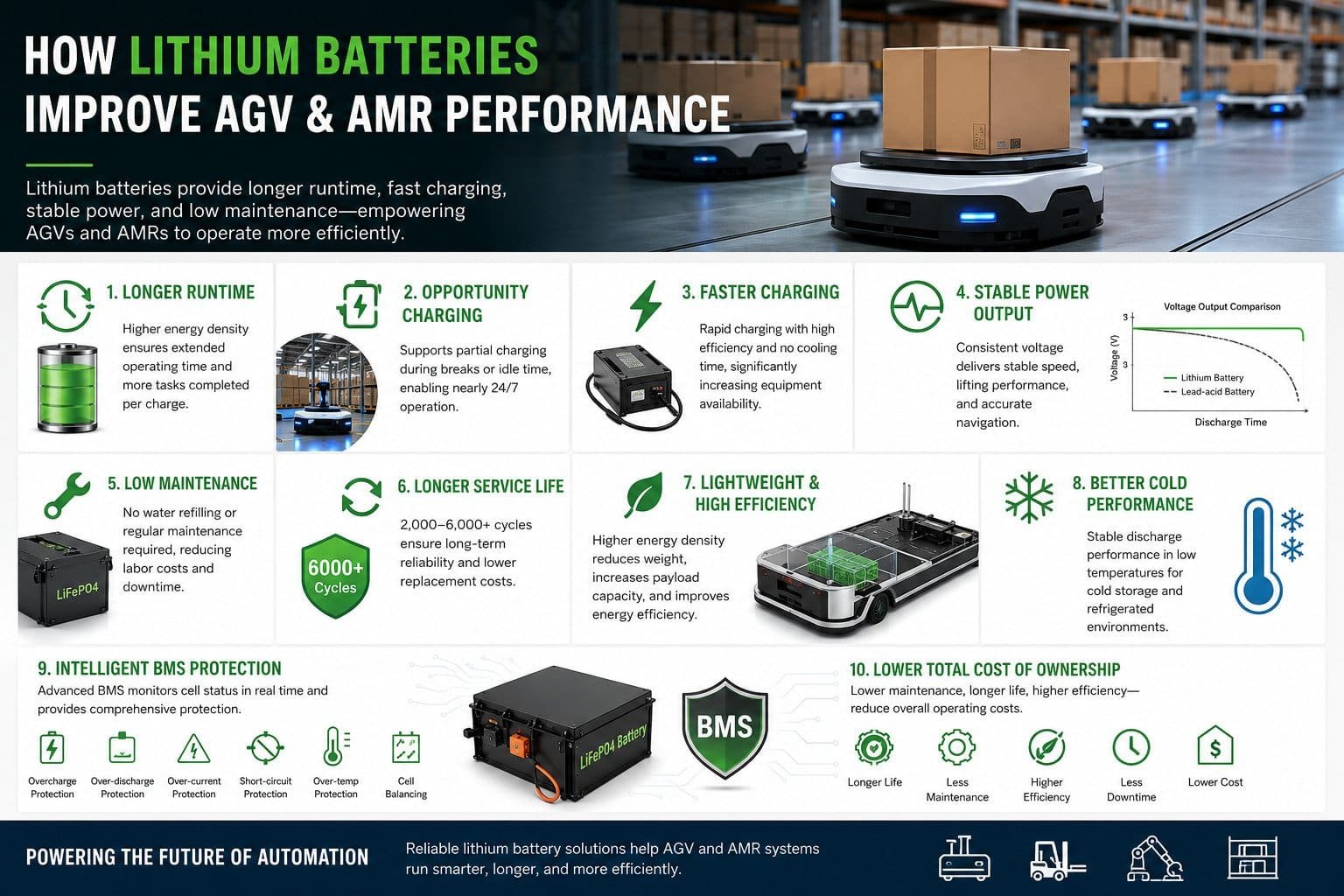
1. Longer Operating Time
Lithium batteries have a much higher energy density than lead-acid batteries.
다음과 같은 혜택이 있습니다:
- Longer runtime per charge
- Reduced charging frequency
- Increased daily productivity
- Extended operating shifts
For AGVs and AMRs working across large facilities, longer runtime means fewer interruptions and more completed tasks.
2. Opportunity Charging Increases Productivity
One of the biggest advantages of lithium batteries is 기회 충전.
Unlike lead-acid batteries, lithium batteries can be recharged during short breaks without damaging battery life.
Examples include:
- During loading
- During unloading
- Lunch breaks
- Shift changes
- Idle waiting periods
This enables nearly continuous operation without battery replacement.
혜택:
- 다운타임 감소
- 선단 가동률 향상
- Smaller battery inventory
- Improved warehouse efficiency
3. Faster Charging
납축 전지는 대개 다음 사항이 필요합니다:
- 8–10 hours charging
- 6–8 hours cooling
- 전용 충전실
Lithium batteries typically support:
- Rapid charging
- High charging efficiency
- No cooling period
- 유연한 충전 일정
This significantly increases equipment availability.
4. Stable Voltage Output
Lead-acid battery voltage gradually drops during discharge.
As voltage decreases:
- Driving speed may reduce
- Lifting performance may decline
- Robot accuracy may decrease
Lithium batteries maintain a relatively stable voltage throughout most of the discharge cycle.
다음과 같은 혜택이 있습니다:
- Consistent travel speed
- Stable lifting capability
- Reliable sensor performance
- Better navigation accuracy
This is especially important for precision warehouse automation.
5. Reduced Maintenance Costs
Lead-acid batteries require:
- 물 리필
- 터미널 청소
- 이퀄라이제이션 충전
- Corrosion inspection
- 환기 관리
리튬 배터리는 사실상 유지보수가 필요 없습니다.
이로 인해 다음이 줄어듭니다:
- Labor costs
- Maintenance downtime
- Human error
- Service interruptions
For fleets with dozens or hundreds of AGVs, maintenance savings can be substantial.
6. Longer Service Life
Battery replacement is a major operating expense.
일반적인 수명:
| 배터리 유형 | 일반적인 주기 수명 |
|---|---|
| 납산 | 500-1,000주기 |
| LiFePO4 | 2,000–6,000+ cycles |
A longer lifespan means:
- Fewer battery replacements
- Lower lifecycle costs
- 투자 수익률 향상
- More predictable maintenance planning
7. Higher Energy Density Reduces Vehicle Weight
리튬 배터리는 더 작고 가벼운 크기로 더 많은 에너지를 저장합니다.
다음과 같은 이점이 있습니다:
- Lower vehicle weight
- 에너지 효율성 향상
- Higher payload capacity
- 더 뛰어난 가속력
- Reduced mechanical wear
Manufacturers can also design more compact AGVs and AMRs while maintaining the same runtime.
8. Better Performance in Cold Environments
Cold-chain logistics and refrigerated warehouses require batteries that can operate reliably at low temperatures.
Modern lithium battery systems can include:
- Low-temperature cells
- Self-heating functions
- Intelligent temperature monitoring
- 열 보호
These features help maintain stable performance in challenging environments.
9. Intelligent Battery Management System (BMS)
A high-quality lithium battery pack includes an intelligent Battery Management System (BMS).
The BMS continuously monitors:
- 세포 전위
- 현재
- 온도
- SOC(충전 상태)
- 건강 상태 (SOH)
보호 기능에는 다음이 포함됩니다:
- 과충전 방지
- 과방전 방지
- 과전류 보호
- 단락 보호
- 과열 보호
- 셀 밸런싱
Many industrial battery packs also support communication protocols such as:
- CAN 버스
- CAN FD
- RS485
- Modbus RTU
This allows seamless integration with AGV and AMR fleet management systems for real-time battery monitoring and predictive maintenance.
10. Improved Safety
Safety is essential in automated facilities.
LiFePO4 배터리의 장점은 다음과 같습니다:
- 뛰어난 열 안정성
- 열 폭주 위험 감소
- High mechanical durability
- 안정적인 화학 구조
Combined with advanced BMS protection and quality manufacturing processes, lithium battery packs provide reliable operation in demanding industrial environments.
11. Lower Total Cost of Ownership (TCO)
Although lithium batteries generally have a higher upfront cost than lead-acid batteries, they can reduce overall operating expenses over time through:
- 더 길어진 서비스 수명
- 더 빠른 충전
- 유지보수 비용 절감
- 더 높은 에너지 효율성
- 다운타임 감소
- Lower replacement frequency
For facilities operating multiple AGVs or AMRs around the clock, these savings can significantly improve long-term cost efficiency.
Choosing the Right Lithium Battery for AGVs and AMRs
When selecting a battery solution, consider the following factors:
- System voltage (24V, 36V, 48V, 60V, 72V, etc.)
- Required capacity (Ah)
- Continuous and peak discharge current
- 사용 가능한 설치 공간
- Weight limitations
- Charging strategy
- 작동 온도 범위
- Communication protocol compatibility
- Required certifications
- Expected service life
Working with an experienced battery manufacturer can help ensure the battery pack is optimized for your vehicle and application.
결론
Lithium battery technology has become a key enabler of high-performance AGV and AMR systems. Compared with traditional lead-acid batteries, lithium solutions provide longer runtime, faster charging, reduced maintenance, consistent power output, and longer service life. These advantages help automated vehicles operate more efficiently while lowering total ownership costs.
For manufacturers, warehouse operators, and system integrators, choosing a reliable lithium battery solution is an important step toward improving automation performance and supporting long-term operational efficiency.
자주 묻는 질문
1. Why are lithium batteries preferred for AGVs and AMRs?
Lithium batteries offer higher energy density, faster charging, longer cycle life, and lower maintenance requirements than lead-acid batteries, making them well suited for continuous industrial operation.
2. Can AGV lithium batteries support opportunity charging?
Yes. Lithium batteries can be recharged during short idle periods without significantly affecting battery life, helping maximize equipment uptime.
3. Which lithium chemistry is commonly used in AGV and AMR batteries?
LiFePO4 (Lithium Iron Phosphate) is widely used because of its long cycle life, thermal stability, and safety characteristics.
4. What communication interfaces are commonly available?
Industrial lithium battery packs often support CAN Bus, CAN FD, RS485, or Modbus RTU for communication with vehicle controllers and fleet management systems.
5. Can lithium batteries be customized for AGV and AMR applications?
Yes. Battery manufacturers can provide customized voltage, capacity, dimensions, discharge performance, communication protocols, enclosure protection ratings, and BMS functions to meet specific vehicle requirements.
 English
  Chinese
  Japanese
  German
  French
  Korean
