
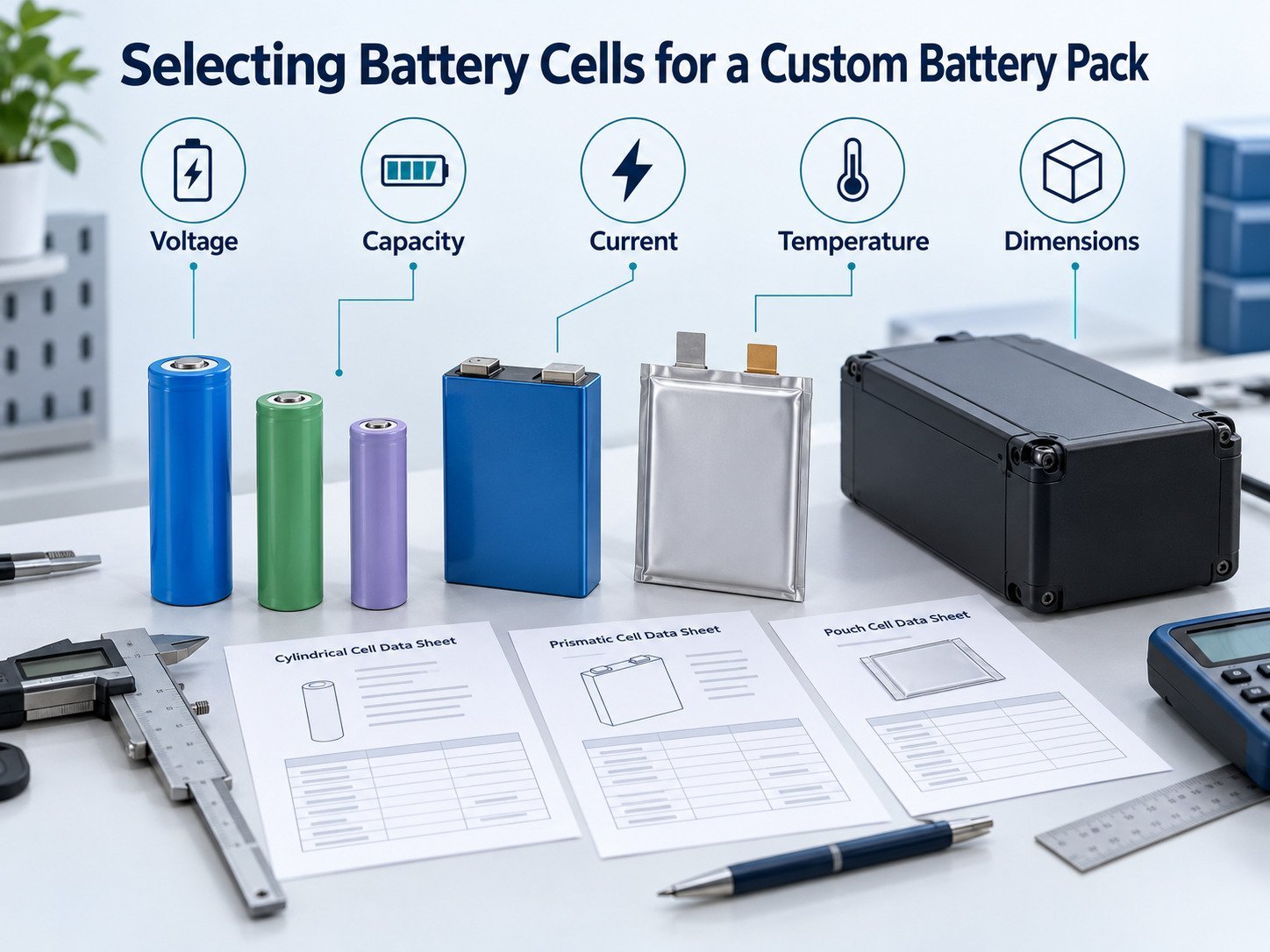
Cell selection begins with the equipment’s operating requirements. Capacity is one consideration, but the design must also address voltage, current, temperature, installation space and charging.
The selected cells must work within a complete pack that includes interconnections, protection, wiring and an enclosure.
This guide explains the information OEMs should review before approving a cell model.
1. Define the Equipment Requirements
Prepare a description of the application.
Document:
- Equipment input-voltage range.
- Operating schedule.
- Continuous current.
- Transient current and duration.
- Task-energy requirement.
- Charging method.
- Installation dimensions.
- Mass limit.
- Operating and storage conditions.
- Service-life criteria.
Identify measured values and assumptions separately.
A request for a particular capacity without load and operating information does not define the complete cell requirement.
2. Review Cell Chemistry
Lithium battery chemistries have different voltage characteristics, charging requirements and operating limits.
The review should address the selected chemistry and cell model rather than relying on a general chemistry label.
확인:
- Nominal voltage.
- Charging limit.
- Discharge endpoint.
- Permitted current.
- Temperature limits.
- Capacity measurement conditions.
- Life-test conditions.
Do not assume that cells of different chemistries can share the same charger, protection settings or series configuration.
3. Match the Voltage Configuration
The series configuration establishes the pack’s voltage range.
For example, ten cells or cell groups in series, each with a specified charging limit of 4.20V, have a calculated full-charge voltage of 42.0V.
This is an illustrative calculation. It is not a charging instruction for every pack labeled 36V.
Check the proposed configuration against:
- Controllers.
- Converters.
- Displays.
- Relays and contactors.
- Auxiliary equipment.
- Charging sources.
Nominal pack voltage alone does not establish compatibility.
4. Interpret Capacity Under Its Test Conditions
Cell capacity is measured using defined charging, discharge and temperature conditions.
검토:
- Nominal or typical capacity.
- Minimum capacity.
- Discharge current.
- Voltage endpoint.
- Temperature.
- Rest periods.
- Charging procedure.
Do not treat a typical value as a guaranteed minimum.
Where energy is stated, check its measurement basis. Multiplying nominal voltage by capacity provides an estimate, not a complete discharge-energy measurement.
5. Evaluate Current Capability
Review continuous discharge and any documented pulse conditions.
A pulse specification should identify duration, repetition and temperature conditions.
Compare the cell requirements with the equipment’s measured load profile, including:
- Startup.
- Motor acceleration.
- Pump activation.
- Actuator movement.
- Communication events.
- Repeated task cycles.
Do not assume that a pulse rating applies continuously.
The approved pack current also depends on interconnections, BMS components, protective devices, cables and connectors.
6. Check Voltage Behavior Under Load
A cell can meet a capacity requirement while the equipment reaches its voltage limit during a load event.
Evaluate voltage response at the intended:
- Current.
- Temperature.
- State of charge.
- Battery condition.
Use the equipment’s input limits as part of the acceptance criteria.
Capacity testing and load-response testing answer different questions. Both may be needed for the project.
7. Review Charging Requirements
Confirm the selected cell’s charging procedure.
Document:
- Charging voltage.
- Current.
- Termination conditions.
- Temperature restrictions.
- Rest requirements, where specified.
Check whether the charger and BMS support those requirements.
A requested charging time needs validation with the proposed cells and pack construction.
If the equipment permits regenerative charging, assess that current profile separately.
8. Define Temperature Conditions
Identify temperatures during operation, charging, transport and storage.
The cell’s permitted temperature range does not establish the temperature reached inside an installed battery.
검토:
- Heat generated by the cells.
- Adjacent electronics.
- Enclosure airflow.
- Installation position.
- Sunlight.
- Sensor placement.
Validate the thermal behavior of the assembled pack.
Do not apply one charging-temperature rule to every lithium cell model.
9. Select the Cell Format
Common formats include cylindrical, prismatic and pouch cells.
The format affects packaging and assembly requirements, but it does not establish performance by itself.
| Format | Integration Items to Review |
|---|---|
| Cylindrical | Holders, interconnections, insulation and arrangement |
| Prismatic | Mounting, terminal connections and manufacturer-specified restraint |
| Pouch | Mechanical support, tab connection, protection and dimensional changes |
Follow the selected manufacturer’s mechanical requirements.
Include electronics, insulation, wiring and structural parts in the installation envelope.
10. Review Cycle and Calendar Life
Cycle-life data needs a defined test procedure and endpoint.
확인:
- Charge and discharge rates.
- Depth of discharge.
- Temperature.
- Voltage window.
- Rest periods.
- Capacity-retention criterion.
- Sample information, where available.
Calendar aging also matters during storage and standby.
Do not convert a cell cycle count into a guaranteed number of equipment service years.
The pack’s service requirement should include task completion, usable energy and power delivery at the defined endpoint.
11. Interpret Internal Resistance Carefully
Internal resistance values depend on the measurement method and conditions.
Record:
- AC or DC method.
- Test frequency or pulse duration.
- Temperature.
- State of charge.
- Rest period.
- Connection arrangement.
Values obtained using different methods should not be treated as directly interchangeable.
Use resistance alongside capacity, voltage response and other evidence. One resistance value does not describe the complete condition of a cell.
12. Define Cell Matching and Incoming Checks
A manufacturing plan may include checks for identity, voltage, capacity, resistance and physical condition.
Define:
- Approved model.
- Batch identification.
- Measurement methods.
- Acceptance limits.
- Sampling.
- Storage before assembly.
- Handling of nonconforming material.
Cell balancing does not replace incoming inspection or resolve every capacity and self-discharge difference.
Do not mix unapproved cell models in a pack.
13. Verify Supply and Traceability
Obtain cells through a documented supply arrangement.
Request:
- Manufacturer and model identification.
- Current data sheet revision.
- Batch information.
- Applicable technical documents.
- Storage and handling instructions.
- Change-notification arrangements.
A printed model number alone does not establish origin.
Avoid unsupported labels such as “Grade A” unless the supplier defines the term and provides evidence for the stated acceptance criteria.
14. Check Document Scope
Confirm that documents refer to the selected cell model and revision.
Distinguish:
- Manufacturer specifications.
- Performance test results.
- Safety assessment documents.
- Transport test information.
Cell documentation does not automatically cover the assembled battery pack or host equipment.
Applicable standards and assessment requirements depend on the intended use and destination market.
15. Validate Cells in the Proposed Pack
Cell data supports design, but pack validation is still required.
| Test Area | Verification |
|---|---|
| Capacity and energy | Results under the specified procedure |
| 현재 | Continuous and transient demand |
| 전압 | Response within equipment limits |
| 충전 | Profile and termination |
| 온도 | Cell and component behavior |
| 보호 | BMS response and recovery |
| Mechanical integration | Restraint, insulation and connections |
| Task operation | Completion of the equipment duty cycle |
Identify the tested cell model, batch, pack construction and firmware.
Use controlled laboratory procedures. Do not perform abuse testing or modify cells outside an approved test process.
16. Control Cell Substitutions
A substitute cell should undergo review even when its dimensions and capacity appear to match.
Review effects on:
- Voltage.
- Current capability.
- Charging.
- Temperature.
- Mechanical construction.
- BMS settings.
- Performance evidence.
- Assessment coverage.
Record approval and the production batch where the change takes effect.
Cell Selection Checklist
Before approving a model, confirm:
- Equipment requirements.
- Chemistry and voltage configuration.
- Capacity test conditions.
- Continuous and transient current.
- Charging requirements.
- Temperature limits.
- Mechanical requirements.
- Life-test conditions.
- Incoming acceptance criteria.
- Supply traceability.
- Document coverage.
- Pack validation.
- Change control.
자주 묻는 질문
Can Cells Be Selected by Capacity Alone?
No. Current, voltage, charging, temperature and installation requirements also apply.
Are Cells With the Same Size Interchangeable?
Not automatically. Their electrical and mechanical requirements may differ.
Does a Cell Rating Establish Pack Performance?
No. The assembled pack includes other components and operating constraints.
Can Internal Resistance Determine Cell Quality?
It is one measurement. Its method and conditions must be known, and other checks remain necessary.
Can a Different Cell Be Used After Production Approval?
Only through the agreed review and validation process.
Preparing the Cell Specification
Start with the equipment’s measured demands and operating conditions.
Select a documented cell model, verify it in the proposed pack and control its use through approved specifications and production records.

 English
 Chinese
 Japanese
 German
 French
 Korean

