
Choosing a suitable lithium battery pack requires more than comparing voltage and capacity. AGVs, golf carts and energy storage systems have different operating conditions, discharge requirements, installation spaces and charging methods. A battery pack designed for one application may not be suitable for another, even when the nominal voltage and capacity are the same.
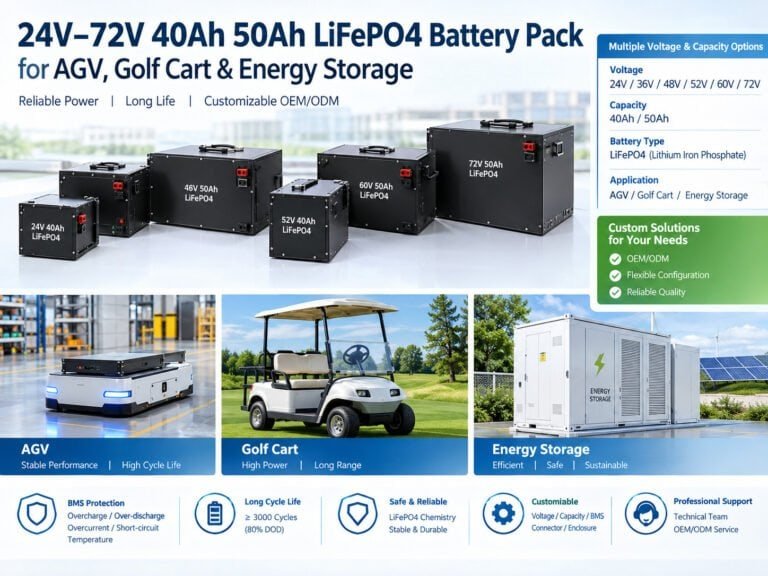
A 24V 40Ah LiFePO4 battery pack, for example, may be used in an automated guided vehicle, while a 48V 50Ah battery pack may be designed for a golf cart. A 72V 50Ah battery pack may serve a mobile energy storage system or industrial equipment. Each application requires a battery configuration that matches its electrical system, mechanical structure and operating environment.
This guide explains the specifications, battery chemistry, application requirements and customization process for 24V, 36V, 48V, 52V, 60V and 72V 40Ah and 50Ah LiFePO4 battery packs.
1. What Is a LiFePO4 Battery Pack?
A LiFePO4 battery pack uses lithium iron phosphate as the positive electrode material. LiFePO4 is a lithium-ion battery chemistry used in applications that require rechargeable energy storage, stable operating characteristics and a long service life.
Compared with lead-acid batteries, LiFePO4 battery packs offer several design advantages:
- Lower weight for equivalent energy capacity in many applications.
- A flatter discharge voltage profile.
- Rechargeable operation with a suitable battery management system.
- Low self-discharge during storage.
- A chemistry that does not contain cobalt or nickel in the cathode material.
- Flexible pack configurations for industrial equipment and energy storage.
LiFePO4 is not automatically suitable for every application. The battery must be designed around the equipment’s current requirements, charging voltage, operating temperature and available installation space.
For AGVs, golf carts and energy storage systems, the battery pack design should also consider communication, protection, thermal management and maintenance requirements.
2. LiFePO4 Battery Pack Voltage and Capacity
Battery voltage and capacity are two of the most important specifications.
Voltage indicates the electrical potential of the battery pack. Capacity, measured in ampere-hours (Ah), indicates how much electrical charge the battery can store under specified test conditions.
The approximate nominal energy of a battery pack can be calculated as:
Nominal Energy (Wh) = Nominal Voltage (V) × Rated Capacity (Ah)
예를 들어
- 24V × 40Ah = 960Wh
- 24V × 50Ah = 1,200Wh
- 48V × 40Ah = 1,920Wh
- 48V × 50Ah = 2,400Wh
- 72V × 40Ah = 2,880Wh
- 72V × 50Ah = 3,600Wh
These figures are nominal energy values rather than guaranteed usable energy. Actual available energy depends on the battery management system, discharge current, temperature, cutoff voltage, cell characteristics and operating conditions.
Buyer-Focused Battery Specification Table
| 배터리 전압 | 용량 | Approx. Nominal Energy | 일반적인 애플리케이션 |
|---|---|---|---|
| 24V LiFePO4 | 40Ah | 960Wh | AGV, pallet truck, compact equipment |
| 24V LiFePO4 | 50Ah | 1,200Wh | AGV, mobile equipment, small energy storage |
| 36V LiFePO4 | 40Ah | 1,440Wh | Golf cart, electric equipment |
| 36V LiFePO4 | 50Ah | 1,800Wh | Golf cart, industrial mobility |
| 48V LiFePO4 | 40Ah | 1,920Wh | AGV, golf cart, energy storage |
| 48V LiFePO4 | 50Ah | 2,400Wh | AGV, golf cart, mobile energy storage |
| 52V LiFePO4 | 40Ah | 2,080Wh | Custom industrial and mobility systems |
| 52V LiFePO4 | 50Ah | 2,600Wh | Custom energy storage and equipment |
| 60V LiFePO4 | 40Ah | 2,400Wh | Industrial equipment, custom mobility |
| 60V LiFePO4 | 50Ah | 3,000Wh | Custom industrial applications |
| 72V LiFePO4 | 40Ah | 2,880Wh | Industrial equipment, energy storage |
| 72V LiFePO4 | 50Ah | 3,600Wh | High-voltage mobile and storage systems |
These voltage and capacity combinations are configurable product options. Final specifications depend on the selected cell type, series-parallel configuration, BMS, enclosure and charging system.
3. 24V LiFePO4 Battery Pack for AGV Applications
Automated guided vehicles use rechargeable battery packs to support material handling, warehouse transportation and repetitive industrial operations.
A 24V LiFePO4 battery pack is suitable for AGV systems designed around a 24V nominal battery voltage. The actual pack voltage must match the vehicle’s motor controller, charger and electrical architecture.
AGV Battery Requirements
An AGV battery pack may need to support:
- Repeated charging and discharging.
- Frequent acceleration and braking.
- High current demand during motor startup.
- Multiple operating shifts.
- Battery monitoring through CAN, RS485 or UART.
- Installation in a limited battery compartment.
- Operating conditions in warehouses, factories or temperature-controlled environments.
A 24V 40Ah battery pack provides approximately 960Wh of nominal energy. A 24V 50Ah pack provides approximately 1,200Wh.
The suitable capacity depends on the AGV’s average power consumption, operating hours, charging opportunities and required reserve capacity.
AGV Battery Pack Design
A custom AGV battery pack may include:
- LiFePO4 prismatic or cylindrical cells.
- A customized battery enclosure.
- BMS with overcharge and over-discharge protection.
- Overcurrent and short-circuit protection.
- Temperature monitoring.
- CAN or RS485 communication.
- Battery status indicators.
- Custom connectors and wiring harnesses.
- Charging interface matched to the AGV system.
For AGV applications, the battery should be evaluated under actual operating conditions rather than selected only by nominal capacity.
4. 36V and 48V LiFePO4 Battery Pack for Golf Carts
Golf carts require battery packs that can provide energy for driving, acceleration, inclines and repeated charging.
A 36V or 48V LiFePO4 battery pack may be suitable for golf carts, depending on the vehicle’s electrical system and motor controller.
36V Golf Cart Battery
A 36V 40Ah LiFePO4 battery pack provides approximately 1,440Wh of nominal energy.
A 36V 50Ah battery pack provides approximately 1,800Wh.
These configurations may be considered for golf carts with moderate energy requirements, but the battery must be matched to the vehicle’s motor power and controller current.
48V Golf Cart Battery
A 48V 40Ah LiFePO4 battery pack provides approximately 1,920Wh of nominal energy.
A 48V 50Ah battery pack provides approximately 2,400Wh.
A 48V system may require a different charging voltage, connector and BMS configuration from a 36V system. The battery pack should be designed for the complete vehicle system.
Golf Cart Battery Design Considerations
A custom golf cart battery pack may require:
- High continuous discharge current.
- Short-duration peak current support.
- Vibration-resistant internal construction.
- A protective enclosure.
- Battery state-of-charge monitoring.
- Charger compatibility.
- BMS communication with the vehicle.
- Suitable mounting points.
- Waterproofing or splash resistance where required.
Golf cart battery design should also consider the vehicle’s weight distribution and available battery compartment.
5. 52V, 60V and 72V LiFePO4 Battery Pack for Industrial Equipment
52V, 60V and 72V battery systems are used in various industrial and mobile applications.
These voltage levels may be selected for custom equipment where the motor controller, inverter or power system requires a specific nominal voltage.
A 52V LiFePO4 battery pack is not interchangeable with a 48V battery pack simply because the voltage difference is small. The charging system and operating voltage range must be compatible with the selected battery.
52V LiFePO4 Battery Pack
A 52V 40Ah battery pack provides approximately 2,080Wh of nominal energy.
A 52V 50Ah battery pack provides approximately 2,600Wh.
The actual cell configuration, nominal voltage and charging voltage should be confirmed during engineering design.
60V LiFePO4 Battery Pack
A 60V 40Ah battery pack provides approximately 2,400Wh of nominal energy.
A 60V 50Ah battery pack provides approximately 3,000Wh.
A 60V battery pack may be used in industrial mobility systems, custom electric equipment and other applications requiring a higher nominal voltage.
72V LiFePO4 Battery Pack
A 72V 40Ah battery pack provides approximately 2,880Wh of nominal energy.
A 72V 50Ah battery pack provides approximately 3,600Wh.
72V systems require attention to insulation, wiring, connector selection, BMS voltage rating and charger compatibility.
The battery pack should be designed according to the equipment’s maximum operating voltage, charging requirements and applicable safety standards.
6. LiFePO4 Battery Pack for Energy Storage Systems
LiFePO4 battery packs are used in energy storage systems for backup power, mobile equipment and other applications.
A 24V, 36V, 48V, 52V, 60V or 72V battery pack may be considered depending on the inverter or power system requirements.
For example, a 48V 50Ah battery pack provides approximately 2.4kWh of nominal energy. The usable energy depends on the permitted depth of discharge, operating temperature and BMS settings.
Energy Storage Battery Design
Energy storage applications may require:
- Stable voltage output.
- Suitable continuous discharge current.
- BMS communication.
- Temperature monitoring.
- Battery state-of-charge estimation.
- 과충전 및 과방전 방지.
- Short-circuit protection.
- A suitable enclosure.
- Parallel connection capability, if supported by the design.
Energy storage systems may have different requirements from AGVs or golf carts. The battery design should be matched to the inverter, charging source and load profile.
Battery Capacity and Runtime
A simplified runtime calculation is:
Runtime (hours) = Usable Energy (Wh) ÷ Load Power (W)
For example, a 48V 50Ah battery pack has approximately 2,400Wh of nominal energy.
If the load is 400W, the theoretical runtime is:
2,400Wh ÷ 400W = 6 hours
Actual runtime will be lower or different depending on battery efficiency, load variation, cutoff voltage and operating temperature.
7. LiFePO4 Battery Pack Configuration
A LiFePO4 battery pack consists of cells connected in series and parallel.
Series connections increase voltage. Parallel connections increase capacity.
A simplified example:
- 8S configuration: approximately 25.6V nominal.
- 12S configuration: approximately 38.4V nominal.
- 16S configuration: approximately 51.2V nominal.
- 20S configuration: approximately 64V nominal.
- 24S configuration: approximately 76.8V nominal.
These are common LiFePO4 nominal voltage configurations, not exact matches for every product name. The final battery configuration must be selected according to the required voltage range and application.
For example, a 48V LiFePO4 battery pack often uses a 16S configuration with a nominal voltage of 51.2V. A 72V LiFePO4 battery pack may use a 24S configuration with a nominal voltage of 76.8V.
This is why product naming, nominal voltage and actual cell configuration should be clearly specified on the technical datasheet.
8. BMS Functions for AGV, Golf Cart and Energy Storage Batteries
The battery management system is an important part of a lithium battery pack.
A BMS monitors battery conditions and manages protection functions.
Common BMS functions include:
과충전 방지
The BMS monitors cell voltage and helps prevent charging beyond the permitted voltage range.
과방전 방지
The BMS disconnects the battery when the voltage reaches the configured discharge limit.
과전류 보호
The BMS monitors current and provides protection when current exceeds the configured limit.
단락 보호
The BMS may disconnect the battery when a short circuit is detected.
온도 모니터링
Temperature sensors monitor battery conditions during charging and discharging.
셀 밸런싱
Cell balancing helps maintain consistent cell voltage within the battery pack.
커뮤니케이션
Depending on the equipment, the BMS may support:
- CAN
- RS485
- UART
- 블루투스
- Other customized communication interfaces
The communication protocol should be confirmed with the equipment manufacturer before production.
9. How to Choose 40Ah or 50Ah LiFePO4 Battery Pack
Choosing between 40Ah and 50Ah depends on the equipment’s power consumption and operating schedule.
A 50Ah battery pack provides 25% more nominal capacity than a 40Ah battery pack at the same voltage.
예를 들어
| Battery Pack | 공칭 에너지 |
|---|---|
| 48V 40Ah | 1,920Wh |
| 48V 50Ah | 2,400Wh |
The 50Ah pack may provide longer operating time under similar conditions, but it may also require more installation space and increase battery weight.
The following factors should be considered:
- Required operating hours.
- Average and peak load current.
- Charging time.
- Battery compartment dimensions.
- Maximum battery weight.
- Operating temperature.
- Required communication functions.
- Required cycle life.
- Applicable certifications.
- Budget and production quantity.
For AGVs, operating schedule and charging method are important. For golf carts, peak current and vehicle compatibility are important. For energy storage systems, load profile and inverter compatibility are important.
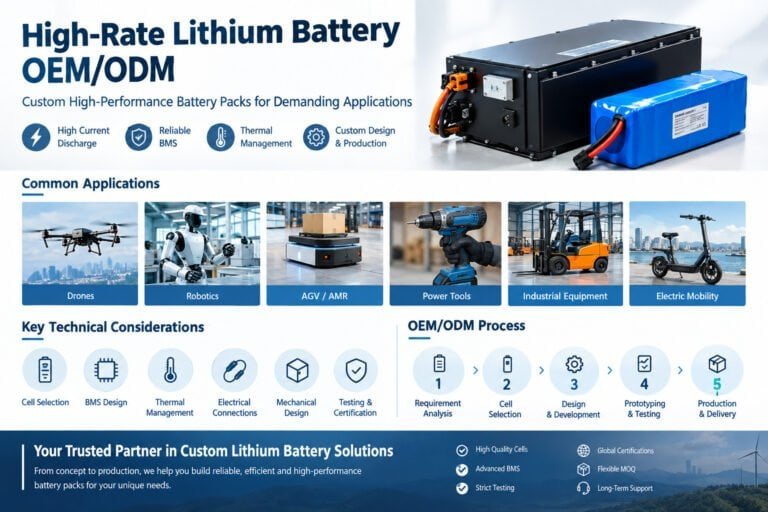
10. Custom LiFePO4 Battery Pack OEM/ODM Process
A custom battery pack manufacturer should evaluate the complete battery design before production.
The OEM/ODM process may include the following stages.
Step 1: Application Assessment
The customer provides information about the equipment, application, operating environment and power requirements.
Step 2: Battery Specification
The battery manufacturer confirms:
- Voltage.
- Capacity.
- Cell type.
- Continuous discharge current.
- Peak discharge current.
- Charging voltage.
- Charging current.
- BMS functions.
- Connector type.
- Enclosure dimensions.
- Communication requirements.
Step 3: Electrical and Structural Design
The engineering team develops the battery pack structure, wiring layout, BMS configuration and enclosure design.
Step 4: Prototype Development
A sample battery pack is produced for evaluation.
Step 5: Testing
The battery pack is tested according to the agreed technical requirements.
Step 6: Customer Approval
The customer evaluates the prototype and confirms any required changes.
Step 7: Mass Production
After the design is approved, the manufacturer prepares production materials and assembles the battery packs.
Step 8: Quality Inspection
The completed battery packs undergo inspection according to the manufacturer’s quality control procedures.
Step 9: Delivery
The battery packs are packaged and shipped according to the agreed requirements.
11. Battery Testing and Quality Control
LiFePO4 battery pack quality depends on cell consistency, assembly quality, BMS configuration and testing procedures.
A battery pack manufacturer may conduct:
- Cell voltage inspection.
- Cell internal resistance inspection.
- Capacity testing.
- Charging and discharging testing.
- BMS protection testing.
- Temperature sensor testing.
- Communication testing.
- Insulation testing.
- Connector inspection.
- Enclosure inspection.
- Final appearance inspection.
For industrial battery packs, testing should be matched to the product’s application and technical requirements.
If the battery pack is intended for international shipping, the manufacturer should also provide the required transportation documentation and test reports.
12. Certifications and Compliance
Battery pack compliance depends on the product design, intended market, battery chemistry, transportation method and end-use application.
Common standards and documents may include:
- UN38.3 transportation testing.
- MSDS documentation.
- IEC 62133-2.
- IEC 62619.
- UL2271 for certain light electric vehicle battery applications.
- EN50604-1 for applicable light electric vehicle battery applications.
- EU Battery Regulation 2023/1542.
- CE-related conformity requirements where applicable.
- RoHS requirements where applicable.
The applicable requirements should be confirmed before production and shipment.
Not every battery pack requires every certification. The manufacturer should evaluate the specific product and target market.
13. Why Choose a Custom Battery Pack Manufacturer?
A custom battery pack manufacturer can support customers who need battery designs adapted to specific equipment.
For AGVs, the manufacturer can help develop a battery pack for the vehicle’s power system and installation space.
For golf carts, the manufacturer can help configure the battery pack for the motor controller, charger and vehicle structure.
For energy storage systems, the manufacturer can help match battery voltage, capacity, BMS functions and communication requirements.
Custom services may include:
- Battery voltage customization.
- Capacity customization.
- Cell selection.
- BMS customization.
- Enclosure design.
- Connector customization.
- Wiring harness design.
- Label and packaging customization.
- OEM/ODM production.
- Prototype development.
- Battery testing.
Dongguan Yizhan Electronics Technology Co., Ltd. provides custom lithium battery pack OEM/ODM services for industrial equipment, AGVs, golf carts, energy storage systems and other applications.
The company supports battery pack development from requirements analysis and design to sampling and mass production.
14. FAQ
What is the difference between 40Ah and 50Ah LiFePO4 battery packs?
A 50Ah battery pack has 25% more nominal capacity than a 40Ah battery pack at the same voltage. The actual operating time depends on the load, temperature and usable battery energy.
Can a 48V LiFePO4 battery replace a lead-acid battery?
A LiFePO4 battery may replace a lead-acid battery in some applications, but compatibility must be confirmed. The charging system, voltage range, BMS and mechanical installation must be suitable.
Can 24V, 36V, 48V, 52V, 60V and 72V batteries be customized?
Yes. Battery voltage, capacity, BMS, enclosure, connector and communication functions can be customized according to the equipment requirements.
Is LiFePO4 suitable for AGVs?
LiFePO4 can be suitable for AGVs when the battery pack is designed for the AGV’s voltage, current, operating schedule, charging system and installation conditions.
Is LiFePO4 suitable for golf carts?
LiFePO4 battery packs can be used in golf carts with compatible electrical systems. The battery must be matched to the motor controller, charger, current requirements and battery compartment.
How do I choose a battery pack for energy storage?
Start with the required voltage, load power, operating time, charging method, installation space and BMS requirements. The battery capacity should be selected based on actual energy consumption.
Can the battery manufacturer provide samples?
Yes. A custom battery manufacturer can develop prototype battery packs for evaluation before mass production.
What information is needed for a custom battery pack quotation?
Useful information includes voltage, capacity, discharge current, charging current, dimensions, application, operating temperature, BMS communication, connector type and expected order quantity.
결론
24V, 36V, 48V, 52V, 60V and 72V LiFePO4 battery packs in 40Ah and 50Ah configurations can support different industrial and energy storage applications.
The correct battery pack depends on the equipment’s electrical requirements, operating conditions, installation space, charging system and compliance needs.
For AGVs, golf carts and energy storage systems, a custom battery pack design can help match the battery to the equipment and production requirements.
동관 이잔 전자 기술 유한 공사(동관 이잔 전자 기술 유한 공사) supports custom LiFePO4 battery pack OEM/ODM services, including battery design, BMS customization, sampling, testing and mass production.


 English
  Chinese
  Japanese
  German
  French
  Korean
