
Agricultural spraying drones have become an important tool in modern precision farming. They help farmers improve spraying efficiency, reduce labor costs, and achieve more accurate crop management. From pesticide spraying and fertilizer spreading to crop monitoring, agricultural UAVs are increasingly used in farms, orchards, and agricultural production areas.
However, the performance of an agricultural spraying drone depends heavily on its power system. Among all components, the battery is one of the most critical parts because it directly affects flight time, payload capacity, operating efficiency, and overall reliability.
Choosing the right agricultural drone battery requires more than simply selecting a battery with a larger capacity. Factors such as voltage, discharge rate, battery chemistry, weight, charging speed, environmental conditions, and battery management systems must all be considered.
This guide explains how to select the right battery for agricultural spraying drones and what battery features UAV manufacturers should evaluate when developing reliable drone power solutions.
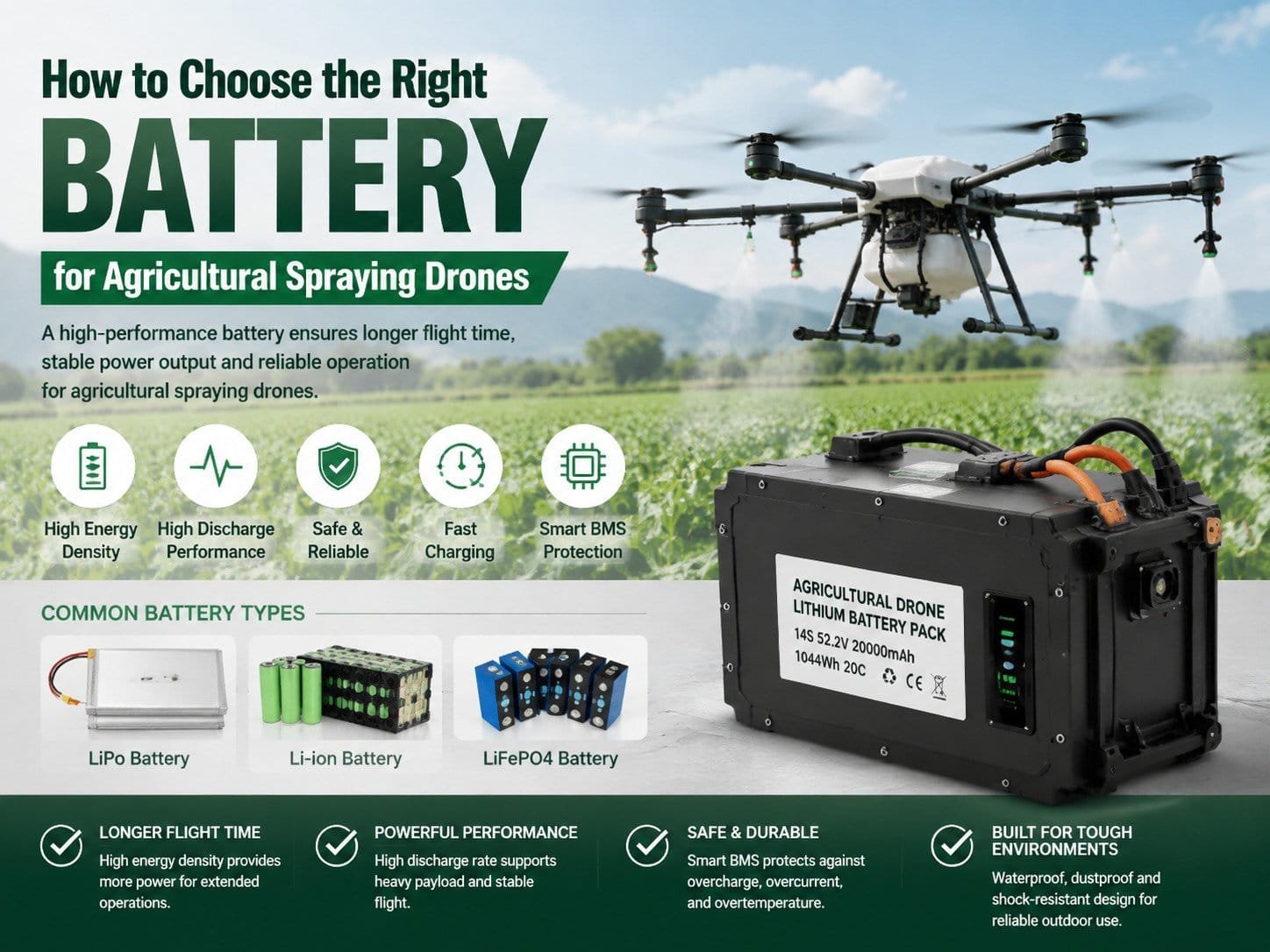
Part 1. Why Battery Selection Matters for Agricultural Spraying Drones
Agricultural drones operate differently from consumer drones. They usually carry additional payloads, including:
- Pesticide tanks
- Fertilizer containers
- Spraying pumps
- 制御システム
- Sensors and communication equipment
Compared with lightweight photography drones, agricultural UAVs require significantly higher power output.
A suitable battery must provide:
- 安定した電圧出力
- High continuous discharge capability
- 長時間の稼働
- Reliable performance under outdoor conditions
- Fast charging for repeated operations
An unsuitable battery may cause:
- Short flight duration
- Sudden voltage drops
- Reduced payload capacity
- バッテリーの過熱
- 耐用年数の短縮
For professional agricultural applications, battery selection is a key factor in improving operational efficiency.
Part 2. Common Battery Types for Agricultural Spraying Drones
Currently, agricultural drones mainly use high-performance lithium battery technologies.
2.1 Lithium Polymer Battery (LiPo)
Lithium polymer batteries are widely used in high-performance UAV applications because they provide excellent power output.
メリット
- 高い吐出量
- 軽量設計
- Strong instantaneous power output
- Suitable for high-load flight conditions
LiPo batteries can provide high current during:
- Drone startup
- Rapid climbing
- Heavy-load spraying
- Strong wind compensation
デメリット:
- Shorter cycle life compared with some lithium-ion solutions
- Requires strict charging and storage management
- Higher maintenance requirements
LiPo batteries are commonly used for agricultural drones that require maximum power performance.
2.2 Lithium-Ion Battery Pack
Lithium-ion battery packs are becoming increasingly popular for industrial agricultural UAV applications.
メリット
- サイクル寿命が長い
- より高いエネルギー密度
- Better long-term operating cost
- More stable performance
Lithium-ion batteries are suitable for:
- Commercial farming operations
- Long-duration missions
- Professional UAV platforms
Common cylindrical cells include:
- 18650 lithium-ion cells
- 21700 lithium-ion cells
These cells can be combined into customized battery packs according to UAV requirements.
2.3 LiFePO4 Battery
Lithium iron phosphate (LiFePO4) batteries are known for safety and long cycle life.
メリット
- 優れた熱安定性
- 長寿命
- 高い安全性
- Good reliability
However, LiFePO4 batteries have lower energy density compared with some lithium-ion chemistries, making them less common for lightweight aerial applications.
They are more suitable for:
- Ground agricultural robots
- Autonomous farming equipment
- Charging stations
- Agricultural energy storage systems
Part 3. Understand Battery Voltage Requirements
Voltage is one of the most important parameters when selecting an agricultural drone battery.
The battery voltage must match:
- Motor system
- Electronic speed controller (ESC)
- Flight controller
- 電源要件
Common agricultural drone battery voltages include:
| Drone Type | Typical Voltage |
|---|---|
| Small agricultural UAV | 22.2V (6S) |
| Medium spraying drone | 44.4V (12S) |
| Large agricultural drone | 48V-52V |
A higher voltage system can reduce current demand under the same power output, improving efficiency and reducing heat generation.
Part 4. Battery Capacity and Flight Time
Battery capacity is measured in Ah (ampere-hours) or mAh.
A larger capacity battery can provide longer operation time, but it also increases weight.
The relationship between capacity and flight performance requires balance.
Factors affecting flight time include:
- Drone weight
- 積載重量
- Spraying volume
- Flight speed
- Weather conditions
- Motor efficiency
例えば、こうだ:
A 20Ah battery may provide longer operation than a 10Ah battery, but the additional weight may reduce the efficiency improvement.
Professional battery design requires optimization between:
- Energy capacity
- 重量
- 出力
Part 5. High Discharge Rate Requirements
Agricultural spraying drones require high current output.
During operation, the battery must support:
- Motor acceleration
- Heavy payload lifting
- Continuous spraying
- 耐風性
The discharge rate is usually expressed as C-rate.
例
A 20Ah battery with a 10C discharge rating can theoretically provide:
20Ah × 10C = 200A continuous current
For agricultural UAV applications, high discharge capability helps maintain:
- 安定した電圧
- Better flight control
- より高い効率
A professional UAV battery should be designed with:
- Low internal resistance cells
- High-current connectors
- Optimized current paths
- Reliable welding technology
Part 6. Battery Management System (BMS) for Agricultural UAV Batteries
A smart Battery Management System plays an important role in protecting UAV batteries.
A properly designed BMS monitors:
電圧監視
含む:
- 個々の細胞の電位
- Total battery voltage
- 電圧不均衡
Current Monitoring
The BMS tracks:
- 充電電流
- 放電電流
- 過電流状態
温度モニタリング
Agricultural drones often operate outdoors in hot environments.
Temperature monitoring helps prevent:
- オーバーヒート
- Battery damage
- Performance degradation
安全保護
A UAV battery BMS normally provides:
- 過充電保護
- 過放電保護
- 短絡保護
- 過熱保護
- セルバランシング
Smart BMS communication options include:
- CAN
- UART
- RS485
This allows communication between the battery and drone control system.
Part 7. Environmental Requirements for Agricultural Drone Batteries
Agricultural drones operate in challenging outdoor environments.
High Temperature Operation
During summer farming seasons, batteries may face:
- 高い周囲温度
- 連続運転
- High current discharge
Battery packs should include:
- 熱管理設計
- 温度センサー
- Heat-resistant materials
Moisture and Chemical Protection
Spraying operations expose equipment to:
- Water droplets
- Fertilizer
- Agricultural chemicals
A suitable battery pack should consider:
- Sealed housing
- 防水コネクタ
- Corrosion-resistant materials
Vibration Resistance
Drone batteries experience vibration from:
- Motors
- Propellers
- Flight movement
Battery PACK design should include:
- Strong mechanical structure
- Reliable cell connection
- Shock-resistant fixing methods
Part 8. Fast Charging and Battery Cycle Life
Agricultural operations often require multiple flights per day.
A practical battery solution should support:
- 急速充電
- Multiple charging cycles
- Quick battery replacement
- Accurate battery status monitoring
For professional farming operations, battery cycle life directly affects operating costs.
A longer-lasting battery helps reduce:
- 交換頻度
- Maintenance expenses
- ダウンタイム
Part 9. Custom Battery Pack Design for Agricultural UAV Manufacturers
Different agricultural drone platforms have different requirements.
A professional battery manufacturer can provide customized solutions including:
Electrical Design
Customization options:
- 電圧
- 定員
- 放電率
- コネクタの種類
- 通信プロトコル
機械設計
含む:
- バッテリー収納ケース
- 取付構造
- 防水設計
- Shock protection
細胞の選択
Available options:
- High-rate 18650 cells
- 21700 lithium-ion cells
- Lithium polymer cells
- Custom lithium battery modules
Testing Process
Professional UAV battery production should include:
- セルの照合
- 溶接検査
- 充放電テスト
- エージング試験
- 安全性試験
Part 10. How to Choose a Reliable Agricultural Drone Battery Manufacturer
When selecting a battery supplier, UAV companies should evaluate:
Technical Capability
Look for manufacturers with:
- Battery PACK engineering experience
- BMS開発能力
- Custom design ability
品質管理
重要な要素としては、以下のものが挙げられます:
- 細胞の均一性試験
- 自動生産設備
- エージングテスト
- Safety verification
認証サポート
Depending on the target market, batteries may require:
- UN38.3
- CE
- IEC 62133
- RoHS
- MSDS
A reliable battery partner can help UAV companies develop products that meet transportation and market requirements.
Part 11. Future Trends of Agricultural Drone Batteries
Agricultural UAV technology continues to develop.
Future battery trends include:
より高いエネルギー密度
Manufacturers are seeking:
- Longer flight time
- Higher payload capacity
- Reduced battery weight
スマートバッテリー管理
Future batteries will provide:
- Cloud monitoring
- Battery health analysis
- 予知保全
Modular Battery Systems
Modular designs allow:
- Faster replacement
- Easier maintenance
- 柔軟な生産能力の拡大
結論
Choosing the right battery for agricultural spraying drones requires careful consideration of voltage, capacity, discharge rate, battery chemistry, safety features, and operating environment.
A high-performance UAV battery should provide:
- 安定した出力
- 長時間の稼働
- 急速充電機能
- Smart battery management
- Strong environmental protection
For agricultural drone manufacturers and operators, working with an experienced lithium battery PACK manufacturer can help develop customized battery solutions that improve drone performance and operational efficiency.
よくあるご質問
What battery is best for agricultural spraying drones?
High-rate LiPo batteries and customized lithium-ion battery packs are commonly used for agricultural spraying drones because they provide high power output and lightweight performance.
How long can an agricultural drone battery last?
Flight time depends on battery capacity, drone size, payload, and weather conditions. Many agricultural drones operate approximately 15-30 minutes per battery.
What voltage battery does a spraying drone use?
Common agricultural drone battery systems include 22.2V, 44.4V, and 48V-52V configurations.
Can lithium-ion batteries replace LiPo batteries in agricultural drones?
Yes. Lithium-ion battery packs can be used when longer cycle life and higher energy efficiency are required.
Why does a drone battery need a smart BMS?
A smart BMS protects the battery by monitoring voltage, current, temperature, and battery health while improving safety and reliability.
 English
  Chinese
  Japanese
  German
  French
  Korean
