
Choosing a golf cart battery involves more than selecting a voltage and amp-hour rating. The battery must work with the motor, controller, charger, battery compartment, wiring system, and vehicle operating conditions.
For golf cart manufacturers, fleet operators, distributors, and replacement battery buyers, the selection process should consider battery chemistry, voltage, capacity, discharge current, BMS configuration, mechanical dimensions, communication functions, charging requirements, and operating conditions.
For OEM and ODM projects, these parameters also determine the battery pack structure, cell configuration, BMS design, enclosure, connectors, wiring, and testing requirements.
This guide explains the main factors to consider when selecting or designing a lithium battery for a golf cart.

1. Start With the Golf Cart Voltage
Voltage is the first parameter to confirm because the battery must match the vehicle’s electrical system.
Common golf cart platforms include:
- 36V
- 48V
- 72V
When using LiFePO4 cells, the actual nominal pack voltage differs from the commonly used system voltage.
例えば、こうだ:
| Golf Cart System | Typical LiFePO4 Configuration | Nominal Pack Voltage |
|---|---|---|
| 36V | 12S | 38.4V |
| 48V | 16S | 51.2V |
| 72V | 24S | 76.8V |
The exact configuration should be confirmed according to the vehicle manufacturer, motor controller, charger, and electrical architecture.
A 48V golf cart, for example, may use a 51.2V LiFePO4 battery because 16 LiFePO4 cells connected in series provide a nominal voltage of approximately 51.2V.
Do not select a battery based only on the label
A battery marked “48V” is not automatically compatible with every 48V golf cart.
Before replacing or developing a battery, check:
- Original battery voltage
- Motor voltage
- Controller voltage
- Controller current
- Charger output
- Regenerative braking requirements
- Vehicle wiring
- Auxiliary electrical loads
This information helps determine the appropriate battery configuration.
2. Select Battery Capacity Based on Energy Requirements
For a basic energy calculation:
エネルギー(Wh)=電圧(V)×容量(Ah)
例えば、こうだ:
51.2V × 100Ah = 5,120Wh
This represents approximately 5.12kWh of nominal energy.
However, nominal energy does not directly translate into driving distance.
Actual golf cart range depends on several variables, including:
- Vehicle weight
- Passenger load
- モーター出力
- Controller settings
- 走行速度
- Road conditions
- 地形
- Slope
- Tire size
- Ambient temperature
- Auxiliary electrical equipment
- Driving frequency and duration
Therefore, selecting a 100Ah battery instead of an 80Ah battery should be based on the required operating time, vehicle load, available installation space, and electrical system requirements.
Common capacity considerations
For different applications, a project may use:
60–80Ah
Suitable for some lightweight or short-distance applications.
80–120Ah
Often considered for golf courses, communities, resorts, and daily transportation.
120–160Ah
Can be considered when longer operating time or higher energy requirements are needed.
160Ah and above
May be considered for heavy-duty vehicles, extended operating cycles, utility vehicles, and applications requiring additional energy capacity.
These ranges are only for preliminary planning. A battery manufacturer should calculate the actual requirement from the vehicle’s operating data.
3. Check Continuous and Peak Discharge Current
Capacity is not the same as power output.
Two batteries can both be rated at 51.2V 100Ah while having different discharge capabilities.
For example, one battery may use a BMS rated for 100A continuous current, while another may be designed for 150A or 200A continuous current.
This difference matters when the golf cart:
- Starts from a standstill
- Accelerates
- Climbs a hill
- Carries multiple passengers
- Operates on rough terrain
- Uses a high-power motor
- Uses a modified controller
- Uses larger tires
The battery specification should therefore include both:
連続放電電流
そして
ピーク放電電流
The required current should be evaluated together with the motor and controller specifications.
例
Suppose a golf cart uses:
- 48V electrical system
- 5kW motor
- High-current controller
- Frequent hill operation
A 51.2V 100Ah battery may provide sufficient energy capacity, but the BMS and cells still need to support the vehicle’s actual current requirements.
This is why an OEM battery project should not be specified using only voltage and Ah.
4. LiFePO4 for Golf Cart Battery Applications
LiFePO4, or lithium iron phosphate, is frequently considered for golf cart battery applications because the chemistry provides characteristics suitable for rechargeable vehicle battery systems.
Compared with traditional lead-acid batteries, a LiFePO4 system can provide:
- Lower battery weight
- Rechargeable energy storage
- Stable voltage characteristics
- High usable energy depending on system design
- Integrated battery management
- Reduced routine maintenance requirements
- Flexible battery pack configurations
However, the actual performance depends on cell selection, pack configuration, BMS parameters, thermal design, charging strategy, and operating conditions.
A lithium battery should therefore be evaluated as a complete system rather than by cell chemistry alone.
5. BMS Design Is a Key Part of the Battery
について バッテリー管理システム(BMS) controls and monitors important operating parameters inside the battery pack.
For a golf cart battery, the BMS may provide functions such as:
- 過充電保護
- 過放電保護
- 過電流保護
- 短絡保護
- 過熱保護
- 低温保護機能
- セルバランシング
- 電圧監視
- Current monitoring
- 温度モニタリング
- State of Charge estimation
The BMS current rating should be selected according to the vehicle’s actual electrical requirements.
通信機能
For smart golf cart battery systems, the BMS can also communicate with external devices through interfaces such as:
- CAN
- RS485
- UART
Communication can be used for battery status monitoring, fault information, SOC data, voltage information, temperature data, and other system parameters.
For OEM projects, the communication protocol can be discussed during the battery design stage so that the battery can integrate with the vehicle controller or display system.
6. Battery Dimensions Must Match the Battery Compartment
A battery with the correct voltage and capacity may still be unsuitable if it cannot physically fit into the golf cart.
Before developing a replacement or custom battery, measure the available battery compartment.
Important dimensions include:
- 長さ
- 幅
- 高さ
- Mounting position
- Terminal location
- Cable outlet direction
- コネクタの位置
- Fixing holes
- Battery tray structure
For OEM/ODM projects, the battery enclosure can be designed around the vehicle’s available space.
Possible customization options include:
- Battery housing
- Mounting brackets
- Terminal position
- コネクタの種類
- ケーブルの長さ
- Cable direction
- Display position
- Service interface
- Waterproof structure
This is particularly useful when converting a golf cart from lead-acid batteries to lithium batteries.
7. Charging System Compatibility
The charger is part of the battery system and should be evaluated together with the battery.
A lead-acid charger should not automatically be reused with a LiFePO4 battery.
The charging system needs to match:
- 電池の化学組成
- Series cell configuration
- 最大充電電圧
- 推奨充電電流
- BMS charging limits
- 温度条件
- Charger communication requirements
For example, a typical 16S LiFePO4 battery used in a 48V golf cart has a nominal voltage of 51.2V and a full-charge voltage commonly around 58.4V, depending on the cell and battery design.
The exact charging parameters should be confirmed by the battery manufacturer.
8. Consider Regenerative Braking
Some golf carts use regenerative braking.
During regenerative braking, energy can flow back from the motor/controller toward the battery.
This means the battery system needs to accommodate not only discharge current but also the relevant charging current generated by the vehicle.
For a golf cart with regenerative braking, the battery supplier should confirm:
- Maximum regenerative charging current
- BMS charge current limit
- Controller characteristics
- Cell charging specifications
- 温度保護
- 通信要件
This is one reason why simply replacing a lead-acid battery with a lithium battery of the same nominal voltage may not be sufficient.
9. Operating Temperature and Environmental Conditions
Golf carts can operate in very different environments.
A vehicle used at a coastal resort may experience humidity and salt exposure, while one used in a cold climate may face low-temperature starting and charging conditions.
The battery design should therefore consider:
- 動作温度
- 充電温度
- 保存温度
- 湿度
- ダスト
- Water exposure
- 振動
- Shock
- 設置位置
For outdoor applications, the battery enclosure and connectors should also be selected according to the expected environmental conditions.
If the vehicle operates in low-temperature regions, the BMS may require low-temperature charging protection or a suitable heating solution.
10. Battery Cycle Requirements
The expected operating cycle is another important factor.
A private golf cart may only operate for a few hours each week, while a commercial fleet may run multiple cycles every day.
Before selecting the battery, determine:
- 毎日の営業時間
- Average discharge depth
- 充電頻度
- Annual operating days
- Expected service period
- Typical load
- Peak load
Battery cycle performance is influenced by:
- 細胞化学
- Cell quality
- 放電深度
- 充電電流
- 放電電流
- 温度
- BMS settings
- 機械設計
For an OEM project, these factors should be considered during cell and pack design rather than evaluated only after production.
11. Golf Cart Battery Configuration Example
Consider a hypothetical 48V golf cart requiring a lithium battery.
A preliminary specification could look like this:
| パラメータ | Example Specification |
|---|---|
| バッテリー化学 | LiFePO4 |
| System Voltage | 48V |
| 公称電圧 | 51.2V |
| 定員 | 100Ah |
| エネルギー | 5.12kWh |
| ビーエムエス | スマートBMS |
| コミュニケーション | CAN / RS485 |
| Continuous Discharge | Project dependent |
| Peak Discharge | Project dependent |
| 充電 | LiFePO4 charger |
| Enclosure | Custom |
| インストール | Golf cart battery compartment |
| 保護 | Overcharge / Over-discharge / Over-current / Short Circuit / Temperature |
This specification is only an example. The actual battery should be designed according to the golf cart model and operating requirements.
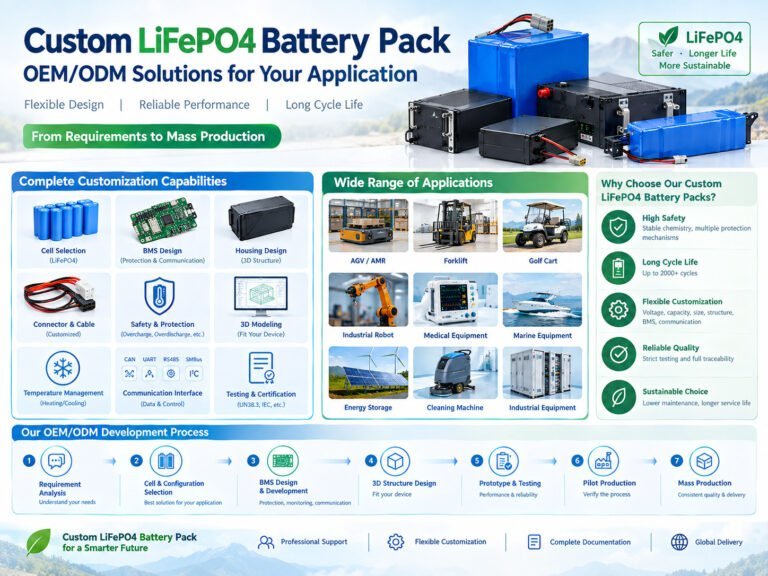
12. OEM/ODM Golf Cart Battery Design
For golf cart manufacturers and battery distributors, a standard battery may not always match the vehicle architecture.
An OEM/ODM battery project can include customization of the entire battery pack.
セルの構成
The manufacturer can determine:
- Series connection
- Parallel connection
- セルタイプ
- セル容量
- Current requirements
- Energy requirements
ビーエムエス
The BMS can be configured according to:
- Continuous current
- ピーク電流
- 充電電流
- Protection thresholds
- 温度モニタリング
- 通信プロトコル
Mechanical structure
The battery housing can be designed according to:
- 利用可能な設置スペース
- 取り付け位置
- ケーブルの配線
- コネクタの位置
- Service requirements
- 環境条件
Electrical interface
The battery can be customized with:
- Power connectors
- Communication connectors
- Charging connectors
- ヒューズ
- コンタクタ
- Pre-charge circuit
- External switch
- Display interface
Software and communication
For smart battery applications, CAN, RS485, or UART communication can be integrated according to the vehicle system.
13. What Information Should You Send to a Golf Cart Battery Manufacturer?
For an accurate OEM/ODM quotation, buyers should provide as much vehicle information as possible.
A useful specification request includes:
1. Golf cart brand and model
2. Existing battery voltage
3. Motor power
4. Controller model and current
5. Required battery capacity
6. Expected driving range
7. Battery compartment dimensions
8. Charger information
9. Connector information
10. Communication requirements
11. Operating temperature
12. Sample quantity
13. Estimated annual order quantity
Photos are also useful.
A manufacturer can evaluate:
- Original battery
- Battery compartment
- コネクタ
- ケーブルの配線
- 取付構造
- コントローラー
- 充電器
- Vehicle dashboard
This information reduces unnecessary design changes during the sampling stage.
14. Golf Cart Battery Replacement vs. Custom Battery
There are two common approaches.
Standard Replacement Battery
A standard replacement battery is suitable when:
- Voltage is compatible
- Dimensions match
- Current requirements are compatible
- Connector configuration is compatible
- Charger requirements are understood
- BMS communication is not a special requirement
This approach can simplify procurement.
Custom OEM Battery
A custom battery may be more appropriate when:
- The battery compartment has unusual dimensions
- The vehicle requires a specific connector
- High current is required
- CAN communication is required
- The vehicle manufacturer needs a private-label battery
- The battery needs a specific enclosure
- Multiple vehicle models require different configurations
- The buyer has specific capacity or range requirements
For OEM customers, battery customization can cover the cell configuration, BMS, enclosure, wiring, connector, communication system, labeling, and packaging.
15. Golf Cart Battery Selection Checklist
Before placing an order, confirm the following:
電気
☐ System voltage
☐ Nominal battery voltage
☐ Capacity
☐ Continuous discharge current
☐ Peak discharge current
☐ Charging current
☐ Charging voltage
ビーエムエス
☐ Overcharge protection
☐ Over-discharge protection
☐ Over-current protection
☐ Short-circuit protection
☐ Temperature protection
☐ Cell balancing
☐ CAN / RS485 / UART if required
Mechanical
☐ Battery dimensions
☐ Mounting points
☐ Connector position
☐ Terminal position
☐ Cable length
☐ Cable direction
☐ Enclosure requirements
申し込み
☐ Motor power
☐ Controller current
☐ Expected driving range
☐ Passenger/load requirements
☐ Terrain
☐ Temperature
☐ Charging frequency
OEM/ODM
☐ Sample quantity
☐ Annual quantity
☐ Logo
☐ Label
☐ Packaging
☐ Housing design
☐ Communication protocol
☐ Testing requirements
結論
Selecting a golf cart battery requires more than matching the original voltage and capacity. The battery should be evaluated as part of the complete vehicle power system.
The key parameters include voltage, capacity, discharge current, BMS, charger compatibility, regenerative braking, mechanical dimensions, operating conditions, and communication requirements.
For OEM and ODM projects, these requirements can be translated into a customized battery pack covering cell configuration, BMS, enclosure, wiring, connectors, communication, testing, labeling, and packaging.
For a battery manufacturer, receiving the golf cart model, motor and controller specifications, battery compartment dimensions, charger information, and expected operating conditions provides a practical starting point for battery design.
A properly defined specification at the beginning of the project can reduce compatibility issues during sampling and provide a clearer path from requirement analysis → battery design → prototype → testing → mass production.
よくあるご質問
What voltage battery does a golf cart use?
Common golf cart systems include 36V, 48V, and 72V platforms. The actual LiFePO4 nominal voltage can be 38.4V, 51.2V, or 76.8V depending on the series configuration.
Is a 51.2V battery suitable for a 48V golf cart?
A 51.2V LiFePO4 battery is commonly used for 48V-class systems, but compatibility should be confirmed with the motor controller, charger, BMS, and vehicle electrical system.
How many Ah does a golf cart battery need?
The required capacity depends on the vehicle’s energy consumption, desired operating range, load, terrain, motor, controller, and available installation space.
What BMS is needed for a golf cart battery?
The BMS should be selected according to the battery configuration, continuous and peak current, charging requirements, temperature conditions, and any CAN, RS485, or UART communication requirements.
Can a golf cart battery be customized?
Yes. An OEM/ODM battery can be customized in areas such as capacity, voltage, BMS, enclosure, connectors, cables, communication, mounting structure, labeling, and packaging.

 English
  Chinese
  Japanese
  German
  French
  Korean
