
Choosing the right pallet jack battery is not simply a matter of matching voltage and capacity. For warehouse and material-handling equipment, the battery affects operating time, charging requirements, vehicle weight, maintenance, safety, and the overall design of the pallet jack.
For OEMs, equipment manufacturers, fleet operators, and battery replacement buyers, the selection process should consider the complete power system rather than looking at a single battery specification.
This guide explains how to evaluate a pallet jack battery based on voltage, capacity, battery chemistry, discharge requirements, dimensions, BMS functions, charging, operating environment, and customization requirements.
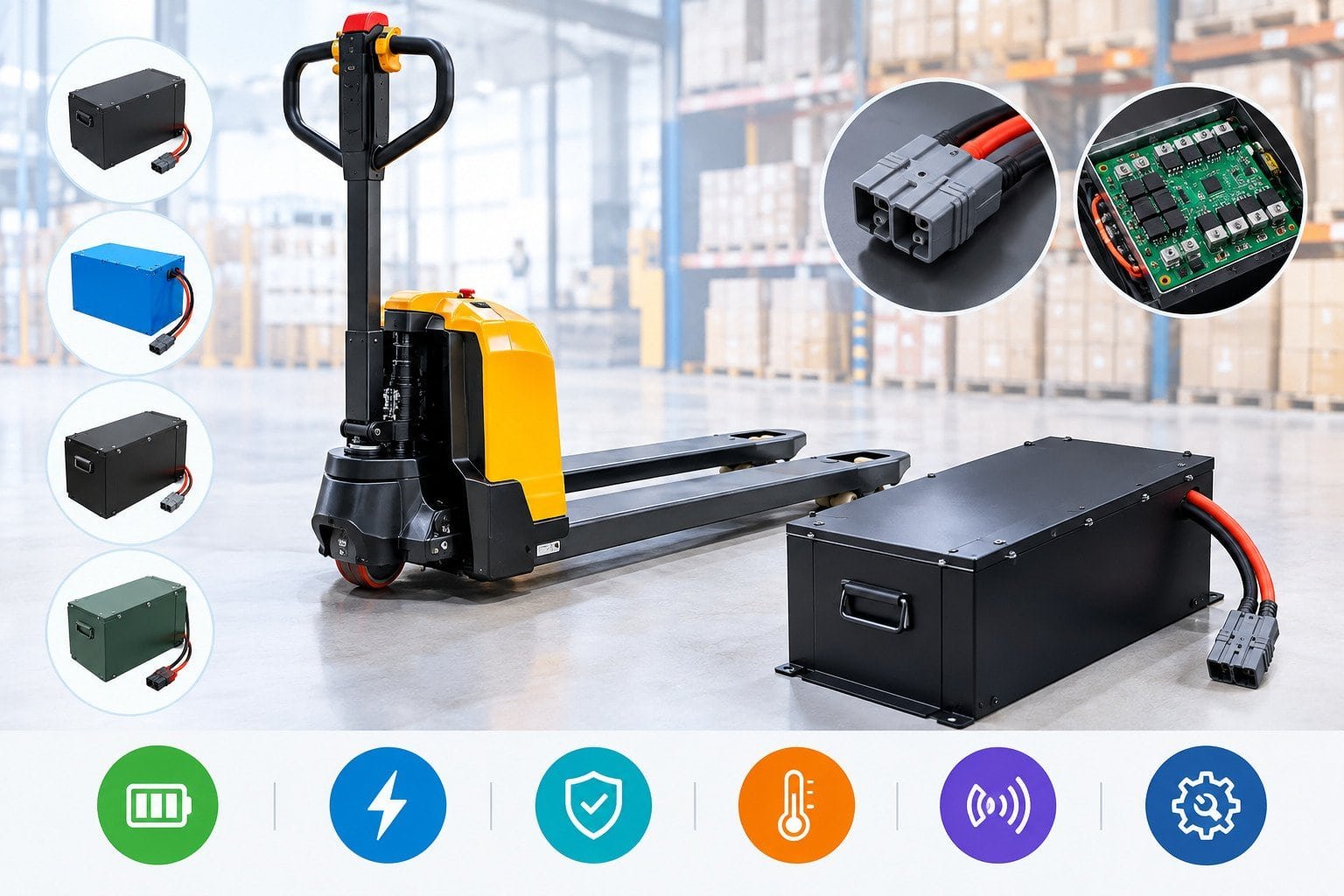
1. Start With the Pallet Jack’s Electrical Requirements
Before selecting a replacement or custom battery, collect the basic electrical specifications of the pallet jack.
The key parameters include:
- 定格電圧
- 必要容量
- モーター出力
- Continuous current
- ピーク電流
- Charger output
- 電池ケースの寸法
- コネクタの種類
- 通信インターフェース
- 動作温度
- Required operating time
For example, an electric pallet jack may use a 24Vリチウム電池, while larger material-handling equipment may require 36V or 48V systems.
The battery voltage should be compatible with the equipment’s motor controller, charger, BMS, and electrical architecture.
Why voltage matters
A battery with an incorrect voltage can cause problems throughout the power system.
If the voltage is too low, the equipment may not provide the required motor performance. If the voltage is too high, electrical components may operate outside their intended specifications.
Therefore, the first step should always be to confirm the original equipment manufacturer’s electrical requirements.
2. Choose the Appropriate Battery Chemistry
Lithium-ion and lead-acid batteries are commonly used in material-handling applications, but their characteristics are different.
For many modern pallet jack applications, LiFePO4バッテリー are considered during system design because of their combination of cycle performance, thermal characteristics, usable energy, and maintenance requirements.
Lithium-ion pallet jack battery
A lithium battery pack can be configured around the equipment’s required voltage, capacity, current, dimensions, and communication requirements.
Typical configurations include:
- 24Vリチウム電池
- 36Vリチウム・バッテリー
- 48Vリチウム電池
- 24V LiFePO4 battery
- 36V LiFePO4 battery
- 48V LiFePO4 battery
The actual nominal voltage depends on the cell configuration.
LiFePO4 pallet jack battery
LiFePO4 is a lithium-ion chemistry based on lithium iron phosphate.
It is often considered for industrial applications where battery safety characteristics, cycle requirements, and operating conditions are important design factors.
However, battery chemistry should be selected according to the equipment’s electrical system, operating environment, required energy, charging strategy, and certification requirements.
3. Calculate the Required Battery Capacity
Battery capacity is usually expressed in Ah, or ampere-hours.
However, Ah alone does not tell you the total energy available from a battery.
A simplified energy calculation is:
エネルギー(Wh)=電圧(V)×容量(Ah)
例えば、こうだ:
| バッテリー | Approx. Nominal Energy |
|---|---|
| 24V 40Ah | 960Wh |
| 24V 60Ah | 1,440Wh |
| 24V 100Ah | 2,400Wh |
| 36V 50Ah | 1,800Wh |
| 48V 50Ah | 2,400Wh |
| 48V 100Ah | 4,800Wh |
These are nominal energy calculations rather than guaranteed usable energy.
Actual operating time depends on motor load, acceleration, load weight, travel distance, operating frequency, temperature, battery age, and other factors.
How much capacity do you need?
A practical approach is to estimate:
Required Energy ≈ Average Power × Operating Time
Then consider an appropriate operating margin rather than designing the battery to operate continuously at its theoretical limit.
For fleet applications, actual duty-cycle data is more useful than relying only on the pallet jack’s rated motor power.
4. 連続放電電流およびピーク放電電流を確認する
Capacity is only one part of battery selection.
The battery must also provide sufficient current for:
- モーターの起動
- 加速
- Load lifting
- Inclines
- Sudden load changes
- Continuous driving
A pallet jack may have a relatively modest average power requirement but still generate short periods of high current demand.
Therefore, the battery specification should distinguish between:
連続放電電流
そして
ピーク放電電流
The BMS must also be designed around these requirements.
For an OEM project, the battery supplier should evaluate the motor controller, motor characteristics, current demand, and protection thresholds together.
5. Pay Attention to Battery Dimensions and Weight
A battery can have the correct voltage and capacity but still be unsuitable if it does not fit inside the pallet jack.
Important mechanical parameters include:
- 長さ
- 幅
- 高さ
- 取り付け位置
- Handle position
- コネクタの位置
- ケーブルの配線
- バッテリー収納ケース
- 重量
- Center of gravity
For replacement batteries, it is useful to provide the supplier with the original battery dimensions and photographs of the battery compartment.
For a new pallet jack design, the battery enclosure can be developed together with the equipment structure.
This is where custom pallet jack battery design becomes useful.
Instead of selecting an off-the-shelf battery and modifying the equipment around it, OEM teams can define the battery structure according to the available installation space.
6. Consider the Battery’s Operating Environment
Warehouse equipment does not always operate in a clean, dry room.
Pallet jacks can be exposed to:
- ダスト
- 水分
- 振動
- Temperature changes
- Rough warehouse floors
- 頻繁な充電
- Repeated acceleration and braking
If the equipment is used in cold storage, temperature becomes particularly important.
Battery performance changes with temperature, and charging lithium batteries at low temperatures requires appropriate battery-system controls.
For demanding environments, the battery design may include:
- 温度センサー
- 低温時の充電保護
- 高温保護
- Waterproof enclosure
- Reinforced housing
- Vibration-resistant construction
- Sealed connectors
The required protection level should be determined by the actual equipment environment and applicable testing requirements.
7. Evaluate the BMS
について バッテリー管理システム(BMS) is an important part of a lithium pallet jack battery.
The BMS can monitor and manage parameters such as:
- 細胞電位
- パック電圧
- 現在
- 温度
- 充電状態
- 過充電保護
- 過放電保護
- 過電流保護
- 短絡保護
- 温度保護
For industrial pallet jacks, communication functions may also be required.
Common interfaces include:
- CAN
- UART
- RS485
A CAN-enabled battery, for example, can communicate battery information with the equipment controller when the system architecture supports it.
This allows the equipment manufacturer to integrate battery status into its control system.
8. Decide Whether Communication Is Required
Not every pallet jack needs a communicating battery.
For a simple replacement battery, the equipment may only require power output and basic protection.
For an OEM pallet jack platform, however, communication can provide additional information.
Possible data includes:
- 充電状態
- バッテリー電圧
- 現在
- 温度
- Fault status
- Cycle information
- Battery alarms
The exact communication protocol should be confirmed between the battery supplier and equipment manufacturer before production.
A custom battery supplier can develop the BMS communication parameters according to the equipment requirements.
9. Compare Charging Requirements
The battery and charger should be treated as one system.
Before selecting a pallet jack battery, check:
- Charger voltage
- 充電器電流
- Charging profile
- コネクタ
- 充電時間
- 充電可能温度範囲
- 通信要件
- Charging protection
A lithium battery should use a charger compatible with its chemistry and battery configuration.
For OEM projects, the battery supplier should confirm the charging parameters during the design stage rather than waiting until mass production.
10. Consider Opportunity Charging
Warehouse equipment may operate for multiple shifts.
In these applications, opportunity charging can be part of the battery-system strategy.
Instead of waiting until the battery is almost empty, equipment may be charged during scheduled breaks or idle periods.
This requires consideration of:
- 電池の化学組成
- 充電電流
- BMS settings
- Charger compatibility
- 熱管理
- Required daily operating schedule
Whether opportunity charging is appropriate depends on the specific battery and equipment design.
11. Check Cycle Life Requirements
Battery cycle life is another important purchasing parameter.
However, the term “cycle” needs to be understood correctly.
Cycle-life test results depend on factors such as:
- Charge/discharge current
- 放電深度
- 温度
- 充電方法
- Rest periods
- End-of-life definition
Therefore, comparing two batteries based only on a stated cycle number may not provide a complete picture.
For an industrial pallet jack project, buyers should ask the supplier:
Under what test conditions was the cycle life measured?
This creates a more meaningful technical comparison.
12. Consider Safety and Protection Functions
A pallet jack battery should include appropriate protection based on the system design.
Typical lithium battery protection functions include:
- 過充電保護
- 過放電保護
- 過電流保護
- 短絡保護
- 過熱保護
- 低温保護機能
- 細胞電位のモニタリング
For industrial applications, mechanical protection is also important.
The battery enclosure should protect the internal cells, BMS, wiring, and connectors against the expected mechanical and environmental conditions.
For OEM applications, additional functions such as pre-charge or anti-spark design may be considered depending on the electrical architecture.
13. Certification and Transportation Documents
The required certifications depend on the target market, battery design, equipment category, and applicable regulations.
For lithium battery projects, buyers may need documentation such as:
- UN38.3
- MSDS/SDS
- CE-related documentation
- EMC-related testing
- RoHS documentation
- IEC test reports
- UL-related certification where applicable
For pallet jack batteries sold into different markets, certification requirements should be confirmed before product development.
This is particularly important for OEM manufacturers because changing the battery design late in the project can affect testing and certification.
14. Replacement Battery vs. Custom OEM Battery
The purchasing process is different depending on your application.
Replacement battery
For a replacement battery, provide:
- Original battery voltage
- Original capacity
- バッテリー寸法
- コネクタ
- Charger information
- Equipment model
- Photos of the original battery
The goal is to achieve electrical and mechanical compatibility.
Custom OEM battery
For an OEM project, provide more detailed information:
- 電圧
- 定員
- 最大電流
- 稼働時間
- 充電時間
- 充電器の仕様
- Installation dimensions
- 通信プロトコル
- BMSの要件
- 動作温度
- IP requirements
- コネクタ
- ケーブルの長さ
- 認証要件
- Expected annual quantity
This allows the battery manufacturer to design the battery around the pallet jack rather than simply supplying a standard pack.
15. What Should You Ask a Pallet Jack Battery Manufacturer?
Before placing an order, ask the supplier for technical information covering the entire battery system.
A useful RFQ checklist is:
| パラメータ | Information to Confirm |
|---|---|
| 電池の化学組成 | LiFePO4 / other lithium chemistry |
| 公称電圧 | 24V / 36V / 48V etc. |
| 定員 | Ah |
| エネルギー | Wh |
| Continuous current | A |
| ピーク電流 | A |
| 寸法 | L × W × H |
| 重量 | kg |
| ビーエムエス | 保護機能 |
| コミュニケーション | CAN / RS485 / UART |
| コネクタ | Model and specification |
| 充電 | Voltage/current |
| 動作温度 | °C |
| IP等級 | Required level |
| Cycle-life test | Test conditions |
| 認証 | Target-market requirements |
| 保証 | Terms and conditions |
| Production quantity | Prototype / batch / mass production |
A supplier that can review these parameters with the equipment manufacturer can help reduce compatibility problems during development.
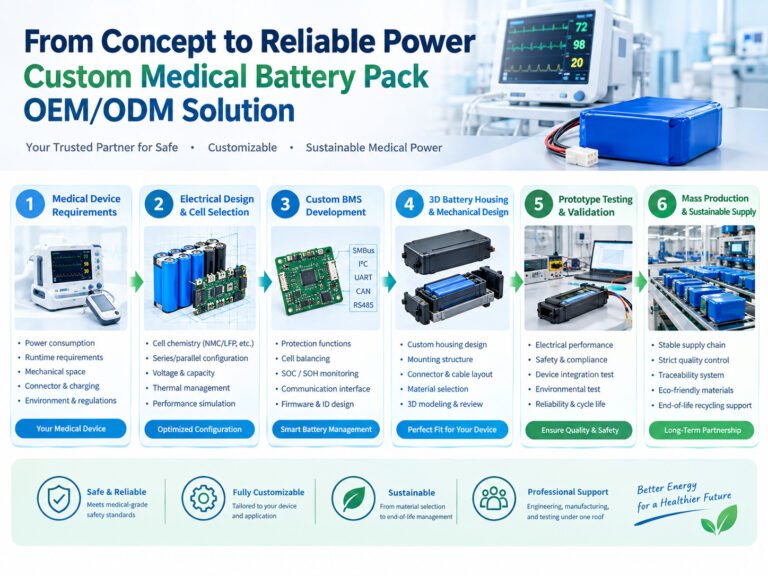
16. Custom Pallet Jack Battery OEM/ODM Process
For an OEM/ODM project, the development process can follow a structured workflow:
Step 1: Requirement Collection
The customer provides the pallet jack specifications, operating conditions, installation space, and expected duty cycle.
ステップ2:バッテリーソリューションの設計
The engineering team determines:
- セルの構成
- バッテリー電圧
- 定員
- ビーエムエス
- 構造
- コネクタ
- Wiring
- Protection strategy
Step 3: 3D Structural Design
The battery enclosure and installation structure can be developed according to the pallet jack’s available space.
Step 4: Prototype
A sample battery is manufactured for initial equipment testing.
Step 5: Integration Testing
The battery is tested together with:
- モーター
- コントローラー
- 充電器
- ディスプレイ
- Communication system
Step 6: Reliability Testing
Testing may include electrical, mechanical, thermal, vibration, charging, discharge, and protection tests according to the project requirements.
Step 7: Certification
Required compliance testing and documentation are completed according to the destination market and application.
Step 8: Mass Production
After the design is approved, the battery enters production with defined quality-control and inspection procedures.
17. Common Mistakes When Buying a Pallet Jack Battery
Several purchasing mistakes can create problems later.
Mistake 1: Choosing based only on Ah
A 100Ah battery is not automatically suitable simply because it has a larger capacity.
Voltage, current, dimensions, BMS, charger compatibility, and operating conditions also matter.
Mistake 2: Ignoring peak current
The battery may provide enough energy but fail to meet short-duration current requirements.
Mistake 3: Ignoring physical dimensions
A battery that cannot fit into the original compartment is not a practical replacement.
Mistake 4: Using an incompatible charger
Battery chemistry and charging parameters must be compatible.
Mistake 5: Treating BMS as an afterthought
The BMS should be designed according to the battery cells and equipment’s electrical requirements.
Mistake 6: Comparing cycle-life numbers without test conditions
Different test methods can produce different results.
18. Pallet Jack Battery Selection Checklist
Before ordering a battery, confirm these questions:
電気
- What voltage does the pallet jack require?
- What capacity is required?
- What is the continuous current?
- What is the peak current?
Mechanical
- What are the maximum battery dimensions?
- What is the allowable battery weight?
- Where are the mounting points?
- What connector is required?
ビーエムエス
- What protection functions are required?
- Is CAN, RS485, or UART communication required?
- Does the controller need SOC information?
充電
- What charger is being used?
- What are the charging voltage and current?
- Is opportunity charging required?
環境
- What is the operating temperature?
- Is the equipment exposed to water or dust?
- Is vibration resistance required?
- Is the battery used in cold storage?
Compliance
- Which countries will the battery be sold in?
- What certifications and transportation documents are required?
結論
正しい選択 pallet jack battery requires more than matching a voltage and Ah rating. The battery needs to work as part of the complete material-handling system.
For replacement applications, focus on electrical compatibility, physical dimensions, charging compatibility, connectors, and BMS protection.
For OEM/ODM pallet jack projects, the design process should also consider motor current, duty cycle, communication, mechanical integration, environmental conditions, certification, and production requirements.
A properly defined battery specification gives the manufacturer enough information to develop a battery pack that fits the equipment’s electrical and mechanical requirements.
For custom projects, the process can start with the pallet jack’s voltage, capacity, current, dimensions, charger, communication requirements, and operating environment, followed by battery cell selection, BMS development, structural design, prototype testing, certification, and mass production
 English
  Chinese
  Japanese
  German
  French
  Korean
