
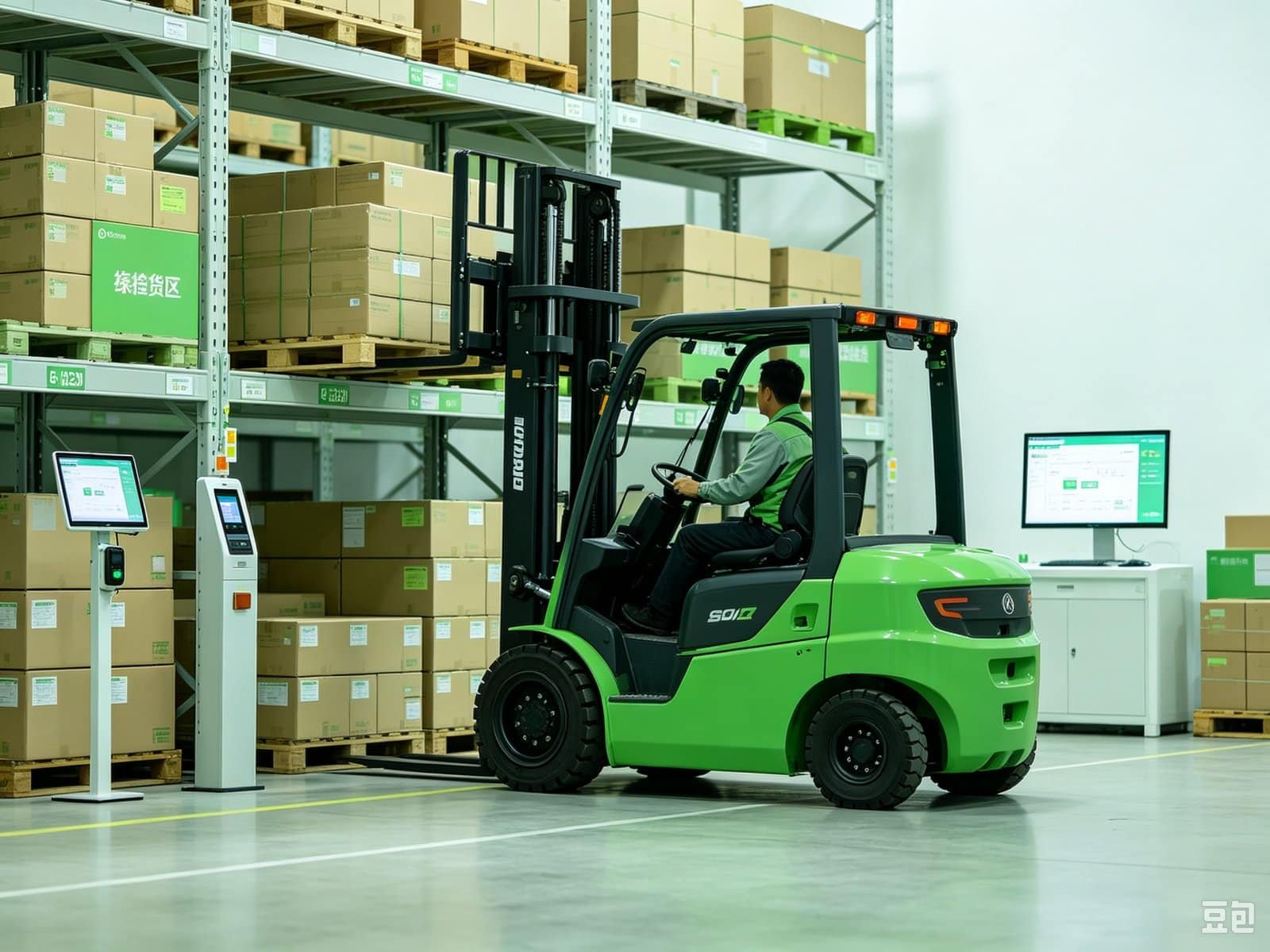
For warehouses, logistics centers, and manufacturing facilities using electric forklifts, battery maintenance is closely related to equipment availability, charging management, and operating costs.
Traditional electric forklifts commonly use lead-acid batteries, while lithium-ion batteries, especially lithium iron phosphate (LiFePO4) batteries, are increasingly being used in material handling equipment.
When a forklift switches from a lead-acid battery to a lithium battery, maintenance does not disappear. Instead, the focus of maintenance changes.
Lead-acid battery maintenance often involves electrolyte levels, water filling, terminal cleaning, and equalization charging. Lithium battery maintenance focuses more on the Battery Management System (BMS), charging conditions, temperature, connectors, wiring, and battery status.
This guide explains the main maintenance differences and what fleet managers should consider when switching to lithium forklift batteries.
1. How Is Lithium Forklift Battery Maintenance Different?
The maintenance requirements of lead-acid and lithium batteries are based on different battery technologies.
| Maintenance Item | Lead-Acid Forklift Battery | リチウムイオン式フォークリフト用バッテリー |
|---|---|---|
| 水の充填 | Usually required | Usually not required |
| Electrolyte maintenance | 必須 | Not required |
| Terminal inspection | 必須 | 必須 |
| 充電管理 | 必須 | 必須 |
| BMSの監視 | Limited or not applicable | Important |
| 温度モニタリング | External management | Often integrated into BMS |
| セルバランシング | Charging-related maintenance | Usually managed by BMS |
| Cable and connector inspection | 必須 | 必須 |
| Long-term storage management | 必須 | Required according to manufacturer instructions |
The main difference is that lithium batteries reduce some routine chemical maintenance while increasing the importance of electrical and electronic system monitoring.
2. No Regular Water Filling for Most Lithium Forklift Batteries
One of the most noticeable differences is water maintenance.
Traditional flooded lead-acid forklift batteries require regular electrolyte level checks and water filling. The frequency depends on the battery design and operating conditions.
Most lithium forklift batteries use a sealed battery pack and do not require routine water filling.
This can reduce tasks such as:
- 電解液の量の確認
- 蒸留水の添加
- Managing battery watering equipment
- Cleaning electrolyte residue
- Scheduling routine watering
For warehouses operating multiple forklifts, eliminating routine water filling can simplify daily battery management.
However, lithium batteries should not simply be described as “maintenance-free.” Other inspections are still necessary.
3. Charging Management Becomes More Important
Lithium forklift batteries can support charging strategies that are different from traditional lead-acid batteries.
Depending on the battery and equipment design, lithium batteries can often be charged during operational breaks instead of waiting for the battery to become deeply discharged.
This approach is commonly referred to as チャンスチャージ.
For example, a forklift may be connected to its charger during:
- Employee breaks
- シフト交代
- Loading and unloading periods
- Scheduled equipment downtime
This can be useful for multi-shift warehouse operations.
However, opportunity charging does not mean that any charger can be used.
The battery voltage, charging voltage, charging current, connector, charger settings, and BMS requirements should all be compatible.
For example, a “48V” lithium battery does not automatically mean that every 48V charger is suitable for it.
4. The BMS Changes the Way Battery Condition Is Monitored
バッテリー管理システム(BMS)は、リチウムイオンバッテリーパックの重要な構成要素です。.
Depending on the design, the BMS may monitor:
- 細胞電位
- パック電圧
- 現在
- バッテリー温度
- 充電状態(SOC)
- 健康状態(SOH)
- Overcharge conditions
- Over-discharge conditions
- 過電流
- 短絡保護
- 故障状態
Some industrial lithium battery packs can also communicate with the forklift or charger through interfaces such as CAN or RS485.
As a result, maintenance personnel need to become familiar with battery data and BMS alerts.
For example, repeated temperature warnings, abnormal cell voltage differences, or communication faults should be investigated instead of simply resetting the system.
5. Connectors and Cables Still Need Regular Inspection
Lithium batteries reduce certain types of maintenance, but mechanical and electrical inspections remain important.
Forklifts operate in environments where batteries can experience:
- 振動
- 機械的衝撃
- 頻繁な加速と減速
- Repeated connection and disconnection
- Dust and moisture
Maintenance personnel should periodically inspect the battery connector for signs of:
- Looseness
- Physical damage
- Burning
- オーバーヒート
- Poor contact
Battery cables should also be checked for:
- Damaged insulation
- Abrasion
- Compression
- 接続の緩み
- Signs of overheating
The battery enclosure and mounting system should also be inspected for visible deformation, cracks, impact damage, or other abnormal conditions.
If an abnormal condition is found, follow the battery manufacturer’s service procedure rather than continuing to operate the battery without investigation.
6. Temperature Management Remains Important
Temperature can affect lithium battery performance and service life.
This is particularly relevant for forklifts used in:
- Cold storage facilities
- Outdoor warehouses
- High-temperature production environments
- Unheated warehouses
- マルチシフト・オペレーション
For cold-storage applications, the battery may require a low-temperature charging strategy or an integrated heating system, depending on the battery design.
For high-temperature environments, thermal management and temperature monitoring become important design considerations.
When purchasing a lithium forklift battery, it is therefore useful to provide the battery manufacturer with information about:
Operating temperature + charging temperature + working hours + load profile + operating environment
rather than specifying only voltage and capacity.
7. Avoid Long-Term Operation at Extreme SOC Levels
SOC, or State of Charge, indicates the approximate charge level of the battery.
Although the BMS can provide protection against certain abnormal charging and discharging conditions, battery operating and storage practices still matter.
Fleet operators should follow the battery manufacturer’s recommendations for:
- 充電
- 排出
- ストレージ
- Minimum SOC
- Storage SOC
- 充電温度
- 保存温度
There is no single SOC rule that applies to every lithium battery.
The correct charging and storage strategy depends on the battery chemistry, cell selection, BMS design, operating conditions, and manufacturer’s specifications.
8. How Should a Lithium Forklift Battery Be Maintained During Long-Term Storage?
If a forklift will remain unused for an extended period, the battery should be stored according to the manufacturer’s instructions.
Before long-term storage, operators should generally:
- Check the battery for active alarms or faults.
- Confirm that the SOC is suitable for storage.
- Store the battery within the recommended temperature range.
- Protect the battery from unsuitable environmental conditions.
- Periodically check the battery condition when required.
- Inspect the battery before returning the forklift to service.
The exact storage SOC, inspection interval, and environmental requirements should come from the battery manufacturer’s technical documentation.
9. How Often Should a Lithium Forklift Battery Be Inspected?
There is no universal maintenance interval for every lithium forklift battery.
Inspection frequency depends on factors such as:
- 電池の化学組成
- バッテリー容量
- 毎日の営業時間
- 充電頻度
- フォークリフトの種類
- 周囲温度
- Warehouse conditions
- Manufacturer requirements
A practical maintenance program can include three levels.
Daily Inspection
Operators can check:
- Battery operating status
- BMS warning messages
- Charger status
- Connector condition
- Visible battery damage
Periodic Inspection
Maintenance personnel can inspect:
- コネクタ
- ケーブル
- バッテリーの取り付け
- 添付資料
- 通信システム
- BMS data
- 充電システム
Professional Service
Issues involving the BMS, abnormal temperature, electrical faults, or internal battery components should be handled by qualified personnel following the manufacturer’s service procedures.
Lithium battery packs should not be opened or repaired by untrained personnel.
10. What Changes for Maintenance Personnel After Switching to Lithium?
The biggest change is not that maintenance disappears. It is that the maintenance focus changes.
With lead-acid batteries, maintenance often focuses on:
Electrolyte → Water → Terminals → Equalization → Cleaning
With lithium batteries, maintenance focuses more on:
BMS → SOC/SOH → Charging → Temperature → Connections → Fault Data
Therefore, companies switching their forklift fleets from lead-acid to lithium batteries should also update their internal maintenance procedures.
Maintenance personnel may need training on:
- BMS warning codes
- Charging procedures
- Battery communication
- コネクタ検査
- Temperature warnings
- Abnormal-condition handling
11. Common Lithium Forklift Battery Maintenance Mistakes
Mistake 1: Assuming Lithium Batteries Are Completely Maintenance-Free
Lithium batteries eliminate some routine maintenance tasks, but they still require inspection and proper operation.
Mistake 2: Using the Existing Lead-Acid Charger Without Verification
A charger designed for lead-acid batteries should not automatically be assumed to be compatible with a lithium battery.
The charging voltage, current, charging profile, connector, and communication requirements should be verified.
Mistake 3: Ignoring BMS Warnings
A BMS warning should not simply be cleared by restarting the battery.
The underlying cause should be identified according to the battery manufacturer’s troubleshooting procedure.
Mistake 4: Opening the Battery Pack Without Proper Training
A lithium battery pack can contain cells, a BMS, high-current connections, protection components, and other electrical components.
Only qualified personnel should perform internal inspection or repair.
Mistake 5: Selecting a Battery Based Only on Capacity
Two batteries with the same voltage and capacity may not be interchangeable.
The battery should also be evaluated based on:
- 連続放電電流
- ピーク電流
- ビーエムエス
- 通信プロトコル
- 外形寸法
- コネクタ
- 充電器
- 設置方法
- 動作温度
12. Maintenance Should Be Considered During Battery Design
When a company plans to replace lead-acid forklift batteries with lithium batteries, maintenance requirements should be discussed during the battery selection and design stage.
Important specifications may include:
- バッテリー電圧
- 定員
- 細胞化学
- セルの構成
- 連続放電電流
- ピーク放電電流
- BMSの機能
- CAN通信
- RS485通信
- 充電器の互換性
- 動作温度
- Low-temperature heating
- IP protection
- バッテリー寸法
- コネクタの種類
- Alarm functions
- Data monitoring
- 保守要件
For OEM projects, the battery PACK can be designed around the forklift’s electrical system and operating conditions.
13. Why Does Custom Battery Design Matter for Forklift Maintenance?
Not every forklift operates under the same conditions.
For example, a warehouse forklift working eight hours per day has different requirements from a forklift operating multiple shifts in a distribution center.
A custom lithium battery solution can be designed around the equipment’s requirements, including:
- 電圧
- 定員
- 細胞の選択
- ビーエムエス
- 通信プロトコル
- Enclosure dimensions
- コネクタ
- 充電システム
- 暖房システム
- 保護要件
For AGVs and AMRs, battery communication with the vehicle control system may also be required.
This means battery maintenance should be considered during the PACK development process rather than after the battery has already been delivered.
14. How Can a Lithium Battery Manufacturer Support Forklift Battery Maintenance?
A battery manufacturer can support the project beyond supplying the battery pack.
During the development process, the manufacturer can help define:
- バッテリー仕様
- セルの構成
- BMSの機能
- 通信プロトコル
- 充電に関する要件
- 温度管理
- Battery protection
- Installation structure
- Maintenance procedures
- Troubleshooting guidelines
For OEM and ODM projects, these requirements can be incorporated into the battery design before mass production.
This approach can make battery maintenance easier to integrate into the overall forklift maintenance program.
FAQ: Forklift Lithium Battery Maintenance
Do lithium forklift batteries need water?
Most lithium forklift batteries do not require routine water filling like flooded lead-acid batteries. Specific maintenance requirements should always follow the battery manufacturer’s instructions.
Are lithium forklift batteries maintenance-free?
Not completely. Lithium batteries generally require less routine maintenance than flooded lead-acid batteries, but they still require proper charging, BMS monitoring, connector inspection, temperature management, and periodic checks.
Can I use a lead-acid charger with a lithium forklift battery?
Do not assume compatibility. The charger should be verified against the lithium battery’s charging voltage, current, charging profile, connector, and BMS requirements.
How often should a lithium forklift battery be inspected?
Inspection frequency depends on the battery, forklift, operating environment, usage pattern, and manufacturer’s recommendations. Daily operator checks and periodic technical inspections are commonly included in a maintenance program.
Does the BMS eliminate battery maintenance?
No. The BMS provides monitoring and protection functions, but it does not replace physical inspections, correct charging practices, or professional servicing.
What should I consider when buying a lithium forklift battery?
Consider more than voltage and capacity. Important factors include cell chemistry, BMS, continuous and peak current, charger compatibility, communication protocol, dimensions, connector, operating temperature, protection requirements, certifications, and maintenance support.
結論
Switching from lead-acid to lithium batteries changes how forklift battery maintenance is performed.
With traditional lead-acid batteries, maintenance often focuses on water filling, electrolyte management, terminal cleaning, and charging practices. With lithium batteries, the focus shifts toward BMS monitoring, charging management, temperature control, electrical connections, and battery status data.
The key point is simple: lithium batteries reduce some maintenance tasks, but they do not eliminate the need for maintenance.
For forklifts, AGVs, AMRs, pallet trucks, and other material handling equipment, battery selection should consider the complete operating environment rather than voltage and capacity alone.
A suitable lithium battery project should integrate cell selection, BMS design, PACK structure, charging requirements, communication, safety, and maintenance procedures from the beginning.
 English
  Chinese
  Japanese
  German
  French
  Korean
