
For electric two-wheelers, cordless home appliances, medical devices and energy storage products, lithium-ion battery compliance depends on more than the destination country. Product application, battery design, sales arrangements and transport conditions also matter.
Passing UN38.3 testing does not mean a battery meets every market’s product safety requirements. Likewise, a certified cell does not automatically make the battery pack assembled from it certified.
This guide explains common lithium-ion battery testing, certification and compliance requirements by country and region, helping manufacturers, buyers and brand owners plan their market access strategy.
Sources checked: October 10, 2026. This article supports preliminary product selection and procurement planning. Applicable standards, editions and implementation dates should be confirmed with the relevant authorities, standards organizations and certification bodies.
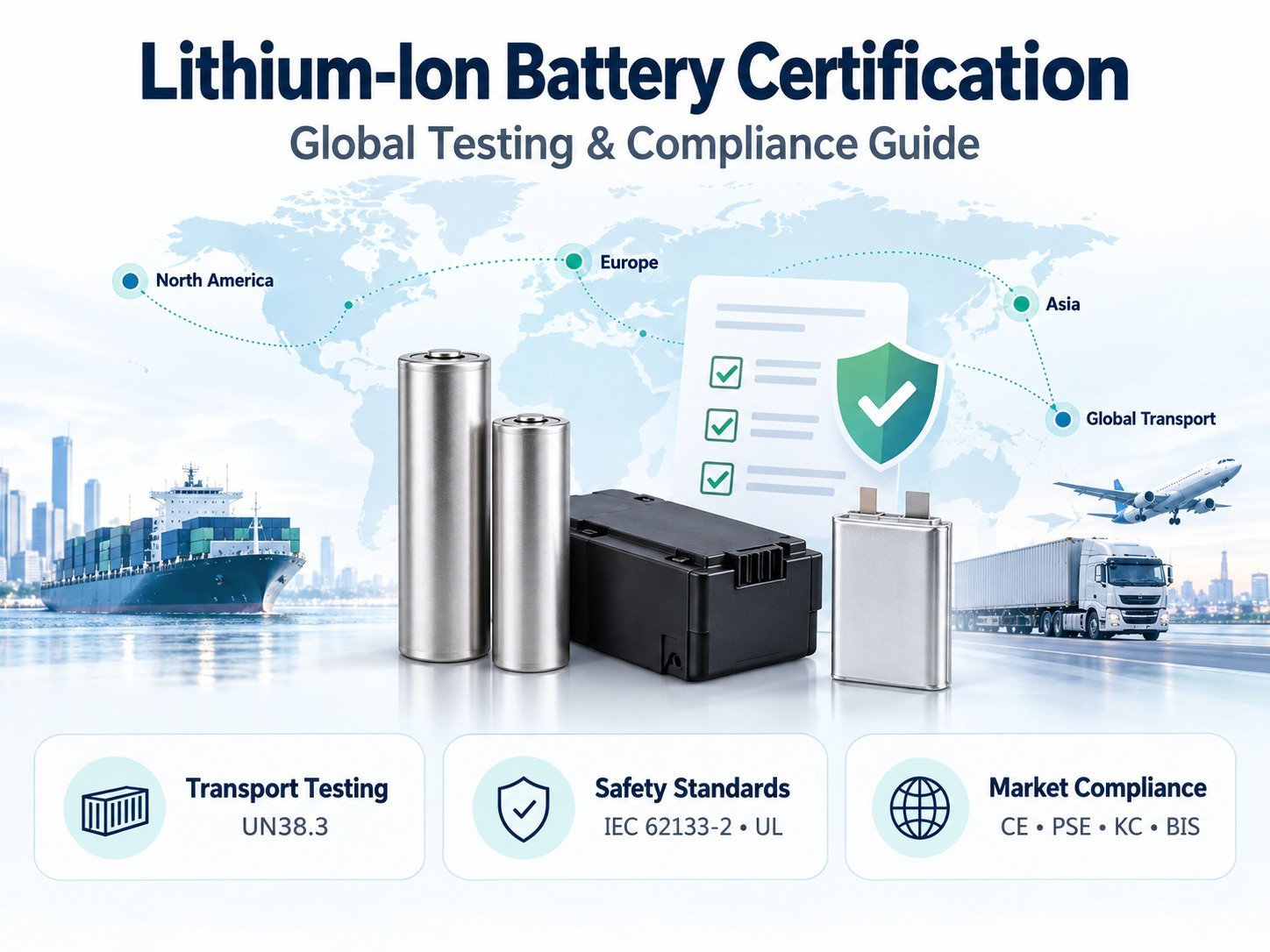
1. Understand the Difference Between Testing, Certification and Compliance Marks
The phrase “fully certified battery” is often used in purchasing discussions, but different documents serve different purposes.
| Category | Common Examples | Main Purpose |
|---|---|---|
| Transport safety testing | UN38.3 | Evaluates cell or battery design safety under transport conditions |
| Product safety standards and testing | IEC 62133-2, IEC 62619, UL 2271 | Evaluates battery safety for the intended application |
| International recognition scheme | IECEE CB Scheme | Uses test reports and certificates to support certification applications in other markets |
| National market access requirements | Japan PSE, Korea KC, India BIS, China CCC | Addresses requirements for specified product categories in individual markets |
| Regulatory conformity marking | CE and UKCA where applicable | Indicates conformity assessment against applicable legislation |
| Chemical and environmental compliance | REACH, RoHS where applicable, battery legislation | Addresses restricted substances, information disclosure and environmental responsibilities |
Buyers should verify the model, manufacturing site, product level and standard edition covered by each document, rather than checking only for a logo.
2. International Transport: UN38.3 as a Foundation for Lithium Battery Shipping
What Is UN38.3?
UN38.3 refers to the lithium battery transport testing requirements in Part III, Subsection 38.3 of the United Nations Manual of Tests and Criteria.
The test series includes altitude simulation, thermal testing, vibration, shock and external short circuit, together with impact or crush, overcharge and forced discharge tests where applicable to the cell or battery type.
The applicable test combination varies. Not every cell and battery pack undergoes exactly the same eight tests. Official guidance from the U.S. Pipeline and Hazardous Materials Safety Administration explains the design testing and test summary requirements. Source: PHMSA Lithium Battery Test Summaries
What Documents Should Be Prepared for Shipping?
Depending on the transport method and carrier, documentation commonly includes:
- UN38.3 testing records and a test summary matching the shipped model.
- Rated voltage, capacity and watt-hour information.
- Applicable packaging, marks, labels and shipping documents.
- Additional documents requested by the carrier, such as an SDS.
An SDS does not replace UN38.3 documentation. Passing UN38.3 also does not allow unrestricted air transport. Batteries shipped alone, packed with equipment or installed in equipment may require different shipping arrangements. Source: PHMSA Transporting Lithium Batteries
3. International Certification Foundations: IEC 62133-2 and the CB Scheme
IEC 62133-2: Safety for Portable Lithium Cells and Batteries
IEC 62133-2 covers portable sealed secondary lithium cells and batteries. It evaluates safety under intended use and reasonably foreseeable misuse.
It is commonly used for portable battery safety assessment, but it should not be treated as a universal replacement for standards covering traction batteries, industrial batteries or energy storage systems. Source: Official IEC 62133-2 Standard Description
Buyers should distinguish between a laboratory test report, a CB Test Report and a certification document. They should also confirm whether the assessment covers the cell or the complete battery pack.
The CB Scheme: Supporting Applications Across Multiple Markets
The IECEE CB Scheme is an international system for recognizing electrotechnical product test reports and certificates.
CB documentation can support national certification applications, but national differences, local application procedures and additional requirements may still apply.
A CB certificate is not a worldwide sales permit and does not automatically replace PSE, KC or other national requirements. Source: ANSI Overview of the IECEE CB Scheme
4. United States and Canada: Select Standards at the Cell, Battery and System Levels
North American battery safety requirements depend on product application, local legislation, purchasing contracts and certification acceptance. It is inaccurate to state that every lithium battery must obtain the same UL certification.
Electric Two-Wheelers: UL 2271 and UL 2849
Two commonly referenced standards for electric bicycle projects are:
- UL 2271: Batteries for light electric vehicle applications.
- UL 2849: Electrical systems of e-bikes, including the interaction of batteries, charging systems and related electrical components.
A battery certified to UL 2271 does not mean the complete e-bike electrical system is certified to UL 2849.
Some jurisdictions, including New York City, have introduced certification requirements for specified micromobility products. Sellers should check the rules for their actual destination market. Source: UL Solutions E-Bike Certification
Energy Storage: UL 1973, UL 9540 and UL 9540A
Stationary energy storage projects should distinguish between these standards:
| スタンダード | Assessment Focus |
|---|---|
| UL 1973 | Batteries for applicable stationary and auxiliary power uses |
| UL 9540 | Energy storage systems and equipment |
| UL 9540A | Test method for evaluating thermal runaway fire propagation |
UL 9540A is a test method. A related test report alone should not be presented as certification of the entire energy storage system.
Batteries, inverters, controls and installation conditions must be assessed within the project’s scope. Source: UL Solutions Energy Storage Testing and Certification
Check Canadian Coverage Separately
For products sold in Canada, verify that the certification and marking cover the Canadian market and are accepted by the relevant local authorities.
Documentation covering only the United States should not automatically be treated as sufficient for a Canadian project.
5. European Union: CE, Battery Legislation, REACH and Applicable RoHS Requirements
CE: Identify the Applicable Legislation
CE marking is not a general battery quality certificate. Businesses must identify applicable legislation, complete the required conformity assessment, prepare technical documentation and declarations of conformity, and meet marking requirements.
Regulation (EU) 2023/1542 on batteries and waste batteries introduces phased requirements covering areas such as conformity assessment, labeling, sustainability and waste battery management. Specific obligations depend on battery category and implementation stage. Source: European Commission Battery Legislation
For light electric vehicle batteries, industrial batteries and other products, determine the regulatory classification first.
Battery compliance does not automatically establish CE compliance for the complete vehicle, charger or medical device.
REACH: Maintain Chemical Compliance Information
REACH involves obligations relating to restricted substances and substances of very high concern.
The Candidate List changes over time, so an older report cannot permanently demonstrate compliance with all future requirements.
Where Candidate List substances exceed applicable thresholds in articles, supply chain communication obligations may arise. Additional notification obligations depend on other conditions.
Buyers should request the assessment date, Candidate List version and materials covered. Source: ECHA Candidate List Obligations
RoHS: Keep It Separate From Battery Legislation
RoHS primarily addresses hazardous substance restrictions in applicable electrical and electronic equipment.
The battery, charger and complete device should each be assessed under the legislation relevant to them. A “RoHS report” alone does not establish complete battery compliance.
For electrical equipment, buyers should verify RoHS applicability, supporting material evidence and relevant exemptions. For batteries, battery-specific substance restrictions and other obligations also require review. Source: European Commission RoHS Overview
6. United Kingdom: Distinguish Great Britain From Northern Ireland
UK compliance cannot be reduced to replacing CE with UKCA.
Great Britain and Northern Ireland have different regulatory arrangements. Acceptance of CE and UKCA also varies by product sector.
Batteries require assessment under relevant battery legislation, while chargers and complete products need a separate review of applicable safety and marking requirements. Source: UK Government Product Marking Guidance
Buyers should ask suppliers to identify the destination market, legal basis and responsible economic operator, rather than supplying only a document described as “UKCA certification.”
UK battery rules also address substance restrictions, labeling and other placing-on-the-market obligations. Source: UK Government Battery Regulations
7. Japan: PSE for Batteries Within the Regulated Scope
PSE is a compliance mark under Japan’s Electrical Appliances and Materials Safety Act.
Certain lithium-ion batteries fall within its scope, but not every lithium battery follows the same PSE route.
Businesses should determine applicability based on battery use, design and legal definitions, and confirm the obligations of the Japanese manufacturer or importer. Source: METI Electrical Appliances and Materials Safety Act Guide
Procurement checks should cover model scope, testing basis, marking information and the local responsible party. Displaying a PSE logo is not sufficient evidence.
8. South Korea: KC and Applicable Battery Safety Standards
The applicable KC procedure depends on the product classification.
Portable secondary lithium battery projects commonly involve KC 62133-2. The scope, edition and implementation arrangements should be confirmed against requirements issued by the Korean Agency for Technology and Standards and relevant bodies.
At the time of this review, official notices concerning revisions to KC 62133-2 were available. Businesses should distinguish a proposed revision from an effective requirement. Source: KATS KC 62133-2 Notice
IEC or CB documentation may support technical preparation, but it does not directly replace the applicable local process.
9. India: Consider BIS Registration
Applicable portable sealed secondary lithium cells and batteries in India are subject to BIS compulsory registration requirements and IS 16046 (Part 2).
Buyers should verify whether the product is within scope and check the manufacturer, factory, model and current registration status.
BIS has also published requirements concerning rated capacity testing for relevant lithium cells and batteries. Source: BIS Rated Capacity Testing Guidance
Batteries for vehicle propulsion or other specialized uses require a separate standards review. The portable battery route should not automatically be applied.
10. China: Consider CCC and GB 31241
China applies CCC requirements to lithium-ion cells, battery packs and power banks within the defined regulatory scope.
The official announcement specifies certificate and certification mark requirements for covered products from August 1, 2024.
Portable electronic product battery projects involve GB 31241—2022. However, CCC applicability must be checked against the product catalog and implementation rules.
It is inaccurate to state that all lithium batteries require the same CCC certification. Source: State Administration for Market Regulation CCC Announcement
Electric two-wheeler and energy storage batteries require separate confirmation of their applicable standards and regulatory requirements.
11. Choose a Compliance Route Based on the Application
Destination market is only one factor. The intended application also affects the appropriate assessment route.
| 申し込み | Preliminary Assessment Priorities |
|---|---|
| Cordless home appliances | Portable battery safety, local market access, complete appliance and charger safety |
| Electric two-wheelers | Battery pack safety, vehicle electrical system, charging compatibility and local rules |
| 医療機器 | Integration of battery safety with medical device requirements and necessary reliability validation |
| Portable energy storage | Battery and complete product classification, charging and output systems, transport conditions |
| Stationary energy storage | Industrial or storage battery standards, system safety, thermal runaway and installation requirements |
Industrial and stationary storage projects may involve IEC 62619 and other applicable standards. IEC 62133-2 should not be selected solely because the product contains a lithium battery. Source: UL Solutions Industrial and Energy Storage Battery Standards
12. How Buyers Can Verify Battery Certification
An effective compliance review connects the documentation to the actual product being shipped.
Check the Model and Construction
Confirm coverage of the actual voltage, capacity, series-parallel configuration, cell model, BMS, enclosure and critical components.
For example, 36V and 48V packs using the same cell should not automatically be assumed to share the same document coverage.
Check the Factory and Certificate Holder
Verify the relationship between the manufacturer, production address, certificate holder and supplier.
A trading company providing certification documents should explain how those documents relate to the products it sells.
Check Document Type and Current Status
Distinguish test reports, certificates, declarations of conformity and transport test summaries.
Where an official or certification body database is available, verify the certificate number and current status.
Check Standard Editions and Scope
Confirm the standard edition, national differences, transition arrangements and target market coverage.
Manage Product Changes
Changes to cells, BMS components, protection devices or enclosure design may affect the original assessment.
Before production, confirm whether additional testing or document updates are required.
Compliance with a UL standard does not necessarily authorize use of the UL trademark. If another body certifies the product against that standard, product descriptions and marks must follow the actual certificate and authorization. Certification logos should not be added to listing images without permission.
13. Frequently Asked Questions
Can UN38.3 Replace UL or IEC 62133-2?
No. UN38.3 addresses transport conditions. Product safety assessment depends on the application and destination market.
Does a Certified Cell Make the Battery Pack Certified?
Not automatically. Battery packs introduce interconnections, protection circuits, enclosures and interfaces. Cell documentation alone does not establish complete pack compliance.
Can a CB Certificate Be Used to Sell in Every Country?
No. CB documentation can reduce duplicate assessment, but national certification, national differences and other local procedures may still apply.
Are CE, RoHS and REACH the Same Certification?
No. CE concerns conformity assessment and marking under applicable legislation. RoHS and REACH address different substance-related obligations.
Does IEC 62133-2 Compliance Establish Medical Device Compliance?
No. Battery safety assessment does not replace the requirements applicable to the complete medical device.
When Should Certification Planning Begin?
During product design and cell selection. Identifying target markets and applications early helps establish the standards, critical components and testing plan before costly design changes are needed.
Conclusion: Build Compliance Around the Market and the Actual Model
Lithium-ion battery compliance requires transport, product safety, national market access and environmental documentation to cover the product actually being supplied.
When requesting quotations, buyers should provide the destination country, application, voltage, capacity, shipping method and customer-specified standards. They should also request a model-specific documentation checklist.
Verifiable documentation provides a stronger basis for purchasing decisions than a general claim that a battery is “fully certified.”
 English
  Chinese
  Japanese
  German
  French
  Korean
