
Choosing the right battery for a four-wheeler or ATV involves more than checking the battery voltage and price. The battery affects starting performance, electrical stability, operating time, vehicle weight, charging requirements, service life, and maintenance.
Lead-acid batteries have been used in ATVs and utility vehicles for many years. AGM and other sealed lead-acid batteries remain common in conventional gasoline-powered four-wheelers because they are available in standard formats and can provide the current required for engine starting.
Lithium-ion batteries are also used in ATV and four-wheeler applications. Depending on the vehicle design, lithium battery packs can provide a lower battery weight, flexible PACK configuration, integrated battery management, and characteristics suitable for frequent cycling. LiFePO4, or lithium iron phosphate, is one lithium chemistry that can be considered for selected mobility and electric vehicle applications.
For consumers, replacing an ATV battery may be a straightforward maintenance task. For ATV manufacturers, distributors, fleet operators, and battery procurement teams, battery selection requires a system-level evaluation.
The appropriate battery depends on the vehicle architecture, voltage, current requirements, battery compartment, charging system, operating environment, usage pattern, and target market.
This guide explains the differences between lead-acid and lithium batteries for four-wheelers and ATVs and provides a practical framework for B2B buyers and OEM manufacturers.

Lead Acid vs. Lithium ATV Batteries: Quick Comparison
| Paramètres | Lead Acid / AGM | Lithium-Ion / LiFePO4 |
|---|---|---|
| Initial purchase cost | Generally lower | Generally higher |
| Poids de la batterie | Relatively heavy | Lower for comparable energy requirements |
| Densité énergétique | Inférieur | Plus élevé |
| Starting current | Available in suitable designs | Available in suitable designs |
| Deep-cycle operation | En fonction de l'application | Suitable designs available |
| Charging | Lead-acid charger required | Lithium-compatible charger required |
| Maintenance | Low for sealed AGM | Low with proper BMS |
| BMS | Usually not required | Required |
| Self-discharge | Relatively higher | Relatively low |
| Résistance aux vibrations | Depends on battery construction | Depends on PACK design |
| Temperature performance | En fonction de l'application | Requires chemistry-specific management |
| Personnalisation | Usually based on standard formats | Flexible PACK configuration |
| Durée de vie | Depends on use and maintenance | Depends on chemistry and operating conditions |
| TCO | Depends on usage pattern | Depends on usage pattern |
Neither chemistry is suitable for every ATV. The battery should be selected according to the actual electrical and mechanical requirements of the vehicle.
1. What Is an ATV Battery?
An ATV battery provides electrical energy to the vehicle’s electrical system.
The exact function depends on whether the four-wheeler is powered by an internal combustion engine or an electric motor.
For a conventional gasoline-powered ATV, the battery may support:
- Engine starting
- Ignition
- Lighting
- Instrumentation
- Electronic control systems
- Fuel injection
- Winches
- Équipements de communication
- Auxiliary accessories
For an electric ATV, the battery becomes the main energy source for the traction motor.
This creates a major difference in battery design.
A gasoline ATV generally needs a battery capable of supplying high current for engine starting, while an electric ATV requires a traction battery capable of delivering energy and current over a longer operating period.
Therefore, “ATV battery” is not a single technical category. The battery requirements depend on the vehicle architecture.
2. What Type of Battery Does a Gasoline ATV Need?
Most gasoline-powered four-wheelers use a low-voltage electrical system, commonly based around a 12 V battery class.
The battery needs to support engine starting and the vehicle’s electrical loads.
Important specifications include:
- Tension nominale
- Battery capacity
- Starting current
- Courant de décharge maximal
- Reserve capacity
- Physical dimensions
- Terminal configuration
- Charging compatibility
- Température de fonctionnement
For a starting battery, capacity in Ah is not the only important parameter.
A battery with adequate Ah capacity may still be unsuitable if its starting-current capability is insufficient.
This is why ATV starting batteries should be evaluated using both capacity and current capability.
3. What Is a Lead-Acid ATV Battery?
Lead-acid batteries use lead-based electrodes and sulfuric acid electrolyte.
ATVs can use several lead-acid battery formats, including:
- Flooded lead acid
- AGM
- Gel
For modern recreational and utility vehicles, sealed AGM batteries are commonly used because their construction reduces the need for routine electrolyte maintenance.
AGM Battery
AGM means Absorbent Glass Mat.
The electrolyte is retained in an absorbent separator within the battery.
AGM batteries are sealed and designed for applications where vibration, installation orientation, and maintenance requirements need to be considered.
Potential advantages for ATV applications include:
- Established technology
- Standard battery formats
- Broad replacement availability
- Low routine maintenance
- Suitable starting-current capability in application-specific designs
For an ATV already designed around a standard AGM battery, replacing the battery with another compatible AGM model can be a straightforward solution.
4. What Is a Lithium ATV Battery?
A lithium ATV battery is a battery PACK built from lithium-ion cells.
A lithium PACK normally contains more components than the cells themselves.
A complete PACK can include:
- Lithium cells
- Système de gestion de la batterie
- Fuse
- Busbars
- Capteurs de température
- Wiring harness
- Connecteurs
- Housing
- Mechanical protection
- Matériaux isolants
The BMS monitors battery conditions and can provide protection functions such as:
- Protection contre les surcharges
- Protection contre la surcharge
- Protection contre les surintensités
- Protection contre les courts-circuits
- Protection de la température
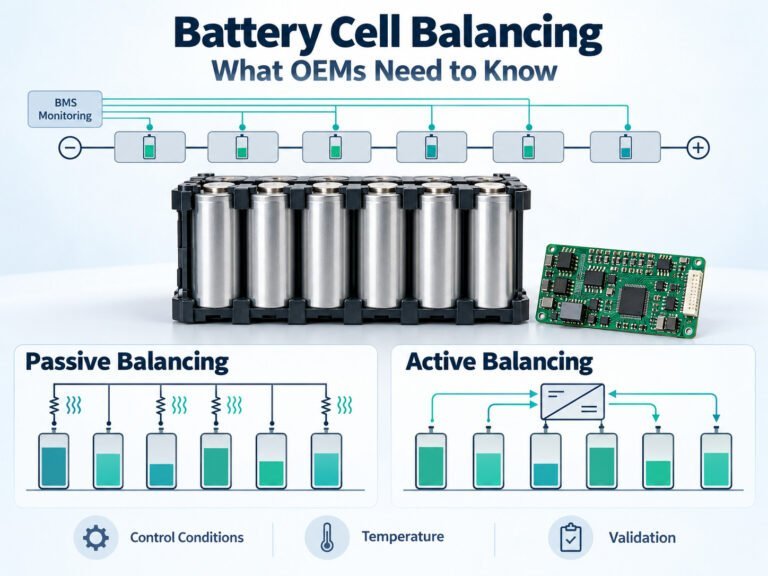
- Équilibre cellulaire
For an OEM application, the BMS should be selected according to the battery’s actual current, voltage, temperature, and communication requirements.
5. Starting Battery vs. Traction Battery
Before choosing lithium or lead acid, the first question should be:
Is the battery used for starting or propulsion?
Starting Battery
A starting battery provides high current for a short period.
The starter motor may draw a substantial current while cranking the engine.
The battery therefore needs:
- Suitable peak current
- Stable voltage during cranking
- Appropriate internal resistance
- Suitable temperature performance
- Charging-system compatibility
Traction Battery
An electric ATV uses a traction battery.
The battery must provide energy to the motor over a longer period.
Important specifications include:
- Tension nominale
- Capacité
- Energy in Wh
- Courant de décharge continu
- Courant de décharge maximal
- Durée du cycle
- Gestion thermique
- BMS
- Communication
- Conditions de recharge
A starting battery and a traction battery should therefore not be evaluated using the same design criteria.
6. Why Battery Weight Matters on Four-Wheelers
ATVs are frequently used in outdoor environments where vehicle weight can affect transportation and handling.
Lead-acid batteries contain relatively heavy materials.
Lithium battery technology can provide a higher energy-to-weight ratio, allowing manufacturers to develop battery packs with lower weight for a given energy requirement.
This can be useful for:
- Recreational ATVs
- Utility four-wheelers
- Electric ATVs
- Hunting vehicles
- Agricultural vehicles
- Équipement de plein air
- Portable off-road vehicles
For OEM manufacturers, reducing battery weight may also create additional design flexibility.
The available weight allowance can potentially be used for:
- Additional battery capacity
- Charge utile
- Accessoires
- Vehicle structure
- Équipements portables
However, the weight of a lithium battery should always be evaluated as a complete PACK, including the cells, BMS, enclosure, wiring, connectors, and protection components.
7. Battery Capacity: Ah and Wh
Battery capacity is commonly expressed in amp-hours.
Par exemple :
12 V 20 Ah
For an energy-storage application, nominal energy can be calculated as:
Énergie (Wh) = Tension (V) × Capacité (Ah)
Therefore:
12 V × 20 Ah = 240 Wh
For an electric ATV:
48 V × 50 Ah = 2,400 Wh
This provides an approximate nominal energy value.
Actual operating time depends on the vehicle’s power consumption and operating conditions.
Parmi les facteurs importants, on peut citer :
- Puissance du moteur
- Controller efficiency
- Poids du véhicule
- Poids du cavalier
- Terrain
- Vitesse
- Accélération
- Pression des pneus
- Température ambiante
- Température de la batterie
- Driving conditions
Therefore, an ATV manufacturer should not estimate range from Ah alone.
8. Starting Current Is Critical for Gasoline ATVs
For a gasoline-powered four-wheeler, the starting system can create a high short-duration current demand.
The battery must be capable of supplying this current while maintaining sufficient voltage.
Parmi les paramètres importants, on peut citer :
Courant de décharge de pointe
This represents the battery’s ability to supply high current over a specified period.
Cold Cranking Performance
Cold cranking performance is relevant when an ATV is operated in low-temperature environments.
Résistance interne
Battery internal resistance affects voltage drop during high-current discharge.
BMS Current Limit
For a lithium starting battery, the BMS must be configured to support the actual starting current.
A battery may contain sufficient energy but still fail to start the engine if the BMS or cells cannot support the required current.
This makes current capability a key part of lithium ATV battery design.
9. Lithium Battery Cycle Life
Cycle life becomes particularly important when an ATV battery is frequently charged and discharged.
Examples include vehicles used for:
- Long working shifts
- Agricultural operations
- Utility services
- Repeated outdoor transportation
- Electric ATV applications
Lithium battery cycle life depends on multiple factors.
Il s'agit notamment de
- Chimie cellulaire
- Qualité des cellules
- Depth of discharge
- Courant de charge
- Courant de décharge
- Température de fonctionnement
- Storage conditions
- Paramètres du BMS
- Tension de charge
Cycle-life claims should therefore be evaluated together with test conditions.
For B2B procurement, a supplier should ideally provide information about the testing method, depth of discharge, temperature, charge/discharge rate, and end-of-life definition.
10. Charging Requirements: Lead Acid vs. Lithium
Charging systems are different for lead-acid and lithium batteries.
Lead-acid batteries use charging profiles designed for their chemistry.
Lithium batteries require a charging profile compatible with the selected lithium chemistry and PACK voltage.
A lithium battery system may require:
- Controlled charging voltage
- Controlled charging current
- Contrôle de la température
- Protection du BMS
- Équilibre cellulaire
The charger must therefore be considered part of the battery system.
A lead-acid charger should not automatically be used with a lithium battery.
When upgrading an ATV from lead acid to lithium, the vehicle charging system should be checked before installation.
11. Can You Replace a Lead-Acid ATV Battery With Lithium?
In many applications, a lithium replacement can be developed.
However, replacing a lead-acid battery with lithium is not simply a matter of matching the nominal voltage.
The following parameters should be evaluated.
Tension
The battery voltage must be compatible with the ATV electrical system.
Tension de charge
The ATV charging system must provide a suitable charging voltage for the lithium battery.
Courant de crête
The battery must support the current required by the starter motor and other loads.
BMS Current Rating
The BMS must be able to handle the actual current demand.
Dimensions de la batterie
The lithium PACK needs to fit into the original battery compartment.
Terminal Position
Terminal type, polarity, and position should match the vehicle installation.
Température
The battery should be suitable for the expected operating environment.
Vehicle Electronics
Modern ATVs may include electronic systems that require stable battery voltage and specific electrical behavior.
A lithium conversion should therefore be treated as a system compatibility project.
12. Lithium BMS Design for ATV Applications
The BMS is an important part of a lithium battery PACK.
For ATV applications, the BMS can provide several functions.
Cell Monitoring
The BMS monitors individual cell or cell-group voltages.
Équilibre cellulaire
Balancing helps maintain appropriate voltage consistency between cells.
Protection contre les surcharges
The BMS can disconnect or control charging when voltage exceeds the defined protection threshold.
Protection contre les surcharges
The BMS can protect cells when the battery voltage reaches the defined lower limit.
Protection contre les surintensités
The BMS can respond to current above the configured limit.
Protection contre les courts-circuits
The BMS can provide protection against abnormal electrical conditions.
Contrôle de la température
Temperature sensors can monitor cell or PACK temperature.
For high-current ATV applications, BMS parameters must be carefully matched to the actual load profile.
13. LiFePO4 for Four-Wheeler Applications
LiFePO4, or lithium iron phosphate, is one lithium-ion chemistry used in rechargeable battery systems.
It can be considered for applications where the battery design requires characteristics such as:
- Fonctionnement stable
- Frequent cycling
- Long service-life potential
- Peu d'entretien
- Custom PACK configuration
- BMS-based protection
LiFePO4 is particularly relevant to certain energy-storage and electric mobility applications.
However, cell chemistry should be selected based on the complete vehicle requirements.
The correct chemistry depends on:
- Tension
- L'énergie
- Actuel
- Température
- Poids
- Available space
- Conditions de recharge
- Exigences de sécurité
- Cost target
There is no single lithium chemistry that fits every ATV.
14. Lithium Battery Configuration
Lithium PACKs are commonly configured using series and parallel connections.
Series connections increase voltage.
Parallel connections increase capacity and current capability.
For example, LiFePO4 cells have a nominal voltage of approximately 3.2 V.
A 4S configuration provides approximately:
4 × 3.2 V = 12.8 V nominal
This can be considered for certain 12 V-class applications, provided that the charging system and electrical system are compatible.
For electric ATVs, a larger number of cells can be connected in series to achieve a higher system voltage.
The final configuration depends on:
- Tension requise
- Capacité requise
- Puissance du moteur
- Courant du contrôleur
- Cell specifications
- Dimensions de la batterie
- BMS architecture
15. ATV Battery Vibration Requirements
ATVs operate on uneven surfaces and can experience continuous mechanical vibration.
Typical operating environments may include:
- Dirt roads
- Gravel
- Boue
- Rocks
- Agricultural land
- Forest trails
- Construction areas
Battery PACK design should therefore address mechanical vibration.
For lithium PACKs, engineering considerations can include:
- Cell fixation
- Internal support
- Busbar structure
- Qualité du soudage
- Connector retention
- Acheminement des câbles
- Enclosure strength
- Mounting structure
Les examens peuvent inclure :
- Essais de vibration
- Mechanical shock testing
- Test de chute
- Tests des connecteurs
- Cable durability testing
The testing method should reflect the actual installation and operating environment.
16. Waterproofing and Dust Protection
Outdoor four-wheelers can encounter rain, mud, dust, and water splash.
A battery housing should therefore be designed according to the environmental requirements of the vehicle.
Potential design elements include:
- Boîtier étanche
- Connecteurs étanches
- Gaskets
- Cable glands
- Corrosion-resistant materials
- Proper drainage
- Internal insulation
An IP rating may be specified when the application requires protection against dust and water.
The required IP level should be determined according to the vehicle’s operating environment and verified through appropriate testing.
17. Temperature Requirements for ATV Batteries
ATVs can operate across a wide range of environmental conditions.
La température influe sur les performances de la batterie et son comportement lors de la recharge.
Parmi les paramètres importants, on peut citer :
- Température de fonctionnement
- Température de charge
- Température de stockage
- Cell temperature
- BMS temperature thresholds
For lithium batteries, low-temperature charging requires particular attention.
Depending on the selected chemistry and battery design, the BMS may prevent charging when the battery temperature is outside the permitted range.
For vehicles intended for cold climates, an OEM may consider:
- Capteurs de température
- Low-temperature charging protection
- Battery heating
- Isolation thermique
- BMS temperature management
The appropriate solution should be determined according to the target climate and application.
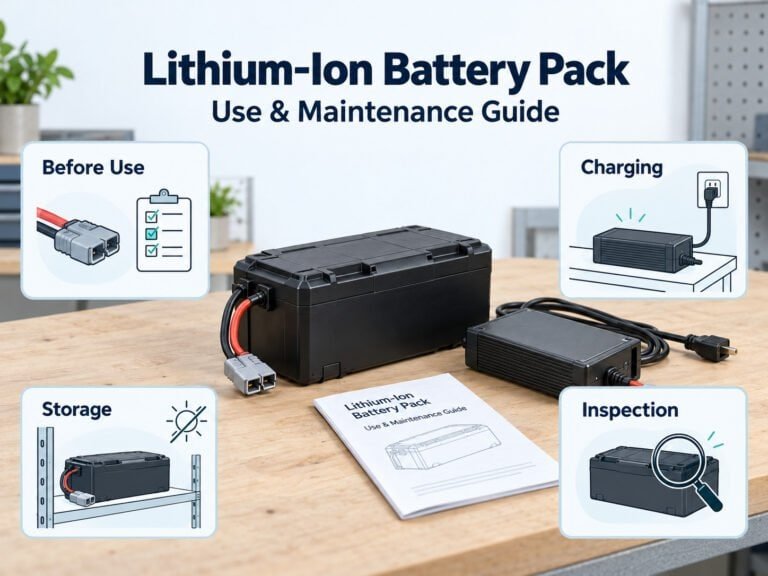
18. Lead Acid vs. Lithium: Maintenance
Sealed AGM batteries require limited routine maintenance compared with flooded lead-acid batteries.
Lithium batteries also require limited routine maintenance when the PACK is properly designed.
However, maintenance does not disappear completely.
Battery users should periodically check:
- Battery terminals
- Connecteurs
- Câblage
- Housing
- Points de fixation
- Charging system
- Visible physical damage
For lithium batteries, BMS fault information should also be monitored when a smart BMS is installed.
Following the manufacturer’s charging and storage instructions is important for both battery technologies.
19. Total Cost of Ownership
Initial battery price is only one part of the commercial decision.
A simplified total-cost-of-ownership model is:
TCO = Initial Cost + Replacement Cost + Charging Cost + Maintenance Cost + Downtime Cost
Lead-acid batteries generally have a lower initial purchase cost.
Lithium battery PACKs generally require additional components such as:
- Lithium cells
- BMS
- Protection components
- Enclosure
- Câblage
- Connecteurs
- Engineering development
This can increase the initial cost.
However, B2B buyers should also evaluate:
- Expected operating cycles
- Fréquence de remplacement de la batterie
- Vehicle usage
- Labor
- Temps d'arrêt
- Transports
- Weight requirements
A battery with a higher purchase price may have a different TCO when used frequently, while lead acid may remain commercially appropriate for low-frequency or cost-sensitive applications.
The correct decision should be based on the actual operating profile.
20. When Lead Acid Makes Sense for an ATV
Lead acid remains a practical choice for many conventional four-wheelers.
It may be appropriate when:
- The ATV is already designed for lead acid
- Initial purchase cost is important
- Battery weight is acceptable
- Standard battery dimensions are required
- Replacement availability is important
- The vehicle has a conventional charging system
- Usage is intermittent
- The existing electrical system has been validated with AGM or another lead-acid type
In these applications, a compatible AGM battery can provide a straightforward replacement solution.
21. When Lithium Makes Sense for an ATV
Lithium may be considered when the vehicle requires:
- Lower battery weight
- Charges et décharges fréquentes
- Compact battery packaging
- Custom battery dimensions
- Integrated BMS functions
- High usable energy within limited space
- Removable battery design
- Surveillance intelligente des batteries
- Customized communication
Lithium is also relevant to electric ATV development, where the battery serves as the main energy source for the traction system.
22. Lithium Batteries for Electric ATVs
Electric ATVs have different battery requirements from gasoline-powered vehicles.
The traction battery must supply energy to the motor through the controller.
Typical specifications include:
- Tension nominale
- Maximum voltage
- Capacité
- L'énergie
- Courant de décharge continu
- Courant de décharge maximal
- Courant de charge
- BMS
- Communication
- Gestion thermique
- Mechanical protection
For example, an electric ATV platform may require a customized battery in a voltage class such as 48 V, 60 V, 72 V, or another system voltage.
The final voltage should be determined by the motor and controller architecture.
The battery should not be selected based only on a desired nominal voltage.
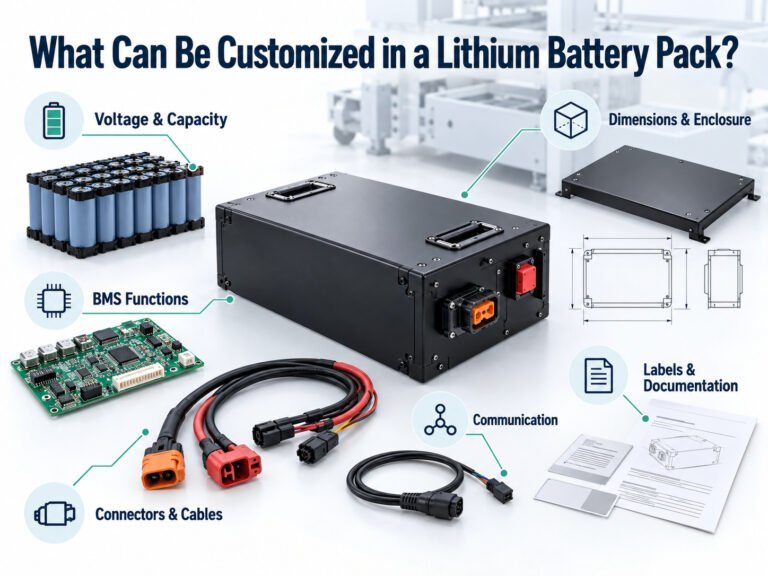
23. Custom ATV Lithium Battery PACK
OEM manufacturers may require a battery that does not match any standard battery format.
A custom lithium PACK can be developed according to:
- Tension
- Capacité
- Actuel
- Dimensions de la batterie
- Mounting structure
- Connecteur
- BMS
- Communication
- Chargeur
- Étanchéité
- Exigences en matière de température
For example, a manufacturer may request:
48 V / 50 Ah lithium battery PACK
with:
- Custom enclosure
- Smart BMS
- Specific connector
- Contrôle de la température
- Interface de communication
- Vehicle mounting structure
The battery supplier can develop the cell configuration and PACK architecture around the vehicle requirements.
24. OEM and ODM ATV Battery Development Process
A professional OEM/ODM battery development project can follow a structured process.
Étape 1 : Analyse des besoins
The battery manufacturer reviews:
- Vehicle voltage
- Motor or starter specifications
- Contrôleur
- Exigences actuelles
- Capacité
- Compartiment à piles
- Chargeur
- Environnement opérationnel
Étape 2 : Sélection des cellules
Cells are selected according to:
- Chimie
- Capacité
- Actuel
- Dimensions
- Température
- Application cycle
Step 3: Electrical Design
The engineering team determines:
- Series configuration
- Parallel configuration
- BMS specification
- Fuse
- Protection system
- Conditions de recharge
Step 4: Mechanical Design
The PACK housing is developed around:
- Compartiment à piles
- Points de fixation
- Connecteurs
- Acheminement des câbles
- Environmental protection
Step 5: Prototype
Prototype battery PACKs are manufactured for vehicle testing.
Step 6: Validation
The prototype can be evaluated through:
- Essais de capacité
- Charging testing
- Discharge testing
- Tests du système de gestion de la batterie (BMS)
- Essais de température
- Essais de vibration
- Essais d'étanchéité
Step 7: Mass Production
After validation, the approved battery design can move into production.
This process allows the battery supplier and ATV manufacturer to address compatibility before mass production.
25. ATV Battery Testing and Quality Control
Battery quality depends on cell consistency, PACK design, manufacturing processes, and testing.
A lithium battery manufacturer may implement multiple inspection stages.
Incoming Cell Inspection
Cells can be checked for:
- Tension
- Résistance interne
- Capacité
- Apparence
- Batch information
Cell Matching
Cells can be grouped according to electrical characteristics.
PACK Assembly
The battery is assembled according to the approved design.
Welding Inspection
Welded connections are inspected according to the selected manufacturing process.
BMS Testing
Protection and monitoring functions are verified.
Capacity Testing
The finished battery is tested against the specified capacity.
Aging Testing
Aging procedures can help identify abnormal battery behavior before shipment.
Essais de vibration
The PACK can be evaluated under mechanical vibration conditions.
Essais d'étanchéité
When an IP-rated design is required, the completed housing can be tested according to the relevant method.
A structured quality-control process helps maintain consistency between production batches.
26. ATV Battery Certification and Compliance
Certification requirements depend on the battery type, vehicle application, and target market.
Depending on the project, requirements may involve:
- ONU 38.3
- Normes CEI
- Normes UL
- CE-related requirements
- RoHS
- Règlement de l'UE sur les batteries
- Transportation requirements
- Country-specific regulations
The exact requirements should be confirmed according to the final battery design and destination market.
For B2B procurement, buyers should request documentation that corresponds to the actual battery model.
A supplier’s general certification should not automatically be assumed to cover every battery configuration.
27. How to Choose an ATV Battery Manufacturer
For B2B buyers, battery supplier selection should include both technical and manufacturing evaluation.
Cell Supply
Ask about the cell manufacturer, chemistry, model, capacity, and traceability.
Engineering Capability
Check whether the supplier can develop customized cell configurations, BMS parameters, housings, connectors, and communication functions.
Développement du BMS
For lithium batteries, confirm whether the BMS can support the required continuous and peak current.
Testing Capability
Ask whether the supplier can perform:
- Essais de capacité
- Tests de vieillissement
- Essais de vibration
- Essais de température
- Essais d'étanchéité
- Tests du système de gestion de la batterie (BMS)
Assistance à la certification
Confirm whether the supplier can provide applicable compliance documents and test reports.
Capacité de production
Evaluate:
- Capacité de production
- Quality-control procedures
- Traçabilité des lots
- Automated or controlled assembly
- Contrôle final
OEM/ODM Support
For a new ATV platform, an OEM/ODM battery manufacturer can support battery development from prototype to mass production.
28. Questions to Ask Before Buying an ATV Lithium Battery
B2B buyers can use the following checklist when communicating with a battery supplier.
Electrical
- What is the nominal voltage?
- What is the capacity?
- What is the nominal energy?
- What is the continuous discharge current?
- What is the peak discharge current?
- What is the maximum charging current?
BMS
- What protection functions are included?
- What is the continuous current rating?
- What is the peak current rating?
- Is temperature monitoring included?
- Does the BMS support communication?
- Can the protection parameters be customized?
Mechanical
- What are the PACK dimensions?
- What is the battery weight?
- How is the battery mounted?
- What connector is used?
- Is the housing customized?
Environnement
- What is the operating temperature?
- What is the charging temperature?
- Is waterproofing required?
- What vibration testing is available?
Compliance
- Which transportation tests are available?
- Which product certifications are available?
- Are the reports applicable to the actual battery model?
- Can the supplier support target-market compliance?
29. ATV Battery Selection Checklist
Before selecting or developing a four-wheeler battery, confirm:
Vehicle
☐ Gasoline or electric ATV
☐ Motor or engine specification
☐ Controller specification
☐ Electrical system voltage
☐ Accessory loads
Batterie
☐ Voltage
☐ Capacity
☐ Energy
☐ Continuous current
☐ Peak current
☐ Dimensions
☐ Weight
Charging
☐ Charger voltage
☐ Charger current
☐ Charging profile
☐ Charging temperature
BMS
☐ Overcharge protection
☐ Over-discharge protection
☐ Overcurrent protection
☐ Short-circuit protection
☐ Temperature protection
☐ Cell balancing
☐ Communication
Environnement
☐ Operating temperature
☐ Storage temperature
☐ Vibration
☐ Shock
☐ Water exposure
☐ Dust exposure
Compliance
☐ UN 38.3
☐ Applicable product standards
☐ Target-market regulations
☐ Test reports
☐ Product traceability
30. Frequently Asked Questions About ATV Batteries
What is the best battery for a four-wheeler?
There is no single battery that fits every four-wheeler. Lead acid can be suitable for conventional starting systems and cost-sensitive applications. Lithium can be considered when low weight, frequent cycling, custom packaging, or integrated BMS functions are required.
Is lithium better than lead acid for an ATV?
The answer depends on the application. Lithium and lead acid have different characteristics. The appropriate choice depends on starting current, weight, charging system, usage frequency, operating environment, and vehicle compatibility.
Can I replace a 12 V lead-acid ATV battery with lithium?
A lithium replacement may be possible, but the charging voltage, peak current, BMS, physical dimensions, terminal configuration, and ATV charging system must be checked first.
Can I use my original lead-acid charger with a lithium ATV battery?
Not automatically. The charger must be compatible with the lithium battery’s chemistry, voltage, and charging requirements.
Is LiFePO4 suitable for an ATV?
LiFePO4 can be used for selected ATV and electric mobility applications when the voltage, current, capacity, temperature, packaging, and charging requirements are properly addressed.
Does lithium reduce ATV battery weight?
Lithium battery technology can provide a lower energy-to-weight ratio than lead acid in suitable designs. The actual weight depends on the complete PACK configuration.
What determines ATV battery range?
For electric ATVs, range depends on battery energy, motor power, vehicle weight, terrain, speed, rider weight, temperature, and driving conditions.
Does an ATV lithium battery need a BMS?
Yes. A lithium battery PACK should use a properly designed BMS to monitor cells and provide appropriate protection functions.
What information does a battery manufacturer need for an OEM ATV project?
Useful information includes the vehicle voltage, motor or starter specification, controller current, required capacity, battery compartment dimensions, connector, charger, operating temperature, communication requirements, and target market.
Conclusion: Lead Acid or Lithium for Four-Wheeler Batteries?
The choice between lead acid and lithium for an ATV should be based on the vehicle’s actual requirements rather than battery chemistry alone.
Accumulateurs au plomb remain suitable for many conventional gasoline-powered four-wheelers, particularly when standard formats, established compatibility, replacement availability, and initial purchase cost are important.
Piles au lithium can be considered for applications requiring lower battery weight, frequent cycling, compact packaging, customized battery dimensions, smart BMS functions, or an electric drivetrain.
For gasoline ATVs, key considerations include:
Starting current + charging system + voltage + physical compatibility
For electric ATVs, the evaluation expands to:
Voltage + energy + continuous current + peak current + BMS + charger + thermal management + mechanical protection
For B2B manufacturers, the battery should be treated as part of the complete vehicle system:
Cell → Battery PACK → BMS → Charger → Controller → Motor / Engine Electrical System → ATV
A suitable battery solution should balance electrical performance, mechanical requirements, environmental conditions, safety, compliance, manufacturing consistency, and total cost of ownership.
For OEM and ODM projects, battery development can begin with an existing battery sample, electrical specification, vehicle wiring information, battery compartment dimensions, or complete vehicle requirements. The battery manufacturer can then work through cell selection, BMS design, PACK engineering, prototype development, testing, certification support, and mass production.
The right ATV battery is ultimately the battery that meets the specific requirements of the vehicle and its intended operating environment.
À propos de Dongguan Yizhan Electronics Technology Co.
Dongguan Yizhan Electronics Technology Co., Ltd. is a lithium battery PACK manufacturer providing customized battery solutions for electric mobility, industrial equipment, outdoor equipment, and other battery-powered applications.
The company supports OEM and ODM battery developmenty compris :
- Lithium cell selection
- Battery PACK design
- Intégration du système de gestion de batterie (BMS)
- Conception structurelle
- Développement de prototypes
- Essais de capacité
- Tests de vieillissement
- Essais de vibration
- Waterproofing solutions
- Soutien à la certification
- Production de masse
For ATV and four-wheeler manufacturers, battery PACKs can be customized according to voltage, capacity, current, dimensions, connectors, BMS functions, communication requirements, charging systems, and operating environments.
A project can begin with a battery specification or complete vehicle requirement, allowing the battery design to be developed around the actual application.
 English
  Chinese
  Japanese
  German
  French
  Korean
