
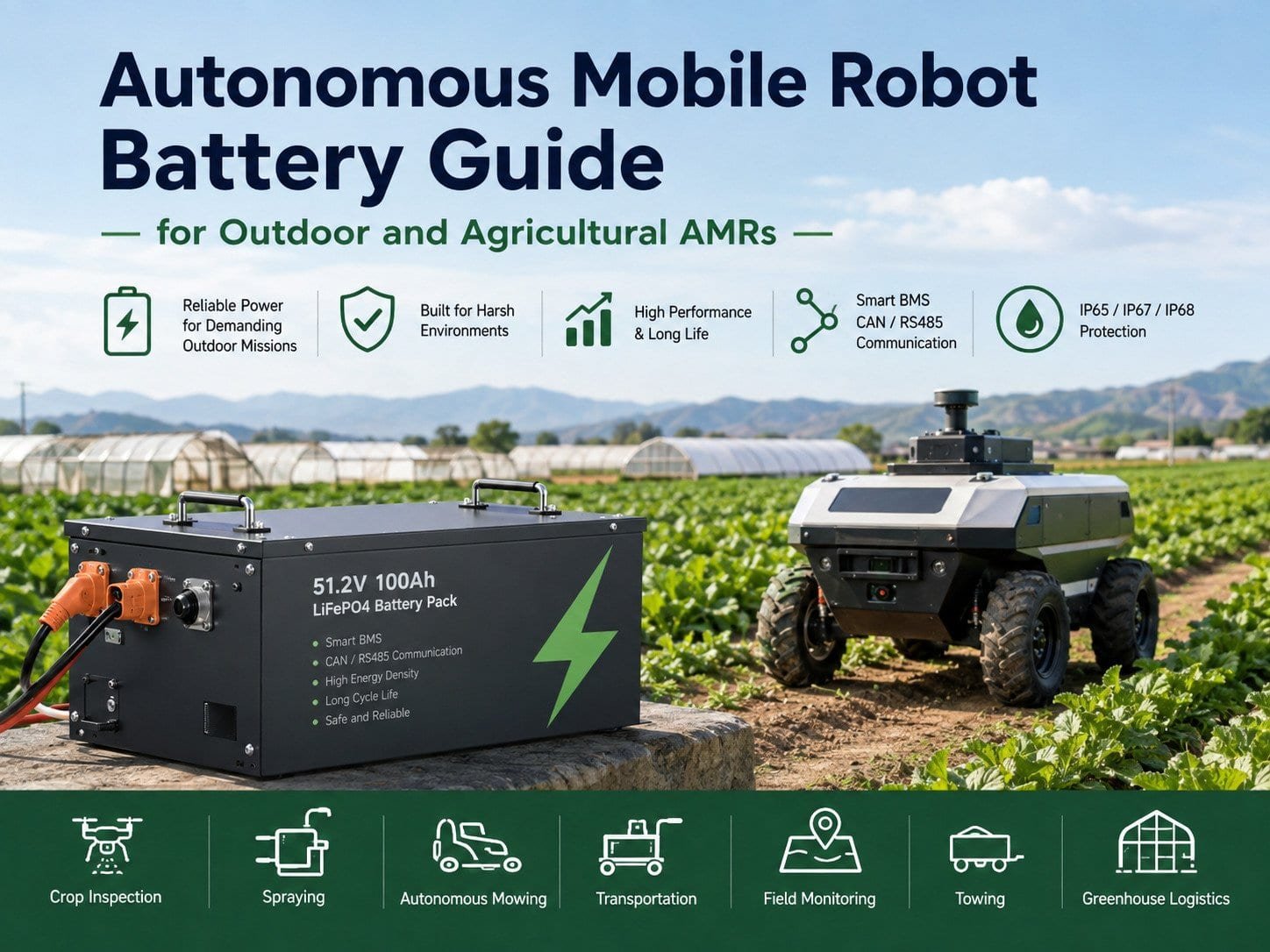
Autonomous mobile robots (AMRs) are moving beyond warehouses and factories into orchards, vineyards, greenhouses, farms, parks, and other outdoor environments. These robots perform tasks such as crop monitoring, transportation, mowing, spraying, inspection, towing, and material handling with limited human intervention.
Compared with indoor AMRs, outdoor and agricultural robots face a wider range of operating conditions. Uneven terrain, slopes, mud, dust, rain, vibration, temperature changes, variable payloads, and long operating cycles can all affect battery performance.
For robot manufacturers, the battery is therefore more than an energy-storage component. It is part of the robot’s complete power system, working together with the motors, motor controller, charger, BMS, sensors, communication system, and onboard computer.
This guide explains how to evaluate and design lithium battery packs for outdoor and agricultural autonomous mobile robots.
1. What Is an Agricultural Autonomous Mobile Robot?
An agricultural AMR is a mobile robotic platform designed to navigate and perform tasks with limited manual operation.
Les applications les plus courantes sont les suivantes
- Crop inspection
- Orchard monitoring
- Vineyard monitoring
- Autonomous mowing
- Weed control
- Agricultural spraying
- Crop transportation
- Harvest assistance
- Greenhouse logistics
- Field inspection
- Soil monitoring
- Autonomous towing
Depending on the application, an AMR may include drive motors, steering systems, cameras, LiDAR, GNSS or RTK positioning, wireless communication, onboard computers, pumps, actuators, and other powered equipment.
Each subsystem consumes energy.
Battery selection should therefore be based on the complete robot duty cycle, rather than the motor’s nominal power alone.
2. What Must an Outdoor AMR Battery Handle?
Outdoor agricultural robots operate in conditions that can change during a single mission.
A robot may travel across:
- Concrete
- Grass
- Soil
- Gravel
- Boue
- Slopes
- Uneven farmland
- Wet surfaces
The battery may also be exposed to:
- Pluie
- Poussière
- Water spray
- Températures élevées
- Températures basses
- Vibrations
- Mechanical shock
These factors influence both the electrical and mechanical requirements of the battery pack.
Variable loads
An agricultural AMR does not normally consume a constant amount of power.
Power demand can increase during:
- Accélération
- Hill climbing
- Tournage
- Driving through soft soil
- Carrying heavy payloads
- Towing
- Starting pumps
- Operating mowing or spraying equipment
The battery therefore needs sufficient energy capacity as well as sufficient continuous and peak discharge capability.
3. How to Calculate AMR Battery Capacity
The first step in battery sizing is to determine the robot’s energy requirement.
The basic equation is:
Énergie (Wh) = Tension (V) × Capacité (Ah)
Par exemple :
A 51.2 V 100 Ah LiFePO4 battery provides approximately:
51.2 V × 100 Ah = 5,120 Wh
or approximately 5.12 kWh of nominal energy.
However, nominal energy is not the same as the energy available for every mission.
Actual usable energy depends on:
- Operating SOC range
- Température de la batterie
- Courant de décharge
- Paramètres du BMS
- Vieillissement de la batterie
- Rendement du système
- Terrain
- Charge utile
- Robot operating strategy
Example battery calculation
Suppose an agricultural AMR consumes an average of 600 W and needs to operate for 8 hours.
Required energy:
600 W × 8 h = 4,800 Wh
The engineering team should then add an appropriate operating reserve based on actual field conditions and the required mission reliability.
The final battery capacity should be validated through prototype and field testing rather than relying only on theoretical calculations.
4. Average Power vs. Peak Power
Battery selection should distinguish between average power et peak power.
Average power
Average power determines how much energy the robot consumes during a typical mission.
It is affected by:
- Vitesse de conduite
- Route length
- Charge utile
- Terrain
- Rendement du moteur
- Capteurs
- Computing
- Auxiliary equipment
Peak power
Peak power determines whether the battery can handle short periods of high demand.
En voici quelques exemples :
- Motor startup
- Rapid acceleration
- Steep slopes
- Heavy towing
- Soft soil
- Pump startup
- Agricultural implements
A battery may have enough watt-hours for the required runtime but still be unsuitable if its BMS or cells cannot support the robot’s peak current.
For this reason, both energy capacity and discharge current should be specified during battery development.
5. Choosing the Battery Voltage
Common voltage platforms for mobile robots include:
- 24 V
- 36 V
- 48 V
- 51.2 V
- 60 V
- 72 V
The correct voltage depends on the robot’s electrical architecture.
The battery must be compatible with:
- Moteurs d'entraînement
- Motor controllers
- DC/DC converters
- Chargeurs
- BMS
- Actuators
- Auxiliary systems
The relationship between power, voltage, and current is:
P = V × I
For a given power requirement, a higher system voltage can reduce current. However, the battery voltage should always be determined together with the complete electrical system.
For an existing robot platform, the battery should match the specified voltage range rather than changing the system voltage simply to increase battery capacity.
6. Why LiFePO4 Is Used for Agricultural Robot Batteries
LiFePO4, or lithium iron phosphate, is widely used in industrial mobile equipment and robotic applications.
For agricultural AMRs, the chemistry can be suitable when the project requires:
- Repeated charging and discharging
- Fonctionnement stable
- Stabilité thermique
- Industrial-duty operation
- Large battery capacity
LiFePO4 batteries are available in cylindrical, prismatic, and other cell formats.
The appropriate cell format depends on:
- Capacité requise
- Courant de décharge
- Available space
- Mechanical structure
- Poids de la batterie
- Production volume
- Thermal requirements
Cell selection should be based on the complete battery specification rather than capacity alone.
7. BMS Requirements for Autonomous Mobile Robots
The Battery Management System is a core part of an AMR battery pack.
A properly designed BMS can monitor:
- Potentiel cellulaire
- Tension du bloc-batterie
- Actuel
- Cell temperature
- Température de la batterie
- SOC
- État des défauts
Protection functions may include:
- Protection contre les surcharges
- Protection contre la surcharge
- Protection contre les surintensités
- Protection contre les courts-circuits
- Protection contre la surchauffe
- Under-temperature protection
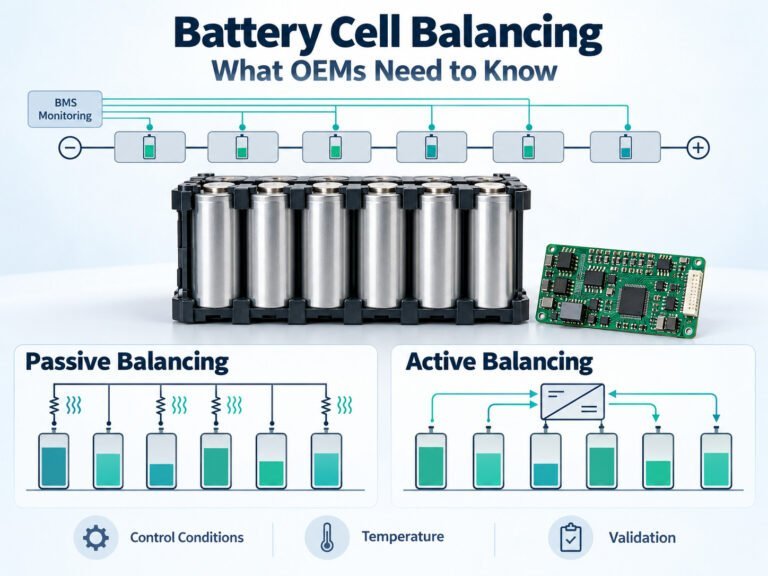
- Équilibre cellulaire
For autonomous robots, BMS communication is also important.
The robot controller can use battery information to determine whether the robot should:
- Continue its current mission
- Return to a charging station
- Reduce power consumption
- Stop safely
- Begin charging
- Request a battery replacement
The BMS therefore becomes part of the robot’s energy-management system.
8. CAN Bus and RS485 Communication
Smart battery communication can be useful for agricultural AMRs.
Common interfaces include:
Bus CAN
CAN is widely used in mobile equipment and vehicle-related systems.
Battery information can include:
- Tension
- Actuel
- SOC
- Température
- État des défauts
- État de charge
RS485
RS485 is also used in industrial systems and can support communication between the battery, robot controller, charger, or other equipment.
However, having the same physical interface does not guarantee compatibility.
The battery and robot controller should define:
- Baud rate
- Protocole de communication
- CAN IDs
- Data format
- Scaling
- Fault codes
- Charging commands
- Communication timeout behavior
Communication should be tested with the actual robot controller before mass production.
9. IP Protection for Outdoor Agricultural Robot Batteries
Outdoor agricultural batteries may encounter dust, rain, irrigation water, mud, and cleaning processes.
The battery enclosure should therefore be designed according to the actual environmental requirements.
Common IP ratings considered for outdoor battery systems include:
- IP65
- IP67
- IP68
The appropriate rating depends on the installation and operating conditions.
For example, IP67 provides protection against dust ingress and temporary immersion under specified test conditions.
However, the battery enclosure is only one part of the system.
Engineers should also evaluate:
- Connecteurs
- Cable glands
- Câblage
- Service covers
- Mounting interfaces
- Venting
- Sealing surfaces
A battery case with an IP rating does not automatically make the complete robot waterproof.
10. Temperature Management
Agricultural robots may operate during different seasons and in different climates.
Battery temperature affects charging, discharging, available power, and battery aging.
High-temperature environments
High ambient temperatures can increase thermal stress.
The battery system should consider:
- Capteurs de température
- BMS temperature protection
- Dissipation thermique
- Enclosure design
- Charging temperature limits
Cold environments
Low temperatures can reduce available battery performance and require additional charging controls.
Selon l'application, la batterie peut nécessiter :
- Low-temperature charging protection
- Heating elements
- Isolation thermique
- BMS-controlled heating
- Contrôle de la température
For agricultural AMRs operating in cold regions, the charging environment should be considered during the initial battery design.
11. Vibration and Shock Testing
Outdoor AMRs are exposed to repeated mechanical vibration.
Typical sources include:
- Uneven farmland
- Gravel
- Ruts
- Stones
- Slopes
- Sudden braking
- Motor vibration
- Transports
Battery pack construction should therefore consider:
- Cell fixation
- Module support
- Busbar structure
- Soudage
- Connector retention
- Acheminement des câbles
- Enclosure strength
- Points de fixation
Testing should ideally reflect the robot’s actual operating environment.
For example, laboratory electrical testing cannot completely reproduce the mechanical loads generated when a robot repeatedly travels across rough agricultural terrain.
12. Charging Strategies for Agricultural AMRs
Charging strategy has a direct relationship with battery capacity.
Three common approaches are:
Full charging
The robot completes a mission, returns to a charging station, and charges before the next mission.
Frais d'opportunité
The robot charges during operational breaks.
En voici quelques exemples :
- Between missions
- During shift changes
- While waiting for another task
- During scheduled downtime
Remplacement de la batterie
A depleted battery is replaced with a charged battery.
This can be useful when the robot needs extended operating time and the mechanical design supports battery replacement.
The battery, charger, and BMS should be developed as one charging system.
13. Battery Mechanical Design
Agricultural robots often have strict space and weight limitations.
The battery may need to be installed:
- Under the chassis
- Inside the frame
- Behind the control cabinet
- Beneath the payload platform
- Inside a sealed compartment
Parmi les paramètres mécaniques importants, on peut citer :
- Longueur
- Largeur
- Hauteur
- Poids
- Trous de fixation
- Position du connecteur
- Cable direction
- Service access
Battery placement also affects the robot’s center of gravity.
A poorly positioned battery can influence:
- Traction
- Stability
- Wheel loading
- Ground clearance
- Turning performance
For this reason, battery mechanical design should ideally begin together with the robot chassis design.
14. Outdoor AMR Battery Safety
A complete battery safety design can include several protection layers.
Cell level
- Surveillance du potentiel cellulaire
- Contrôle de la température
- Équilibre cellulaire
BMS level
- Protection contre les surcharges
- Protection contre la surcharge
- Protection contre les surintensités
- Protection contre les courts-circuits
- Protection de la température
Pack level
- Fuse
- Contactor or MOSFET protection
- Pre-charge circuit when required
- Insulation
- Mechanical protection
System level
- Charger communication
- Motor controller coordination
- Emergency shutdown
- Fault reporting
Battery safety should be validated according to the actual product design and applicable standards.
15. Battery Testing for Agricultural AMRs
A battery designed for an outdoor robot should undergo electrical, environmental, and mechanical validation.
Contrôles électriques
Typical tests include:
- Essais de capacité
- Charge testing
- Discharge testing
- Continuous-current testing
- Peak-current testing
- Tests de protection du système de gestion de la batterie (BMS)
- Tests de communication
Environmental testing
Depending on the application:
- Essais à haute température
- Essais à basse température
- Temperature cycling
- Humidity testing
- Water ingress testing
- Dust exposure
Essais mécaniques
Possible tests include:
- Essais de vibration
- Shock testing
- Drop testing where applicable
- Connector retention
- Enclosure strength
Production testing
Battery production may also include:
- Voltage inspection
- Internal resistance inspection
- Tests de communication du système de gestion de la batterie (BMS)
- Essais de capacité
- Contrôle de l'isolation
- Tests de vieillissement
- Tests fonctionnels
Testing requirements should be defined according to the robot’s actual operating conditions.
16. Battery Certification and Compliance
For AMR manufacturers selling products internationally, battery compliance should be considered during the development stage.
Potential requirements may include:
- UN38.3
- IEC 62133-2
- CE
- RoHS
- EMC-related requirements
- Règlement de l'UE sur les batteries
- Exigences spécifiques au client
The exact certification path depends on the battery design, destination market, transportation requirements, robot classification, and final application.
For the European market, Regulation (EU) 2023/1542 specifically includes batteries intended for agricultural activities within its broad industrial-battery category.
The regulation also establishes performance and durability information requirements for rechargeable industrial batteries above 2 kWh.
Therefore, European AMR projects should consider battery documentation, performance data, traceability, labeling, and other applicable requirements early in the development process.
17. How to Choose an AMR Battery Manufacturer
For an OEM/ODM agricultural robot project, the battery supplier should be evaluated beyond the quoted voltage and capacity.
Consider whether the manufacturer can provide:
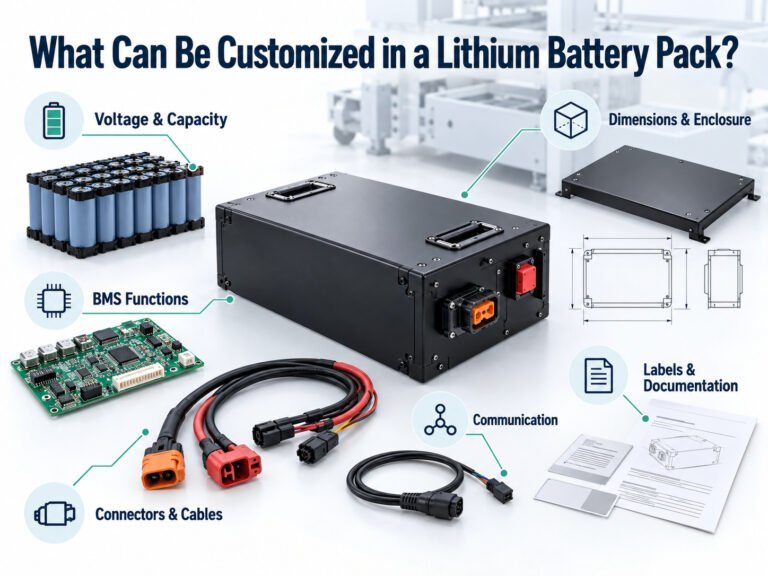
Conception personnalisée de la batterie
- Personnalisation de la tension
- Personnalisation de la capacité
- Dimensions
- BMS
- Connecteurs
- Câblage
- Communication
- Enclosure
- Mounting structure
Développement de prototypes
A typical development process can include:
Requirement → Battery Design → Prototype → Robot Integration → Testing → Optimization → Mass Production
Battery traceability
Ask about:
- Cell batch information
- BMS version
- Production records
- Test records
- Serial numbers
- Quality inspection
Soutien à la certification
The supplier should understand the certification and transportation requirements of the target market.
18. OEM/ODM Battery Solutions for Agricultural AMRs
Agricultural AMRs often require customized battery packs rather than standard batteries.
A custom battery may be designed around:
- Robot voltage
- Capacité requise
- Courant de crête
- Durée de fonctionnement
- Espace disponible pour l'installation
- Weight limitations
- Protocole de communication
- Chargeur
- Conditions environnementales
Par exemple :
Battery Chemistry: LiFePO4
Tension nominale : 51.2 V
Capacity: 100 Ah
Energy: 5.12 kWh
BMS: Smart BMS
Communication: CAN / RS485
Application: Agricultural AMR
Enclosure: Outdoor-rated
Chargement : Dedicated charger
Personnalisation : Housing, connector, wiring and mounting
The final specification should be based on measured robot loads and field operating conditions.
19. Agricultural AMR Battery Specification Checklist
Before contacting a battery manufacturer, prepare the following information:
| Paramètres | Information |
|---|---|
| Application | Agricultural AMR |
| Composition chimique des batteries | LiFePO4 / Li-ion |
| Tension nominale | 24V / 36V / 48V / 51.2V / 72V |
| Capacité | Ah |
| L'énergie | Wh / kWh |
| Courant continu | A |
| Courant de crête | A |
| Peak Duration | Seconds / Minutes |
| Operating Time | Hours |
| Temps de charge | Hours |
| Chargeur | Voltage / Current |
| Communication | CAN / RS485 |
| IP Requirement | IP65 / IP67 / IP68 |
| Température de fonctionnement | °C |
| Dimensions | L × W × H |
| Maximum Weight | kg |
| Connecteur | Model / Current |
| Installation | Fixed / Removable |
| Certification | Target market |
| Production Volume | Prototype / Pilot / Mass Production |
The more complete the specification, the easier it is for the battery manufacturer to develop a suitable solution.
20. Final Considerations When Selecting an Outdoor AMR Battery
An agricultural robot battery needs to perform as part of the complete robot system.
The battery should be evaluated according to:
- Energy requirements
- Peak power
- Courant continu
- Duty cycle
- Chimie des batteries
- BMS
- Communication
- Charging
- Température
- Water and dust exposure
- Vibrations
- Mechanical installation
- Certification
- Production traceability
For many outdoor AMR applications, a LiFePO4 battery pack with a smart BMS, CAN/RS485 communication, appropriate enclosure protection, and customized mechanical design can provide a suitable platform for robot power-system development.
The key is to avoid selecting a battery based only on an Ah number.
The right AMR battery is designed around the robot’s actual mission, terrain, load, charging strategy, and operating environment.
 English
  Chinese
  Japanese
  German
  French
  Korean
