
Industrial equipment is becoming more intelligent, automated, and energy-efficient. From electric forklifts and warehouse vehicles to AGV robots, AMR systems, cleaning machines, marine equipment, and energy storage systems, reliable power supply has become a key factor affecting productivity.
Traditional lead acid batteries have been widely used in industrial applications for many years. However, with increasing requirements for longer operating time, faster charging, lower maintenance, and improved safety, more companies are upgrading to LiFePO4 battery packs (Lithium Iron Phosphate Battery Packs).
Choosing the right LiFePO4 battery pack is not simply selecting a battery with a higher capacity. A suitable industrial lithium battery solution needs to consider:
- Exigences en matière de tension
- Battery capacity
- Discharge performance
- Environnement opérationnel
- Système de gestion de batterie (BMS)
- Exigences en matière de communication
- Certifications de sécurité
- Conception mécanique
- Long-term operating costs
This guide explains how to select the right LiFePO4 battery pack for industrial applications.
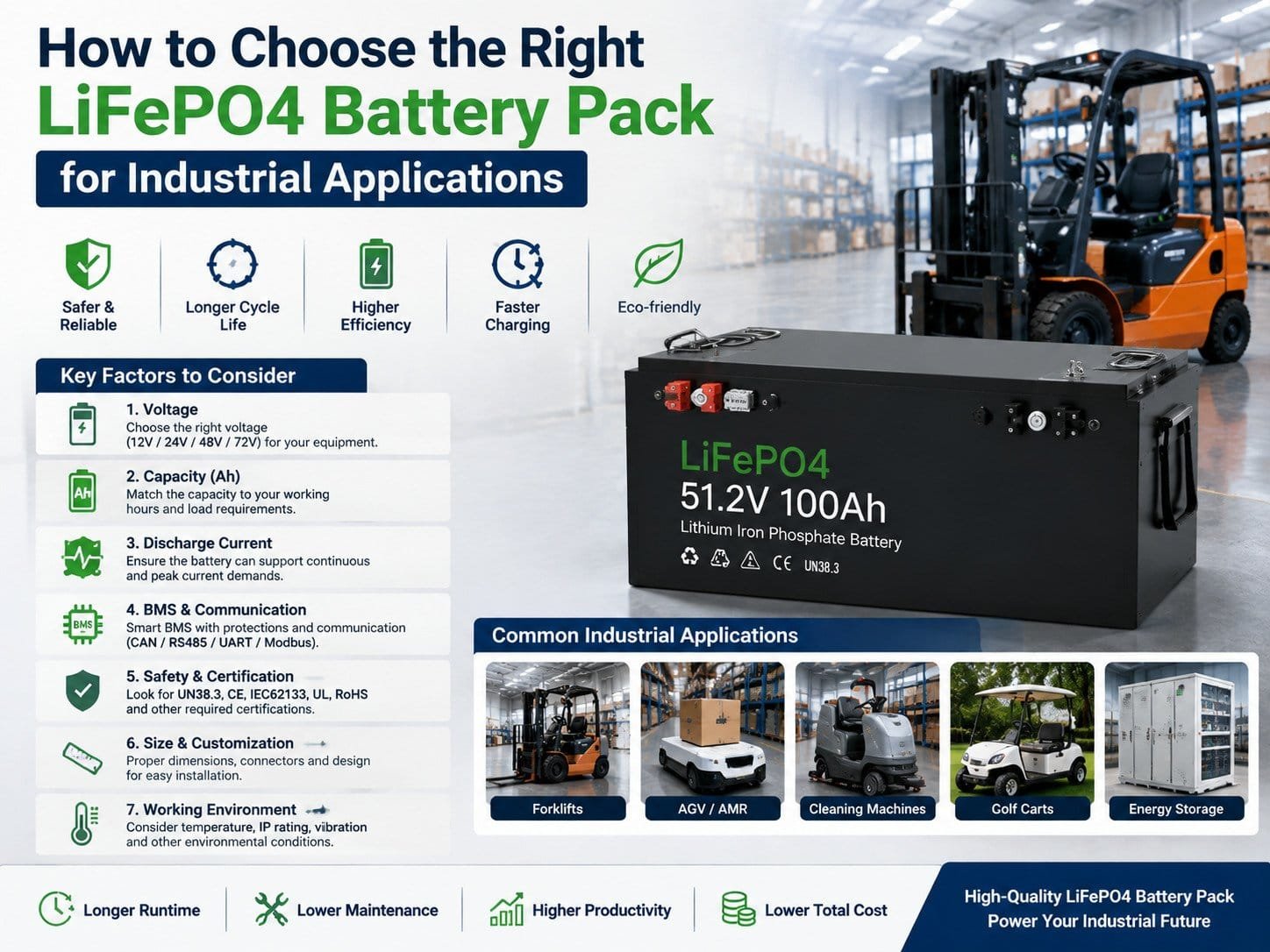
1. Understand Your Application Requirements First
Before choosing a LiFePO4 battery pack, the first step is understanding how the battery will be used.
Different industrial applications have different power requirements.
Par exemple :
| Application | Main Battery Requirements |
|---|---|
| Forklift | High current discharge, long working hours |
| AGV/AMR Robot | Stable output, communication function |
| Voiturette de golf | Long range, lightweight design |
| Cleaning Machine | Cycles de charge fréquents |
| Équipements marins | Waterproof and corrosion resistance |
| Stockage d'énergie | Long lifespan and safety |
A battery designed for a forklift may not be suitable for a small robot because the operating conditions and electrical requirements are different.
2. Select the Correct Battery Voltage
Voltage is one of the most important parameters when selecting a LiFePO4 battery pack.
Common industrial lithium battery voltages include:
- 12.8V LiFePO4 Battery
- 25.6V LiFePO4 Battery
- 38.4V LiFePO4 Battery
- 51.2V LiFePO4 Battery
- 72V LiFePO4 Battery
The battery voltage should match the equipment system.
Common Applications
12V LiFePO4 Battery
Convient pour :
- Small devices
- Systèmes d'alimentation de secours
- Electronics equipment
24V LiFePO4 Battery
Convient pour :
- Véhicules électriques
- Small industrial equipment
- Machines de nettoyage
48V/51.2V LiFePO4 Battery
Convient pour :
- Chariots élévateurs
- Voiturettes de golf
- Robots AGV
- Véhicules industriels
72V LiFePO4 Battery
Convient pour :
- Véhicules lourds
- Équipements à haute puissance
- Machines industrielles
3. Choose the Right Battery Capacity (Ah)
Battery capacity determines how long the equipment can operate.
Capacity is measured in:
Ah (Ampere-hour)
A higher Ah rating generally means:
- Longer runtime
- More stored energy
- Durée de fonctionnement plus longue
La capacité requise dépend des éléments suivants :
- Consommation électrique des équipements
- Working hours per day
- Conditions de charge
- Fréquence de recharge
Exemple :
A warehouse AGV operates:
- 8 hours per day
- Average current: 20A
Capacité requise :
20A × 8 hours = 160Ah
A suitable battery design may consider:
48V 160Ah LiFePO4 battery pack.
4. Check Continuous and Peak Discharge Current
Industrial equipment often requires high power during startup or acceleration.
Therefore, battery selection should consider:
Courant de décharge continu
The maximum current the battery can continuously provide.
Courant de décharge de pointe
The short-term current output during:
- Motor startup
- Heavy loading
- Accélération
Par exemple :
A forklift may require higher peak current when lifting heavy loads.
A professional battery supplier should evaluate:
- Puissance du moteur
- Caractéristiques techniques du contrôleur
- Maximum operating load
5. Choose the Right Battery Cell Type
LiFePO4 battery packs are built using different cell formats.
Cylindrical Cells
Exemples :
- 18650
- 21700
Avantages :
- Une grande cohérence
- Flexible design
- Suitable for compact applications
Used in:
- Robots
- Power equipment
- Appareils portables
Prismatic LiFePO4 Cells
Avantages :
- Higher capacity
- Simple structure
- Better space utilization
Used in:
- Chariots élévateurs
- Stockage d'énergie
- Batteries marines
- Véhicules industriels
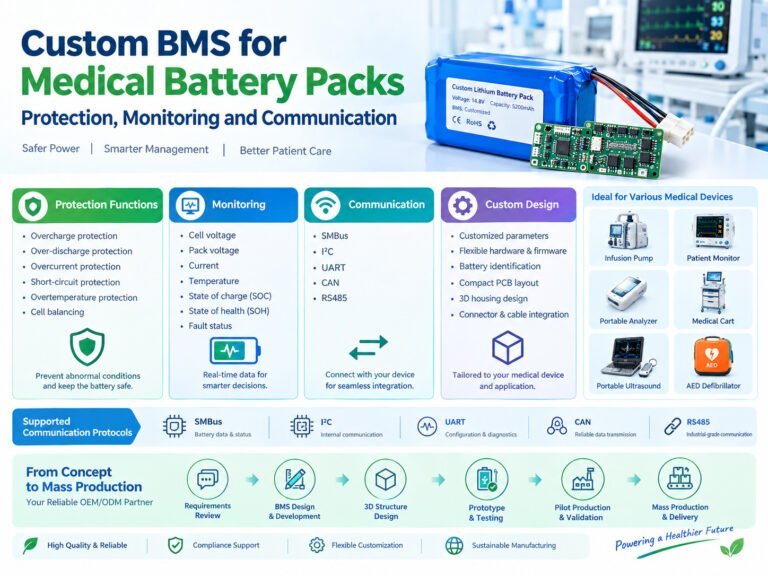
6. Pay Attention to Battery Management System (BMS)
The BMS is the “brain” of a lithium battery pack.
A high-quality BMS provides:
Protection de la sécurité
Y compris :
- Protection contre les surcharges
- Protection contre la surcharge
- Protection contre les surintensités
- Protection contre les courts-circuits
- Protection de la température
Battery Monitoring
Smart BMS can monitor:
- Tension
- Actuel
- Température
- SOC (état de charge)
- SOH (état de santé)
Communication Functions
Industrial applications may require:
- Communication CAN
- Communication RS485
- UART
- Modbus
This allows the battery to communicate with:
- Vehicle controllers
- Industrial systems
- Remote monitoring platforms
7. Consider the Operating Environment
Industrial environments can be challenging.
Before selecting a battery pack, evaluate:
Temperature Conditions
Normal LiFePO4 operation:
Chargement :
0°C à 45°C
Discharging:
De -20°C à 60°C
For extreme environments:
Choose:
- Low-temperature heating battery
- Système de gestion de batterie (BMS) à température contrôlée
Dust and Water Protection
For outdoor or industrial environments, consider:
- IP65
- IP67
- IP68
protection levels.
Parmi les applications, on peut citer :
- Outdoor robots
- Équipement maritime
- Véhicules industriels
8. Battery Size and Mechanical Design
A battery pack must physically fit the equipment.
Customization may include:
- Battery enclosure design
- Mounting structure
- Type de connecteur
- Longueur du câble
- Interface de communication
For OEM projects, battery design should consider:
- Espace d'installation
- Répartition du poids
- Heat management
- Mesures de sécurité
9. Safety Certifications and Compliance
For industrial lithium battery applications, certifications are important.
Les certifications les plus courantes sont les suivantes
UN38.3
Obligatoire pour le transport de batteries au lithium.
CE
Required for many European markets.
IEC 62133
Battery safety standard.
Certification UL
Important for North American markets.
RoHS
Restriction of hazardous substances.
Choosing a manufacturer with complete certification capability helps reduce compliance risks.
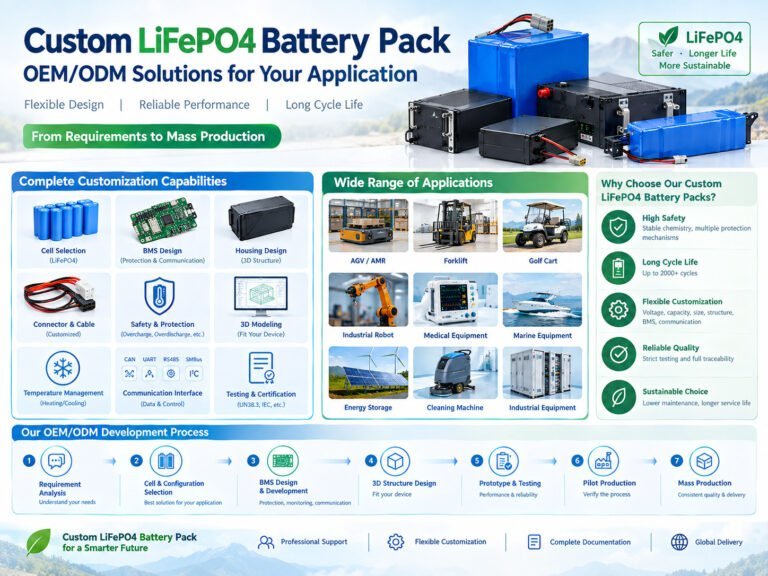
10. Evaluate Battery Manufacturer Capability
Selecting the right supplier is as important as selecting the battery.
A professional LiFePO4 battery manufacturer should provide:
OEM/ODM Capability
Y compris :
- Tension personnalisée
- Custom capacity
- Custom enclosure
- Custom connector
- Custom communication protocol
Capacité de production
Important manufacturing processes:
- Tri cellulaire
- Soudage au laser
- Ensemble de batterie
- Tests de vieillissement
- Performance testing
Contrôle de la qualité
A reliable supplier should perform:
- Cell matching
- Charge/discharge testing
- Essais de température
- Contrôle de sécurité
- Tests de vieillissement
11. LiFePO4 Battery Pack Applications
Forklift Lithium Battery
Avantages :
- Durée de fonctionnement plus longue
- Chargement rapide
- Entretien réduit
- Efficacité accrue
AGV and AMR Battery Pack
Conditions requises :
- Longue durée de vie
- Conception compacte
- Smart communication
Golf Cart Lithium Battery
Avantages :
- Longer driving distance
- Poids réduit
- Durée de vie plus longue
Industrial Robot Battery
Conditions requises :
- Stable voltage
- Haute fiabilité
- Custom design
Marine LiFePO4 Battery
Important features:
- Conception étanche
- Résistance à la corrosion
- Longue durée de vie
12. Common Mistakes When Choosing Industrial LiFePO4 Batteries
Mistake 1: Only Comparing Battery Price
The cheapest battery may not provide the best long-term value.
Réfléchissez à ceci :
- Durée du cycle
- Garantie
- Sécurité
- Performances
Mistake 2: Ignoring BMS Quality
A battery without a suitable BMS may experience:
- Poor protection
- Communication problems
- Reduced lifespan
Mistake 3: Choosing Incorrect Capacity
Too small:
- Short runtime
- Recharges fréquentes
Too large:
- Higher cost
- Increased weight
The correct capacity should match actual usage.
FAQ: LiFePO4 Battery Pack Selection
Q1: What is the best LiFePO4 battery for industrial applications?
The best battery depends on the equipment requirements, including voltage, capacity, discharge current, environment, and communication needs.
Q2: How long does an industrial LiFePO4 battery last?
A quality industrial LiFePO4 battery pack can typically achieve 2000-5000 cycles depending on operating conditions.
Q3: Can LiFePO4 batteries replace lead acid batteries?
Yes. Many industrial applications can upgrade from lead acid to LiFePO4 with proper voltage, charger, and BMS compatibility.
Q4: Do industrial LiFePO4 batteries need customized design?
For many applications, customized solutions are recommended to ensure correct dimensions, power output, and communication compatibility.
Q5: What certifications should industrial lithium batteries have?
Common certifications include UN38.3, CE, IEC 62133, UL, and RoHS depending on the target market.
Conclusion
Choisir le bon LiFePO4 battery pack for industrial applications requires careful evaluation of electrical performance, operating conditions, safety requirements, and future expansion needs.
A properly designed lithium battery solution can help industrial equipment achieve:
- Durée de fonctionnement plus longue
- Réduction des coûts de maintenance
- Higher productivity
- Fiabilité améliorée
Whether you need a battery solution for forklifts, AGVs, AMRs, industrial vehicles, marine systems, or energy storage, working with an experienced custom LiFePO4 battery manufacturer ensures the battery pack meets your specific application requirements.
 English
  Chinese
  Japanese
  German
  French
  Korean
