
For rowboats, dinghies, fishing boats, inflatable boats, and small electric boats, battery weight directly affects performance. A heavy battery can reduce cruising time, make transportation harder, and take up valuable space.
In 2026, LiFePO4 (Lithium Iron Phosphate) marine batteries have become a popular choice for small watercraft because they provide a combination of lightweight design, stable power output, long cycle life, and low maintenance requirements.
For rowboat owners using electric trolling motors, fish finders, navigation equipment, or small onboard electronics, selecting the right lithium battery can turn the boat from a floating storage box into a quiet, efficient power platform.
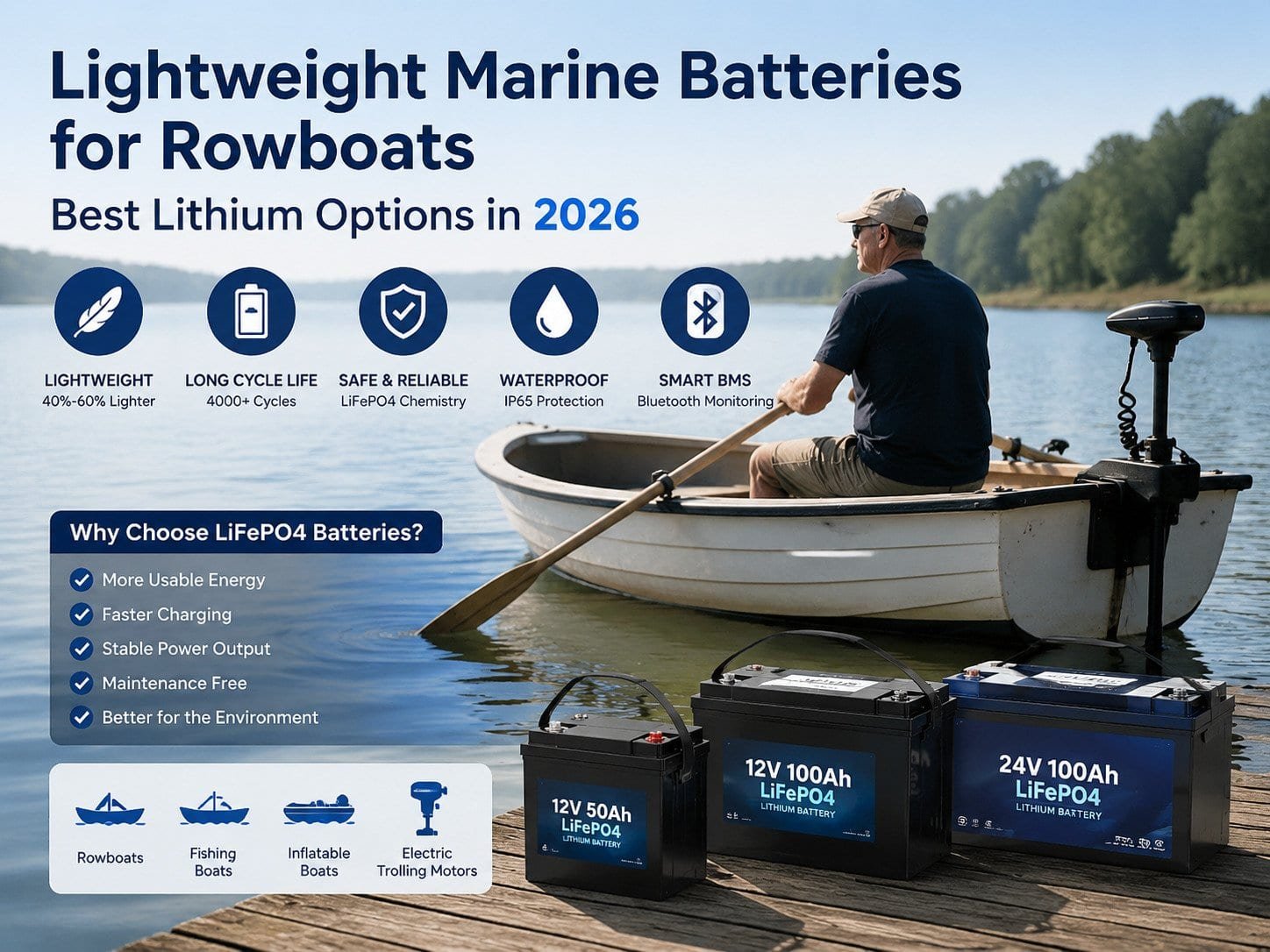
Part 1.Why Choose Lithium Batteries for Rowboats?
Traditional lead-acid marine batteries have been widely used for decades, but their weight and limited usable capacity create challenges for small boats.
A lithium marine battery offers several practical advantages:
| Fonctionnalité | Batterie au plomb | Batterie au lithium LiFePO4 |
|---|---|---|
| Poids | Lourd | 40%-60% lighter |
| Capacité utile | Around 50% | 80%-100% |
| Cycle de vie | Des centaines de cycles | Des milliers de cycles |
| Maintenance | Requires maintenance | Sans entretien |
| Stabilité de la tension | Chutes pendant le déchargement | Rendement stable |
| Vitesse de recharge | Plus lent | Plus rapide |
LiFePO4 batteries commonly provide thousands of cycles and maintain more stable voltage during discharge, making them suitable for repeated marine use.
Part 2.Best Lithium Battery Types for Rowboats in 2026
1. 12V 50Ah LiFePO4 Battery: Lightweight Choice for Small Rowboats
For:
- Kayaks
- Small inflatable boats
- Lightweight fishing boats
- Short-distance electric trolling
A 12V 50Ah lithium battery is often enough.
Energy:
12.8V × 50Ah ≈ 640Wh
Avantages :
- Dimensions compactes
- Easy to carry
- Suitable for small trolling motors
- Lower initial investment
Applications typiques :
- 30-40 lb thrust trolling motors
- Fish finders
- GPS devices
- LED lighting
For anglers who frequently transport their boat by hand, reducing battery weight can make a noticeable difference.
2. 12V 100Ah LiFePO4 Battery: The Most Popular Rowboat Option
For most small electric boats, a:
12V 100Ah LiFePO4 battery
is the balanced choice.
Energy:
12.8V × 100Ah ≈ 1.28kWh
Convient pour :
- 40-55 lb thrust trolling motors
- Fishing trips
- Day cruising
- Small electric propulsion systems
Avantages :
✓ Longer runtime
✓ Better weight distribution
✓ Enough power for full-day use
✓ Easy replacement for Group 27/31 lead-acid batteries
Many small boat users choose 100Ah LiFePO4 batteries because they offer a practical balance between weight, capacity, and cost.
3.24V Lithium Battery Pack: For Higher Power Trolling Motors
If your rowboat uses:
- 70-80 lb thrust trolling motors
- Faster electric propulsion
- Durée de fonctionnement plus longue
a 24V battery system may be more suitable.
Configurations courantes :
- 24 V 50 Ah
- 24V 60Ah
- 24 V 100 Ah
Avantages :
- Meilleur rendement du moteur
- Lower current demand
- De meilleures performances pour les longs trajets
A custom 24V LiFePO4 pack can also reduce installation space compared with connecting multiple lead-acid batteries.
Part 2.Key Features to Look for in a Marine Lithium Battery
1. Built-in BMS Protection
A reliable marine lithium battery should include a Battery Management System (BMS).
The BMS protects against:
- Surcharge
- Surdécharge
- Surintensité
- Court-circuit
- Temperature issues
For marine environments, BMS reliability is especially important because batteries experience vibration, humidity, and temperature changes.
2. Waterproof and Marine-Grade Housing
Rowboats are exposed to:
- Éclaboussure d'eau
- Pluie
- Humidité
- Condensation
Fonctionnalités recommandées :
- IP65 or higher enclosure
- Bornes résistantes à la corrosion
- Sealed battery case
A waterproof battery box adds another layer of protection for outdoor use.
3. Low Temperature Protection
For users boating in colder climates, choose batteries with:
- Low-temperature charging protection
- Contrôle de la température
- Optional heating function
Charging LiFePO4 batteries below freezing temperatures requires protection because lithium cells can be damaged under certain low-temperature charging conditions.
4. Smart Monitoring Function
Modern lithium marine batteries may support:
- Surveillance Bluetooth
- Communication CAN
- Communication RS485
Users can check:
- Capacité restante
- Tension
- Actuel
- Température de la batterie
- Cycle information
This is useful for fishing boats and long-distance trips.
Part 3.Recommended Battery Capacity by Rowboat Application
| Boat Type | Moteur | Batterie recommandée |
|---|---|---|
| Small kayak | Small electric motor | 12V 20Ah-50Ah |
| Inflatable boat | 30-40 lb trolling motor | 12 V, 50 Ah |
| Fishing rowboat | 40-55 lb trolling motor | 12 V 100 Ah |
| Heavy fishing boat | 70-80 lb motor | 24V 50Ah-100Ah |
| Bateau à propulsion électrique | Higher power motor | Custom 24V/36V pack |
Part 4.Lithium vs AGM for Rowboats
AGM batteries are still used by some boat owners because of their lower upfront cost.
However:
AGM Advantages
- Lower purchase price
- Simple replacement
- Good starting current
LiFePO4 Advantages
- Much lighter
- More usable energy
- Durée de vie plus longue
- Chargement plus rapide
- Better voltage stability
For frequent boat users, lithium often provides better long-term value because the battery can handle many more charging cycles.
Part 5.How to Calculate Battery Runtime for a Rowboat
Formula:
Battery Energy (Wh) ÷ Motor Power (W) = Runtime (hours)
Exemple :
A 12V 100Ah battery:
12.8V × 100Ah = 1280Wh
A trolling motor consuming:
300W average power
Runtime:
1280Wh ÷ 300W ≈ 4.2 hours
La durée d'exécution réelle dépend des facteurs suivants :
- Poids du bateau
- Conditions hydrologiques
- Vitesse
- Rendement du moteur
- Vent et courant
Custom Lithium Battery Solutions for Rowboats
For OEM boat manufacturers and electric propulsion companies, standard batteries may not always fit.
Custom marine lithium battery packs can be designed with:
- Customized dimensions
- Different voltage platforms
- Integrated BMS
- Boîtier étanche
- Communication interfaces
- Battery handles
- Marine connectors
Typical custom solutions:
- 12 V, 50 Ah
- 12 V 100 Ah
- 24 V 50 Ah
- 36V trolling motor batteries
- 48V electric boat battery systems
FAQ
Are lithium batteries safe for rowboats?
Yes. LiFePO4 batteries are widely used in marine applications because they have good thermal stability and do not contain liquid acid that can leak.
How long does a lithium marine battery last?
A quality LiFePO4 marine battery can typically provide several thousand charge cycles depending on usage conditions, charging method, and battery management quality.
Can I replace my lead-acid boat battery with lithium?
In many cases, yes. However, you should check:
- Charger compatibility
- Caractéristiques techniques du moteur
- Tension de charge
- Battery compartment size
What is the best lithium battery size for a fishing rowboat?
For most fishing rowboats, a 12V 100Ah LiFePO4 battery is a practical option because it provides enough energy while keeping weight manageable.
Conclusion
For rowboats in 2026, LiFePO4 lithium batteries provide a lightweight and reliable power solution. Whether you need a compact battery for a kayak or a higher-capacity pack for electric propulsion, choosing the correct voltage and capacity will improve boating efficiency.
For most small boats:
- 12 V, 50 Ah → lightweight portable option
- 12 V 100 Ah → balanced choice for fishing and trolling motors
- 24V/36V custom packs → higher-power electric boats
The right lithium marine battery helps your boat carry more energy and less weight, leaving more room for what actually belongs onboard: fishing gear, exploration, and a little extra horizon.
 English
  Chinese
  Japanese
  German
  French
  Korean
