
Thermal management is an important part of lithium battery pack design. During charging and discharging, battery cells generate heat due to electrochemical reactions and internal electrical resistance. If heat is not managed according to the battery specifications and operating conditions, it can affect battery performance, service life, and operational safety.
For applications such as electric bicycles, electric scooters, AGVs, AMRs, service robots, industrial equipment, and energy storage systems, thermal management should be considered during the battery development process.
Different applications have different power requirements, installation conditions, and operating environments. These factors influence battery cell selection, cell arrangement, enclosure structure, BMS configuration, and cooling methods.
This article explains the main thermal management considerations in custom lithium battery pack design and how they affect battery development.
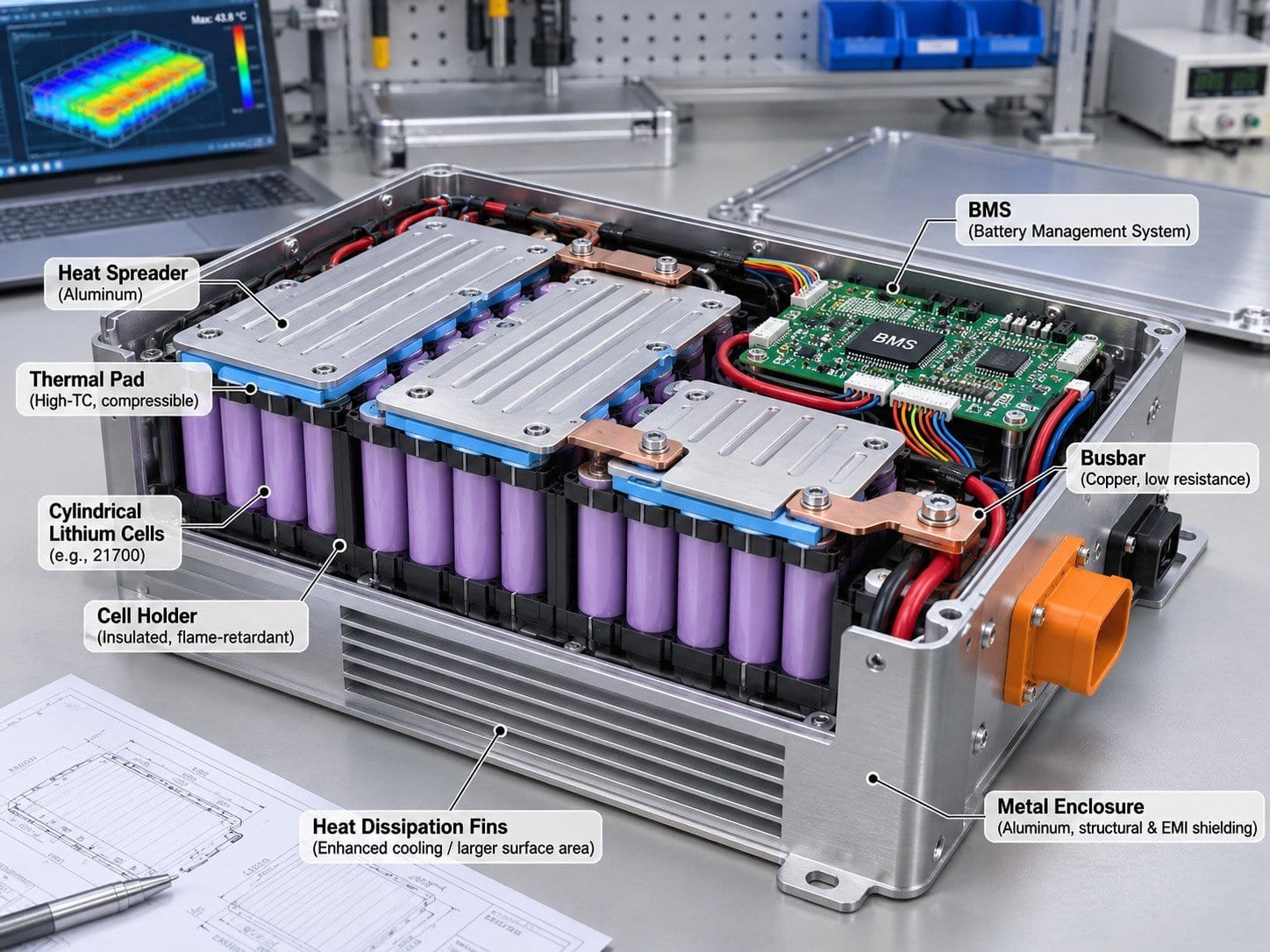
Part 1. Why Thermal Management Matters in Lithium Battery Packs
Lithium battery cells generate heat during charging and discharging. The amount of heat depends on several factors, including current, internal resistance, cell chemistry, operating temperature, and battery condition.
When battery temperature exceeds the operating limits specified by the cell manufacturer, several issues may occur:
- Capacity degradation: Elevated temperatures can accelerate chemical aging and reduce available battery capacity over time.
- Cycle life changes: Prolonged exposure to elevated temperatures can affect battery cycle life.
- Charging limitations: Battery charging must follow the cell manufacturer’s temperature requirements.
- Performance changes: Temperature affects internal resistance, voltage behavior, and available power.
- Thermal safety risks: Abnormal heating or uncontrolled temperature increases may lead to thermal runaway under certain conditions.
For custom battery packs, thermal management should address both normal operating temperatures and abnormal operating conditions.
The design should consider the heat generated by individual cells, electrical connections, BMS components, and other internal components.
Part 2. What Causes Heat Generation in Lithium Battery Packs?
Understanding heat generation helps engineers define thermal management requirements.
Résistance interne
One source of battery heat is electrical resistance inside the cells and electrical connections.
A simplified calculation of resistive heat generation is:
P = I² × R
Where:
- P = Resistive heat generation (W)
- I = Current (A)
- R = Electrical resistance (Ω)
For example, when a battery pack supplies high discharge current to an electric motor, heat is generated by the cells, busbars, connectors, and electrical connections.
As current increases, resistive heat generation increases according to the square of the current, assuming constant resistance.
Electrochemical Reactions
Battery charging and discharging involve electrochemical reactions that generate or absorb heat.
The amount of heat depends on:
- Chimie des batteries
- État de charge (SOC)
- Courant de charge
- Courant de décharge
- Température de fonctionnement
- Cell design
Heat generation may also vary during different stages of battery operation.
High Discharge Current
Battery packs used in robots, AGVs, electric motorcycles, and industrial equipment may experience continuous current loads and short-duration peak current demands.
For example, an industrial robot may operate at a continuous discharge current of 50A and require a peak current of 120A during acceleration.
The thermal design should evaluate both current conditions and their duration.
Environmental Temperature
Ambient temperature also affects battery pack thermal conditions.
A battery pack installed inside an enclosed machine may experience heat accumulation from both the battery and surrounding electrical equipment.
Outdoor battery packs may also be exposed to direct sunlight and seasonal temperature changes.
Therefore, ambient temperature and installation conditions should be included in the thermal design assessment.
Part 3. Battery Cell Selection and Thermal Characteristics
Battery chemistry and cell specifications influence thermal behavior.
Two commonly used lithium battery chemistries are ternary lithium-ion and LiFePO4.
Ternary Lithium-Ion Batteries
Ternary lithium-ion batteries use cathode materials containing nickel, manganese, and cobalt (NMC).
They are used in applications requiring specific energy density, voltage, and discharge performance.
Thermal design considerations include:
- Cell internal resistance
- Courant de décharge continu
- Courant de décharge maximal
- Courant de charge
- Cell operating temperature
- Cell spacing and heat transfer
- Thermal protection requirements
Typical applications include electric bicycles, electric scooters, electric motorcycles, and mobile robots.
Batteries LiFePO4
LiFePO4 (Lithium Iron Phosphate) batteries are used in industrial equipment, energy storage systems, AGVs, AMRs, and other battery-powered applications.
Thermal design considerations include:
- Cell capacity and configuration
- Résistance interne
- Charging and discharging current
- Température de fonctionnement
- Cell temperature consistency
- Enclosure heat dissipation
Cell chemistry alone does not determine the thermal requirements of a battery pack. The actual cell model, electrical load, installation environment, and manufacturer specifications must also be considered.
Part 4. Battery Cell Arrangement and Heat Dissipation
Battery cell arrangement affects heat distribution inside a battery pack.
When multiple cells are installed in a compact enclosure, heat generated by individual cells can accumulate if the thermal design does not provide an appropriate heat transfer path.
During battery pack design, engineers should evaluate:
Cell Spacing
Cell spacing affects the thermal interaction between adjacent cells and the available space for insulation or thermal materials.
The required spacing depends on cell dimensions, electrical insulation, mechanical structure, and thermal design.
Cell Arrangement
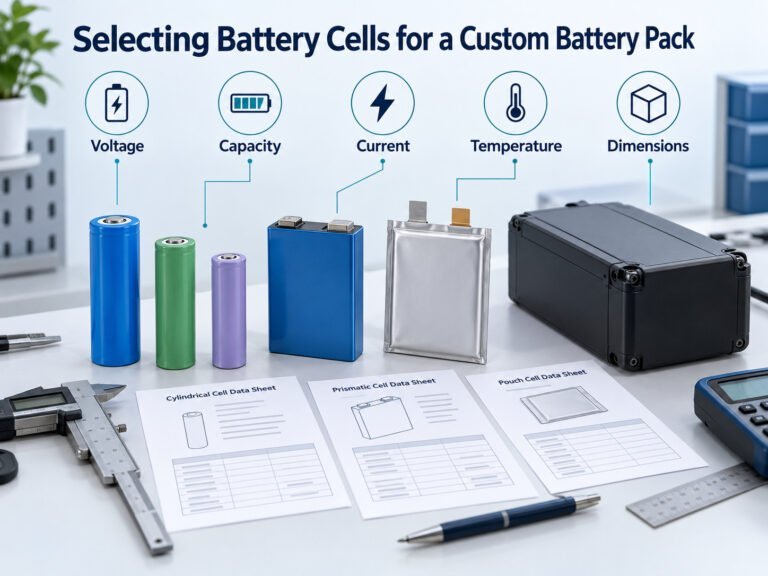
Battery cells may be arranged in cylindrical, prismatic, or pouch configurations.
Each cell format has different mechanical and thermal characteristics.
Par exemple :
- Cylindrical cells are commonly arranged in rows or groups using cell holders.
- Prismatic cells are often arranged in a compact module structure.
- Pouch cells require appropriate compression and mechanical support.
The arrangement should consider heat distribution, electrical connections, insulation, and available installation space.
Thermal Interface Materials
Thermal interface materials can help transfer heat between battery components and designated heat dissipation structures.
Depending on the application, materials may include:
- Coussinets thermiques
- Thermal gap fillers
- Electrically insulating thermal materials
- Heat-conductive interface sheets
Material selection should consider thermal conductivity, electrical insulation, mechanical compatibility, aging characteristics, and the cell manufacturer’s requirements.
Thermal materials should not be used without evaluating their effects on electrical insulation and battery mechanical structure.
Part 5. Passive and Active Battery Cooling Methods
Thermal management methods can be divided into passive and active systems.
The selection depends on battery power, installation conditions, enclosure design, and thermal requirements.
Passive Cooling
Passive cooling relies on natural heat transfer without powered cooling equipment.
Common methods include:
Natural Convection
Heat transfers from the battery enclosure to the surrounding air through natural airflow.
The enclosure design and installation orientation influence heat dissipation.
Thermal Conduction
Heat transfers through materials from battery cells or electrical components to the enclosure or designated heat dissipation structure.
Aluminum housings and thermal interface materials may be used as part of this design.
Heat Dissipation Structures
Metal housings, heat spreaders, and heat sinks can provide heat transfer paths for battery components.
Passive cooling may be considered for battery packs with thermal loads that can be managed through the enclosure and surrounding environment.
Active Cooling
Active cooling uses powered components to control battery temperature.
Common methods include:
Forced-Air Cooling
Fans move air through designated cooling paths to remove heat from the battery enclosure.
This approach requires consideration of airflow distribution, dust protection, moisture exposure, and fan reliability.
Liquid Cooling
Liquid cooling systems circulate coolant through cooling plates or channels to transfer heat away from designated battery components.
They may be considered for battery systems with specific thermal management requirements.
The design involves cooling plates, coolant channels, pumps, tubing, sealing structures, and monitoring functions.
Thermoelectric Cooling
Thermoelectric devices use electrical energy to transfer heat between surfaces.
Their application requires evaluation of power consumption, heat transfer capacity, and system integration.
Active cooling is not necessary for every custom battery pack. The cooling method should be selected according to the actual thermal load and application requirements.
Part 6. BMS Temperature Monitoring and Protection
The Battery Management System (BMS) plays an important role in battery temperature monitoring and protection.
Temperature sensors, commonly NTC thermistors, can be installed at designated positions within the battery pack.
The BMS monitors temperature data and applies protection functions according to its hardware and software configuration.
Common BMS temperature-related functions include:
- Cell temperature monitoring
- Charging over-temperature protection
- Discharging over-temperature protection
- Low-temperature charging protection
- Temperature fault reporting
- Temperature-based current limitation, where supported
NTC Sensor Placement
NTC sensors should be positioned according to the battery pack’s thermal design.
Possible monitoring locations include:
- Between selected battery cells
- Near cell groups
- Close to high-current electrical connections
- Near BMS power components
- At designated enclosure locations
Sensor quantity and placement depend on the battery configuration, expected heat distribution, and monitoring requirements.
A single temperature sensor may not represent the temperature of every cell in a large battery pack.
CAN Communication and Temperature Data
For AGV, AMR, and industrial robot battery applications, customers may require CAN communication.
A customized BMS can transmit battery information such as:
- Tension de la batterie
- Charging and discharging current
- SOC
- Température de la batterie
- Informations sur les pannes
- Operating status
The receiving equipment controller can use this information for battery status monitoring and system-level control.
The actual communication functions depend on the BMS hardware, firmware, and agreed communication protocol.
Part 7. Thermal Management and Battery Enclosure Design
The battery enclosure affects heat transfer and thermal protection.
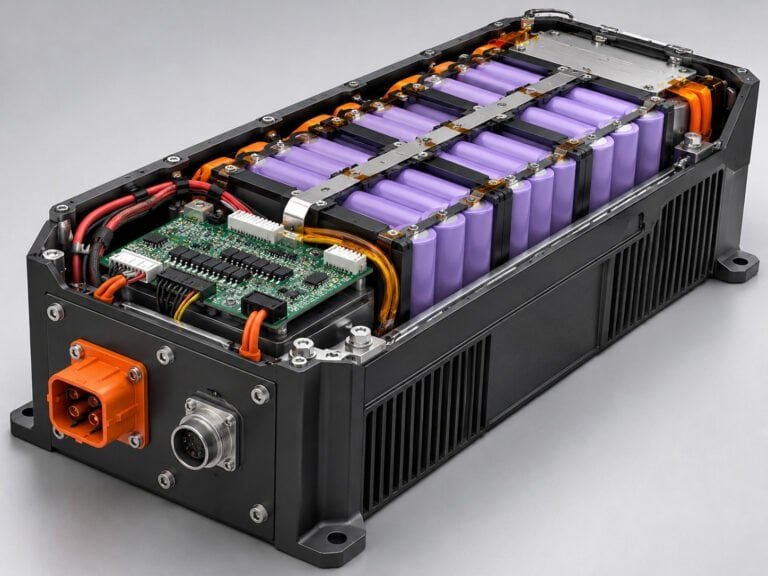
Custom battery packs may use plastic housings, aluminum enclosures, or application-specific mechanical structures.
During enclosure design, engineers should consider:
Enclosure Material
Aluminum can provide a heat transfer path from internal components to the enclosure surface.
Plastic housings have different thermal conductivity characteristics and may require other heat management arrangements.
The material should be selected according to electrical insulation, mechanical strength, environmental exposure, and thermal requirements.
Enclosure Ventilation
For battery packs using forced-air cooling, the enclosure may require designated air inlet and outlet structures.
Ventilation openings must be evaluated together with dust protection, water protection, and applicable IP requirements.
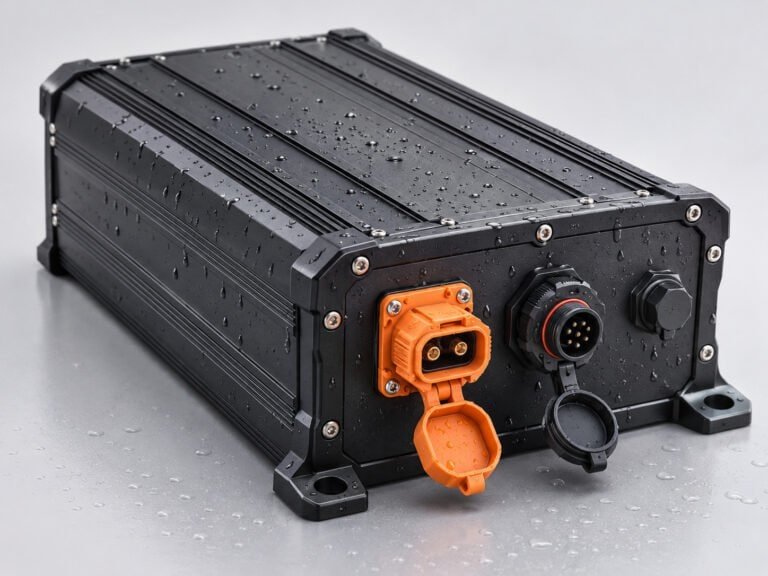
Waterproof and Thermal Design
Sealed battery packs require attention to internal heat accumulation because air exchange with the surrounding environment is restricted.
For waterproof battery designs, engineers should evaluate the relationship between enclosure sealing, heat transfer, connector protection, and operating current.
The selected IP rating should be verified through testing of the final assembled battery pack.
Installation Space
The battery installation location also influences thermal conditions.
For example, a battery installed inside a compact robot chassis may experience heat from motors, controllers, and other electronic components.
Thermal evaluation should include the surrounding equipment and actual installation environment.
Part 8. Thermal Runaway Prevention and Battery Safety
Thermal runaway is an uncontrolled increase in battery temperature caused by internal reactions that generate additional heat.
It can occur under abnormal conditions such as internal short circuits, severe overcharging, mechanical damage, or excessive external heating.
Thermal runaway may result in gas release, smoke, fire, and propagation to adjacent cells.
Battery pack design should address thermal safety through multiple engineering measures.
Cell Selection
Battery cells should be selected according to the required electrical performance, application conditions, and manufacturer specifications.
Electrical Protection
The BMS and other protection components should be configured according to the battery design.
Protection functions may include overcharge, over-discharge, overcurrent, short-circuit, and temperature protection.
Electrical Insulation
Insulation materials and structural design should help prevent unintended electrical contact between cells, busbars, and conductive enclosure components.
Mechanical Protection
The battery enclosure should provide mechanical support and protection according to the application’s installation conditions.
Thermal Propagation Evaluation
For battery systems with specific safety requirements, thermal propagation and abnormal-condition testing may be required.
The testing scope should be determined according to the applicable product standards and project requirements.
BMS protection alone cannot guarantee prevention of thermal runaway. Battery safety requires consideration of cell design, electrical protection, mechanical structure, thermal management, and manufacturing quality.
Part 9. Thermal Management Considerations for Different Applications
Different applications have different thermal management requirements.
| Application | Thermal Design Considerations |
|---|---|
| Electric Bicycle | Motor current, enclosure space, outdoor temperature, charging conditions |
| Scooter électrique | Discharge current, compact enclosure, airflow, ambient temperature |
| AGV | Continuous operation, acceleration current, charging cycles, installation space |
| AMR | Operating duty cycle, current peaks, internal equipment heat |
| Service Robot | Outdoor temperature, charging conditions, enclosure design |
| Industrial Forklift | High-current discharge, operating cycles, charging requirements |
| Floor-Cleaning Machine | Continuous motor load, enclosure ventilation, charging conditions |
| Energy Storage System | Cell temperature monitoring, module arrangement, thermal management system |
E-bike Battery Packs
Electric bicycle battery packs are often installed in bottle housings, down-tube enclosures, or rear-rack structures.
Thermal management should consider motor power, continuous discharge current, battery dimensions, enclosure materials, and outdoor operating conditions.
AGV and AMR Battery Packs
AGVs and AMRs may operate for extended periods in warehouses and factories.
Their battery packs may experience repeated acceleration, deceleration, charging, and discharging cycles.
Thermal evaluation should include the continuous current, peak current duration, operating schedule, and charging conditions.
Service Robot Battery Packs
Service robots may operate in indoor or outdoor environments.
Battery design should consider equipment power consumption, operating duration, enclosure dimensions, ambient temperature, and charging arrangements.
Industrial Battery Packs
Industrial battery applications may involve continuous power demand and high-current operation.
The thermal design should consider the electrical load, equipment duty cycle, installation environment, and heat generated by surrounding components.
Part 10. Thermal Testing and Validation for Custom Battery Packs
Thermal testing helps evaluate battery pack performance under specified operating conditions.
Depending on the application, testing may include:
Temperature Rise Testing
Measures battery temperature during specified charging and discharging conditions.
Testing can include cell surfaces, electrical connections, BMS components, and enclosure surfaces.
High-Temperature Operation Testing
Evaluates battery operation under specified elevated ambient temperature conditions.
Low-Temperature Operation Testing
Evaluates battery discharge performance and charging restrictions under specified low-temperature conditions.
Continuous Discharge Testing
Evaluates temperature changes during continuous discharge at the specified current.
Peak Current Testing
Evaluates the thermal response during short-duration peak current discharge.
Thermal Cycling Testing
Evaluates the battery pack’s response to repeated temperature changes according to the specified test procedure.
BMS Temperature Protection Testing
Verifies temperature sensor readings, protection thresholds, and BMS responses according to the approved design specifications.
Test conditions should be based on the battery cell datasheet, battery pack configuration, application requirements, and applicable standards.
Part 11. Information Required for Custom Battery Pack Thermal Design
Before developing a custom lithium battery pack, OEM customers should provide the following information:
1. Battery Specifications
Nominal voltage, capacity, cell chemistry, and required energy.
2. Courant de décharge continu
The current required during normal equipment operation.
3. Peak Discharge Current
Peak current value and duration during acceleration or other high-power operating conditions.
4. Charging Requirements
Charging voltage, charging current, charging time, and charging temperature.
5. Operating Temperature
Minimum and maximum ambient temperatures during battery operation.
6. Installation Conditions
Battery dimensions, mounting position, available ventilation, and surrounding heat sources.
7. BMS Requirements
Temperature sensor quantity, CAN communication, temperature reporting, and protection functions.
8. Cooling Requirements
Whether passive cooling, forced-air cooling, liquid cooling, or another thermal management method is required.
9. Testing Requirements
Temperature rise limits, operating temperature conditions, and applicable product standards.
These details help engineers evaluate cell selection, electrical configuration, enclosure design, BMS functions, and thermal management requirements.
Part 12. Custom Lithium Battery Pack Manufacturing at Dongguan Yizhan Electronics Technology Co., Ltd.
Dongguan Yizhan Electronics Technology Co. Ltd., operating under the Première puissance brand, provides OEM and ODM custom lithium battery pack development and manufacturing services.
Our battery pack business covers electric mobility, robotics, industrial equipment, and energy storage applications.
Our customization scope includes:
- Ternary lithium-ion and LiFePO4 battery pack configurations
- Customized voltage and capacity
- Sélection des cellules de batterie
- BMS hardware and software customization
- CAN, UART, and RS485 communication
- NTC temperature monitoring
- Plastic and aluminum battery enclosures
- Customized wiring and connectors
- Battery pack assembly and testing
- Technical documentation and certification project support
For each project, battery specifications, operating conditions, electrical load, installation dimensions, and environmental requirements are evaluated as part of the development process.
The thermal management approach is determined according to the confirmed project requirements and selected battery configuration.
Conclusion
Thermal management is an important engineering consideration in lithium battery pack design.
Heat generation, battery cell selection, cell arrangement, enclosure materials, BMS temperature monitoring, cooling methods, and operating conditions all influence the thermal design of a battery pack.
For OEM and ODM projects, thermal requirements should be defined during the initial development stage rather than treated as an additional consideration after battery assembly.
Whether you are developing an electric bicycle battery, AGV battery module, AMR battery system, service robot battery, or industrial energy storage system, thermal management should be evaluated according to the actual application and electrical requirements.
Looking for a custom lithium battery pack for your equipment?
Contact Dongguan Yizhan Electronics Technology Co., Ltd. (First Power) with your battery voltage, capacity, discharge current, operating temperature, installation dimensions, and BMS requirements.
Our team can review your project specifications and discuss a battery pack design based on your application requirements.
 English
 Chinese
 Japanese
 German
 French
 Korean

