
As demand for lithium batteries continues to grow across e-bikes, AGVs, forklifts, energy storage systems, robots, and industrial equipment, manufacturing a lithium battery pack has become far more than simply connecting battery cells. It is a comprehensive process involving precision manufacturing, automated assembly, intelligent quality control, and full traceability.
For OEM customers, the quality of a battery pack depends not only on the cells used but also on the consistency of the manufacturing process, production technology, and inspection standards.
This article walks you through the complete manufacturing process of a high-quality lithium battery pack, from individual battery cells to a fully tested finished product.
Stage 1: Cell Sorting
Why Is Cell Sorting Important?
Even cells from the same production batch have slight differences in voltage, internal resistance, and capacity. Assembling unmatched cells can lead to:
- Capacity imbalance
- Higher internal resistance variation
- Increased voltage deviation
- Kürzere Lebensdauer
- Frequent BMS balancing
- Premature battery pack failure
To ensure consistency, premium battery manufacturers perform automated cell sorting before assembly.
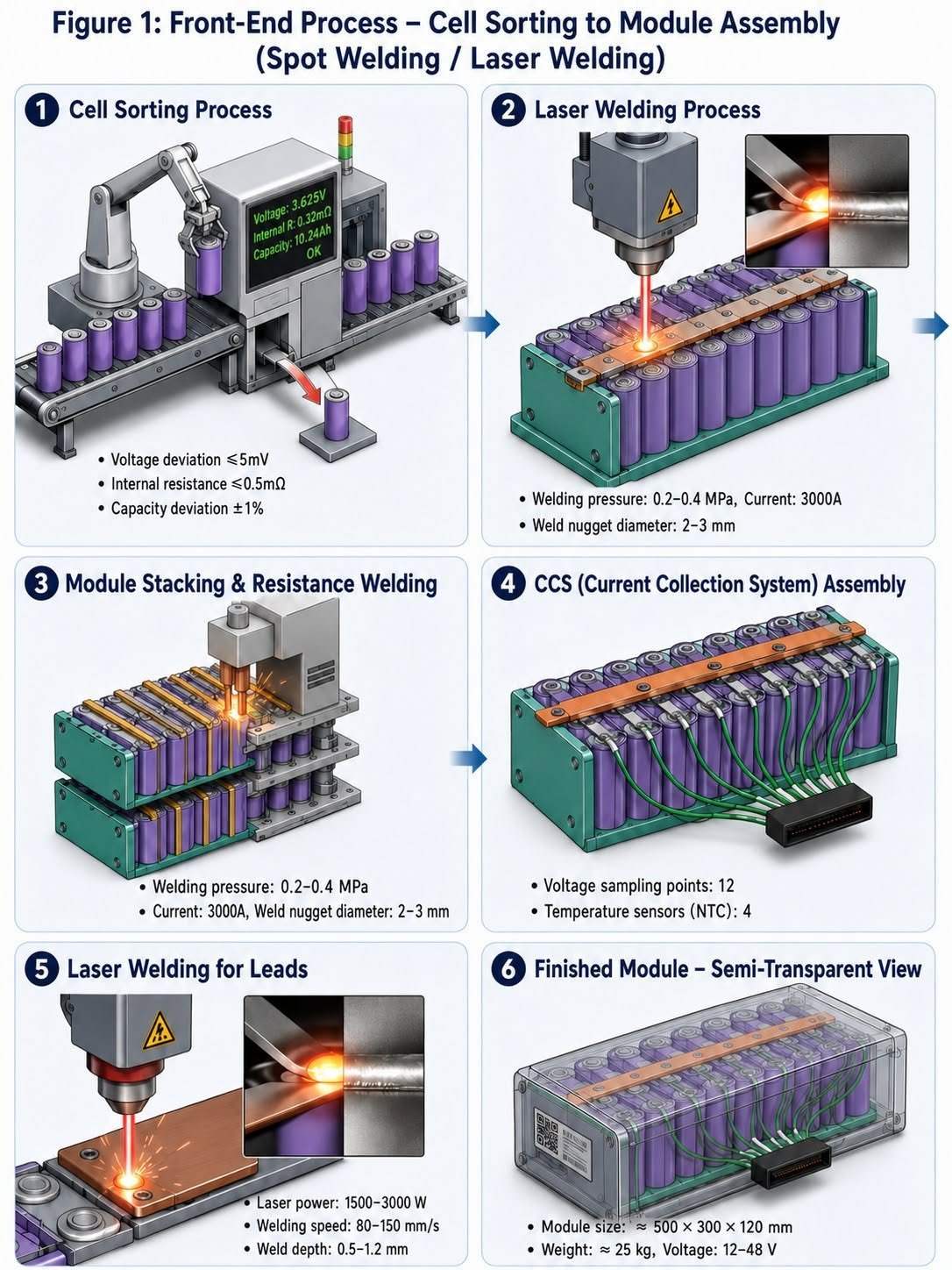
Cell Sorting Parameters
Each battery cell is automatically tested for:
- Spannung
- Innenwiderstand
- Kapazität
Typical sorting standards include:
- Voltage deviation ≤ 5 mV
- Internal resistance deviation ≤ 0.5 mΩ
- Capacity deviation ±1%
Only qualified cells proceed to the next production stage.
Vorteile:
- Improved cell consistency
- Längere Lebensdauer des Zyklus
- Geringere Wärmeentwicklung
- Higher battery reliability
Stage 2: Laser Welding
After sorting, qualified cells are connected together.
Most premium battery packs use laser welding instead of traditional spot welding because it offers:
- Stronger weld joints
- Smaller heat-affected zones
- Higher automation
- Better welding consistency
Typical welding parameters include:
- Welding pressure: 0.2–0.4 MPa
- Welding current: Approximately 3000 A
- Weld nugget diameter: 2–3 mm
Laser welding significantly reduces the risk of weak or missing welds while improving overall pack reliability.
Stage 3: Module Stacking and Module Welding
Individual cell groups are assembled into battery modules.
This process includes:
- Module positioning
- Compression
- Module connection
- Busbar welding
Key quality controls include:
- Module flatness
- Module spacing
- Compression force
- Welding accuracy
A robust module structure improves vibration resistance and long-term durability.
Stage 4: CCS (Current Collection System) Assembly
The Current Collection System (CCS) monitors voltage and temperature throughout the battery pack.
The CCS typically includes:
- Voltage sensing wires
- NTC temperature sensors
- Signal connectors
- Flexible circuit boards
Zum Beispiel:
- 12 voltage sampling points
- 4 NTC temperature sensors
These signals are transmitted to the Battery Management System (BMS) for:
- Zellausgleich
- Überwachung der Temperatur
- Over-voltage protection
- Under-voltage protection
Accurate CCS installation is critical for precise BMS performance.
Stage 5: Laser Welding of Battery Terminals
The positive and negative terminals are then welded using high-power laser equipment.
Typical parameters include:
- Laser power: 1500–3000 W
- Welding speed: 80–150 mm/s
- Weld penetration: 0.5–1.2 mm
High-quality terminal welding minimizes electrical resistance and improves high-current discharge capability.
Stage 6: Battery Module Completion
After all electrical connections are completed, the battery module is assembled.
The process includes:
- Einbau des Gehäuses
- Module fixation
- Connector installation
- Structural fastening
This stage determines the mechanical strength and structural integrity of the battery module.
Stage 7: Battery Pack Assembly
Multiple battery modules are installed inside the battery enclosure.
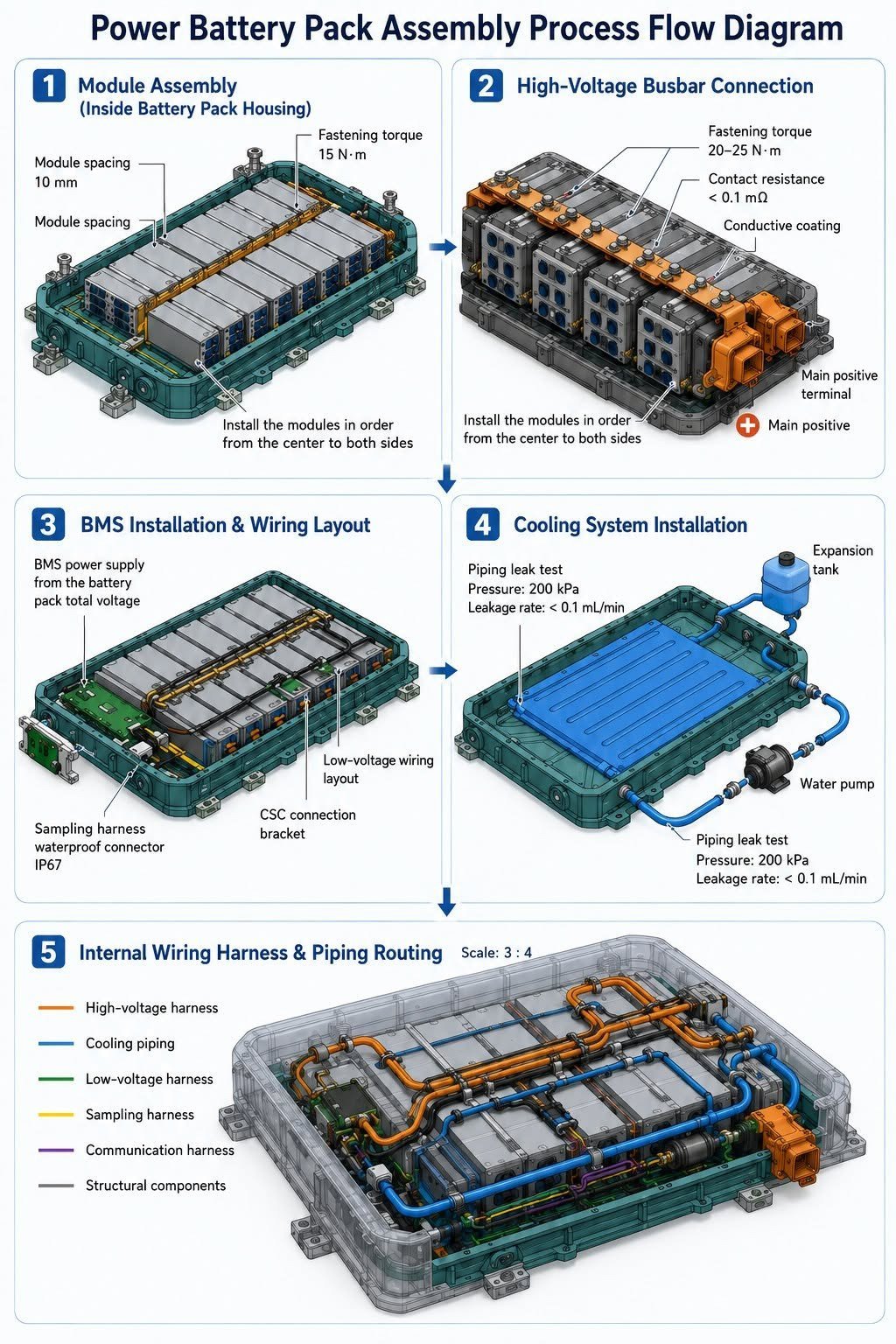
To minimize mechanical stress, modules are generally installed from the center outward.
Typical assembly specifications include:
- Module spacing: Approximately 10 mm
- Fastening torque: Approximately 15 N·m
Proper assembly ensures the battery pack remains secure during transportation and operation.
Stage 8: High-Voltage Busbar Installation
High-voltage busbars connect the battery modules electrically.
Critical assembly requirements include:
- Copper busbar installation
- Contact surface treatment
- Conductive coating
- Torque-controlled fastening
Typical specifications include:
- Tightening torque: 20–25 N·m
- Contact resistance: <0.1 mΩ
Low contact resistance reduces heat generation, improves efficiency, and extends battery life.
Stage 9: BMS Installation and Wiring
The Battery Management System (BMS) serves as the brain of the battery pack.
This stage includes:
- BMS-Installation
- Voltage sensing harness connection
- Communication cable installation
- CAN/RS485 interface integration
- Waterproof connector installation
Proper cable routing helps:
- Reduce electromagnetic interference (EMI)
- Simplify maintenance
- Improve long-term reliability
Stage 10: Cooling System Installation (For Liquid-Cooled Battery Packs)
Large battery packs used in energy storage systems and electric vehicles often require liquid cooling.
The cooling system typically consists of:
- Cooling plates
- Water pump
- Coolant piping
- Expansion tank
After installation, the cooling circuit undergoes leak testing.
Typical test conditions include:
- Test pressure: 200 kPa
- Leakage rate: <0.1 mL/min
This ensures reliable thermal management throughout the battery’s service life.
Stage 11: Internal Harness Routing
Inside the battery pack, engineers organize:
- High-voltage cables
- Low-voltage cables
- Communication harnesses
- Voltage sensing wires
- Cooling pipelines
All wiring is carefully secured, insulated, and protected against vibration and abrasion.
A well-organized internal layout enhances safety, reliability, and serviceability.
Stage 12: Battery Pack Sealing
The battery enclosure is sealed by installing:
- Upper cover
- Rubber gasket
- Waterproof sealant
- Fastening bolts
Automated screw tightening and precision sealant dispensing ensure uniform sealing performance.
Stage 13: Helium Leak Testing
Once sealed, the battery pack undergoes a helium leak test.
The purpose is to verify:
- Airtightness
- Waterproof capability
- IP protection performance
Typical testing conditions include:
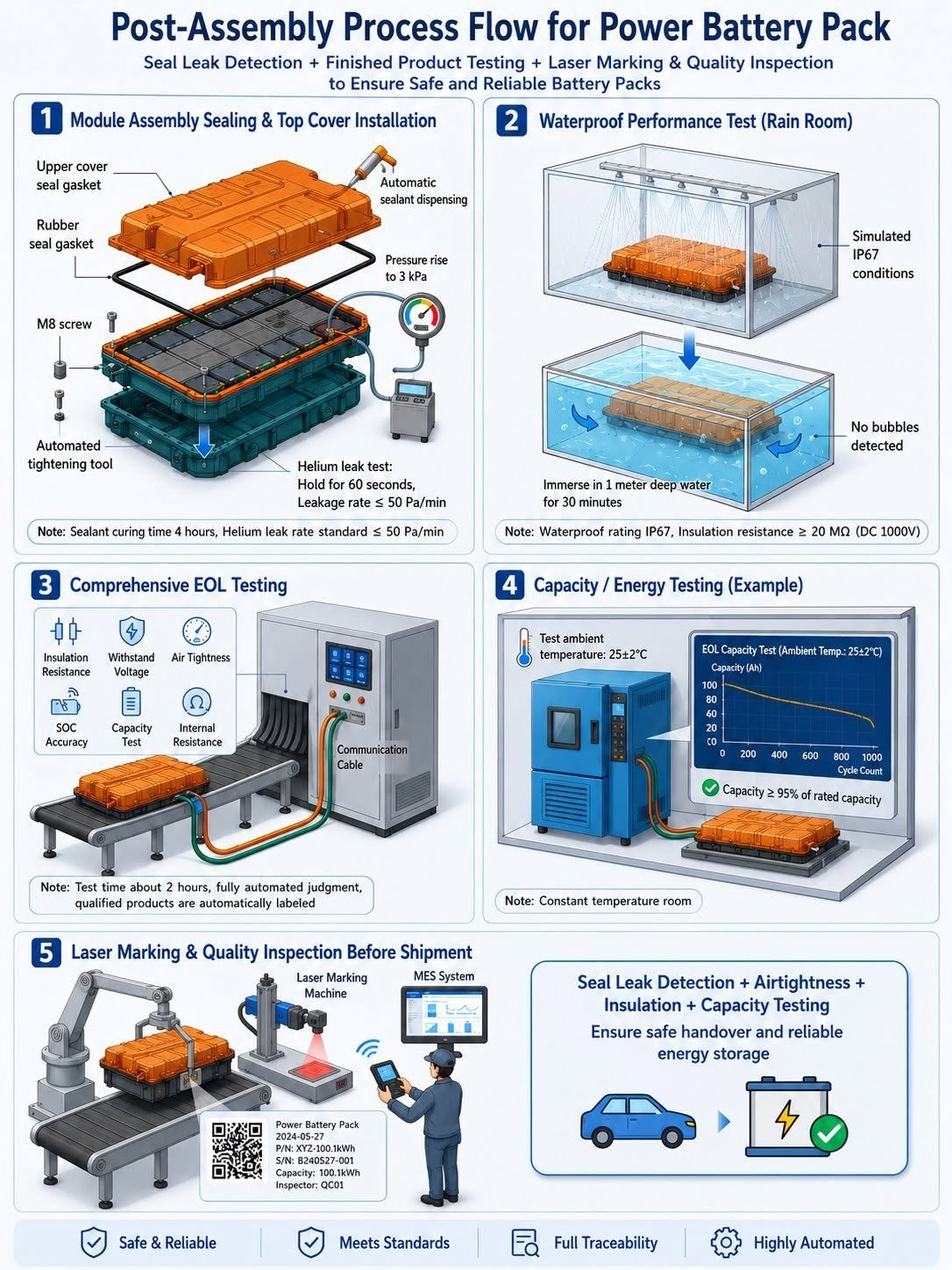
- Pressure holding time: 60 seconds
- Leakage rate: ≤50 Pa/min
Helium leak testing is widely used for EV and energy storage battery packs to ensure long-term sealing reliability.
Stage 14: Waterproof Testing (IP67/IP68)
The completed battery pack then undergoes waterproof validation.
Zu den gängigen Tests gehören:
- Rain simulation
- Water immersion testing
Typical IP67 testing conditions:
- Water depth: 1 meter
- Immersion time: 30 minutes
Inspection items include:
- Water ingress
- Insulation resistance
- Bubble detection
Only battery packs meeting IP67 or IP68 standards proceed to the next stage.
Stage 15: End-of-Line (EOL) Testing
End-of-Line (EOL) testing is one of the most critical quality control procedures.
Comprehensive tests include:
- Insulation resistance
- Withstand voltage
- Airtightness
- Überprüfung der Kapazität
- Innerer Widerstand
- State of Charge (SOC) calibration
- Kommunikationstests
- BMS functional verification
Fully automated EOL systems ensure every battery pack meets design specifications before shipment.
Stage 16: Capacity and Performance Testing
Battery packs are tested inside a constant-temperature chamber under standardized charging and discharging conditions.
Typical testing conditions:
- Ambient temperature: 25 ± 2°C
- Standard charge/discharge rate
Performance verification includes:
- Actual capacity
- Energy output
- Discharge curve
- Leistungskonstanz
Most manufacturers require the measured capacity to reach at least 95% of the rated capacity before approval.
Stage 17: Laser Marking and Final Quality Inspection
The final production stage includes:
- Laser marking
- Serial number generation
- QR code labeling
- MES system registration
This enables complete product traceability, including:
- Raw material tracking
- Manufacturing records
- Test data
- After-sales service history
After a final appearance inspection, the battery pack is ready for packaging and shipment.
Why Is a Standardized Manufacturing Process So Important?
A high-quality lithium battery pack is not defined solely by premium battery cells. It is the result of precision engineering, automated manufacturing, and rigorous quality control throughout every production stage.
From cell sorting and laser welding to BMS integration, waterproof sealing, End-of-Line testing, and full traceability, each manufacturing step directly impacts the battery pack’s safety, reliability, performance, and service life.
For OEMs, selecting a battery manufacturer with standardized production processes, advanced automation, and comprehensive quality inspection systems helps reduce failure rates, improve product performance, lower warranty costs, and strengthen market competitiveness.
Kontakt
Looking for a reliable Hersteller von kundenspezifischen Lithium-Batteriepacks?
Dongguan Yizhan Electronics Technology Co, Ltd. specializes in OEM & ODM lithium battery solutions for e-bikes, robots, AGVs, forklifts, energy storage systems, industrial equipment, and other electric applications.
Wir bieten:
- Kundenspezifisches Akkupack-Design
- BMS-Entwicklung
- Strukturelle Anpassung
- Unterstützung bei der internationalen Zertifizierung
- Automated manufacturing
- 100% End-of-Line testing
- Global OEM production services
Contact us today to discuss your custom lithium battery project and discover how our engineering team can power your next innovation.
 English
  Chinese
  Japanese
  German
  French
  Korean
