
For decades, lead acid batteries have been widely used in industrial equipment, electric vehicles, backup power systems, and material handling applications. Their low initial cost and mature technology made them a common energy solution.
However, as industries move toward higher efficiency, automation, and sustainable operation, traditional lead acid batteries are facing increasing challenges:
- Short service life
- Long charging time
- 重量级
- Frequent maintenance requirements
- Reduced performance under high-frequency operation
Today, more companies are upgrading from lead acid batteries to LiFePO4 电池(磷酸铁锂电池) to achieve longer operating time, lower maintenance costs, and improved reliability.
From forklifts and warehouse vehicles to AGVs, AMRs, golf carts, marine systems, and renewable energy storage, LiFePO4 battery technology is becoming a preferred replacement solution for industrial applications.
This guide explains why businesses are making the transition, how the upgrade process works, and what factors should be considered before replacing lead acid batteries with lithium battery packs.
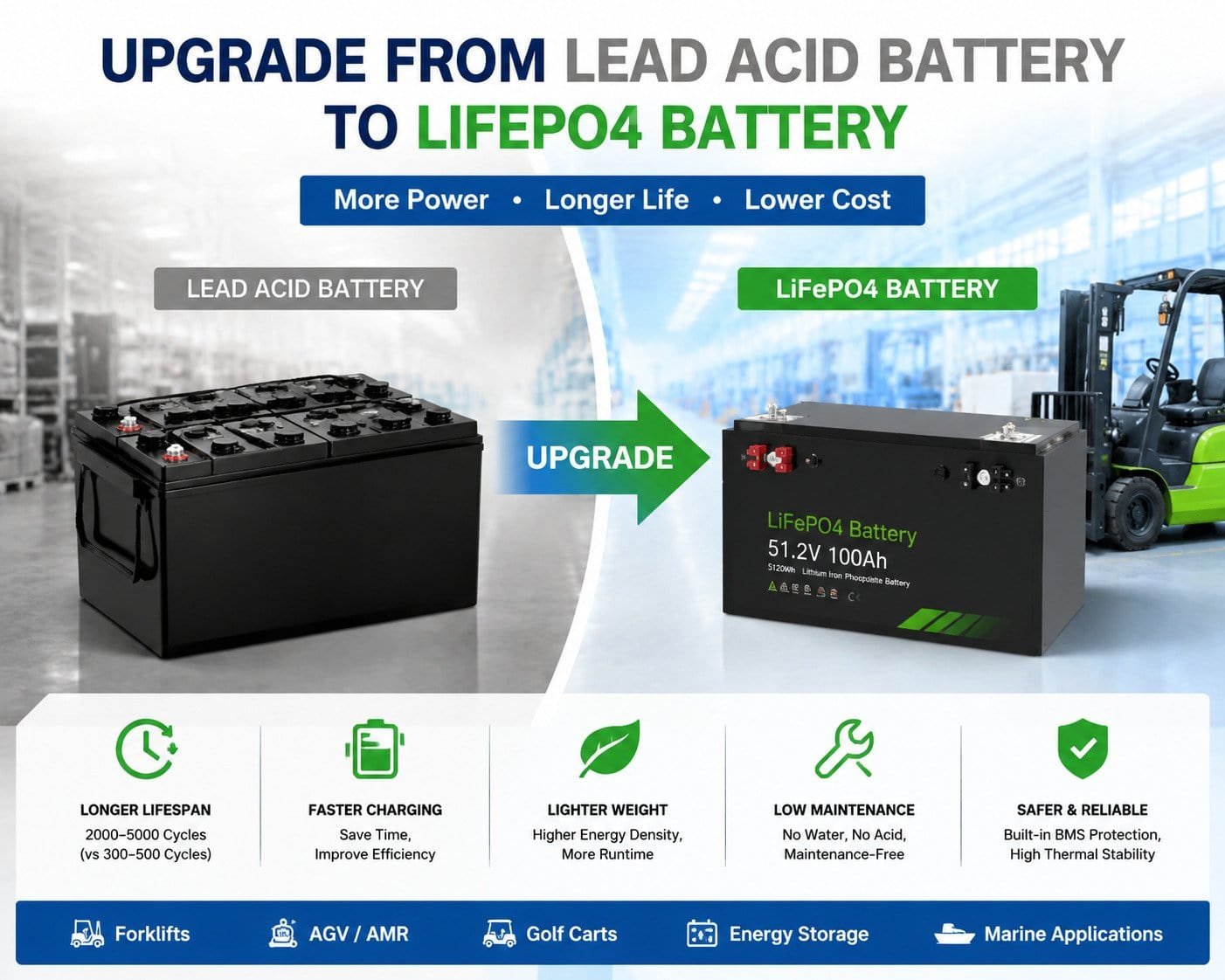
Part 1. Why Upgrade From Lead Acid Battery to LiFePO4 Battery?
The decision to upgrade is not only about replacing one battery chemistry with another. It is about improving the overall performance and operating efficiency of the equipment.
Modern industrial applications require batteries that can provide:
- Longer working hours
- 更快的充电能力
- 稳定的功率输出
- 维护要求较低
- Better safety performance
- Longer lifecycle
LiFePO4 batteries are designed to meet these requirements.
Part 2. Lead Acid Battery vs LiFePO4 Battery: Key Differences
Battery Lifespan
One of the biggest limitations of lead acid batteries is their relatively short cycle life.
Typical cycle performance:
| 电池类型 | 周期寿命 |
|---|---|
| 铅酸蓄电池 | 300-500 cycles |
| Lithium NMC Battery | 1000-2000 cycles |
| 磷酸铁锂电池 | 2000-5000+ cycles |
For equipment operating every day, such as forklifts or warehouse robots, frequent battery replacement can create additional costs and downtime.
A LiFePO4 battery pack can significantly reduce replacement frequency and improve long-term investment value.
Part 3. Higher Usable Capacity and Energy Efficiency
A battery’s rated capacity does not always represent its actual usable energy.
Lead acid batteries typically have:
- Limited depth of discharge
- Voltage drop during operation
- Reduced capacity at high loads
LiFePO4 batteries provide:
- Higher usable capacity
- Stable discharge voltage
- Better energy efficiency
例如
A 48V 100Ah lead acid battery system may not deliver its full rated capacity during operation.
A 51.2V 100Ah LiFePO4 battery pack can provide more stable power output throughout the discharge cycle.
This means industrial equipment can operate longer with fewer charging interruptions.
Part 4. Faster Charging Improves Productivity
Charging time is a major factor affecting industrial efficiency.
Traditional Lead Acid Battery Charging
Normally requires:
- 8-10 hours charging time
- Cooling period after charging
- Dedicated charging area
LiFePO4 Battery Charging
优势包括
- 充电速度更快
- Higher charging efficiency
- Opportunity charging capability
For warehouse operations, this means equipment can receive short charging periods during breaks and return to operation quickly.
This is especially valuable for:
- 电动叉车
- AGV 机器人
- 清洁机器
- Logistics vehicles
Part 5. Lower Maintenance Requirements
Lead acid batteries require regular maintenance, including:
- Electrolyte checking
- 注水
- 终端清洁
- 防腐蚀
- 通风管理
LiFePO4 batteries are almost maintenance-free.
A professional lithium battery pack integrates:
- 电池管理系统 (BMS)
- 过充电保护
- 过放电保护
- 过温保护
- 短路保护
Smart BMS systems can also support:
- CAN 通信
- RS485通信
- 远程监控
- Battery status tracking
Part 6. Weight Reduction and Equipment Optimization
Battery weight is an important consideration for many applications.
Compared with lead acid batteries, LiFePO4 batteries offer:
- 更高的能量密度
- Lower overall weight
- More flexible installation options
Reducing battery weight can improve:
- Vehicle efficiency
- Operating performance
- 能源消耗
Applications benefiting from lightweight designs include:
- Electric carts
- 机器人
- 医疗设备
- Portable industrial devices
Part 7. Improved Safety With LiFePO4 Chemistry
Safety is one of the main reasons industries choose LiFePO4 technology.
Compared with other lithium chemistries, LiFePO4 provides:
- 卓越的热稳定性
- Strong chemical stability
- 降低热失控风险
A reliable industrial LiFePO4 battery pack normally includes:
- 高品质电池电芯
- 智能 BMS 保护
- 温度监测
- Structural protection design
For industrial environments requiring continuous operation, safety and reliability are critical factors.
Part 8. Industrial Applications for Lead Acid to LiFePO4 Upgrade
8.1 Forklift Lithium Battery Upgrade
Forklifts are one of the most common applications for lithium conversion.
Traditional lead acid forklift batteries often experience:
- Long charging downtime
- Heavy battery replacement operations
- 维护费用
After upgrading to LiFePO4 forklift batteries:
福利包括
✔ Longer operating hours
✔ 充电更快
✔ Reduced maintenance
✔ Improved warehouse efficiency
Lithium forklift batteries are widely used in:
- 仓库
- Manufacturing plants
- Logistics centers
- Distribution facilities
8.2 AGV and AMR Robot Battery Upgrade
Automated guided vehicles require stable and reliable power.
AGV and AMR applications need batteries with:
- High cycle life
- 稳定的电压输出
- Smart communication
- 快充功能
LiFePO4 battery packs can support:
- CAN 通信
- RS485通信
- Customized battery dimensions
This makes them suitable for modern automated factories.
8.3 Golf Cart Battery Replacement
Many golf carts still use multiple lead acid batteries.
Common problems include:
- 重量级
- Limited driving distance
- 频繁更换
A LiFePO4 golf cart battery upgrade provides:
- Longer range
- 充电更快
- 使用寿命更长
- 降低维护成本
8.4 Marine Battery Upgrade
Marine applications require batteries that can handle:
- 湿度
- 振动
- Long operation periods
LiFePO4 marine batteries provide:
- 可靠的功率输出
- 轻质设计
- 使用寿命更长
应用包括
- 电动船
- Fishing boats
- Yacht auxiliary power
- Marine energy storage
8.5 Solar Energy Storage Upgrade
Renewable energy systems require reliable storage solutions.
Compared with lead acid batteries, LiFePO4 batteries offer:
- Higher cycle life
- Better energy efficiency
- Longer service period
They are commonly used in:
- 住宅太阳能储能
- 商用储能
- 离网供电系统
Part 9. How to Upgrade From Lead Acid Battery to LiFePO4 Battery?
Replacing a battery system requires careful evaluation.
Step 1: Check Voltage Compatibility
Common conversions include:
| Lead Acid System | LiFePO4 Replacement |
|---|---|
| 12V | 12.8V |
| 24V | 25.6V |
| 36V | 38.4V |
| 48V | 51.2V |
The system voltage should match the equipment requirements.
Step 2: Calculate Required Capacity
请考虑:
- 工作时间
- Load power
- 工作环境
- 充电频率
A professional battery supplier can help design the correct capacity.
Step 3: Select Proper BMS Configuration
The BMS should match:
- Maximum discharge current
- 充电电流
- 通信要求
- 温度条件
Industrial applications may require customized BMS solutions.
Step 4: Replace the Charger
Lead acid chargers and lithium chargers use different charging profiles.
When upgrading, use:
- LiFePO4 compatible charger
- Correct charging voltage
- Proper charging current
Part 10. Is Upgrading to LiFePO4 Battery Worth It?
Although LiFePO4 batteries have a higher initial purchase cost, the total ownership cost is often lower.
Long-term savings come from:
- 减少更换
- Less maintenance
- 减少停机时间
- Higher productivity
- 降低能耗
For businesses operating equipment daily, lithium conversion can provide significant economic benefits.
Part 11. Choosing the Right LiFePO4 Battery Manufacturer
A reliable battery manufacturer should provide:
Battery Customization
包括
- Voltage design
- 容量定制
- 电池外壳设计
- 连接器定制
- Communication protocol support
质量控制
Important processes include:
- 细胞分选
- 激光焊接
- 老化测试
- 充放电测试
- 安全检查
认证
Industrial lithium battery solutions may require:
- UN38.3
- CE
- IEC 62133
- UL认证
- RoHS
FAQ: Upgrade From Lead Acid Battery to LiFePO4 Battery
Q1: Can I directly replace a lead acid battery with LiFePO4?
In many applications, yes, but compatibility should be checked first. Voltage, charger specifications, BMS configuration, and installation dimensions need to match the equipment requirements.
Q2: How long does a LiFePO4 battery last compared with lead acid?
Lead acid batteries typically last around 300-500 cycles, while LiFePO4 batteries can achieve 2000 cycles or more depending on operating conditions.
Q3: Do LiFePO4 batteries require maintenance?
No. Unlike lead acid batteries, LiFePO4 battery packs do not require electrolyte maintenance or regular water filling.
Q4: Are LiFePO4 batteries safer than lead acid batteries?
LiFePO4 batteries provide excellent thermal and chemical stability. With a professional BMS and proper battery design, they are widely used in demanding industrial applications.
Q5: Which industries benefit most from lithium battery upgrades?
常见的应用包括
- 叉车
- AGV
- AMR
- 高尔夫球车
- 工业车辆
- Marine equipment
- 太阳能储存系统
结论
Upgrading from lead acid batteries to LiFePO4 batteries is becoming an important step for industries seeking higher efficiency, lower operating costs, and improved reliability.
With advantages including longer lifespan, faster charging, lower maintenance, and stable performance, LiFePO4 battery technology provides a practical solution for modern industrial applications.
For companies looking to improve equipment performance and reduce long-term energy costs, a customized LiFePO4 battery pack upgrade can provide a reliable path toward smarter and more efficient operations.
 English
  Chinese
  Japanese
  German
  French
  Korean
