
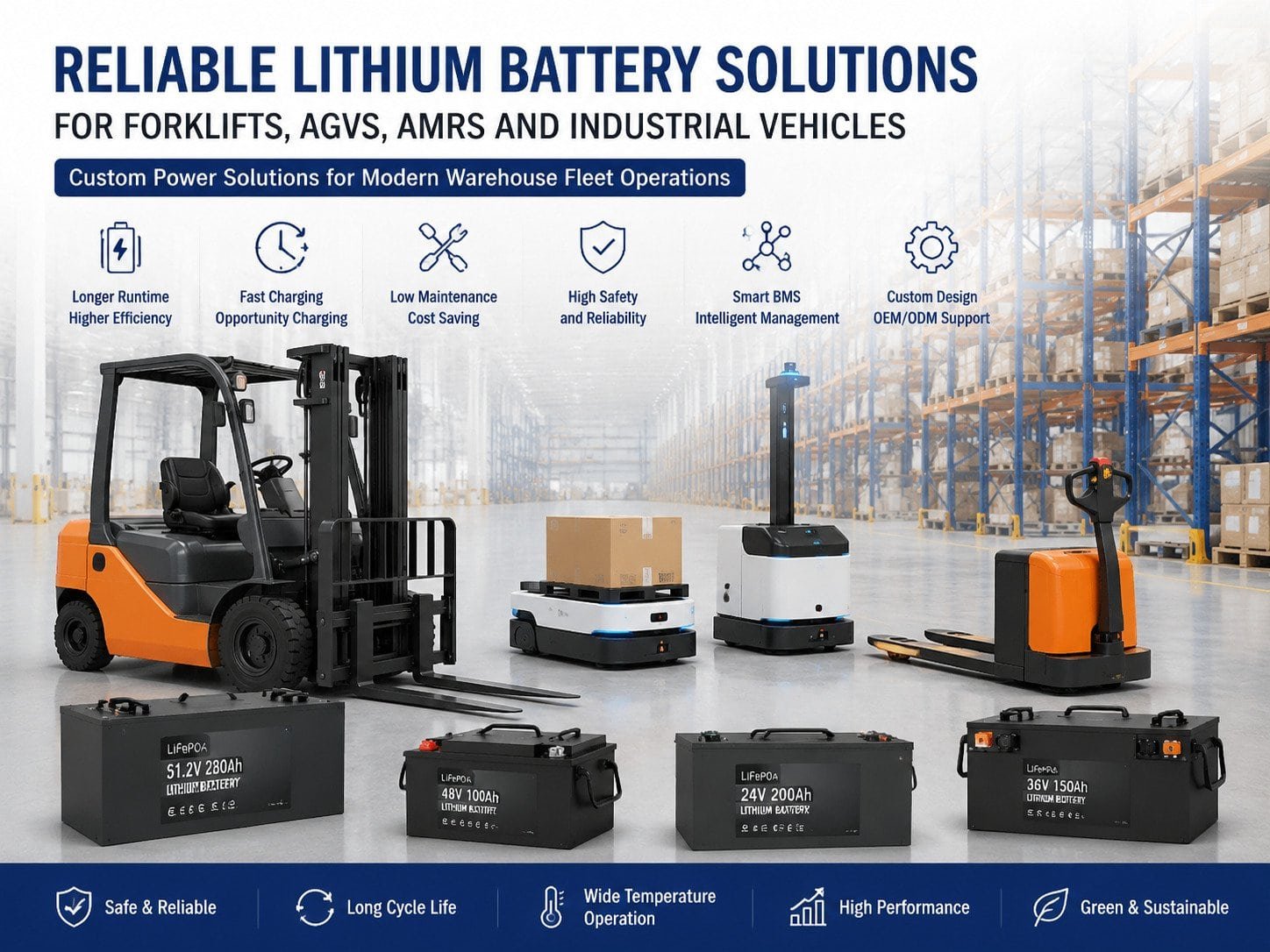
The rapid growth of smart manufacturing, automated warehouses, and intelligent logistics is transforming the way companies manage their industrial vehicle fleets. Forklifts, AGVs (Automated Guided Vehicles), AMRs (Autonomous Mobile Robots), and other warehouse transportation equipment are now required to operate longer, work more efficiently, and minimize downtime.
As traditional lead-acid batteries struggle to meet the demands of modern industrial applications, lithium battery technology has become an increasingly preferred power solution for warehouse fleets. With longer cycle life, faster charging capability, lower maintenance requirements, and flexible customization options, lithium battery packs provide reliable energy support for industrial vehicles.
A professional lithium battery manufacturer can design customized battery solutions based on equipment requirements, including voltage, capacity, battery dimensions, communication protocols, and operating environments.
Whether upgrading existing warehouse equipment or developing new automation systems, customized lithium battery solutions help businesses improve productivity, reduce operating costs, and build more efficient energy management systems.
Part 1.Why Lithium Batteries Are Becoming the Preferred Choice for Warehouse Fleets
Warehouse and logistics operations require continuous equipment availability. Every minute of equipment downtime can impact productivity, delivery schedules, and operational efficiency.
Traditional lead-acid batteries have been widely used in forklifts and industrial vehicles for decades. However, they also bring several challenges:
- Long charging time
- 定期维护要求
- Limited cycle life
- Reduced performance during heavy-duty operation
- 电池更换频率
Lithium battery technology solves many of these challenges by providing more efficient and reliable power.
1. Longer Operating Time for Industrial Vehicles
Lithium batteries offer higher energy density compared with traditional battery technologies. This means more usable energy can be stored within the same physical space.
For warehouse vehicles such as electric forklifts and pallet trucks, longer operating time means:
- 减少电池更换次数
- Reduced charging interruptions
- Higher equipment utilization
- 提高车队效率
For companies operating multiple shifts, battery reliability directly affects overall warehouse productivity.
2. Fast Charging and Opportunity Charging Capability
Modern logistics operations often run continuously, especially in:
- 电子商务配送中心
- 自动化仓库
- 生产设施
- 配送中心
Lithium batteries support flexible charging strategies, including opportunity charging.
Instead of waiting several hours for a complete recharge, operators can recharge batteries during short breaks or shift changes.
福利包括
- 减少停机时间
- Higher equipment availability
- Improved workflow efficiency
- Better fleet management
For automated warehouse systems using AGVs and AMRs, fast and intelligent charging capability is essential for maintaining continuous operation.
3. Lower Maintenance Requirements
Maintenance costs are an important factor when evaluating industrial battery solutions.
Traditional lead-acid batteries require:
- 电解液检查
- Water replenishment
- Cleaning procedures
- 通风管理
Lithium battery packs are designed with a sealed structure and intelligent battery management systems, reducing routine maintenance requirements.
Lower maintenance means:
- Less labor cost
- Fewer service interruptions
- Easier fleet management
Over the entire battery lifecycle, lithium technology can significantly reduce the total cost of ownership (TCO).
Part 2.Customized Lithium Battery Solutions for Forklifts
Electric forklifts are one of the most important applications for industrial lithium batteries.
Different forklift models require different battery specifications depending on:
- 电机功率
- 承载能力
- 工作时间
- Charging environment
- 安装空间
A customized forklift lithium battery solution can include:
Voltage Customization
Common industrial vehicle battery systems include:
- 24V lithium battery packs
- 36V lithium battery packs
- 48V lithium battery packs
- 51.2V LiFePO4 battery systems
- 72V industrial battery solutions
Capacity Optimization
Battery capacity should be designed according to:
- Daily operation time
- Load conditions
- 能源消耗
- 充电频率
Professional battery engineers can calculate the suitable Ah capacity to ensure stable performance.
机械设计
Industrial vehicles often have limited installation space.
Custom battery design allows manufacturers to optimize:
- 电池尺寸
- 住房结构
- 连接器位置
- 安装方法
This ensures perfect compatibility with different forklift models.
Part 3.Lithium Battery Solutions for AGV and AMR Robots
The development of Industry 4.0 has accelerated the adoption of automated guided vehicles and autonomous mobile robots.
AGVs and AMRs are widely used in:
- Smart factories
- 自动化仓库
- 物料搬运系统
- Production lines
- 配送中心
Unlike traditional vehicles, robots require batteries with specific characteristics.
Key Battery Requirements for AGV and AMR Applications
Compact Design
Robotic systems usually have limited internal space. Battery packs must provide high energy output while maintaining compact dimensions.
稳定的功率输出
AGV and AMR systems require stable voltage to ensure:
- Accurate movement
- Reliable navigation
- Consistent operation
智能通信
Modern robotic systems often require communication between the battery and vehicle controller.
Supported communication options may include:
- CAN总线
- RS485
- UART
- Modbus communication
Smart BMS data allows operators to monitor battery status and improve system management.
Part 4.Why LiFePO4 Batteries Are Widely Used in Industrial Vehicles
Among different lithium battery chemistries, Lithium Iron Phosphate (LiFePO4) batteries are commonly selected for industrial applications.
卓越的安全性能
LiFePO4 化学体系具有出色的热稳定性,适用于要求严苛的工业环境。.
Safety advantages include:
- 稳定的化学结构
- Lower thermal risk
- Reliable long-term operation
长使用寿命
Warehouse vehicles typically experience frequent charging and discharging.
A long cycle life battery helps:
- Extend service intervals
- Reduce replacement costs
- Improve investment return
稳定的性能
Industrial equipment requires consistent energy output.
LiFePO4 batteries provide stable performance under various operating conditions, making them suitable for:
- 叉车
- AGV
- AMR
- 清洁机器
- Industrial carts
Part 5.Smart BMS Technology for Industrial Lithium Batteries
The Battery Management System (BMS) is a critical component of modern lithium battery packs.
A smart BMS continuously monitors battery conditions and protects the system.
Important monitoring functions include:
电压监控
Ensures each cell operates within safe voltage limits.
温度监控
Prevents overheating and improves battery reliability.
Current Protection
Controls charging and discharging current to protect battery performance.
State Management
Provides information about:
- 充电状态 (SOC)
- 健康状况(SOH)
- 剩余容量
For industrial applications, communication-enabled BMS solutions allow integration with vehicle control systems.
Part 6.Battery Safety Testing and Quality Control
Industrial battery applications require strict quality control because equipment often operates in demanding environments.
A professional lithium battery manufacturer performs comprehensive testing, including:
电气性能测试
- 充放电测试
- 能力测试
- 内部电阻测试
- 周期寿命测试
环境测试
- High temperature testing
- Low temperature testing
- Humidity testing
Mechanical Testing
- 振动测试
- Impact testing
- 防护测试
安全认证
Depending on market requirements, industrial lithium battery packs may require:
- UN38.3
- CE
- IEC 62133
- UL认证
- RoHS compliance
These certifications help ensure batteries meet international transportation and safety requirements.
Part 7.How to Select the Right Lithium Battery Solution for Your Warehouse Fleet
Choosing the correct battery solution requires evaluating several factors.
1. Understand Equipment Requirements
Before selecting a battery, consider:
- Vehicle model
- 电机功率
- Voltage requirement
- Daily working hours
- Load conditions
2. Evaluate Working Environment
Environmental conditions affect battery design.
重要因素包括:
- 室内或室外运行
- 温度范围
- Dust exposure
- Moisture conditions
For harsh environments, additional protection such as IP-rated housing may be required.
3. Consider Future Expansion
For growing warehouse operations, battery solutions should support:
- Fleet expansion
- 智能监控
- 通信一体化
- Energy management systems
A scalable battery design provides long-term value.
Part 8.Professional OEM Lithium Battery Manufacturer for Industrial Applications
Choosing the right battery supplier is as important as selecting the battery technology itself.
An experienced OEM/ODM lithium battery manufacturer can provide complete support from initial concept to mass production.
Professional services include:
Battery Requirement Analysis
Engineers evaluate:
- 应用场景
- 电源要求
- Installation conditions
Custom Battery Design
包括
- 细胞选择
- Electrical design
- 结构设计
- BMS 配置
原型开发
Rapid prototypes allow customers to verify:
- Battery performance
- Installation compatibility
- 通信功能
批量生产
Reliable manufacturing processes ensure:
- Consistent quality
- Stable supply
- 生产可扩展性
Part 9.Future Trends of Lithium Batteries in Warehouse Automation
The future of warehouse operations will continue moving toward automation and electrification.
主要趋势包括
Increased AGV and AMR Adoption
More companies are introducing autonomous robots to improve logistics efficiency.
智能电池管理
Battery systems will become more connected through:
- Cloud monitoring
- 数据分析
- 预测性维护
可持续能源解决方案
Lithium batteries support cleaner industrial operations by improving energy efficiency and reducing battery waste.
As warehouse automation continues to grow, customized lithium battery solutions will play an increasingly important role in industrial power systems.
Conclusion: Powering the Future of Smart Warehouse Operations
Reliable energy is the foundation of efficient warehouse operations.
From electric forklifts to AGVs, AMRs, and industrial vehicles, customized lithium battery solutions provide the performance, flexibility, and reliability required by modern businesses.
By combining advanced lithium battery technology, intelligent BMS systems, and professional OEM manufacturing capabilities, companies can achieve:
- 更长的运行时间
- 充电更快
- 降低维护成本
- 生产效率的提高
- More efficient fleet management
A customized lithium battery solution is not only a power source but also a strategic investment in the future of industrial automation.
常见问题
1. Are lithium batteries suitable for forklifts?
Yes. Lithium batteries are widely used in electric forklifts because they provide longer runtime, faster charging, lower maintenance requirements, and stable performance.
2. Can lithium batteries be customized for AGV and AMR robots?
Yes. Battery voltage, capacity, dimensions, connectors, BMS communication, and protection features can all be customized.
3. What is the best lithium battery chemistry for warehouse vehicles?
LiFePO4 batteries are commonly selected because of their safety, long cycle life, and stable performance.
4. How long do industrial lithium batteries last?
The service life depends on usage conditions, battery design, charging habits, and operating environment.
5. Why choose an OEM lithium battery manufacturer?
An OEM manufacturer can provide customized design, engineering support, testing, certification assistance, and stable production capability.
 English
  Chinese
  Japanese
  German
  French
  Korean
