
For decades, lead acid batteries have been widely used in industrial equipment, electric vehicles, backup power systems, and material handling applications. Their low initial cost and mature technology made them a common energy solution.
However, as industries move toward higher efficiency, automation, and sustainable operation, traditional lead acid batteries are facing increasing challenges:
- Kurze Lebensdauer
- Long charging time
- Schweres Gewicht
- Frequent maintenance requirements
- Reduced performance under high-frequency operation
Today, more companies are upgrading from lead acid batteries to LiFePO4-Batterien (Lithium-Eisenphosphat-Batterien) to achieve longer operating time, lower maintenance costs, and improved reliability.
From forklifts and warehouse vehicles to AGVs, AMRs, golf carts, marine systems, and renewable energy storage, LiFePO4 battery technology is becoming a preferred replacement solution for industrial applications.
This guide explains why businesses are making the transition, how the upgrade process works, and what factors should be considered before replacing lead acid batteries with lithium battery packs.
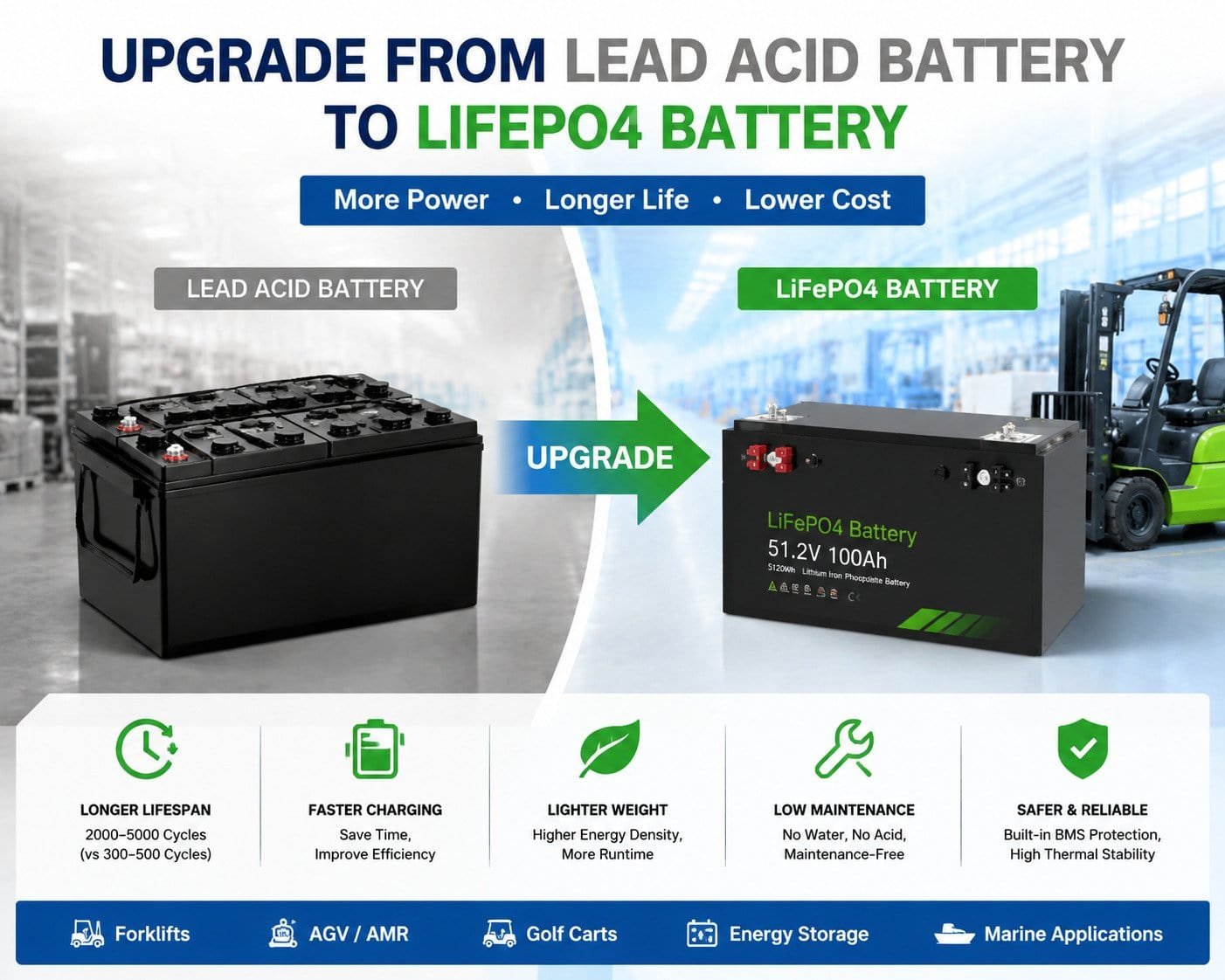
Part 1. Why Upgrade From Lead Acid Battery to LiFePO4 Battery?
The decision to upgrade is not only about replacing one battery chemistry with another. It is about improving the overall performance and operating efficiency of the equipment.
Modern industrial applications require batteries that can provide:
- Longer working hours
- Schnellere Ladefunktion
- Stabile Leistungsabgabe
- Geringerer Wartungsaufwand
- Better safety performance
- Longer lifecycle
LiFePO4 batteries are designed to meet these requirements.
Part 2. Lead Acid Battery vs LiFePO4 Battery: Key Differences
Battery Lifespan
One of the biggest limitations of lead acid batteries is their relatively short cycle life.
Typical cycle performance:
| Akku-Typ | Zyklus Leben |
|---|---|
| Blei-Säure-Batterie | 300-500 cycles |
| Lithium NMC Battery | 1000-2000 cycles |
| LiFePO4-Akku | 2000-5000+ cycles |
For equipment operating every day, such as forklifts or warehouse robots, frequent battery replacement can create additional costs and downtime.
A LiFePO4 battery pack can significantly reduce replacement frequency and improve long-term investment value.
Part 3. Higher Usable Capacity and Energy Efficiency
A battery’s rated capacity does not always represent its actual usable energy.
Lead acid batteries typically have:
- Limited depth of discharge
- Voltage drop during operation
- Reduced capacity at high loads
LiFePO4 batteries provide:
- Higher usable capacity
- Stable discharge voltage
- Better energy efficiency
Zum Beispiel:
A 48V 100Ah lead acid battery system may not deliver its full rated capacity during operation.
A 51.2V 100Ah LiFePO4 battery pack can provide more stable power output throughout the discharge cycle.
This means industrial equipment can operate longer with fewer charging interruptions.
Part 4. Faster Charging Improves Productivity
Charging time is a major factor affecting industrial efficiency.
Traditional Lead Acid Battery Charging
Normally requires:
- 8-10 hours charging time
- Cooling period after charging
- Dedicated charging area
LiFePO4 Battery Charging
Die Vorteile sind:
- Schnellere Ladegeschwindigkeit
- Higher charging efficiency
- Opportunity charging capability
For warehouse operations, this means equipment can receive short charging periods during breaks and return to operation quickly.
This is especially valuable for:
- Elektro-Gabelstapler
- AGV-Roboter
- Reinigungsmaschinen
- Logistics vehicles
Part 5. Lower Maintenance Requirements
Lead acid batteries require regular maintenance, including:
- Electrolyte checking
- Wasserbefüllung
- Reinigung des Terminals
- Corrosion prevention
- Lüftungsmanagement
LiFePO4 batteries are almost maintenance-free.
A professional lithium battery pack integrates:
- Batterie-Management-System (BMS)
- Schutz vor Überladung
- Schutz vor Überentladung
- Schutz vor Überhitzung
- Kurzschlussschutz
Smart BMS systems can also support:
- CAN-Kommunikation
- RS485-Kommunikation
- Fernüberwachung
- Battery status tracking
Part 6. Weight Reduction and Equipment Optimization
Battery weight is an important consideration for many applications.
Compared with lead acid batteries, LiFePO4 batteries offer:
- Höhere Energiedichte
- Lower overall weight
- More flexible installation options
Reducing battery weight can improve:
- Vehicle efficiency
- Geschäftsergebnis
- Energieverbrauch
Applications benefiting from lightweight designs include:
- Electric carts
- Robotik
- Medizinische Ausrüstung
- Portable industrial devices
Part 7. Improved Safety With LiFePO4 Chemistry
Safety is one of the main reasons industries choose LiFePO4 technology.
Compared with other lithium chemistries, LiFePO4 provides:
- Ausgezeichnete thermische Stabilität
- Strong chemical stability
- Geringeres Risiko des thermischen Durchgehens
A reliable industrial LiFePO4 battery pack normally includes:
- Hochwertige Batteriezellen
- Intelligenter BMS-Schutz
- Überwachung der Temperatur
- Structural protection design
For industrial environments requiring continuous operation, safety and reliability are critical factors.
Part 8. Industrial Applications for Lead Acid to LiFePO4 Upgrade
8.1 Forklift Lithium Battery Upgrade
Forklifts are one of the most common applications for lithium conversion.
Traditional lead acid forklift batteries often experience:
- Long charging downtime
- Heavy battery replacement operations
- Instandhaltungskosten
After upgrading to LiFePO4 forklift batteries:
Die Vorteile umfassen:
✔ Longer operating hours
✔ Schnelleres Aufladen
✔ Reduced maintenance
✔ Improved warehouse efficiency
Lithium forklift batteries are widely used in:
- Lagerhallen
- Manufacturing plants
- Logistics centers
- Distribution facilities
8.2 AGV and AMR Robot Battery Upgrade
Automated guided vehicles require stable and reliable power.
AGV and AMR applications need batteries with:
- High cycle life
- Stabiler Spannungsausgang
- Smart communication
- Schnellladefunktion
LiFePO4 battery packs can support:
- CAN-Kommunikation
- RS485-Kommunikation
- Customized battery dimensions
This makes them suitable for modern automated factories.
8.3 Golf Cart Battery Replacement
Many golf carts still use multiple lead acid batteries.
Common problems include:
- Schweres Gewicht
- Limited driving distance
- Häufiger Austausch
A LiFePO4 golf cart battery upgrade provides:
- Longer range
- Schnelleres Laden
- Längere Lebenserwartung
- Geringere Wartung
8.4 Marine Battery Upgrade
Marine applications require batteries that can handle:
- Luftfeuchtigkeit
- Vibration
- Long operation periods
LiFePO4 marine batteries provide:
- Zuverlässige Leistungsabgabe
- Leichte Konstruktion
- Längere Nutzungsdauer
Die Anwendungen umfassen:
- Elektroboote
- Fishing boats
- Yacht auxiliary power
- Marine energy storage
8.5 Solar Energy Storage Upgrade
Renewable energy systems require reliable storage solutions.
Compared with lead acid batteries, LiFePO4 batteries offer:
- Higher cycle life
- Better energy efficiency
- Longer service period
They are commonly used in:
- Solarstromspeicher für Privathaushalte
- Energiespeicherung für gewerbliche Zwecke
- Netzunabhängige Stromversorgungssysteme
Part 9. How to Upgrade From Lead Acid Battery to LiFePO4 Battery?
Replacing a battery system requires careful evaluation.
Step 1: Check Voltage Compatibility
Common conversions include:
| Lead Acid System | LiFePO4 Replacement |
|---|---|
| 12V | 12.8V |
| 24V | 25.6V |
| 36V | 38.4V |
| 48V | 51.2V |
The system voltage should match the equipment requirements.
Step 2: Calculate Required Capacity
Bedenken Sie Folgendes:
- Betriebsstunden
- Load power
- Arbeitsumfeld
- Ladehäufigkeit
A professional battery supplier can help design the correct capacity.
Step 3: Select Proper BMS Configuration
The BMS should match:
- Maximaler Entladestrom
- Ladestrom
- Kommunikationsanforderungen
- Temperaturbedingungen
Industrial applications may require customized BMS solutions.
Step 4: Replace the Charger
Lead acid chargers and lithium chargers use different charging profiles.
When upgrading, use:
- LiFePO4 compatible charger
- Correct charging voltage
- Proper charging current
Part 10. Is Upgrading to LiFePO4 Battery Worth It?
Although LiFePO4 batteries have a higher initial purchase cost, the total ownership cost is often lower.
Long-term savings come from:
- Weniger Ersatzbeschaffungen
- Less maintenance
- Reduzierte Ausfallzeiten
- Higher productivity
- Geringerer Energieverbrauch
For businesses operating equipment daily, lithium conversion can provide significant economic benefits.
Part 11. Choosing the Right LiFePO4 Battery Manufacturer
A reliable battery manufacturer should provide:
Battery Customization
Einschließlich:
- Voltage design
- Anpassung der Kapazität
- Konstruktion eines Batteriegehäuses
- Anpassung von Steckverbindern
- Communication protocol support
Qualitätskontrolle
Important processes include:
- Zellsortierung
- Laserschweißen
- Alterungsprüfung
- Prüfung von Ladung und Entladung
- Sicherheitsüberprüfung
Zertifizierungen
Industrial lithium battery solutions may require:
- UN38.3
- CE
- IEC 62133
- UL-Zertifizierungen
- RoHS
FAQ: Upgrade From Lead Acid Battery to LiFePO4 Battery
Q1: Can I directly replace a lead acid battery with LiFePO4?
In many applications, yes, but compatibility should be checked first. Voltage, charger specifications, BMS configuration, and installation dimensions need to match the equipment requirements.
Q2: How long does a LiFePO4 battery last compared with lead acid?
Lead acid batteries typically last around 300-500 cycles, while LiFePO4 batteries can achieve 2000 cycles or more depending on operating conditions.
Q3: Do LiFePO4 batteries require maintenance?
No. Unlike lead acid batteries, LiFePO4 battery packs do not require electrolyte maintenance or regular water filling.
Q4: Are LiFePO4 batteries safer than lead acid batteries?
LiFePO4 batteries provide excellent thermal and chemical stability. With a professional BMS and proper battery design, they are widely used in demanding industrial applications.
Q5: Which industries benefit most from lithium battery upgrades?
Zu den üblichen Anwendungen gehören:
- Gabelstapler
- AGVs
- AMRs
- Golfwagen
- Nutzfahrzeuge
- Marine equipment
- Solare Speichersysteme
Schlussfolgerung
Upgrading from lead acid batteries to LiFePO4 batteries is becoming an important step for industries seeking higher efficiency, lower operating costs, and improved reliability.
With advantages including longer lifespan, faster charging, lower maintenance, and stable performance, LiFePO4 battery technology provides a practical solution for modern industrial applications.
For companies looking to improve equipment performance and reduce long-term energy costs, a customized LiFePO4 battery pack upgrade can provide a reliable path toward smarter and more efficient operations.
 English
  Chinese
  Japanese
  German
  French
  Korean
