
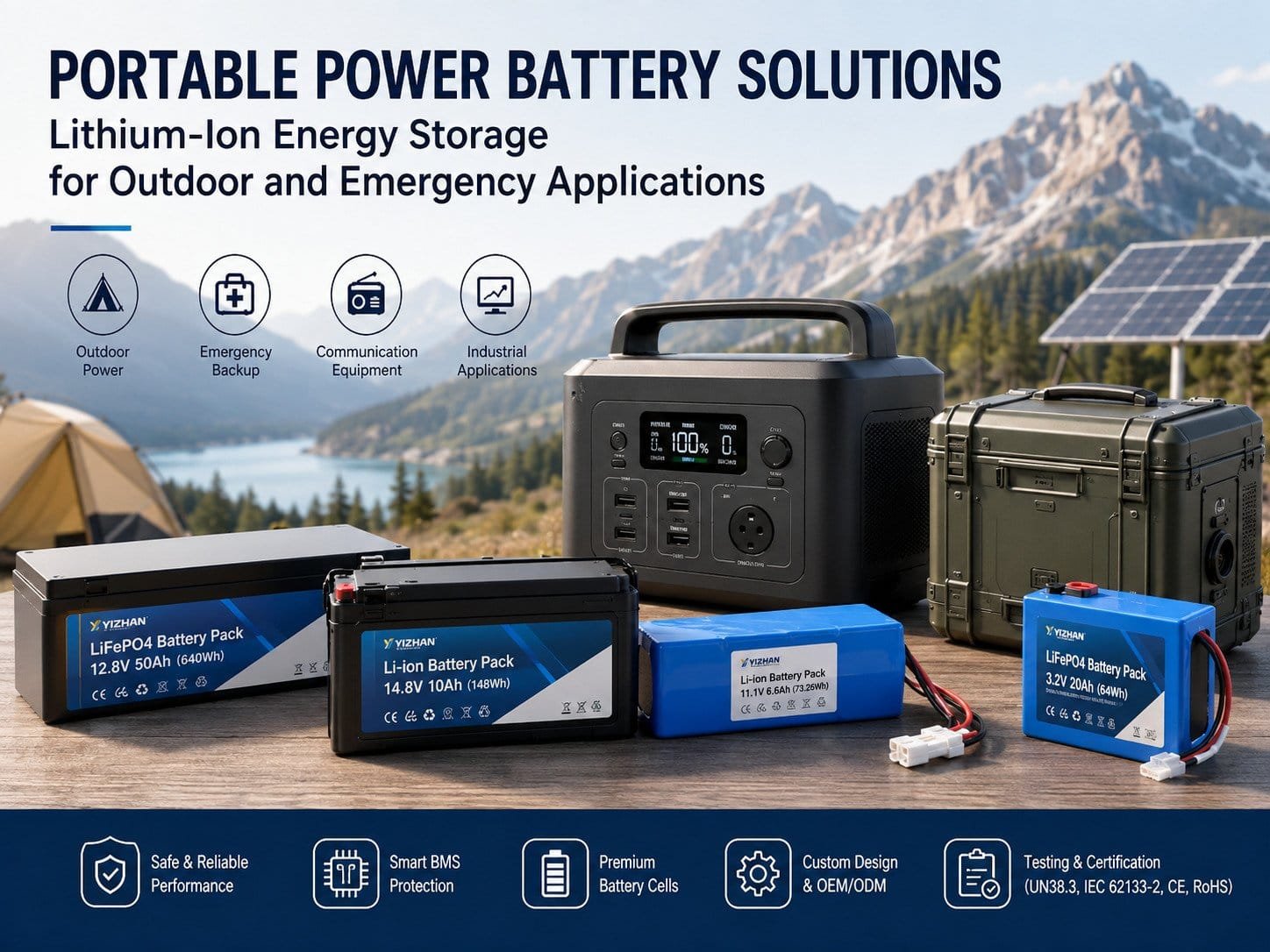
Portable power systems are used in situations where grid electricity is unavailable, unreliable, or difficult to access. Outdoor equipment, emergency backup systems, mobile workstations, communication devices, medical equipment, and small energy storage units all require a battery pack that matches their electrical, mechanical, and environmental requirements.
Lithium-ion battery technology is widely used in portable energy storage because battery packs can be configured around the required voltage, capacity, discharge current, dimensions, and communication functions. However, selecting a portable power battery is not simply a matter of choosing a battery with a large capacity. Cell chemistry, battery configuration, BMS protection, thermal management, enclosure design, charging requirements, transportation regulations, and application conditions all affect the final battery solution.
For equipment manufacturers and system integrators, a custom lithium battery PACK can provide a practical way to match the battery to the product’s available space and operating requirements.
Part 1.What Is a Portable Power Battery?
A portable power battery is a rechargeable battery pack designed to provide electrical energy to equipment that needs mobile or backup power. Depending on the application, the pack may include lithium-ion cells, a battery management system (BMS), protection components, temperature sensors, wiring, connectors, a structural enclosure, and communication interfaces.
The battery’s energy is normally expressed in watt-hours (Wh).
The basic calculation is:
能量 (Wh) = 电压 (V) × 容量 (Ah)
For example, a 24 V 20 Ah battery has a nominal energy rating of approximately 480 Wh:
24 V × 20 Ah = 480 Wh
The actual usable energy depends on factors such as the battery’s operating voltage range, discharge conditions, temperature, BMS settings, and equipment power requirements.
For portable power applications, the battery should therefore be specified according to the complete electrical system rather than capacity alone.
Part 2.Lithium-Ion Battery Chemistry for Portable Energy Storage
Different lithium battery chemistries have different electrical and thermal characteristics. Two commonly considered options for portable energy storage are lithium-ion batteries using NMC chemistry and lithium iron phosphate (LiFePO4) batteries.
NMC Lithium-Ion Batteries
Nickel manganese cobalt oxide, commonly referred to as NMC, can provide a relatively high energy density within a compact battery design. This can be useful when equipment has limited installation space or when battery weight needs to be controlled.
NMC battery packs are used in various portable electronic products, mobility equipment, power systems, and other applications where their voltage and energy characteristics match the system requirements.
LiFePO4 Batteries
Lithium iron phosphate, or LiFePO4, is another lithium battery chemistry used in portable and stationary energy storage.
LiFePO4 battery packs are often selected for applications where thermal characteristics, cycle performance, operating stability, and service requirements are important design considerations.
The appropriate chemistry depends on the application. A battery engineer should evaluate required energy, current, operating temperature, physical dimensions, charging method, expected duty cycle, and applicable regulations before selecting the cell chemistry.
Part 4.Key Specifications for a Portable Power Battery Pack
A portable power battery should be specified using several parameters rather than a single capacity value.
1. Nominal Voltage
Nominal voltage determines whether the battery is electrically compatible with the equipment.
Common configurations include 12 V, 24 V, 36 V, 48 V, and other customized voltage platforms.
The actual battery voltage changes during charging and discharging, so the equipment’s allowable voltage range must be checked against the battery’s operating voltage range.
2. Capacity
Capacity is normally expressed in ampere-hours (Ah). It indicates the amount of electrical charge that a battery can provide under specified test conditions.
For portable energy storage, capacity should be evaluated together with voltage.
A 48 V 20 Ah battery and a 24 V 40 Ah battery both have approximately 960 Wh of nominal energy, although their electrical integration and physical design can be different.
3. Energy
Energy, expressed in Wh, provides a more useful reference when comparing battery requirements across different voltage systems.
The required energy can be estimated from equipment power consumption and operating time:
Required Energy ≈ Load Power × Operating Time
For example, a 100 W device operating for five hours would require approximately 500 Wh before accounting for conversion losses, battery operating limits, and other system losses.
4. Continuous and Peak Current
The battery must supply the current required by the load.
A motor, compressor, pump, or other inductive load may have a starting current that differs significantly from its normal operating current. The battery cells, BMS, wiring, connectors, and protection devices therefore need to be evaluated against both continuous and transient current requirements.
5. Operating Temperature
Portable batteries may be used outdoors, inside vehicles, warehouses, emergency shelters, or other environments with changing temperatures.
Temperature affects battery performance and charging conditions. A BMS can monitor battery temperature through NTC sensors and apply programmed protection or control strategies when the measured temperature falls outside the specified range.
Part 5.BMS Design for Portable Power Battery Packs
The Battery Management System is an important part of a rechargeable lithium battery pack.
A BMS can monitor parameters such as:
- 细胞电位
- 电池组电压
- 充放电电流
- Cell or pack temperature
- 电量状态
- Protection status
- Communication data
Depending on the design, a BMS may provide protection against overcharge, over-discharge, over-current, short circuit, and temperature conditions.
For equipment that needs communication between the battery and the main controller, the BMS may support interfaces such as CAN, UART, or RS485.
For example, a portable energy storage system can use CAN communication to exchange battery status information with an inverter or control system. The specific communication protocol and data structure should be defined during the battery integration stage.
A BMS should be selected according to the battery chemistry, cell configuration, current requirements, charging system, communication requirements, and protection strategy.
Part 6.Battery Configuration: Series and Parallel Connections
Lithium battery cells are connected in series and parallel to achieve the required voltage and capacity.
A series connection increases the voltage. A parallel connection increases the available capacity and current capability.
例如
13S4P
means 13 cell groups connected in series, with four cells connected in parallel within each group.
The final battery configuration depends on the selected cell’s nominal voltage and capacity.
The battery designer must also consider cell matching, voltage consistency, internal resistance, current distribution, thermal behavior, and BMS architecture.
Part 7.Portable Power Battery Applications
Portable lithium battery packs can be designed for different types of equipment.
Outdoor Power Equipment
Camping equipment, portable refrigerators, lighting systems, electronic devices, communication equipment, and mobile workstations may require battery power when access to the electrical grid is limited.
Battery packs for these applications may require compact dimensions, suitable connectors, charging interfaces, and an enclosure designed for the expected environmental conditions.
Emergency Backup Power
Emergency battery systems can provide temporary power for selected electrical loads during grid interruptions.
The required battery capacity depends on the equipment being powered and the expected backup duration.
For example, communication equipment may have a relatively stable load, while a portable medical or emergency system may have different operating modes. Battery sizing should account for the actual load profile instead of using nominal power alone.
医疗设备
Portable medical devices may require a battery pack with defined voltage, capacity, communication, and protection characteristics.
Battery design for medical equipment also requires attention to applicable product regulations and the requirements of the equipment manufacturer. IEC 62133-2 specifies safety requirements and tests for portable sealed secondary lithium cells and batteries under intended use and reasonably foreseeable misuse.
The applicable standard for a complete medical device can depend on the device type and market, so battery certification should be evaluated as part of the complete product compliance process.
Communication and Field Equipment
Portable communication systems, monitoring equipment, inspection devices, and field service tools may operate away from fixed power sources.
These products can require battery packs with communication functions, custom connectors, mechanical mounting features, and protection against environmental conditions encountered during field operation.
Mobile Workstations
Portable industrial computers, inspection equipment, measurement instruments, and mobile service equipment can use customized lithium battery packs.
In these applications, the battery enclosure and connector arrangement are often as important as the electrical specifications because the pack needs to fit within a defined mechanical structure.
Part 8.Battery Enclosure and Mechanical Design
A battery pack is not only an electrical assembly. Mechanical design also affects its performance and service life.
The enclosure may need to provide:
- Cell and component protection
- Mechanical support
- Connector mounting
- 电缆布线
- 散热
- Water and dust protection
- 安装兼容性
For outdoor applications, the required IP rating should be determined according to the actual environment and equipment design.
An IP67 enclosure, for example, may be appropriate for some products that require protection from dust and temporary immersion, but the complete product design must be evaluated to confirm that the required protection is achieved.
Sealing materials, enclosure joints, connectors, pressure equalization, cable exits, and assembly processes can all influence the final protection level.
Part 9.Battery Testing for Portable Power Applications
Battery testing should be planned around the intended application.
Typical PACK-level tests can include:
- 能力测试
- 充放电测试
- BMS保护测试
- Over-current protection testing
- Short-circuit protection testing
- 温度监测
- 老化测试
- 通信测试
- 振动测试
- Mechanical inspection
- Waterproof or IP testing where applicable
Vibration testing can be particularly relevant to portable equipment that is transported frequently or used on vehicles, outdoor paths, industrial floors, or other environments with mechanical movement.
The test method and acceptance criteria should be established according to the product design and applicable standards rather than using a generic test condition for every battery.
Part 10.Lithium Battery Safety and Certification
Battery safety is closely related to cell selection, electrical design, BMS configuration, mechanical construction, charging control, and manufacturing quality.
IEC 62133-2 covers safety requirements and tests for portable sealed secondary lithium cells and batteries, including mechanical tests such as vibration and shock.
Transportation compliance is another important consideration. Lithium cells and batteries offered for transport are subject to design tests under Section 38.3 of the UN Manual of Tests and Criteria. The U.S. Department of Transportation’s PHMSA also notes that manufacturers must make lithium battery test summary documents available upon request under applicable requirements.
Other requirements may apply depending on the destination market and product category. These can include CE-related conformity requirements, RoHS, market-specific battery standards, and product-specific certification schemes.
Certification should therefore be considered during the battery design stage instead of being treated as a final documentation step.
Part 11.EU Battery Regulation Considerations
Companies supplying batteries to the European Union should also consider Regulation (EU) 2023/1542 concerning batteries and waste batteries.
The regulation covers areas including sustainability, safety, labeling, marking, information, producer responsibilities, collection, and treatment of waste batteries.
The regulation applies across several battery categories, including portable batteries, light means of transport batteries, electric vehicle batteries, and industrial batteries.
Because requirements can depend on battery category, market role, product configuration, and implementation dates, manufacturers and importers should review the applicable obligations for their specific product.
Part 12.How to Choose a Portable Power Battery Manufacturer
When sourcing a custom portable power battery, buyers should evaluate the manufacturer’s engineering and production capabilities rather than focusing only on the quoted battery price.
Important questions include:
- Can the manufacturer select cells according to the required voltage, capacity, and current?
- Can the battery configuration be customized?
- Can the BMS be programmed for the intended application?
- Can the battery communicate with the host equipment?
- Does the manufacturer provide prototype development?
- What battery testing is performed during production?
- Can the supplier support applicable certification requirements?
- Can the enclosure and connectors be customized?
- Are production and quality records available?
- Can the supplier support the required production volume?
These questions help connect the battery design with the actual operating conditions of the final product.
Part 13.Custom Portable Power Battery PACK Solutions
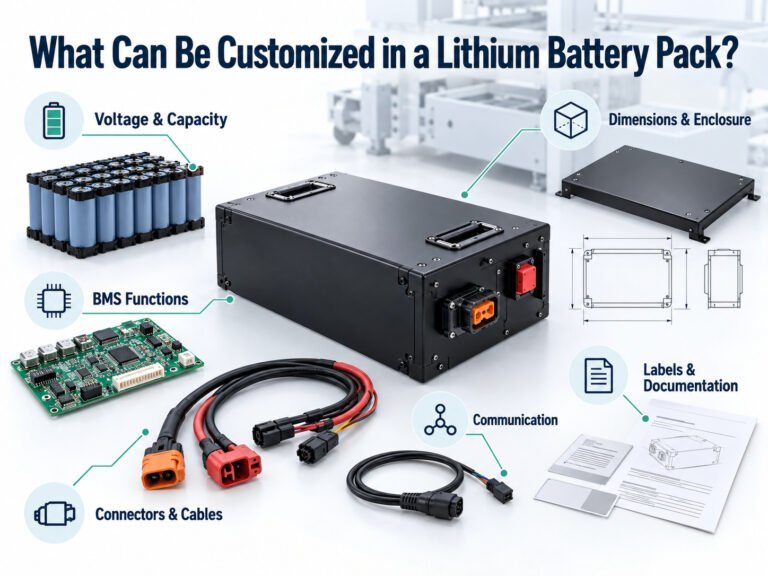
For OEM and ODM projects, battery customization can involve much more than changing the capacity.
定制电池项目可能包括:
Cell selection → Electrical design → Battery configuration → BMS selection → Structural design → Prototype → Testing → Certification support → Mass production
The design team can evaluate the equipment’s voltage, power consumption, operating time, installation space, communication requirements, charging method, environmental conditions, and transportation requirements.
Based on these inputs, the battery PACK can be developed around the product rather than forcing the equipment to use a standard battery format.
For example, a portable power system may require a compact battery with a specific connector and CAN communication, while an emergency backup product may prioritize capacity, enclosure protection, and charging compatibility.
Part 14.Why Battery PACK Manufacturing Experience Matters
A lithium battery PACK combines electrochemical cells with electrical, electronic, mechanical, and manufacturing components.
Cell consistency affects electrical performance. BMS configuration affects protection and battery control. Welding quality affects electrical connections. Mechanical construction affects vibration resistance and enclosure protection. Testing verifies whether the finished pack meets defined requirements.
For this reason, battery PACK development requires coordination between electrical engineering, mechanical engineering, BMS development, production, quality control, and compliance.
Dongguan Yizhan Electronics Technology Co., Ltd. provides customized lithium battery PACK development for applications including portable power equipment, outdoor equipment, mobility products, industrial equipment, medical equipment, robotics, and other battery-powered systems.
The customization process can cover cell selection, PACK configuration, BMS integration, structural design, prototype production, testing, certification support, and mass production.
常见问题
What is a portable power battery?
A portable power battery is a rechargeable battery pack designed to supply electrical energy to mobile equipment or provide temporary backup power. A typical lithium battery PACK may include cells, a BMS, protection components, sensors, wiring, connectors, and an enclosure.
How do I calculate the capacity needed for portable power equipment?
Start with the equipment’s power consumption and expected operating time:
Energy requirement (Wh) = Load power (W) × Operating time (h)
Then account for conversion losses, battery operating limits, temperature, and the desired operating margin when determining the battery’s rated capacity.
Is LiFePO4 suitable for portable power applications?
LiFePO4 can be used in portable power applications where its electrical and thermal characteristics match the system requirements. The final selection should consider energy requirements, dimensions, weight, current, operating temperature, charging conditions, and applicable regulations.
Does every portable lithium battery need the same certification?
No. Applicable requirements depend on the battery design, application, destination market, transportation method, and product category. Certification and compliance should be evaluated according to the specific project.
Can a portable power battery be customized?
Yes. Customization can include cell chemistry, voltage, capacity, series-parallel configuration, BMS, communication protocol, connectors, enclosure dimensions, charging method, and mechanical mounting.
What information is needed to develop a custom battery?
A battery manufacturer normally needs the required voltage, capacity or operating time, continuous and peak current, equipment power, charging method, dimensions, connector requirements, operating temperature, communication requirements, installation method, target market, and applicable certification requirements.
结论
Portable power battery design is a system engineering task. The appropriate solution depends on the relationship between battery chemistry, voltage, capacity, discharge current, BMS protection, mechanical structure, thermal conditions, charging requirements, testing, and regulatory requirements.
For outdoor and emergency applications, lithium-ion and LiFePO4 battery technologies can be configured into different PACK formats to meet specific equipment requirements. A well-defined specification at the beginning of a project can help reduce redesign work and provide a clear path from prototype development to production.
For companies developing portable power equipment, working with an experienced lithium battery PACK manufacturer can provide engineering support across cell selection, battery design, BMS integration, testing, certification preparation, and production.
东莞一展电子科技有限公司 supports OEM and ODM lithium battery PACK projects for portable power, outdoor equipment, emergency backup systems, medical equipment, industrial equipment, and other applications requiring customized rechargeable battery solutions.
 English
  Chinese
  Japanese
  German
  French
  Korean
