
1. Scope
This manual provides general instructions for installing, operating, charging, storing and inspecting equipment battery packs.
Voltage, current, temperature and maintenance requirements vary by model. Read the model-specific specification, equipment manual and charger instructions before use.
If the documents contain conflicting instructions, stop and contact the supplier. Do not select operating parameters yourself.
2. Product Information
Complete and verify the following information before issuing this manual with a product.
| 项目 | Product Information |
|---|---|
| 电池型号 | To be completed |
| Compatible equipment | To be completed |
| 额定电压 | To be completed |
| Rated capacity and energy | To be completed |
| 充电电压和电流 | To be completed |
| Continuous and peak discharge limits | To be completed |
| Charging temperature range | To be completed |
| Discharging temperature range | To be completed |
| Storage temperature and charge requirements | To be completed |
| Storage inspection interval | To be completed |
| Approved charger | To be completed |
| Service contact | To be completed |
Do not charge, connect or adjust battery protection settings until the applicable requirements have been confirmed.
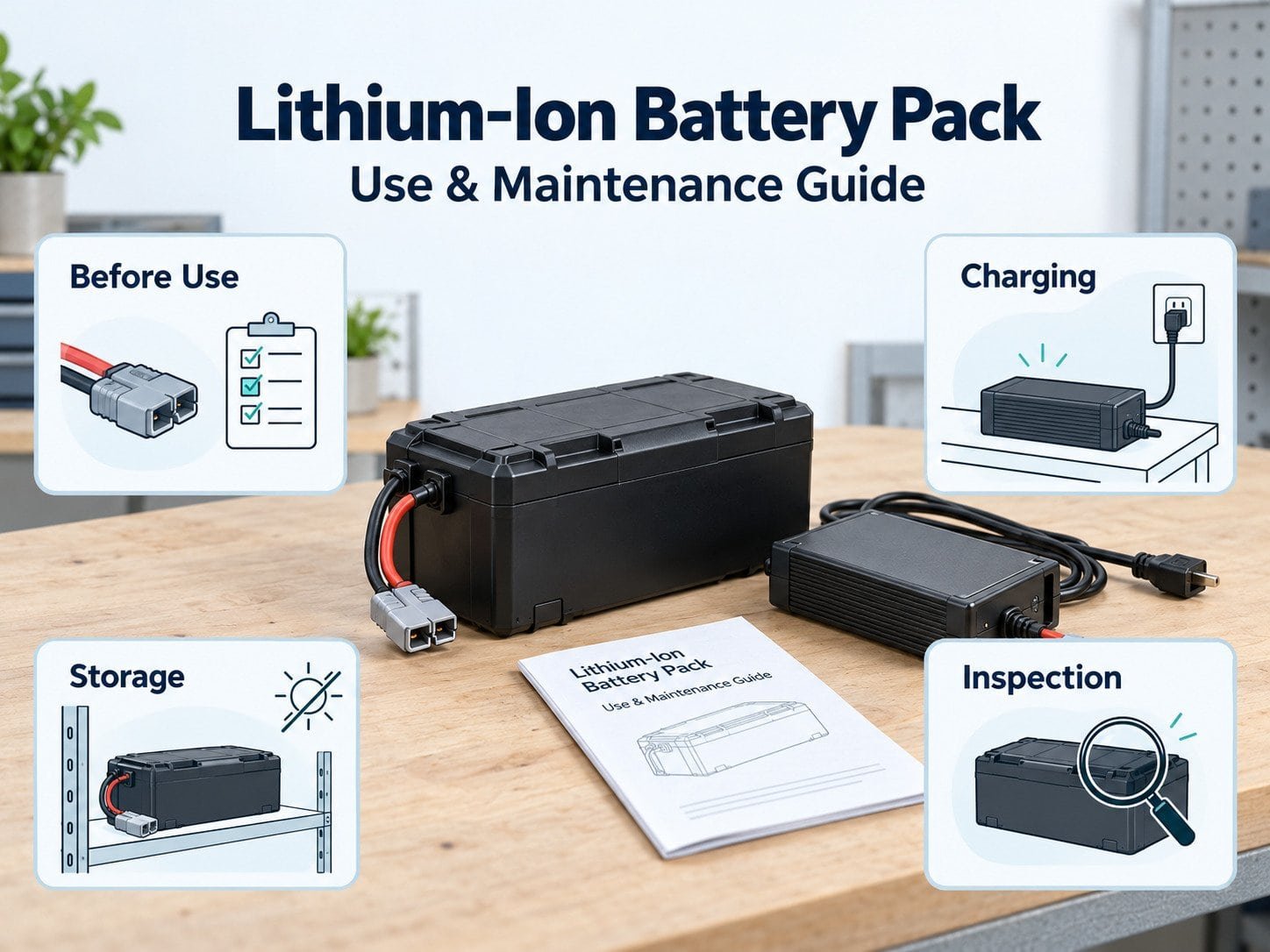
3. Inspection Before Use
Before each use, check for:
- Cracks, deformation or swelling.
- Loose, burned or corroded connectors.
- Foreign material inside connectors.
- Damaged, compressed or exposed wiring.
- Moisture on the battery or connections.
- Loose mounting parts, locks or retention features.
- Unusual heat, odor, leakage or fault indications.
Stop using the battery if an abnormal condition is found. Contact the supplier.
After a drop, impact, crushing event or water exposure, suspend use and follow the prescribed inspection procedure, even if external damage is not visible.
4. Installation and Connection
- Confirm that the battery model is approved for the equipment.
- Switch off the equipment and follow its isolation procedure.
- Check connector type, polarity and orientation.
- Secure the battery using the specified mounting parts.
- Ensure cables are not stretched, compressed or routed against sharp edges.
- Follow the specified connection and startup sequence.
Do not force connectors into place or pull on cables to disconnect them.
Do not connect battery packs in series or parallel unless the arrangement has been approved for that purpose. Appearance, connector fit and nominal voltage do not establish compatibility.
5. Charging Instructions
Use the Approved Charger
Use the charger supplied with the product or confirmed by the manufacturer for the battery model.
A connector that fits does not establish matching voltage, polarity or charging control.
Check Charging Conditions
Before charging:
- Inspect the battery, charger and cables.
- Confirm that connections are clean and dry.
- Confirm that battery temperature is within the permitted range.
- Follow the specified connection procedure.
Do not use external heating, ovens or similar methods to force the battery into its charging temperature range.
Use the Designated Charging Location
Charge in a dry, ventilated location away from heat sources, combustible materials and escape routes.
Do not cover the battery or charger. Do not charge on beds, sofas or other soft surfaces.
Remain present when charging portable equipment. Do not charge while sleeping. Automatic charging equipment must operate according to its approved system instructions.
Observe Charging Status
Stop charging if there is unusual heat, odor, deformation, leakage or a fault indication.
Do not repeatedly reconnect or restart the system, or substitute an unapproved charger, to force charging.
Operation during charging and continuous charger connection are permitted only where specified for the battery and equipment.
6. Operating Precautions
- Operate within the specified voltage, current and temperature limits.
- Follow the equipment’s charging or shutdown procedure when a battery warning appears.
- Do not repeatedly restart a battery after protection has activated.
- Do not bypass the BMS, fuses or other protective devices.
- Do not modify protection settings, cables or connectors.
- Do not open the enclosure, replace internal cells or resolder connections.
- Keep the battery away from flames, heating equipment and other heat sources.
An ingress protection rating does not establish suitability for every water exposure or cleaning method. Follow the product instructions.
7. Storage and Maintenance
Follow Model-Specific Requirements
Confirm storage temperature, state of charge and inspection intervals from the product specification.
Do not apply full-charge storage, complete discharge or a fixed recharging interval to every battery model.
Prevent Short Circuits and Damage
During storage:
- Keep the location dry.
- Avoid direct sunlight and heat sources.
- Prevent metal objects from contacting terminals.
- Protect against drops, crushing and stacked loads.
- Use the specified terminal protection and packaging.
Manage Extended Idle Periods
The battery or connected equipment may consume power after the equipment is switched off.
Follow the prescribed disconnection, sleep or storage procedure. Inspect the battery and check its charge condition at the specified intervals. Recharge as instructed.
If the battery does not wake or accept charging, do not attempt forced activation using an external power source.
Return to Service
Inspect the enclosure, connectors and cables. Complete the prescribed charging and functional checks before installation and operation.
8. Cleaning
Follow the product’s cleaning instructions. Unless otherwise specified, wipe the exterior with a dry, soft cloth.
Do not:
- Spray water into connectors.
- Immerse the battery.
- Apply a pressure washer directly to the battery.
- Use unapproved solvents.
- Insert metal tools into connectors.
- Open the enclosure for cleaning.
After water exposure, do not assume the battery is suitable for use because the exterior is dry. Contact the supplier.
9. Abnormal Conditions
| Condition | Required Action |
|---|---|
| Equipment does not start | Stop repeated attempts, record indications and follow the inspection procedure |
| Power stops during operation | Stop the task, retain fault information and do not bypass protection |
| Battery does not charge | Check the approved charger, connections and temperature conditions; do not force charging |
| Drop, impact or water exposure | Suspend use and arrange inspection |
| Swelling, leakage, burning or unusual odor | Stop use; do not dismantle or repair the battery yourself |
| Smoke, venting, rapid heating or fire | Move away, warn others, evacuate and call emergency services |
Do not touch, carry or approach a battery that is smoking, venting or burning. Do not approach it to record video.
Disconnect external power only if this can be done without approaching the hazard. Follow the site emergency plan and instructions from emergency responders.
Use the emergency number applicable to your location. In mainland China, call 119 for fire emergencies.
10. Repair and Replacement
Internal repairs must be performed by qualified, authorized personnel.
A replacement battery must match the equipment’s approved electrical, mechanical, charging and communication requirements.
Do not install unapproved cells or components. Do not reuse internal parts from an old battery in another pack without an approved process.
Complete the required inspection and verification after repair before returning the battery to service.
11. Transport and Recycling
Before transport, confirm battery condition, packaging, terminal protection and required documents. Determine shipping state-of-charge requirements from the applicable transport arrangements.
Do not ship a damaged, leaking, swollen or suspected faulty battery as an ordinary undamaged product. Contact the supplier and carrier for handling instructions.
Do not place waste lithium batteries in household rubbish or general recycling bins. Use an authorized local battery collection or recycling service.
12. Inspection Record
| Date | Model / Serial Number | Enclosure and Connections | Charge / Fault Information | Action Taken | Inspector |
|---|---|---|---|---|---|
When requesting service, provide the model, serial number, equipment details, fault indications and operating conditions.
Do not continue operating an abnormal battery to reproduce a fault.

 English
  Chinese
  Japanese
  German
  French
  Korean
