
Warehouse operations depend on the continuous movement of materials, products, and inventory. Forklifts, pallet trucks, stackers, tow tractors, AGVs, AMRs, and other electric material-handling equipment all require a reliable power source to perform their daily tasks.
For many warehouses, battery performance is directly connected to equipment availability and workflow continuity. When a battery requires extended charging, frequent maintenance, or replacement during a work shift, the equipment may spend more time away from productive operations.
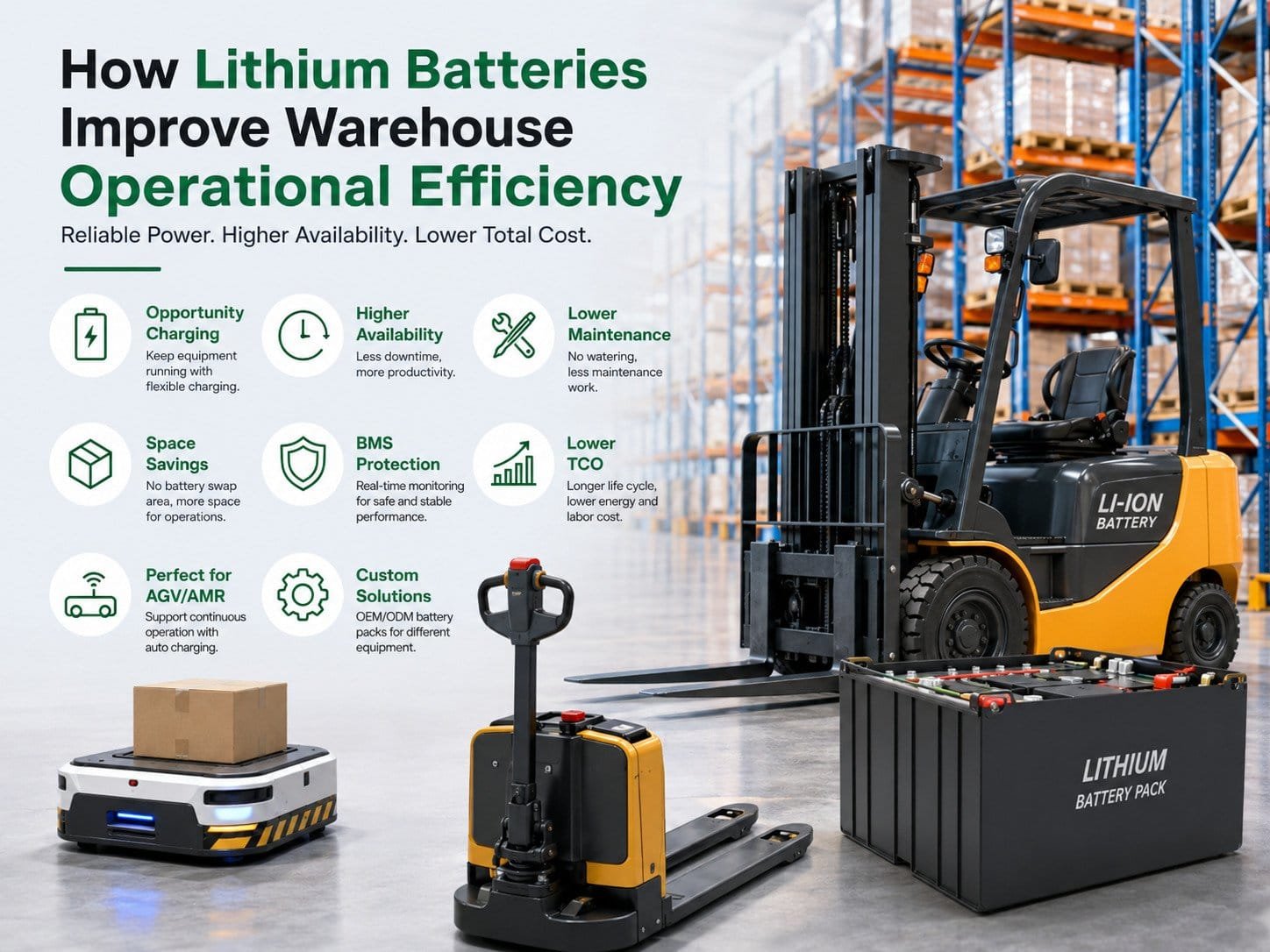
Lithium-ion batteries provide an alternative to traditional lead-acid batteries for many warehouse applications. Depending on the equipment design and operating requirements, a lithium battery system can support opportunity charging, reduce routine battery maintenance, provide battery monitoring through a Battery Management System (BMS), and allow more flexible battery-pack configurations.
For warehouse operators, the key question is not simply whether lithium batteries are better than lead-acid batteries. The more useful question is:
How can a lithium battery system be designed and managed to support the specific operating requirements of a warehouse?
This article explains the main factors to consider when applying lithium battery technology to warehouse equipment and fleet operations.
1. Why Battery Performance Matters in Warehouse Operations
A warehouse is a connected operating system.
An interruption to one piece of equipment can affect material movement, picking, replenishment, loading, and delivery schedules.
For example, a forklift may be responsible for moving pallets between storage racks and loading areas. If the forklift is unavailable because its battery needs extended charging, another vehicle may need to take over the task.
This can create additional workload for the remaining equipment.
Battery-related factors that can influence warehouse operations include:
- 工作电压
- 电池容量
- 充电时间
- 充电频率
- 放电电流
- 电池温度
- Battery state of charge
- Battery condition
- Charging infrastructure
- Battery replacement requirements
- Battery maintenance
- BMS 功能
Therefore, battery selection should be considered as part of the overall warehouse equipment strategy rather than as an isolated purchasing decision.
2. Lithium Batteries Support Opportunity Charging
One of the important characteristics of lithium battery systems is their ability to support opportunity charging when the battery, charger, and equipment are designed for this operating method.
Opportunity charging means charging the battery during scheduled equipment downtime instead of waiting for the battery to become fully depleted.
For example, a warehouse vehicle may be charged during:
- Employee breaks
- 班次交接
- Loading and unloading periods
- Scheduled equipment downtime
- Short operational intervals
This operating approach can help reduce the need for long charging periods.
However, opportunity charging should always follow the battery manufacturer’s charging specifications. Charging current, battery temperature, BMS settings, charger compatibility, and operating conditions must all be considered.
A lithium battery system should therefore be designed together with the appropriate charger rather than selecting the battery and charger independently.
3. Reduce Battery-Related Equipment Downtime
Equipment availability is an important consideration for warehouses operating multiple shifts.
Traditional battery management may involve removing a depleted battery, moving it to a charging area, installing a charged battery, and maintaining additional batteries for rotation.
A lithium battery system can be configured around the operating schedule of the equipment.
例如
Single-shift operation
The battery can be charged during scheduled downtime.
Multi-shift operation
Opportunity charging can be incorporated into the operating schedule.
Continuous AGV/AMR operation
Automatic charging stations can be integrated into the vehicle’s workflow.
The appropriate strategy depends on the equipment, battery capacity, charger specification, duty cycle, and warehouse operating schedule.
4. Reduce Routine Battery Maintenance
Battery maintenance is another factor that affects warehouse labor requirements.
Traditional lead-acid batteries can require tasks such as:
- Electrolyte level inspection
- 补水
- 清洁
- Terminal inspection
- Charging-area management
- Battery rotation
Lithium battery systems generally do not require the same water-maintenance process associated with flooded lead-acid batteries.
This can reduce the number of routine battery-related tasks performed by warehouse personnel.
However, lithium batteries still require appropriate inspection and maintenance.
Warehouse operators should follow the manufacturer’s recommendations for:
- 连接器
- 电缆
- 电池盒
- BMS
- Charging equipment
- 温度条件
- 机械安装
- Warning and fault information
Lithium batteries are not maintenance-free equipment. Proper inspection remains part of responsible fleet management.
5. Use BMS Data for Battery Management
A Battery Management System is an important component of a lithium battery pack.
The BMS monitors and manages battery operating conditions. Depending on the system design, it may monitor:
- 细胞电位
- 电池组电压
- 充电电流
- 放电电流
- 细胞温度
- Pack temperature
- 充电状态 (SOC)
- 健康状况(SOH)
- 充电状态
- Protection status
The BMS can also provide protection functions such as:
- Overvoltage protection
- Undervoltage protection
- 过流保护
- 短路保护
- 过温保护
- 低温保护
For warehouse fleet operators, battery data can provide additional information for maintenance planning and equipment scheduling.
For example, if a battery consistently shows abnormal temperature behavior or reduced available capacity, maintenance personnel can investigate the issue before it causes an unexpected equipment interruption.
6. Improve Warehouse Space Utilization
Battery charging and battery replacement areas can occupy valuable warehouse space.
A traditional fleet using multiple lead-acid batteries may require:
Equipment → Battery Removal → Charging Area → Battery Storage → Battery Replacement
This process can require additional floor space and handling equipment.
A lithium battery system that supports opportunity charging can change the workflow:
Equipment → Scheduled Charging → Return to Operation
Depending on the fleet configuration, this may reduce the need for battery swapping and spare-battery storage.
For warehouses where floor space is limited, reducing dedicated battery-handling areas can provide additional flexibility for warehouse layout planning.
The actual space savings depend on the number of vehicles, battery capacity, charging infrastructure, and operating schedule.
7. Lithium Batteries for Forklifts
Forklifts are one of the major applications for industrial lithium battery systems.
A forklift battery needs to meet several requirements simultaneously.
电压
Common industrial battery platforms include:
- 24V
- 36V
- 48V
- 51.2V
- 72V
The correct voltage depends on the forklift’s electrical system.
容量
Battery capacity is usually expressed in Ah or kWh.
例如
Battery Energy = Nominal Voltage × Capacity
A 51.2V 200Ah battery has a nominal energy rating of approximately:
51.2 × 200 = 10.24 kWh
Actual usable energy depends on the battery management strategy, operating conditions, allowable depth of discharge, and system design.
放电能力
The battery must also provide sufficient current for:
- 开始
- 举重
- Driving
- 加速度
- Hydraulic systems
Peak and continuous current requirements should be evaluated separately.
8. Lithium Batteries for Pallet Trucks
Electric pallet trucks operate in environments where compact battery dimensions and convenient charging can be important.
Depending on the pallet truck model, lithium battery packs can be designed for:
- 24V systems
- 36 伏系统
- Removable battery configurations
- Fixed battery configurations
- Swappable battery systems
- Integrated charging systems
A custom battery pack can also be designed around the available battery compartment.
Important design parameters include:
Battery Size + Voltage + Capacity + Connector + BMS + Charger
This approach allows the battery to be integrated into the equipment rather than forcing the equipment to accommodate a standard battery size.
9. Lithium Batteries for AGV and AMR Systems
Automated Guided Vehicles and Autonomous Mobile Robots have different battery requirements from conventional forklifts.
An AGV or AMR may operate continuously according to a programmed workflow.
Its battery system may need to support:
- Repeated acceleration
- Frequent stopping
- Short charging periods
- 自动充电
- Communication with the vehicle
- 电池状态监测
- Defined operating temperatures
For these applications, battery capacity alone does not determine system performance.
The battery designer should consider:
Operating cycle → Energy consumption → Charging opportunity → Battery capacity → Charger power
For example, if an AMR consumes a specific amount of energy during a working cycle and has regular opportunities to recharge, a smaller battery combined with automated charging may be appropriate.
For another vehicle operating for long periods without charging access, a higher-capacity battery may be required.
10. LiFePO4 Batteries for Warehouse Applications
Lithium battery chemistry should be selected according to the application.
Lithium iron phosphate, commonly known as LiFePO4 or LFP, is frequently considered for industrial battery applications because of its thermal characteristics, cycle performance, and suitability for battery-pack configurations.
A LiFePO4 cell typically has a nominal voltage of approximately 3.2V.
例如
16S 磷酸铁锂
16 cells connected in series provide:
16 × 3.2V = 51.2V nominal
This voltage platform is used in various industrial battery applications.
However, cell chemistry should not be selected solely based on nominal voltage.
The battery design also needs to consider:
- 所需容量
- 最大连续电流
- 峰值电流
- 工作温度
- Charging requirements
- 周期要求
- 可用安装空间
- BMS 要求
- 通信协议
- 安全要求
- Applicable certifications
11. Custom Battery Packs for Warehouse Equipment
Not every warehouse vehicle uses the same battery compartment.
Even equipment with similar voltage requirements can have different physical and electrical interfaces.
A custom lithium battery pack can be developed around specific equipment requirements.
Typical customization parameters include:
电气设计
- 电压
- 容量
- Maximum discharge current
- 峰值电流
- 充电电流
- BMS protection parameters
机械设计
- 长度
- 宽度
- 高度
- 重量
- 安装点
- Handle configuration
- 电池盒
交流
Depending on the equipment, the battery may require communication with the vehicle controller.
Possible interfaces include:
- CAN
- RS485
- UART
- Other application-specific protocols
环境要求
Warehouse equipment may operate in:
- Cold storage
- Humid environments
- Dusty environments
- Outdoor loading areas
- Temperature-controlled warehouses
The enclosure and protection design should therefore be selected according to the actual operating environment.
12. Battery Protection and Safety
Battery safety is an important part of industrial battery design.
A lithium battery pack should incorporate appropriate protection mechanisms through the BMS and electrical design.
Protection functions may include:
- 过充电保护
- 过放电保护
- 过流保护
- 短路保护
- 温度监测
- 细胞平衡
The mechanical design is also important.
Depending on the application, a battery pack may require:
- Reinforced enclosure
- 抗冲击和振动
- Water and dust protection
- Secure cell fixation
- 隔热
- Appropriate connectors
For example, warehouse vehicles may experience repeated vibration and mechanical impact during daily operation. The battery PACK should therefore be designed for its intended operating environment.
13. Vibration Testing for Warehouse Battery Packs
Battery packs installed in forklifts, AGVs, pallet trucks and other mobile equipment can experience repeated vibration.
A battery manufacturer’s testing program may include vibration testing to evaluate:
- Cell fixation
- Welding points
- 母线
- 连接器
- Wiring
- BMS connections
- Enclosure integrity
For example, a manufacturer may conduct a 10,000-cycle vibration test as part of its internal quality-control program for a specific battery design.
The exact test method, frequency, amplitude, duration and acceptance criteria should be documented rather than using the number of test cycles alone as a measure of battery quality.
This is an important distinction for B2B buyers evaluating battery suppliers.
14. Charging Infrastructure Matters
A lithium battery cannot be evaluated separately from its charger.
The charging system must be compatible with:
- 电池化学
- 电池电压
- 电池容量
- BMS
- 充电电流
- 通信要求
- 工作温度
For fleet operators, charger placement is also important.
Charging stations can be positioned around:
- Warehouse entrances
- Break areas
- Vehicle parking zones
- 自动充电站
- Production interfaces
The objective is to make charging part of the workflow instead of treating it as an isolated maintenance activity.
15. Consider Total Cost of Ownership
Battery purchasing decisions should not be based solely on initial purchase price.
A more complete evaluation considers Total Cost of Ownership (TCO).
A simplified TCO model can include:
Battery Purchase Cost + Charger Cost + Maintenance + Labor + Energy + Replacement + Downtime
For example, a warehouse may compare two battery systems with different purchase prices.
The lower-priced battery may require:
- More maintenance
- More battery rotation
- More charging infrastructure
- Additional spare batteries
The higher-priced system may have a different operating profile.
Therefore, the warehouse should calculate costs over the expected operating period instead of evaluating only the initial quotation.
16. How to Choose a Lithium Battery for Warehouse Equipment
Before purchasing a lithium battery pack, warehouse operators should collect the following information.
Step 1: Identify the Equipment
Determine whether the battery will be used for:
- Forklift
- Pallet truck
- Stacker
- Tow tractor
- AGV
- AMR
- Cleaning machine
- Warehouse robot
Step 2: Confirm Electrical Requirements
收集:
- 额定电压
- 所需容量
- 电机功率
- 连续电流
- 峰值电流
Step 3: Analyze the Work Cycle
Record:
- 每日营业时间
- 班次数量
- Average load
- Peak workload
- 充电机会
Step 4: Check Physical Dimensions
Measure the battery compartment and installation method.
Step 5: Define BMS Requirements
Determine whether the equipment requires:
- Basic protection
- SOC 显示屏
- CAN 通信
- RS485通信
- 远程监控
Step 6: Determine Environmental Conditions
请考虑:
- Indoor/outdoor use
- 温度
- 湿度
- 灰尘
- 振动
- 接触水
Step 7: Confirm Compliance Requirements
Depending on the market and application, requirements may include relevant transportation, product safety, EMC, environmental, or regional certification standards.
17. Why OEM/ODM Battery Manufacturing Can Be Important
For equipment manufacturers and fleet operators, an off-the-shelf battery may not always match the required dimensions or electrical interface.
OEM/ODM battery manufacturing allows the battery supplier to develop a solution around the equipment.
A typical development process may include:
Requirement Analysis → Electrical Design → Cell Selection → BMS Design → 3D/Mechanical Design → Prototype → Testing → Certification → Mass Production
The battery supplier should be able to provide technical documentation covering relevant specifications and test results.
For B2B customers, it is also useful to evaluate:
- Cell supplier
- 细胞模型
- BMS architecture
- Production process
- Quality-control process
- 测试能力
- 认证
- 可追溯性
- 售后支持
- Production capacity
This helps buyers evaluate a battery manufacturer based on engineering and manufacturing capability rather than marketing claims alone.
18. How a Battery Manufacturer Can Support Warehouse Projects
A professional lithium battery PACK supplier can support a warehouse project from initial specification to production.
The process can include:
Requirement Assessment
The manufacturer reviews the equipment specifications and operating environment.
电池配置
Engineers determine the appropriate cell configuration, voltage, capacity and current capability.
BMS 开发
The BMS is configured according to the battery and equipment requirements.
机械设计
The battery enclosure is designed around the available installation space.
Prototype Production
Prototype battery packs are produced for equipment testing.
可靠性测试
测试可能包括:
- 能力测试
- Charging and discharging tests
- 老化试验
- 温度测试
- 振动测试
- 防水测试
- BMS测试
认证支持
Depending on the target market and product category, the manufacturer can help coordinate applicable certification and compliance testing.
批量生产
After design validation, the battery pack can move into controlled mass production.
19. Warehouse Battery Efficiency Starts With the Right System Design
There is no universal lithium battery specification for every warehouse.
A battery designed for an AMR may not be suitable for a forklift.
A battery designed for a pallet truck may not provide the current required by a heavy-duty industrial vehicle.
The correct solution starts with the equipment’s actual operating conditions.
例如
| 应用 | Key Battery Considerations |
|---|---|
| Forklift | Capacity, peak current, operating hours, charging |
| Pallet Truck | Size, weight, capacity, charging |
| AGV | Duty cycle, communication, automatic charging |
| AMR | Weight, compact design, charging strategy |
| Tow Tractor | Continuous current, capacity, operating cycle |
| Cold Storage Vehicle | Low-temperature performance, charging conditions |
| Warehouse Robot | Energy consumption, cycle time, BMS communication |
20. Conclusion
Lithium batteries can support warehouse operational efficiency by changing how material-handling equipment is powered, charged, monitored and maintained.
Potential operational benefits include:
- 灵活的充电时间安排
- Reduced battery-related downtime
- Less routine battery maintenance
- Reduced battery swapping requirements
- More flexible warehouse space planning
- Battery condition monitoring through BMS
- Integration with AGV and AMR charging systems
- Custom battery configurations for different equipment
However, the actual benefits depend on battery design, equipment requirements, charging infrastructure and warehouse operating practices.
For warehouse operators considering a transition from lead-acid to lithium batteries, the first step should be a detailed assessment of the existing fleet.
Voltage, capacity, current, duty cycle, charging opportunities, installation space, operating temperature, BMS communication and certification requirements should all be evaluated before selecting a battery system.
A properly engineered lithium battery PACK can become part of the warehouse’s energy and fleet-management system rather than simply serving as a replacement power source.
FAQ: Lithium Batteries for Warehouse Operations
Are lithium batteries suitable for warehouse equipment?
Lithium batteries can be used in many types of warehouse equipment, including forklifts, pallet trucks, stackers, tow tractors, AGVs, AMRs and warehouse robots. Suitability depends on the equipment’s voltage, current, capacity, mechanical and charging requirements.
Can lithium forklift batteries be opportunity charged?
Many lithium forklift battery systems can support opportunity charging when the battery and charger are designed for this operating method. The charging current, temperature and BMS specifications should be followed.
Do lithium warehouse batteries require maintenance?
Lithium batteries generally do not require the water replenishment associated with flooded lead-acid batteries. However, inspection of connectors, cables, enclosure, BMS and charging equipment is still required according to the manufacturer’s maintenance recommendations.
Is LiFePO4 suitable for warehouse applications?
LiFePO4 is used in various industrial battery applications. Its suitability depends on the equipment’s energy, current, size, temperature and cycle requirements.
Can lithium batteries be customized for AGVs and AMRs?
Yes. AGV and AMR battery packs can be customized according to voltage, capacity, dimensions, weight, connector configuration, BMS and communication requirements.
How can I calculate the required warehouse battery capacity?
一个基本的计算方法是:
Battery Energy (kWh) = Voltage (V) × Capacity (Ah) ÷ 1,000
Actual battery sizing should also consider energy consumption, operating hours, depth of discharge, efficiency, temperature, peak loads and charging opportunities.
What should a warehouse consider when replacing lead-acid batteries with lithium batteries?
The evaluation should include battery capacity, equipment compatibility, charging infrastructure, BMS, battery dimensions, operating schedule, maintenance requirements, safety requirements, certification and Total Cost of Ownership.
关于东莞一展电子科技有限公司
东莞一展电子科技有限公司 specializes in customized lithium battery PACK solutions for industrial and commercial applications.
The company provides OEM/ODM battery solutions for forklifts, AGVs, AMRs, pallet trucks, warehouse robots, golf carts, industrial equipment and other electric mobility applications.
Its battery development process can cover cell selection, PACK design, BMS development, prototype production, testing, certification support and mass production.
 English
  Chinese
  Japanese
  German
  French
  Korean
