
Lithium batteries are used in electric forklifts, pallet trucks, stackers, automated guided vehicles (AGVs), and other material handling equipment. These machines rely on battery systems to power traction motors, hydraulic systems, control units, and electrical components.
For equipment manufacturers, selecting a lithium battery involves electrical specifications, mechanical integration, charging requirements, and operating conditions.
Lithium batteries for electric forklifts and material handling equipment must be evaluated according to the vehicle’s voltage, capacity, discharge current, battery compartment, and operating cycle.
Battery Management System (BMS) functions, charging interfaces, communication requirements, and applicable safety standards are also part of the development process.
This article explains the technical considerations involved in lithium battery selection and custom battery pack development for electric forklifts and industrial material handling applications.
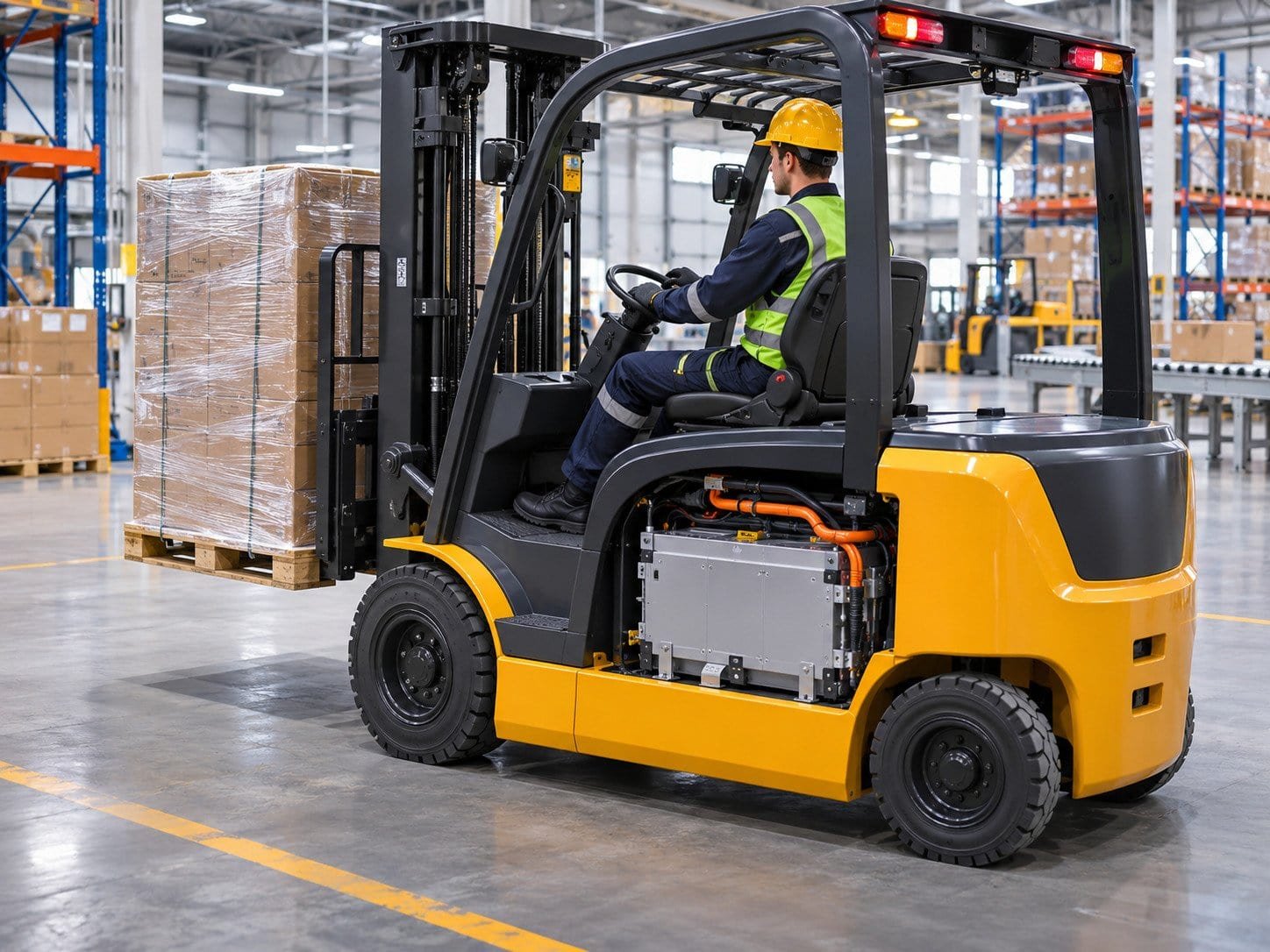
1. Lithium Battery Applications in Material Handling Equipment
Material handling equipment is used in warehouses, manufacturing facilities, distribution centers, and logistics operations.
Different equipment types have different electrical and mechanical requirements.
常见的应用包括
电动叉车
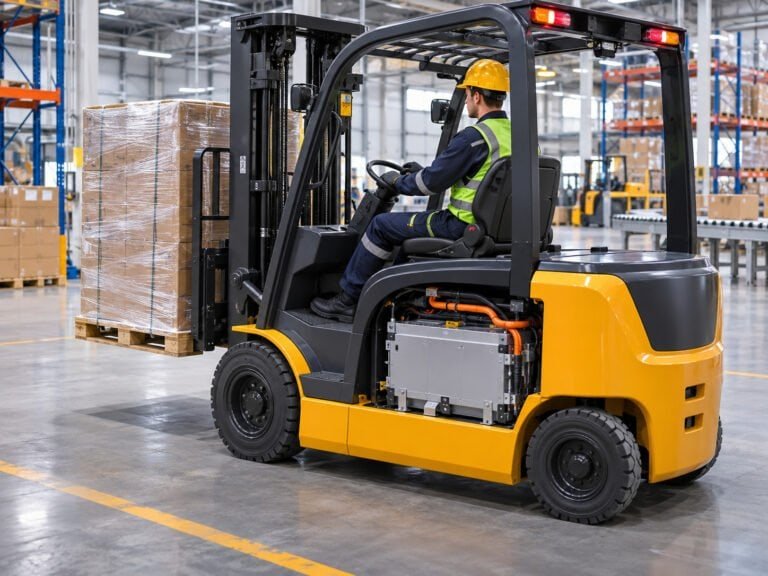
Electric forklifts use battery systems to supply power for vehicle movement, lifting, and other electrical functions.
Battery requirements depend on the forklift model, rated load, motor controller, hydraulic system, and operating conditions.
Electric Pallet Trucks
Electric pallet trucks are used to transport goods over warehouse floors.
Battery specifications depend on the equipment’s motor power, operating cycle, charging method, and installation space.
Electric Stackers
Electric stackers use battery power for traction and lifting functions.
Battery design should consider the current required during movement and lifting operations.
前移式堆高车
Reach trucks are used in warehouse storage and material handling applications.
Battery selection should follow the vehicle manufacturer’s electrical and mechanical specifications.
AGV 和 AMR
Automated Guided Vehicles (AGVs) and Autonomous Mobile Robots (AMRs) are used in automated material handling systems.
Their battery packs may require customized dimensions, BMS functions, and communication interfaces.
Each equipment application requires evaluation of the battery voltage, current, capacity, enclosure structure, and charging requirements.
2. Selecting Battery Voltage for Electric Forklifts
Battery voltage is a basic parameter in industrial battery design.
The required voltage depends on the vehicle’s motor controller, drive system, electrical components, and charging system.
Voltage classes encountered in material handling equipment include:
- 24V
- 36V
- 48V
- 80V
The actual battery voltage depends on the selected chemistry and series cell configuration.
LiFePO4 Battery Configurations
LiFePO4 battery cells have a typical nominal voltage of 3.2V per cell.
Examples of series configurations include:
| LiFePO4 Configuration | 额定电压 | Equipment Voltage Class |
|---|---|---|
| 8S | 25.6V | 24V class |
| 12S | 38.4V | Application-dependent |
| 15S | 48.0V | 48V class |
| 16S | 51.2V | 48V class, subject to compatibility |
| 25S | 80.0V | 80V class |
These configurations are calculation examples. They do not represent specific products of Dongguan Yizhan Electronics Technology Co., Ltd.
Equipment voltage classes do not establish the permitted battery operating voltage range.
Before selecting a battery configuration, the forklift manufacturer should confirm:
- 额定系统电压
- Motor controller operating voltage range
- Maximum allowable battery voltage
- Minimum operating voltage
- Charging voltage requirements
- Compatibility with the existing electrical system
A battery pack should not be selected based only on a nominal voltage label.
3. Battery Capacity and Operating Time
Battery capacity determines the amount of electrical charge available under specified operating conditions.
Capacity is expressed in ampere-hours (Ah), while battery energy is expressed in watt-hours (Wh) or kilowatt-hours (kWh).
Battery Energy Calculation
Nominal battery energy can be calculated using:
Energy (Wh) = Nominal Voltage (V) × Capacity (Ah)
For example, a theoretical LiFePO4 battery pack with:
- 额定电压: 51.2V
- Capacity: 200Ah
Has a nominal energy of:
51.2V × 200Ah = 10,240Wh = 10.24kWh
This example is for calculation purposes and does not represent an existing product of Dongguan Yizhan Electronics Technology Co., Ltd.
Factors Affecting Battery Capacity Selection
Required battery capacity depends on:
- 设备功耗
- 工作时间
- 载重
- 旅行距离
- 起重频率
- Acceleration and braking cycles
- Charging intervals
- 环境温度
- Equipment standby consumption
For forklift projects, customers should provide the vehicle’s electrical specifications and operating duty cycle.
Battery capacity should be evaluated according to the expected energy consumption and required operating time.
4. Continuous and Peak Discharge Current Requirements
Electric forklifts and industrial handling equipment may draw different currents during normal travel, motor startup, and lifting operations.
Continuous discharge current and peak discharge current should be defined separately.
连续放电电流
Continuous discharge current refers to the current required during sustained operation.
This parameter affects:
- 电池单元的选型
- BMS current rating
- Busbar design
- Power cable selection
- Connector specifications
- 热管理
峰值放电电流
Peak discharge current refers to a short-duration current demand.
Current pulses may occur during:
- Vehicle acceleration
- 电机启动
- Hydraulic lifting
- Movement under load
- Changes in operating conditions
For example, a proposed battery specification may require:
| 参数 | Illustrative Requirement |
|---|---|
| 额定电压 | 51.2V |
| 容量 | 200 安培 |
| 连续放电电流 | 100A |
| 峰值放电电流 | 200A |
| Peak Current Duration | 5 seconds |
These values are illustrative engineering requirements, not verified production battery specifications.
The peak current duration and repetition frequency should be confirmed during technical evaluation.
The selected battery cells, BMS, electrical connections, and connectors must be evaluated according to the complete current profile.
5. LiFePO4 Battery Cell Selection for Forklift Applications
Lithium Iron Phosphate (LiFePO4) is a battery chemistry used in industrial traction and material handling applications.
Cell selection depends on the required electrical specifications, battery dimensions, operating temperature, and equipment requirements.
Prismatic LiFePO4 Cells
Prismatic cells are used in industrial battery modules and energy storage systems.
Their rectangular structure allows engineers to design battery arrangements according to the available enclosure dimensions.
Cell selection should consider:
- 标称容量
- 连续放电电流
- Pulse current capability
- 内部电阻
- Cycle life specifications
- 工作温度
- 细胞尺寸
- Terminal structure
- Manufacturer documentation
Series and Parallel Configuration
Battery cells are connected in series and parallel to obtain the required voltage and capacity.
Series connections determine the pack voltage.
Parallel connections determine the combined capacity and contribute to the pack’s current capability.
The configuration must also account for the available installation space, electrical connections, insulation, and thermal conditions.
Cell Manufacturer Requirements
If a forklift project specifies a particular cell manufacturer or model, the requirement should be included in the technical documentation.
The final cell configuration should be evaluated according to the manufacturer specifications and the equipment’s electrical load.
6. Battery Management System Requirements
The Battery Management System (BMS) monitors battery conditions and provides protection functions according to its hardware and firmware configuration.
For forklift and material handling battery packs, BMS requirements should be defined during the design stage.
Electrical Protection Functions
Depending on the design, BMS functions may include:
- 过充电保护
- 过放电保护
- 过流保护
- 短路保护
- 温度保护
- 电池电压监测
- 细胞平衡
电流监测
The BMS may monitor charging and discharging current according to its measurement system.
The continuous current rating and peak current requirements should be evaluated alongside the selected electrical protection components.
温度监控
Temperature sensors may be installed at defined locations within the battery pack.
Monitoring positions can include selected cells, electrical connections, and BMS components.
The number and location of sensors depend on the battery configuration and thermal design.
SOC and SOH Reporting
Depending on the BMS configuration, battery information may include:
- 充电状态 (SOC)
- 健康状况(SOH)
- 电池电压
- 电池电流
- 电池温度
- 故障状态
The availability of these functions should be confirmed according to the selected BMS hardware and firmware.
7. CAN Communication for Electric Forklift Batteries
Some industrial vehicles and material handling systems require battery information to be transmitted to the equipment controller.
CAN communication may be used for this purpose.
A CAN-enabled BMS can transmit defined battery information according to an agreed communication protocol.
The transmitted information may include:
- 电池电压
- 电池电流
- SOC
- 电池温度
- Protection status
- 故障信息
CAN Protocol Requirements
For battery projects requiring CAN communication, customers should provide:
- CAN bit rate
- CAN identifiers
- Message format
- Data definitions
- Transmission intervals
- Connector pin assignments
- Required status information
CAN Monitoring and Control
CAN communication does not automatically provide control over battery charging or discharging.
In a monitoring-only configuration, CAN transmits battery information to the equipment controller.
Charging and discharging functions depend on the BMS electrical design and connected equipment.
If the project requires CAN-based control functions, these requirements must be defined and evaluated separately.
8. Charging Systems for Forklift Lithium Batteries
Battery charging is part of the equipment’s operating system.
The required charger specifications depend on the selected battery cells, battery configuration, BMS, and vehicle design.
充电电压
The charger output voltage must be compatible with the battery’s charging voltage requirements.
充电电流
Charging current should be selected according to the cell manufacturer specifications and battery pack design.
Charging Connectors
Charging connector selection should consider:
- 额定电压
- 额定电流
- Connector structure
- Cable specifications
- 安装位置
- 机械保护
- 环境条件
Charger Communication
Some charging systems use communication between the battery, charger, and equipment controller.
The communication protocol and charging current control responsibilities should be defined during system integration.
Charging Operation
Equipment manufacturers should confirm whether the forklift uses:
- Manual charging
- Battery removal for charging
- Onboard charging
- Dedicated charging stations
- Scheduled charging during operating breaks
The charging arrangement affects the electrical interface, mechanical structure, and project requirements.
9. Mechanical Design and Battery Compartment Requirements
The battery pack must fit within the equipment’s designated installation compartment.
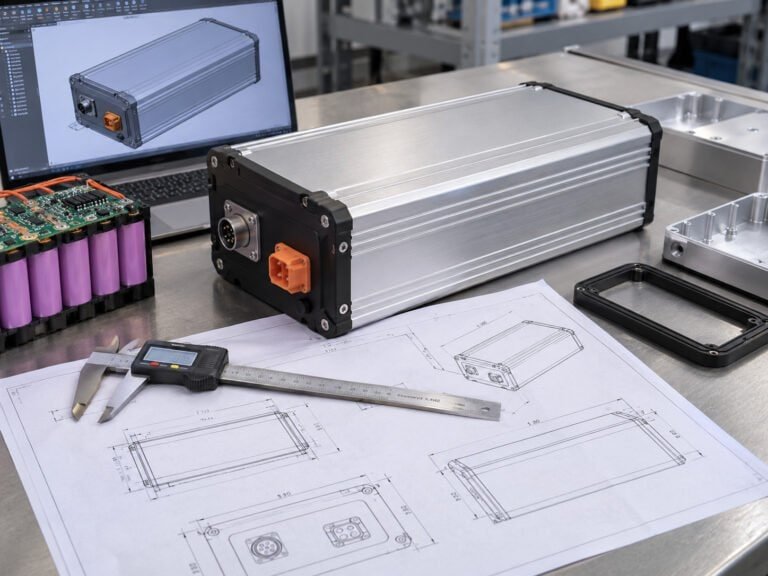
For custom forklift lithium battery packs, mechanical requirements may include:
- Battery length
- Battery width
- Battery height
- 电池重量
- Mounting positions
- Cable outlet positions
- Connector locations
- 外壳材料
- 维护访问
Battery Enclosure
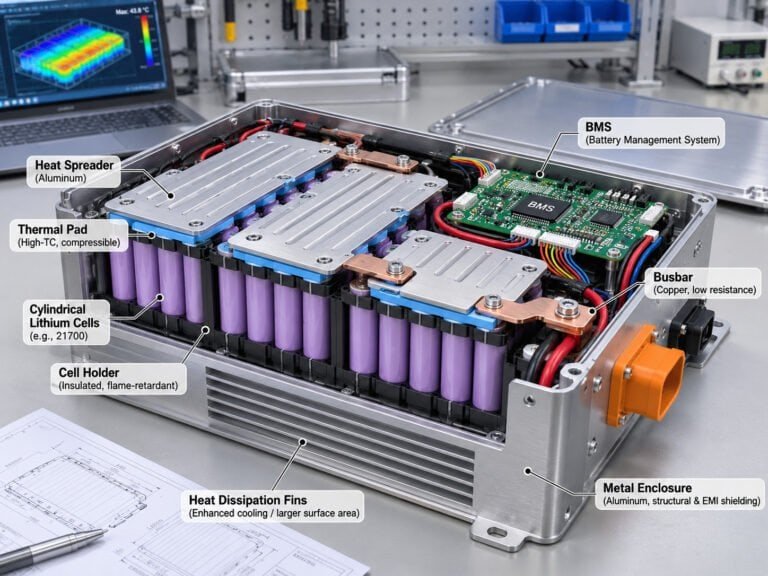
Industrial battery enclosures may use metal structures designed according to the mechanical requirements.
The enclosure should account for:
- Cell mounting
- 电气绝缘
- Mechanical support
- 振动条件
- Connector protection
- 散热
- Installation and removal procedures
Battery Weight and Forklift Stability
Battery weight requires specific attention in forklift applications.
For certain electric forklifts, battery mass contributes to the vehicle’s stability and counterweight arrangement.
A lithium battery pack should not be treated as a direct replacement for an existing battery based only on voltage, capacity, and compartment dimensions.
When replacing or modifying a battery system, the equipment manufacturer should confirm:
- Permitted battery weight range
- 电池仓要求
- 车辆稳定性要求
- Counterweight arrangement
- Mounting and retention requirements
- Approval requirements for changes to the vehicle
Battery weight and vehicle modifications must follow the equipment manufacturer’s instructions and applicable safety requirements.
10. Thermal Management and Operating Conditions
Forklift batteries generate heat during charging and discharging.
Thermal behavior depends on the battery cell model, current, electrical resistance, operating temperature, and enclosure design.
Thermal considerations include:
- 连续放电电流
- 峰值电流持续时间
- 充电电流
- 细胞排列
- BMS温度
- 外壳材料
- 环境温度
- 散热
工作温度
Customers should provide the specified operating temperature range.
For example, forklifts operating in refrigerated warehouses may require evaluation of battery discharge performance and charging temperature restrictions.
Charging and discharging temperature limits should be considered separately.
Dust and Water Protection
Material handling equipment may operate in warehouses or industrial environments involving dust and moisture.
If an ingress protection rating is required, the complete battery enclosure should be evaluated according to the specified IP classification.
The required rating depends on the installation environment and equipment requirements.
11. Battery Safety Standards and Testing Requirements
Battery testing and certification requirements depend on the application, destination market, and product classification.
The following standards may be relevant during project evaluation.
| 标准 | Application or Purpose |
|---|---|
| IEC 62619 | Safety requirements for secondary lithium cells and batteries used in industrial applications |
| UN38.3 | Lithium battery transportation testing |
| IEC 60529 | Degrees of protection provided by enclosures |
| UL 2580 | Safety evaluation of batteries for electric vehicles, where applicable |
The applicable standards should be confirmed according to the battery product and target market.
Electrical Validation
Electrical testing may include:
- Voltage inspection
- 能力验证
- 充放电测试
- Continuous current evaluation
- Peak current testing
- BMS protection verification
Mechanical Validation
Depending on the application, mechanical validation may include:
- Dimensional inspection
- Enclosure inspection
- Mounting verification
- 振动测试
- 连接器检查
Thermal Validation
Thermal evaluation may include:
- 温度升高试验
- Operating temperature evaluation
- Temperature sensor verification
- BMS temperature protection testing
The testing scope and acceptance criteria should follow the approved project requirements.
Engineering validation does not automatically establish formal product certification.
12. Information Required for a Custom Forklift Battery Quotation
When requesting a custom lithium battery pack for a forklift or material handling application, customers should provide the following information.
| 项目 | Required Information |
|---|---|
| Equipment Type | Forklift, pallet truck, stacker, reach truck, AGV or other equipment |
| Equipment Manufacturer | Brand and model |
| 额定电压 | Required voltage |
| 电池容量 | Ah or Wh |
| 连续放电电流 | A |
| 峰值放电电流 | A and duration |
| 电池化学 | LiFePO4 or specified chemistry |
| 电池尺寸 | Length × Width × Height |
| 电池重量 | Required or permitted weight range |
| BMS Requirements | Protection and monitoring functions |
| 交流 | CAN, UART, RS485 or other interface |
| 充电 | Voltage, current and charger specifications |
| 连接器 | Charging, discharging and communication interfaces |
| 工作温度 | Charging and discharging temperature ranges |
| 环境要求 | Dust, moisture and vibration |
| 认证 | Applicable standards and target market |
| Prototype Quantity | Required sample quantity |
| Production Quantity | Initial order and estimated annual demand |
| Delivery Destination | Country and address |
For forklift applications, customers should also provide the vehicle manufacturer’s battery installation specifications and applicable approval requirements.
These details are used to evaluate the battery configuration, mechanical design, electrical components, and project scope.
13. Custom Industrial Lithium Battery Packs at Dongguan Yizhan Electronics Technology Co., Ltd.
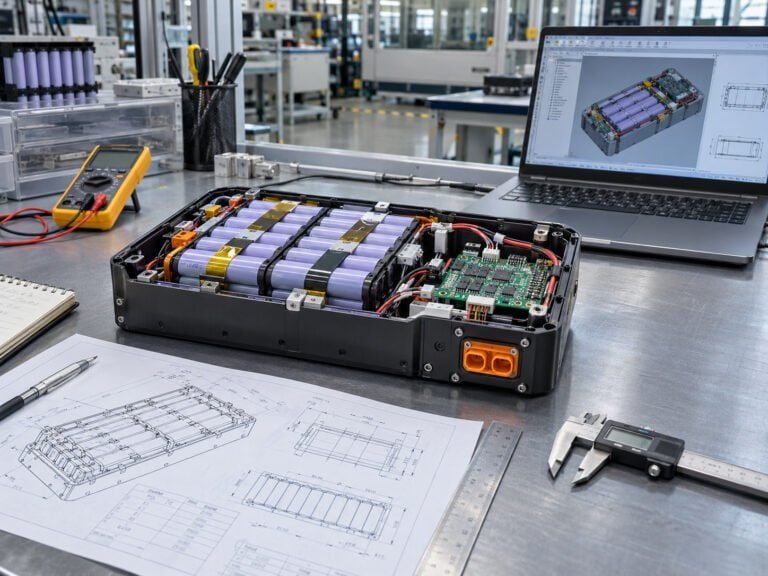
东莞一展电子科技有限公司 provides OEM and ODM custom lithium battery pack development and manufacturing services for electric mobility, robotics, industrial equipment, and energy storage applications.
Our customization scope includes:
- LiFePO4 and ternary lithium-ion battery configurations
- Customized battery voltage and capacity
- 电池单元的选型
- BMS configuration according to project requirements
- CAN, UART, and RS485 communication options
- NTC temperature monitoring
- 定制连接器和布线
- Plastic and metal battery enclosures
- 电池组总成
- Technical documentation and project testing coordination
For material handling battery projects, electrical specifications, installation dimensions, operating current, communication interfaces, and environmental requirements are considered during technical evaluation.
Forklift-specific battery requirements, including battery weight, vehicle compatibility, and relevant safety requirements, must be confirmed according to the equipment manufacturer’s specifications.
The battery configuration and manufacturing scope are determined according to the confirmed project requirements.
结论
Lithium batteries are used in electric forklifts and material handling equipment with defined electrical, mechanical, and operating requirements.
Battery selection involves voltage, capacity, continuous and peak discharge current, BMS protection, charging systems, connectors, and enclosure design.
For forklift applications, battery weight and vehicle stability must also be considered during battery selection or replacement projects.
OEM and ODM customers should provide equipment specifications, battery compartment dimensions, electrical requirements, and production quantities during the quotation stage.
Looking for a custom lithium battery pack for material handling equipment?
联系方式 东莞一展电子科技有限公司 with your equipment model, battery voltage, capacity, discharge current, installation dimensions, BMS requirements, and estimated order quantity.
Our team can review the project specifications and discuss a battery configuration based on the equipment requirements.
 English
 Chinese
 Japanese
 German
 French
 Korean

