
Developing a custom lithium battery pack involves several stages, from defining technical requirements to engineering design, prototype manufacturing, testing, and mass production.
For OEM and ODM projects, the development timeline depends on battery specifications, cell selection, Battery Management System (BMS) requirements, enclosure design, component availability, and certification requirements.
Applications such as electric bicycles, AGVs, AMRs, service robots, industrial equipment, and energy storage systems have different electrical and mechanical requirements. Each project requires evaluation before production planning.
Understanding the custom battery pack development timeline helps equipment manufacturers coordinate product development, prototype evaluation, component procurement, and production schedules.
This article explains the main stages of custom lithium battery pack development and the factors that influence each stage.
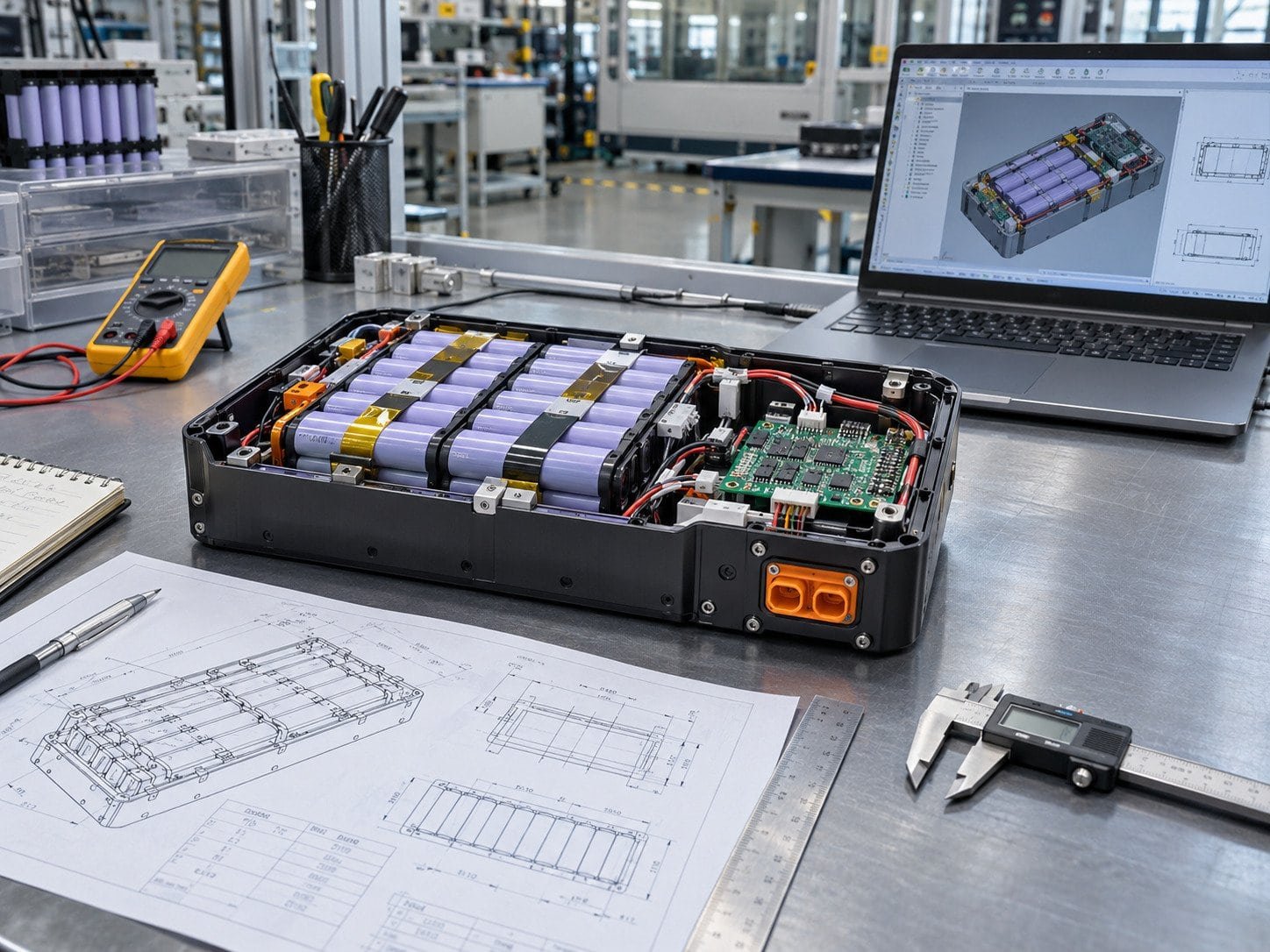
1. Stage One: Define Battery Pack Requirements
The development process begins with confirming the battery specifications and equipment requirements.
Before designing a custom lithium battery pack, the manufacturer needs to understand the equipment’s electrical load, installation conditions, and operating environment.
电气要求
OEM customers should provide:
- Nominal battery voltage
- Required capacity (Ah or Wh)
- 充电电压和电流
- 连续放电电流
- Peak discharge current and duration
- 工作温度
- Expected operating duty cycle
For example, an AGV battery project may require a 48V-class battery with a specified capacity, continuous discharge current, and peak current during acceleration.
These parameters determine the battery cell configuration and BMS electrical requirements.
机械要求
The battery must fit within the available installation space.
Customers should provide:
- Maximum length, width, and height
- Battery compartment drawings
- Installation orientation
- Mounting positions
- Connector locations
- Cable routing requirements
- Enclosure material requirements
- Environmental protection requirements
Mechanical drawings in STEP, STP, or 2D PDF format can be used for design evaluation.
Communication and BMS Requirements
Some battery applications require communication between the battery and equipment controller.
Possible interfaces include:
- CAN
- UART
- RS485
Customers should also confirm whether the system requires SOC reporting, SOH reporting, temperature monitoring, fault information, or customized protection functions.
Stage Output: Confirmed battery requirements and initial technical specifications.
2. Stage Two: Technical Feasibility and Battery Design
After receiving the technical requirements, the battery manufacturer evaluates the proposed battery configuration.
This stage includes cell selection, electrical design, BMS evaluation, enclosure planning, and component selection.
电池芯选择
Battery cells are selected according to the required voltage, capacity, discharge current, operating temperature, and mechanical dimensions.
Common battery chemistries include:
Ternary Lithium-Ion Batteries
Ternary lithium-ion cells, including nickel manganese cobalt (NMC) chemistry, are used in electric mobility, robotics, and portable equipment applications.
LiFePO4 Batteries
LiFePO4 cells are used in industrial equipment, AGVs, AMRs, and energy storage systems.
Cell selection should follow the technical specifications of the selected manufacturer and model.
Series and Parallel Configuration
The battery pack configuration is determined by the required nominal voltage and capacity.
例如
| 电池配置 | 额定电压 | Application Example |
|---|---|---|
| 10S Ternary Lithium-Ion | 36V | Electric bicycle |
| 13S Ternary Lithium-Ion | 46.8V | 48V-class electric mobility |
| 14S Ternary Lithium-Ion | 50.4V | Equipment requiring this voltage range |
| 8S LiFePO4 | 25.6V | 24V-class industrial equipment |
| 16S 磷酸铁锂 | 51.2V | Industrial equipment and energy storage |
The voltage examples are based on typical cell nominal voltages. Actual configurations depend on the selected cell specifications.
BMS Design and Evaluation
The BMS is selected or customized according to the electrical and communication requirements.
Design considerations may include:
- 电池电压监测
- Charging and discharging protection
- 过流和短路保护
- 温度监测
- 细胞平衡
- CAN, UART, or RS485 communication
- SOC and SOH reporting
- Connector and wiring configuration
If a project requires a customized BMS PCB or firmware development, the engineering scope should be confirmed before prototype production.
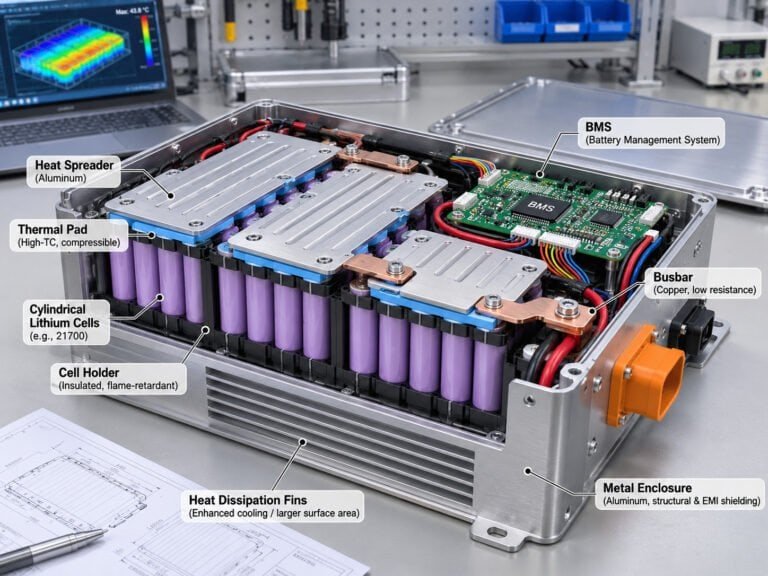
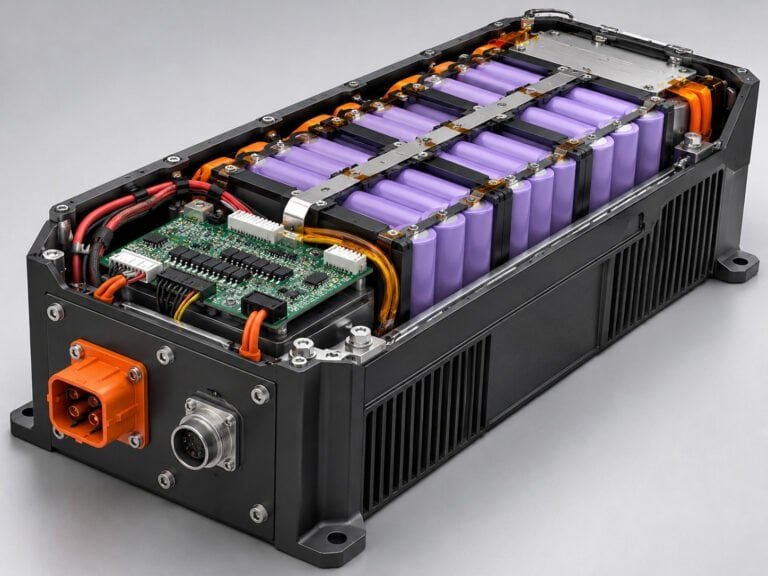
Mechanical and Enclosure Design
Battery enclosure design may include:
- 细胞排列
- Internal insulation
- BMS installation position
- 住房结构
- Connector layout
- 安装支架
- 防水密封
- 散热
The design should account for manufacturing processes, assembly requirements, and the equipment’s installation conditions.
Stage Output: Proposed electrical configuration, BMS solution, mechanical design, and preliminary bill of materials (BOM).
3. Stage Three: Engineering Review and Design Confirmation
Before prototype manufacturing, the proposed battery design should be reviewed against the customer’s technical requirements.
This stage may include coordination between the battery manufacturer and the customer’s engineering team.
Electrical Design Review
The review covers:
- Battery voltage and capacity
- 单元配置
- 连续放电电流
- Peak current capability
- Charging requirements
- BMS保护功能
- Connector specifications
Mechanical Design Review
The mechanical review covers:
- External dimensions
- Installation orientation
- Mounting positions
- Connector locations
- Cable lengths
- Enclosure structure
- Assembly requirements
Project Cost Confirmation
The manufacturer may also confirm development-related costs, including:
- 原型制作
- Customized BMS development
- Mechanical tooling
- Special connectors
- Certification testing
- Production tooling
Any design changes should be documented before sample manufacturing.
Stage Output: Approved prototype specifications, drawings, and development scope.
4. Stage Four: Custom Battery Pack Prototyping
Prototype production is an important stage of custom battery pack development.
Engineering samples allow the manufacturer and customer to evaluate the battery’s electrical performance, mechanical compatibility, and system integration.
Prototype Material Preparation
Materials may include:
- 电池单元
- BMS boards
- Nickel strips or busbars
- 电池托架
- 隔热材料
- 连接器
- Wiring harnesses
- Battery enclosures
Material preparation depends on component specifications, stock availability, and purchasing requirements.
Battery Pack Assembly
Prototype assembly may involve:
- Battery cell inspection
- 细胞排列
- Electrical connection and welding
- Insulation installation
- BMS assembly and connection
- Wiring and connector installation
- Enclosure assembly
- Initial electrical inspection
The assembly method depends on the battery cell format and mechanical structure.
Prototype Inspection
Before samples are submitted for customer evaluation, inspection may include:
- 电池电压
- Cell group voltage
- Connection polarity
- 隔热
- BMS保护功能
- Charging and discharging operation
- 通信功能
- External dimensions
The testing scope should follow the approved prototype specifications.
Stage Output: Engineering battery pack samples for internal and customer evaluation.
5. Stage Five: Battery Pack Testing and Validation
After prototype assembly, the battery pack must be evaluated against the project requirements.
Testing helps identify electrical, mechanical, thermal, and communication issues before production approval.
电气测试
Electrical testing may include:
- 能力测试
- Charging verification
- Continuous discharge testing
- Peak current testing
- 过充电保护
- 过放电保护
- 过流保护
- 短路保护
热测试
Temperature-related testing may include:
- Temperature rise during discharge
- 高温运行
- 低温放电
- Charging temperature protection
- BMS 温度监测
Test conditions should follow the selected cell specifications and project requirements.
机械测试
Depending on the application, mechanical evaluation may include:
- Dimension inspection
- Installation fit testing
- 振动测试
- Connector mating verification
- Enclosure inspection
- Mounting structure verification
通信测试
For battery packs equipped with CAN, UART, or RS485 communication, testing may cover:
- Data transmission
- SOC报告
- Voltage and current reporting
- Temperature information
- 故障信息
- 通信协议兼容性
Communication functions must be verified according to the agreed interface specifications.
Stage Output: Prototype test results and technical evaluation records.
6. Stage Six: Customer Sample Evaluation and Approval
After receiving the prototype, the customer evaluates the battery in the actual equipment.
This stage is important because laboratory testing alone may not represent the complete equipment operating conditions.
Equipment Integration Testing
The customer may evaluate:
- Battery installation
- Equipment startup
- Motor operation
- Continuous power demand
- Peak current behavior
- Charging compatibility
- 与设备控制器的通信
- Operating runtime
For example, an AMR manufacturer may test the battery during repeated acceleration, navigation, loading, and charging cycles.
Design Modifications
If the prototype does not meet the agreed requirements, modifications may be necessary.
Common changes include:
- BMS parameter adjustments
- 连接器更换
- Cable length modifications
- Enclosure dimension changes
- Cell configuration adjustments
- Communication protocol modifications
Changes affecting electrical or mechanical safety may require additional testing.
After the required evaluations are completed, the customer can confirm the battery design for production preparation.
Stage Output: Customer-approved battery specifications and design confirmation.
7. Stage Seven: Certification and Compliance Evaluation
Certification requirements should be identified during the initial project planning stage.
Depending on the battery application and target market, testing or certification may involve the following standards:
| 标准 | Application or Purpose |
|---|---|
| UN38.3 | Lithium battery transportation testing |
| IEC 62133-2 | Safety requirements for portable sealed secondary lithium cells and batteries |
| IEC 62619 | Safety requirements for industrial secondary lithium cells and batteries |
| EN 50604-1 | Safety requirements for lithium-ion battery systems in applicable light electric vehicle applications |
| UL 2271 | Safety requirements for batteries used in light electric vehicle applications |
| IEC 60529 | Enclosure ingress protection classification |
The applicable requirements depend on product classification, destination market, equipment application, and certification scope.
Certification-related activities may include:
- Preparing test samples
- Technical documentation
- Laboratory evaluation
- Electrical safety testing
- Environmental testing
- Design modifications
- Retesting where required
Certification testing may take place during appropriate stages of product development, depending on the test plan and design maturity.
Stage Output: Required test documentation and certification results, where applicable.
8. Stage Eight: Pilot Production and Manufacturing Preparation
After the battery design is approved, the project may proceed to pilot production.
Pilot production is used to evaluate manufacturing processes and confirm the production documentation.
Production Material Preparation
The manufacturer confirms:
- 电池单元模型
- BMS specifications
- Enclosure materials
- 连接器
- Wiring harnesses
- 隔热材料
- Packaging materials
Production Process Preparation
Preparation may include:
- Assembly instructions
- 焊接参数
- BMS programming requirements
- Electrical inspection procedures
- 生产工装
- Quality inspection criteria
- Packaging instructions
Pilot Production Evaluation
A pilot batch may be used to verify:
- Assembly sequence
- Component compatibility
- Electrical performance
- Manufacturing process
- 检查程序
- 产品一致性
The pilot production quantity depends on the project scope and production requirements.
Stage Output: Verified manufacturing process and production documentation.
9. Stage Nine: Mass Production and Quality Control
After production approval, the project proceeds to mass manufacturing according to the confirmed order quantity and delivery schedule.
Battery Pack Production
The production process may include:
- 来料检验
- Battery cell grouping
- 细胞排列
- Welding and electrical connections
- BMS 安装
- Insulation assembly
- Enclosure assembly
- 电气测试
- 最终检查
- 包装
Production Quality Control
Quality control activities may include:
- Cell model verification
- Voltage inspection
- Connection inspection
- BMS protection verification
- Charging and discharging checks
- Communication testing where applicable
- Dimension inspection
- 标签验证
Inspection requirements should be defined in the production quality plan.
Packaging and Shipping
Packaging and transportation arrangements depend on the battery specifications, destination, and applicable shipping regulations.
Customers should confirm:
- Order quantity
- Delivery address
- Shipping method
- Required transportation documents
- Packaging requirements
- Applicable Incoterms
Stage Output: Manufactured battery packs prepared for delivery according to the approved specifications.
10. What Factors Affect the Custom Battery Pack Development Timeline?
The development timeline depends on the technical scope and manufacturing requirements of each project.
| Factor | Potential Impact on Development Schedule |
|---|---|
| Battery cell availability | Procurement time and sample preparation |
| Customized BMS | Hardware development, firmware programming, testing |
| 外壳设计 | Mechanical drawings, tooling, prototype production |
| Special connectors | Supplier procurement and interface validation |
| 通信协议 | Software integration and system testing |
| 认证要求 | Laboratory scheduling, sample preparation, testing |
| Customer evaluation | Equipment integration, feedback, sample approval |
| Design changes | Drawing revisions, sample modifications, retesting |
| Production quantity | Material procurement and production scheduling |
Battery Cell Procurement
Cell availability depends on the selected brand, model, quantity, and supplier conditions.
If a project requires a specific cell model, procurement should be considered during development planning.
Customized BMS Development
Projects requiring new BMS hardware or firmware involve engineering design and functional verification.
Communication protocol integration may also require testing with the customer’s equipment.
Custom Enclosure Tooling
A new plastic injection mold or metal enclosure design may require tooling preparation and mechanical validation.
Customer Approval
The customer’s evaluation schedule is part of the overall project timeline.
Sample modifications and additional testing should be included in the project plan when required.
11. How to Plan a Custom Battery Pack Development Schedule
OEM customers can organize the project into defined milestones.
| Development Milestone | Required Confirmation |
|---|---|
| Requirement Review | Electrical and mechanical specifications |
| 技术设计 | Cell configuration, BMS, enclosure |
| Design Approval | Drawings, BOM, prototype requirements |
| Prototype Production | Sample quantity and manufacturing specifications |
| 样品测试 | Electrical, mechanical, thermal and communication tests |
| Customer Evaluation | Equipment integration and sample feedback |
| Design Freeze | Approved specifications and revision status |
| 认证 | Applicable standards and testing scope |
| 试生产 | Manufacturing process and quality requirements |
| 批量生产 | Order quantity, delivery and inspection requirements |
The time allocated to each milestone should be determined according to the confirmed project scope.
Some engineering, material procurement, and documentation activities may take place in parallel when the project conditions allow.
12. Information Required to Estimate Battery Development Lead Time
To prepare a development schedule, a battery manufacturer generally requires the following information:
1. Battery Specifications
Nominal voltage, capacity, cell chemistry, and charging voltage.
2. Current Requirements
Continuous discharge current, peak current, and peak duration.
3. Mechanical Requirements
Battery dimensions, mounting positions, enclosure material, and mechanical drawings.
4. BMS Requirements
Protection functions, CAN, UART, RS485, and temperature monitoring.
5. Connector Requirements
Charging, discharging, and communication connector models.
6. Environmental Requirements
Operating temperature, waterproof protection, vibration, and installation conditions.
7. Certification Requirements
Target market and applicable battery standards.
8. Sample Quantity
Number of prototype batteries required for evaluation.
9. Production Plan
Initial order quantity, expected production volume, and target delivery schedule.
Providing this information helps establish the engineering scope, material requirements, and development milestones.
13. Custom Battery Pack Development at Dongguan Yizhan Electronics Technology Co., Ltd.
东莞一展电子科技有限公司, operating under the First Power brand, provides OEM and ODM custom lithium battery pack development and manufacturing services.
Our battery pack business covers electric mobility, robotics, industrial equipment, and energy storage applications.
Our customization scope includes:
- Ternary lithium-ion and LiFePO4 battery pack configurations
- 定制电压和容量
- 电池单元的选型
- BMS hardware and software customization
- CAN, UART, and RS485 communication
- Customized plastic and aluminum enclosures
- Battery connector and wiring customization
- NTC temperature monitoring
- Battery pack assembly and testing
- Technical documentation and certification project support
For OEM battery projects, development activities may include technical requirement evaluation, electrical configuration, BMS development, mechanical design, prototype production, testing, and manufacturing preparation.
Project schedules are evaluated according to the confirmed specifications, component availability, development requirements, and production quantity.
结论
The custom battery pack development timeline includes multiple stages, from technical requirement confirmation and engineering design to prototyping, testing, customer approval, and mass production.
Battery cell selection, BMS development, enclosure design, certification requirements, and customer evaluation can influence the development schedule.
For OEM and ODM projects, establishing technical specifications and project milestones during the initial development stage helps coordinate engineering activities, component procurement, prototype evaluation, and manufacturing preparation.
Whether you are developing an electric bicycle battery, AGV battery module, AMR battery system, service robot battery, or industrial battery pack, the development schedule should be based on the actual product requirements.
Planning a custom lithium battery pack project?
联系方式 Dongguan Yizhan Electronics Technology Co., Ltd. (First Power) with your battery specifications, mechanical drawings, BMS requirements, prototype quantity, and estimated production demand.
Our team can review your project requirements and discuss the technical development scope, prototype arrangements, and production planning.
 English
 Chinese
 Japanese
 German
 French
 Korean

