
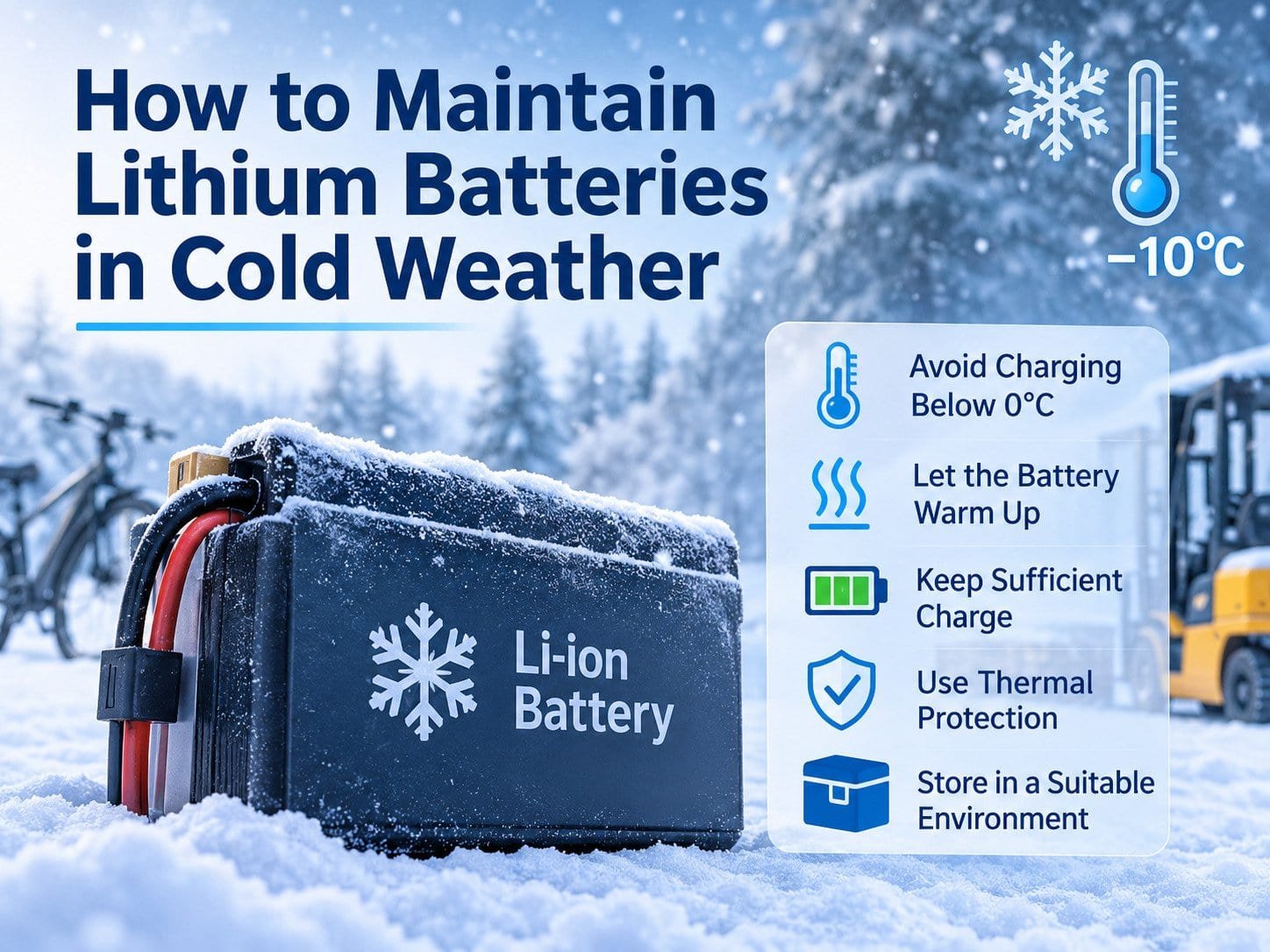
Cold weather can significantly affect lithium battery performance. When temperatures drop, lithium-ion batteries may show reduced available capacity, increased internal resistance, slower charging performance, and shorter runtime.
For applications such as e-bikes, AGVs, AMRs, robots, golf carts, forklifts, medical equipment, power tools, and other battery-powered devices, understanding how to use and maintain lithium batteries in cold weather is important for both performance and battery life.
The good news is that low temperatures do not necessarily mean a lithium battery is permanently damaged. In many cases, the reduction in performance is temporary and improves when the battery returns to a suitable operating temperature.
However, charging a lithium battery at temperatures below its permitted charging range can cause serious damage. Therefore, cold-weather battery management should focus not only on keeping the battery warm, but also on controlling when and how it is charged and discharged.
1. How Does Cold Weather Affect Lithium Batteries?
Temperature affects the electrochemical reactions inside a lithium-ion cell.
As the temperature decreases, the movement of lithium ions becomes slower and the internal resistance of the cell increases. As a result, the battery may not be able to deliver the same amount of power that it can provide at room temperature.
Common effects of cold weather include:
- Reduced available capacity
- Higher internal resistance
- Lower discharge performance
- Reduced voltage under load
- Shorter operating time
- Slower charging
- Increased charging restrictions
- Temporary reduction in battery performance
The actual impact depends on the battery chemistry, cell design, state of charge, discharge current, and temperature.
For this reason, a battery that works normally at 20–25°C may behave differently in a cold outdoor environment.
2. Do Lithium Batteries Lose Capacity in Cold Weather?
A lithium battery may appear to have less capacity in cold weather, but this does not always mean that the battery has permanently lost capacity.
Low temperatures can reduce the amount of energy that is practically available from the battery.
For example, an e-bike battery may provide less range during winter than during warmer weather. An electric forklift may also experience reduced operating time in a cold warehouse.
Once the battery returns to an appropriate temperature, some of the temporarily reduced performance may recover.
This is different from permanent capacity degradation caused by factors such as aging, excessive heat, repeated cycling, or long-term storage at unsuitable conditions.
Therefore, cold-weather performance should be evaluated separately from permanent battery capacity loss.
3. Avoid Charging a Frozen Lithium Battery
One of the most important rules for cold-weather battery maintenance is to avoid charging the battery when its temperature is below the manufacturer’s permitted charging range.
Charging lithium-ion cells at excessively low temperatures can cause lithium plating on the anode.
Lithium plating can reduce battery performance and may increase safety risks. Repeated exposure to unsuitable low-temperature charging conditions can contribute to permanent degradation.
For this reason:
Do not charge a lithium battery immediately after bringing it in from a very cold environment.
Instead, allow the battery to reach an appropriate temperature before charging.
The exact minimum charging temperature depends on the cell chemistry and manufacturer specifications, so the battery’s technical documentation should always be followed.
4. Let the Battery Warm Up Before Charging
If a battery has been operating or stored outdoors in cold conditions, allow it to warm naturally before connecting it to a charger.
For example, if an e-bike is left outside during winter, the battery should not necessarily be connected to the charger immediately after being brought indoors.
Instead:
- Move the battery to a suitable indoor environment.
- Allow its temperature to stabilize.
- Check the battery condition if necessary.
- Begin charging only when the battery is within the permitted charging temperature range.
Avoid using uncontrolled external heat sources such as open flames, heaters placed directly against the battery, or other high-temperature equipment.
A controlled battery heating system may be appropriate for some specialized applications, but it should be designed as part of the complete battery system.
5. Keep the Battery Warm During Operation
For applications that operate outdoors or in cold environments, maintaining the battery within an appropriate operating temperature range can improve performance.
Possible solutions include:
- Thermal insulation
- 电池外壳设计
- 加热元件
- 热管理系统
- Preheating before operation
- Temperature monitoring through the BMS
For example, an AGV or AMR operating in a cold warehouse may require a battery design that accounts for low ambient temperatures and repeated high-current discharge.
Similarly, an e-bike used during winter may benefit from keeping the battery indoors when it is not in use.
The appropriate solution depends on the battery capacity, operating current, environmental temperature, and application requirements.
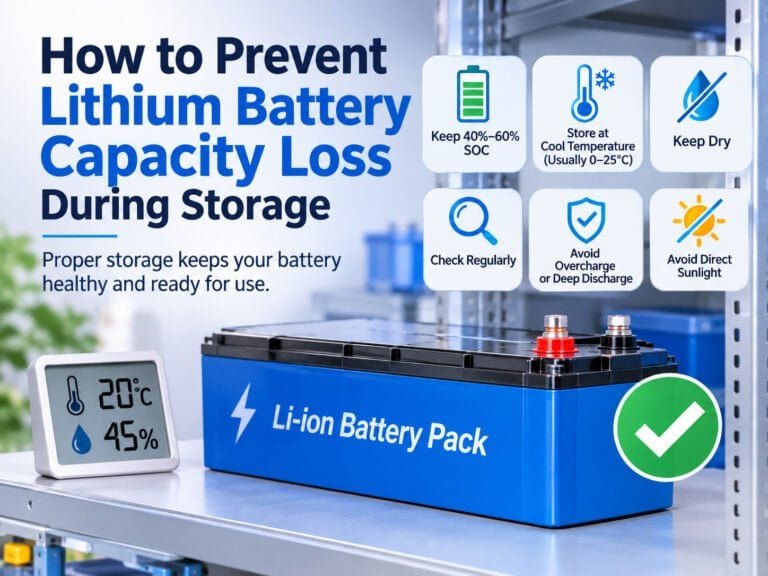
6. Store Lithium Batteries in a Suitable Environment
When a lithium battery is not being used for an extended period during winter, storage conditions should be carefully managed.
Avoid leaving the battery for long periods in:
- Freezing outdoor environments
- Unheated vehicles
- Areas with extreme temperature fluctuations
- Damp locations
- 直射阳光
- Locations exposed to condensation
A cool, dry, and stable environment is generally preferable.
For long-term storage, the battery should also be maintained at the manufacturer’s recommended state of charge rather than being stored completely full or completely empty.
7. Avoid Deep Discharge in Cold Weather
Cold temperatures can make a battery’s voltage drop more quickly under load.
This can cause the battery management system to trigger undervoltage protection earlier than expected.
For example, an e-bike battery may appear to have a low state of charge more quickly when riding in cold weather, even if the battery has not actually experienced the same level of permanent capacity loss.
Repeatedly operating a lithium battery until it reaches very low voltage can increase stress on the battery.
Therefore, in cold weather:
- Avoid unnecessary deep discharge.
- Monitor battery state of charge.
- Recharge according to the manufacturer’s recommendations.
- Avoid continuing operation after low-voltage protection has been triggered.
8. Reduce High-Current Loads When the Battery Is Very Cold
Cold temperatures increase internal resistance.
When a high current is drawn from a cold battery, the voltage can drop significantly.
This is particularly important for applications that require high peak power, such as:
- AGV
- AMR
- 电动叉车
- 高尔夫球车
- 电动工具
- 电动自行车
- 机器人
A battery may be able to operate normally under a moderate load but experience a significant voltage drop under a high-current load when cold.
If the application requires high power at low temperatures, the battery should be designed and tested specifically for that operating condition.
9. Monitor Battery Temperature Through the BMS
A properly designed Battery Management System (BMS) can monitor important battery parameters, including temperature.
Temperature sensors can help the BMS identify whether the battery is:
- Too cold to charge
- Too hot to charge
- Too cold for normal operation
- Too hot during discharge
Depending on the battery design, the BMS may prevent charging when the cell temperature is outside the permitted charging range.
For applications exposed to significant temperature changes, temperature monitoring is an important part of battery safety and reliability.
However, the BMS temperature thresholds must be correctly configured according to the cell manufacturer’s specifications.
10. Consider Low-Temperature Performance When Selecting Cells
If a lithium battery will regularly operate in cold environments, low-temperature performance should be considered during cell selection.
重要参数包括:
- 工作温度范围
- Charging temperature range
- Discharge temperature range
- 内部电阻
- Capacity retention at low temperature
- Maximum discharge current
- Low-temperature cycle performance
Different lithium-ion cells can behave differently under the same temperature conditions.
Therefore, simply choosing a cell based on nominal voltage and capacity may not be sufficient for cold-weather applications.
For custom battery packs, the cell should be selected according to the actual environmental and electrical requirements of the equipment.
11. Consider a Battery Heating System for Extreme Cold
For applications that must operate reliably in very cold environments, a battery heating system may be necessary.
A heating element can raise the battery temperature before or during operation.
A typical system may include:
- Heating element
- Temperature sensor
- BMS control
- 隔热
- Power management circuit
- 热保护
The heating system should not simply run continuously.
Instead, the BMS or control system can activate heating when the battery temperature falls below a defined threshold and stop heating when the appropriate temperature is reached.
This approach can help balance battery performance, energy consumption, and safety.
12. Pay Attention to Condensation
Moving a cold battery into a warm and humid environment can create condensation.
Moisture may accumulate on the battery enclosure, connectors, or electronic components.
This can be particularly important for battery packs with:
- Exposed connectors
- Communication ports
- External BMS components
- Cooling or ventilation structures
Allowing the battery to reach room temperature gradually can help reduce condensation-related problems.
Battery enclosures should also be designed with the required environmental protection level for the application.
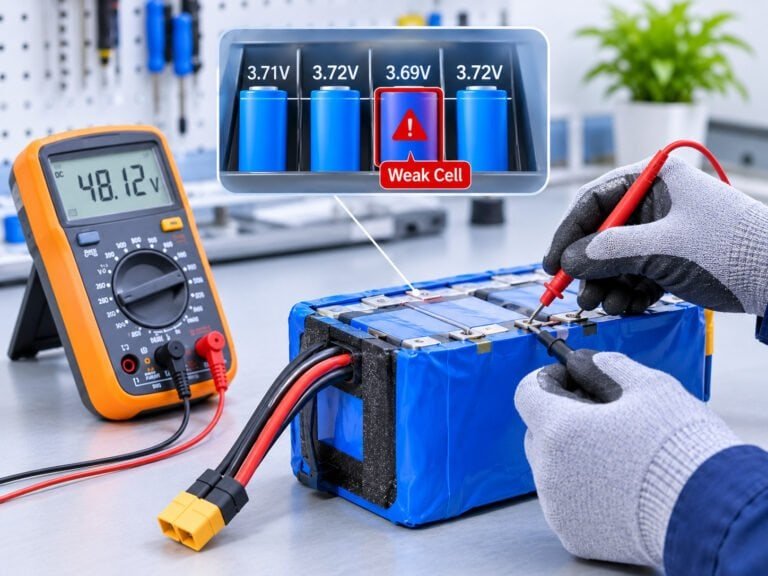
13. Check the Battery Before Winter Use
Before using a battery extensively in cold weather, it is useful to inspect its condition.
Depending on the application, checks may include:
- 电池电压
- 电量状态
- Cell voltage difference
- 内部电阻
- BMS fault records
- Battery temperature sensors
- Connector condition
- Housing condition
If the battery already has abnormal cell imbalance or increased internal resistance, cold temperatures may make the symptoms more noticeable.
Testing the battery before winter operation can help identify potential problems early.
14. Cold Weather Maintenance for Different Applications
Different applications have different requirements for cold-weather battery management.
E-Bike Batteries
For e-bikes, avoid leaving the battery outside in freezing temperatures for extended periods.
When possible:
- Store the battery indoors.
- Avoid charging immediately after cold outdoor use.
- Allow the battery to warm to the permitted charging temperature.
- Keep the battery away from moisture.
- Monitor remaining capacity during winter rides.
Cold weather can reduce riding range, so users may need to account for shorter runtime.
AGV and AMR Batteries
AGVs and AMRs operating in cold warehouses may require more advanced thermal management.
Battery designers should consider:
- Continuous operating temperature
- 峰值电流
- 充电温度
- 充电频率
- 供暖要求
- BMS温度保护
- 可用安装空间
For automated equipment, battery performance can directly affect operating schedules and productivity.
Electric Forklift Batteries
Forklifts operating in cold storage facilities may experience increased energy consumption and reduced battery performance.
The battery system should be selected according to the actual warehouse temperature and operating cycle.
If the forklift operates continuously, thermal management and charging strategy become particularly important.
Medical and Emergency Equipment
For medical equipment and emergency devices, battery reliability can be critical.
The battery should be evaluated across the expected storage and operating temperature ranges.
Cold-weather requirements should be considered during the initial battery design rather than treated as an afterthought.
15. Common Mistakes in Cold-Weather Lithium Battery Maintenance
Charging a Cold Battery Immediately
This can be harmful if the cell temperature is below the permitted charging range.
Using Direct Heat
Applying uncontrolled high heat to a battery can damage the cells or create safety risks.
Leaving the Battery Empty for Long Periods
Cold conditions combined with low SOC can increase the risk of excessive voltage drop and over-discharge.
Ignoring Temperature Data
Battery voltage alone may not provide enough information about battery condition in cold environments.
Selecting Cells Without Low-Temperature Data
A battery cell that performs well at room temperature may not meet the requirements of a cold-weather application.
Assuming Reduced Winter Range Means Permanent Damage
Cold temperatures can temporarily reduce available capacity. A performance reduction during winter does not automatically mean that the battery has permanently lost the same amount of capacity.
Cold-Weather Lithium Battery Maintenance Checklist
Before using a lithium battery in cold weather, consider the following:
- Check the battery’s permitted operating temperature.
- Check the permitted charging temperature.
- Avoid charging a battery that is below the specified charging temperature.
- Allow a cold battery to warm before charging.
- Store unused batteries in a suitable environment.
- Avoid deep discharge.
- Monitor SOC during operation.
- Monitor battery temperature.
- Check BMS temperature protection.
- Reduce unnecessary high-current loads when the battery is very cold.
- Consider insulation or battery heating for extreme environments.
- Test the battery before extended winter operation.
- Follow the cell and battery manufacturer’s specifications.
结论
Cold weather can significantly affect lithium battery performance, but proper battery management can reduce many of these effects.
The most important rule is to distinguish between cold-weather performance reduction 和 permanent battery degradation. A battery may temporarily provide less usable capacity and higher internal resistance at low temperatures, while its performance may recover after returning to an appropriate temperature.
Charging requires particular attention. Lithium batteries should not be charged outside the manufacturer’s permitted temperature range, especially when the cells are extremely cold.
For applications that regularly operate in cold environments, temperature monitoring, BMS protection, appropriate cell selection, thermal insulation, and battery heating may all need to be considered during battery design.
For custom lithium battery packs, cold-weather performance should be addressed from the beginning of the design process. Cell selection, battery configuration, BMS parameters, thermal management, enclosure design, and testing should all match the actual operating environment.
YIZHAN provides custom lithium battery pack solutions for e-bikes, AGVs, AMRs, robots, golf carts, forklifts, medical equipment, and other specialized applications. Our battery development process covers cell selection, electrical design, BMS development, structural design, prototype production, testing, and mass production according to specific application requirements.
If your equipment needs a lithium battery that can operate reliably in cold environments, contact YIZHAN to discuss your voltage, capacity, current, temperature range, dimensions, and BMS requirements.
 English
 Chinese
 Japanese
 German
 French
 Korean

